Cardiovascular & Respiratory Systems
 Call Kai
 Learn
Learn Practice Test
 Spaced Repetition
 Match
Match Flashcards
 Knowt Play
1/33

There's no tags or description
Looks like no tags are added yet.
Name | Mastery | Learn | Test | Matching | Spaced | Call with Kai |
|---|
No analytics yet
Send a link to your students to track their progress
34 Terms
Homeotherms
organisms that maintain a relatively constant body temperature regardless of their surroundings
Pulmonary circulation
Circuit that delivers oxygenated blood from the right ventricle, to the pulmonary arteries, to the lungs, to the left atrium (Right heart - lungs - left heart)
Systemic circulation
Circuit that delivers oxygenated blood from the left ventricle, to the aorta, to the body, to the right atrium (Left heart - body - right heart)
Cardiovascular system
Carries oxygen (lungs), nutrients (bloodstream from intestine), and hormones to cells and in exchange remove CO2 and metabolic wastes from cells; maintains body temperature
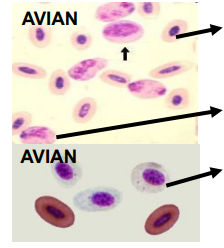
Red blood cells
What cell in chicken blood is 1?
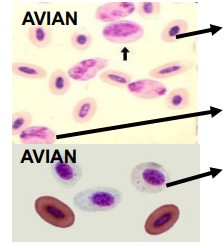
White blood cells
What cell in chicken blood is 2?
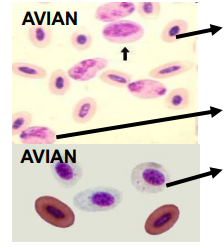
Thrombocytes
What cell in chicken blood is 3?
Right ventricle
Pumps blood to the lungs
Left ventricle
Pumps blood to the rest of the body
Venous system
carries deoxygenated blood from from the body to the heart
Arterial system
carries oxygenated blood from the heart to the body
Heart size
Increases with latitude and altitude; smaller birds have larger hearts
Plasma
light yellowish fluid containing water (~85%), dissolved minerals, electrolytes, lots of proteins (~11%), other nutrients, hormones, and waste products
Red blood cells (Erythrocytes)
large,elongated flat cells with oval nucleus; cannot change shape (cannot pass through capillaries)
Nucleated RBCs
Chicken RBCs
Not nucleated RBCs
Human RBCs
White blood cells (Leucocytes)
important in protecting birds from infectious agents (viruses and bacteria); include basophils, eosinophils, heterophils
Thrombocytes
nucleated; significant for blood clotting in chickens (human equivalent = platelets)
Heterophils
Poultry equivalent of neutrophils
Functions of blood
Moves O2 to body cells & removes CO2 from them, absorbs nutrients from the alimentary tract & transports them to tissues and cells, removes waste products of cellular metabolism; transports hormones produced by the endocrine glands to various sections of the body; helps regulate the water content of body tissues
Nares
usually located at the base of the beak; act as the passageway for air to be breathed in and out
Larynx
The entrance of the trachea; does not have vocal chords
Glottis
Opening of the larynx
Trachea
Formed by a series of ring-shaped cartilages (closed-in)
Syrinx (voice box)
Trachea bifurcates (divides) into bronchi after entering the thoracic cavity; produces sound for vocalization
Parabronchi
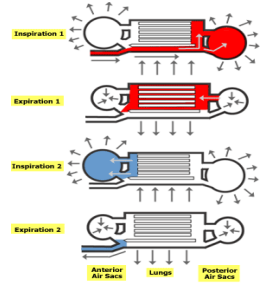
Tiny, inelastic lungs filled with tubular air capillaries; Movement of air is unidirectional through parabronchi, compared to dead-end structure of mammalian alveoli
Lungs
Only minimally expand and contract during inspiration and expiration; birds lack a diaphragm; act as organs in which gas exchange in the blood takes place
Air sacs
Recieving air during inspiration, acting as a cooling system since birds dont have sweat glands, for buoyancy, and defecation/egg-laying muscle assistance
Cervical
Air sacs in the neck region of poultry; help ventilate the neck and upper body, assist airflow, and act as air reservoirs during breathing; contain 2
Interclavicular
Air sac around the clavicle; help ventilate the humerus and wing bones and act as a central air distribution sac; contain 1
Anterior thoracic
Air sacs on the front of the thorax; help move air out of lungs, maintains continuous airflow throughout lungs, and reduces body density slightly; contain 2
Posterior thoracic
Air sacs on the rear thorax; primary air intake sacs and help drive unidirectional airflow through lungs; contain 2
Abdominal
Air sacs on the abdomen; largest air sac for expelling air from lungs; contain 2
Oxygen exchange
occurs on inspiration and expiration; 2-cycle pump; TWO inhalation /exhalation cycles required to move each breath totally through respiratory system; posterior air sacs to lungs to anterior air sacs