Phillips Curve L & R
 Call Kai
 Learn
Learn Practice Test
 Spaced Repetition
 Match
Match Flashcards
 Knowt Play
1/9

There's no tags or description
Looks like no tags are added yet.
Name | Mastery | Learn | Test | Matching | Spaced | Call with Kai |
|---|
No analytics yet
Send a link to your students to track their progress
10 Terms
What happened in 2000 that made all inflation move together?
Inflation targeting was created instead of just trying to keep it as low as possible
Central banks started communicating increasing credibility
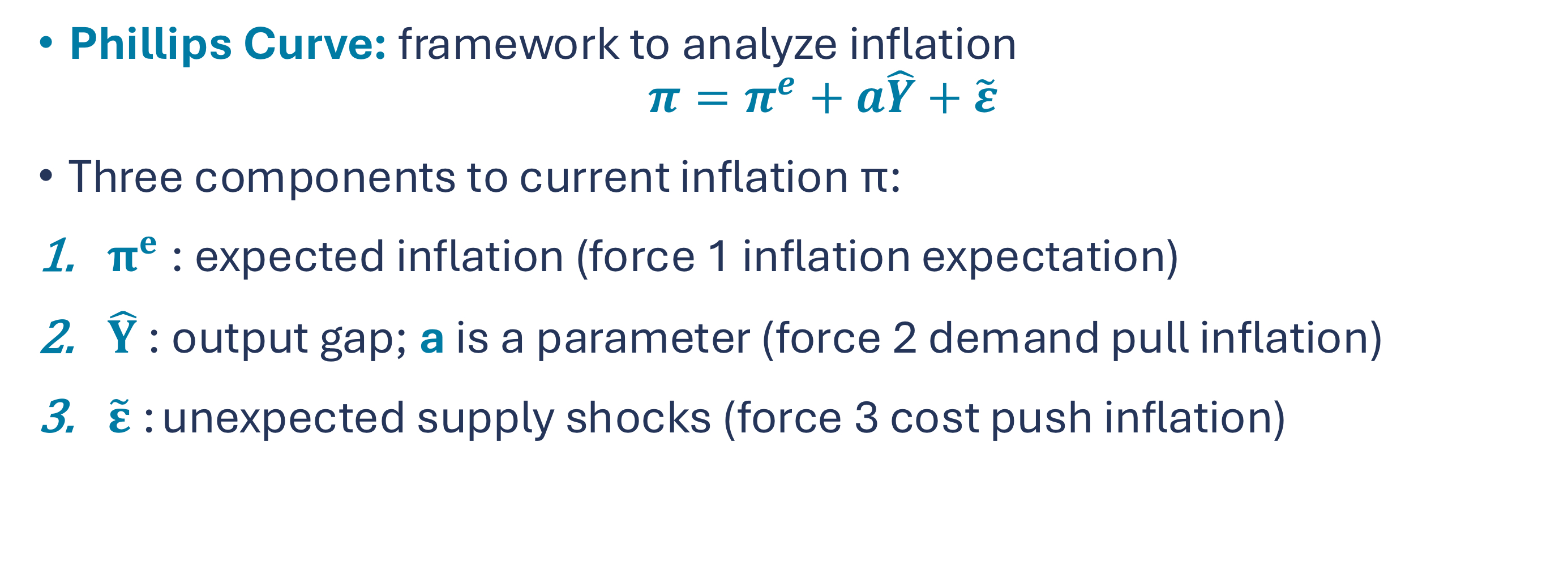
3 Forces Behind Inflation
Inflation Expectation: The rate at which average prices are anticipated to rise next year
Demand Pull Inflation: Inflation resulting from excess demand
Cost Push Inflation: Inflation that results from supply shocks and unexpected increase in production costs
Inflation = Expected Inflation + Demand-pull inflation + Cost push inflation
Inflation Expectations
(πe) The rate at which average prices are anticipated to rise next year
Forms foundation for actual inflation
Self fulfilling prophecy: high πe can cause high π, (all firms bekive prices will rise by 2% next year, production costs and competitor prices will rise by 2%, firms will raise their own prices by 2% in response)
How are inflation expectations formed
Adaptive: history matters, backward looking, uses no information about the future
Anchored: faith in the central bank, central bank’s target
Rational: fully informed
Sticky: pnly pay attention when it matters, infrequent learning
Likely combo of all 4
Ways to track inflation expectations
Surveys
Economists Forecasts
Financial markets deduce by comparing interest yields of real return and regular return bonds
Inflation expectations stats
Highest for 18-24
Highest for least educated
Highest for lowest earners
Demand Pull Inflation
Excess demand leads inflation to rise above inflation expectations, insufficient demand leads inflation to fall below inflation expectation
Generates unexpected inflation
When at potential output inflation equals inflation expectation
Y(hat) > 0, vs Y(hat) < 0
Demand greater than economy’s potential output, prices will rise
Demand lower than economy’s potential output, prices will fall
Cost Push Inflation
Determined by unexpected shocks in production costs, in normal times value is 0
Input prices: raw materials, intermediate goods and labour,
Wage-price spiral: a cycle where higher prices lead to higher nominal wages, which leads to higher prices
Productivity: faster than expected productivity growth lowers the marginal costs of production. Instead, slower than expected productivity growth increases the marginal cost of production
Phillips Curve