Week 2 PAL
 Call Kai
 Learn
Learn Practice Test
 Spaced Repetition
 Match
Match Flashcards
 Knowt Play
1/9

There's no tags or description
Looks like no tags are added yet.
Name | Mastery | Learn | Test | Matching | Spaced | Call with Kai |
|---|
No analytics yet
Send a link to your students to track their progress
10 Terms
The outward movement of K+ ions from inside a neuron _________ (Mark all that apply)
repolarizes the membrane potential
generates excitatory postsynaptic potentials
generates inhibitory postsynaptic potentials
establishes resting membrane potential
repolarizes the membrane potential
generates inhibitory postsynaptic potentials
establishes resting membrane potential
Imagine you created a toxin such that binds to the sodium-potassium pump. The toxin binds immediately to the sodium-potassium pump at the peak of the action potential but does not alter the function of voltage-gated sodium and potassium channels.
Which of the processes would the toxin prohibit in the neuron? Select all that apply.
the repolarization phase of an action potential
the depolarization phase of an action potential
maintaining resting potential
returning to resting potential after the hyperpolarization phase of an action potential
the hyperpolarization phase of an action potential
maintaining resting potential
returning to resting potential after the hyperpolarization phase of an action potential
Some people have low levels of calcium circulating in the blood, a condition known as hypocalcemia. While for many this disorder has little to no effect, for some it can be life-threatening.
How could low levels of calcium harm an individual?
Low levels of calcium would not have any effect on synaptic transmission.
Low levels of calcium would result in fewer chemical signals sent between the presynaptic and postsynaptic cell.
Low levels of calcium would cause sustained depolarization of the presynaptic cell.
Low levels of calcium would result in fewer chemical signals sent between the presynaptic and postsynaptic cell.
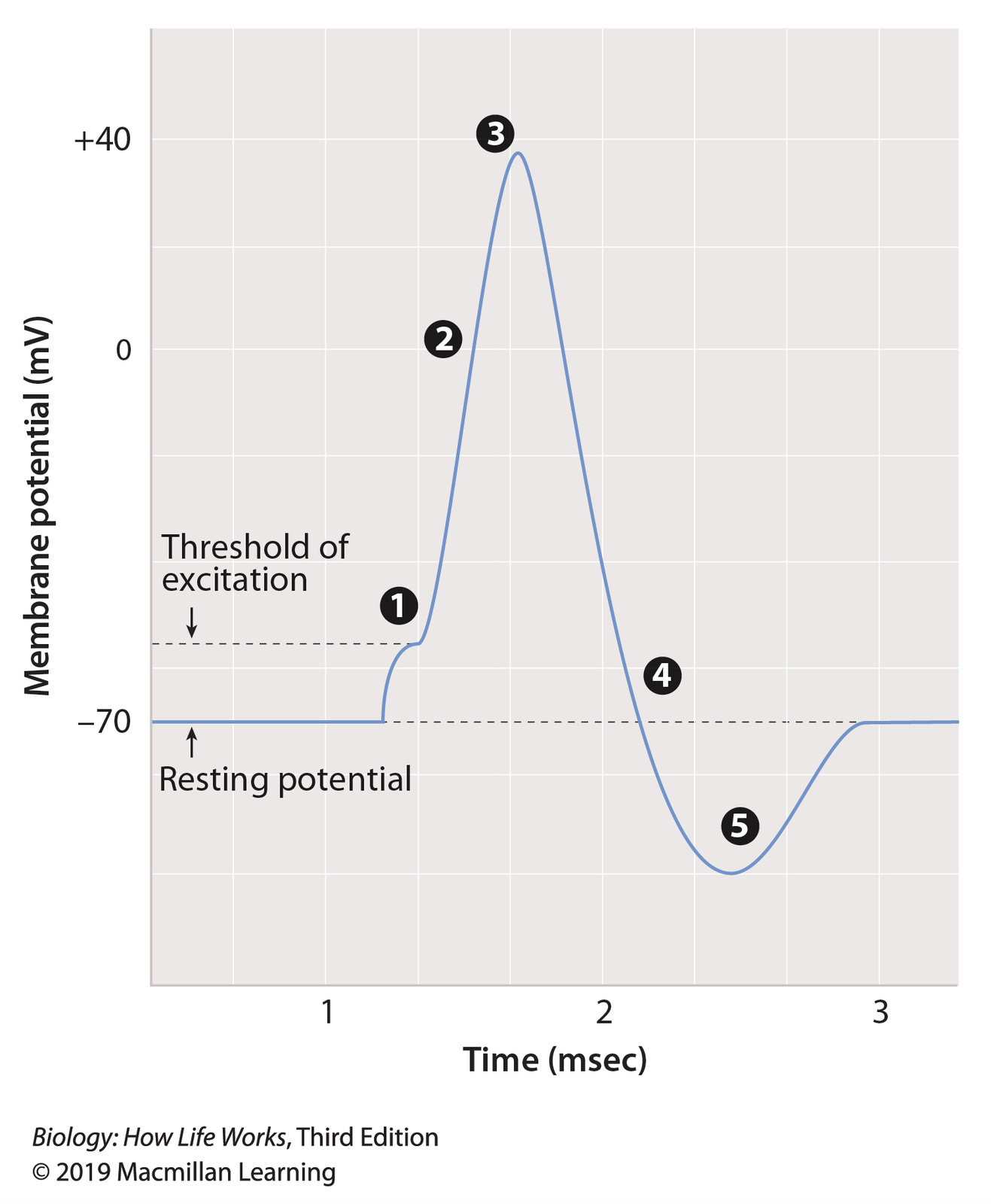
T/F: The changes in voltage seen at point 2 and point 4 in the figure are caused by similar movements, in the same direction, of the same ions across the membrane.
False
Constricted pupils, increased digestive activity, decreased respiratory rate, and uptake of glucose by the liver are all signs of activity of:
the parasympathetic division of the autonomic system.
the somatic nervous system.
both divisions of the autonomic nervous system.
the sympathetic division of the autonomic system.
the parasympathetic division of the autonomic system.
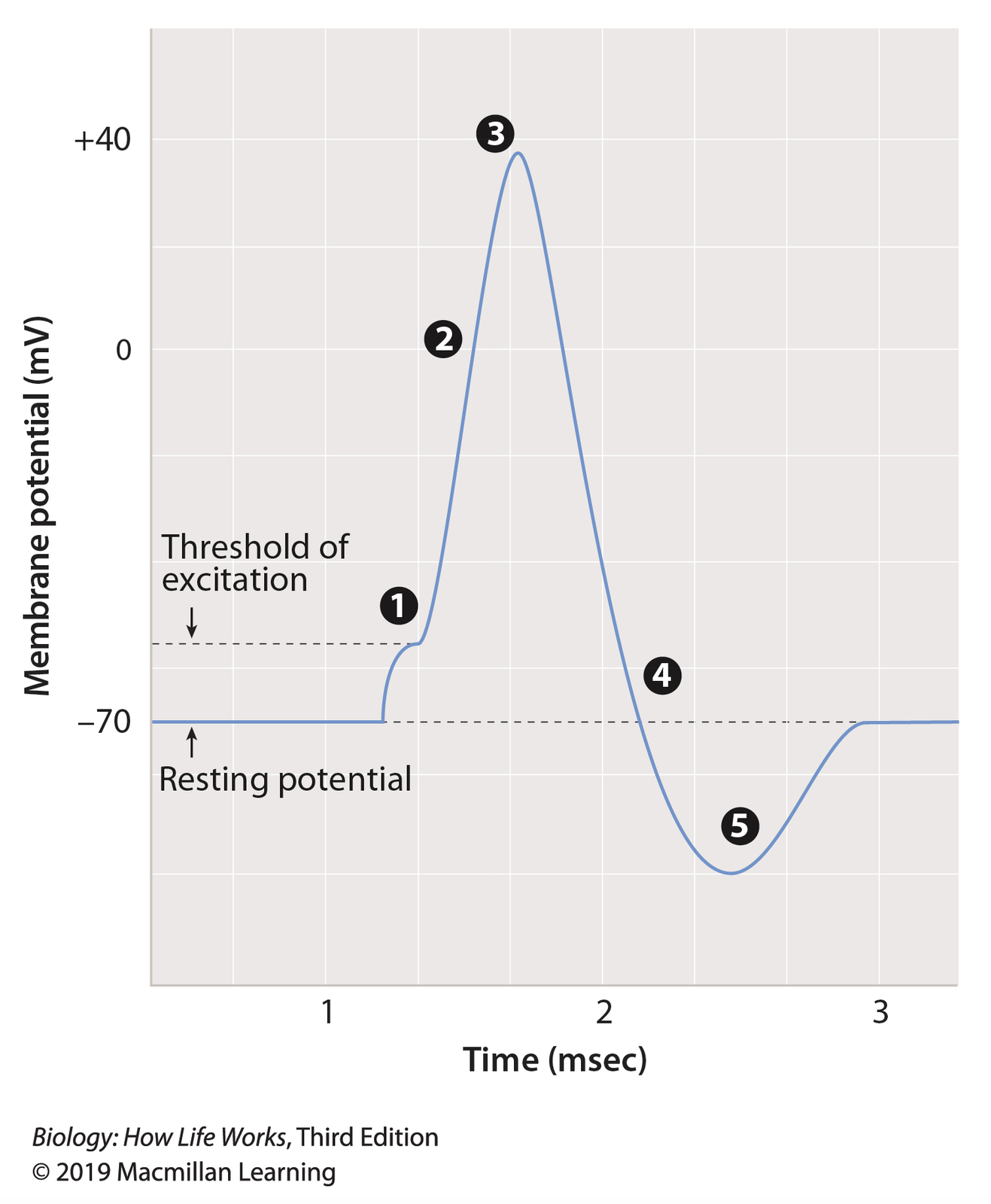
Imagine you genetically engineered a neuron to produce voltage-gated Na+ and K+ channels that opened at the same time in response to a change in voltage. How would that change the recording shown in the figure?
No action potential would be generated.
The period of hyperpolarization would be longer.
Threshold values would increase.
The peak would occur over a longer period of time.
The peak voltage would be higher.
No action potential would be generated.
Which of the scenarios will most likely trigger an action potential? Select all that apply.
an excitatory postsynaptic potential (EPSP) and an inhibitory postsynaptic potential (IPSP) arriving simultaneously on the postsynaptic cell that when spatially summed exceed threshold potential
multiple excitatory postsynaptic potentials (EPSPs) arriving close in time at a single synapse (temporal summation) on the postsynaptic cell
an excitatory postsynaptic potential (EPSP) and an inhibitory postsynaptic potential (IPSP) of equal magnitude arriving simultaneously on the postsynaptic cell (cancellation)
single excitatory postsynaptic potentials (EPSPs) arriving simultaneously at several different synapses (spatial summation) on the postsynaptic cell
an excitatory postsynaptic potential (EPSP) and an inhibitory postsynaptic potential (IPSP) arriving simultaneously on the postsynaptic cell that when spatially summed exceed threshold potential
multiple excitatory postsynaptic potentials (EPSPs) arriving close in time at a single synapse (temporal summation) on the postsynaptic cell
single excitatory postsynaptic potentials (EPSPs) arriving simultaneously at several different synapses (spatial summation) on the postsynaptic cell
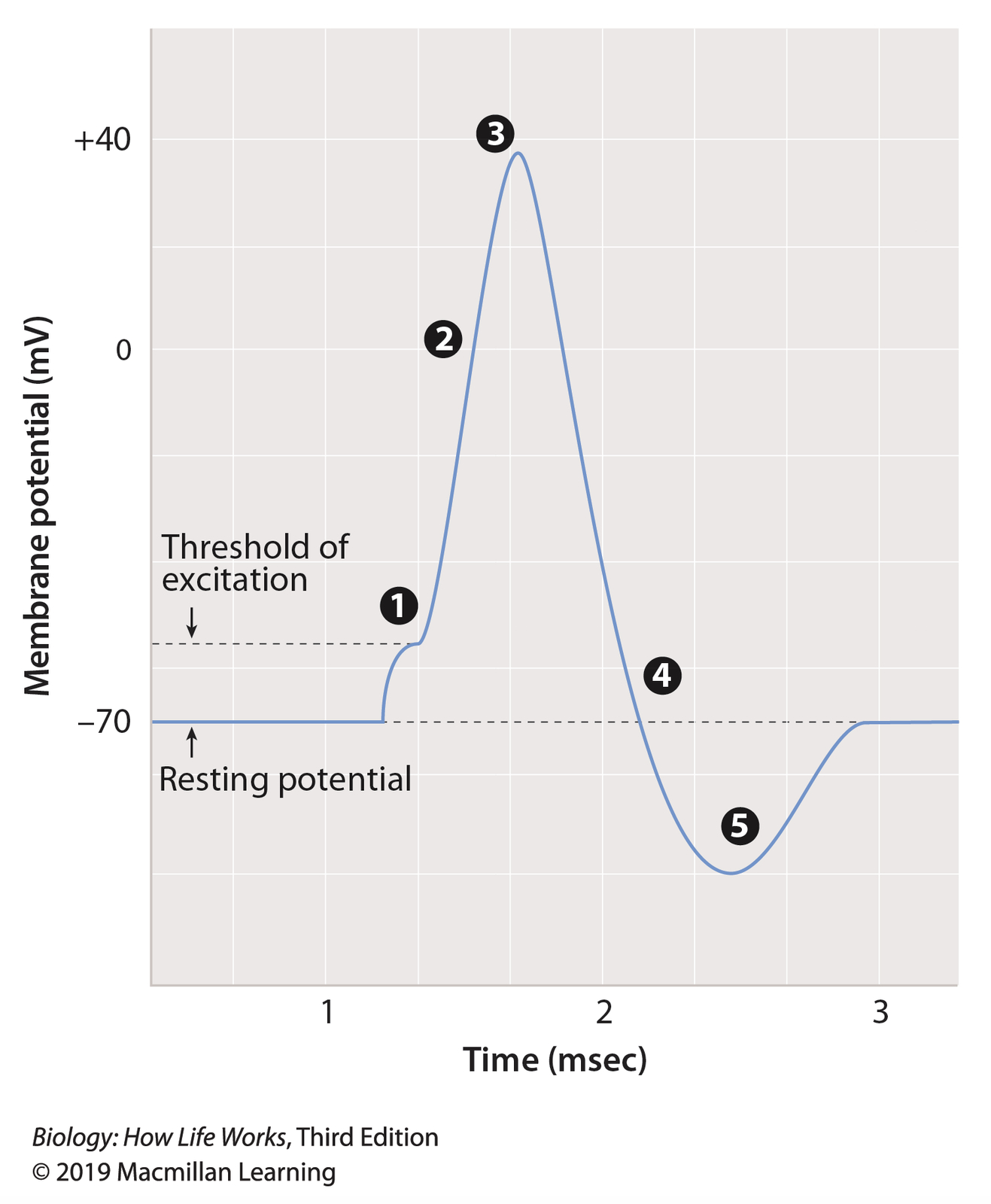
T/F: Low-frequency inhibitory postsynaptic potential (IPSP) received at the dendrites and high-frequency excitatory postsynaptic potential (EPSP) received at the cell body would most likely result in a membrane depolarization of sufficient strength to reach threshold at the axon hillock occurred at point 1 on the figure.
True
An interneuron may receive multiple stimuli from multiple sensory neurons over a very short period of time. When the firing rate of the receiving neuron is proportional to the number of signals received from multiple sensory neurons at a fixed moment in time, which process is this an example?
spatial summation
action potential
hyperpolarization
temporal summation
spatial summation
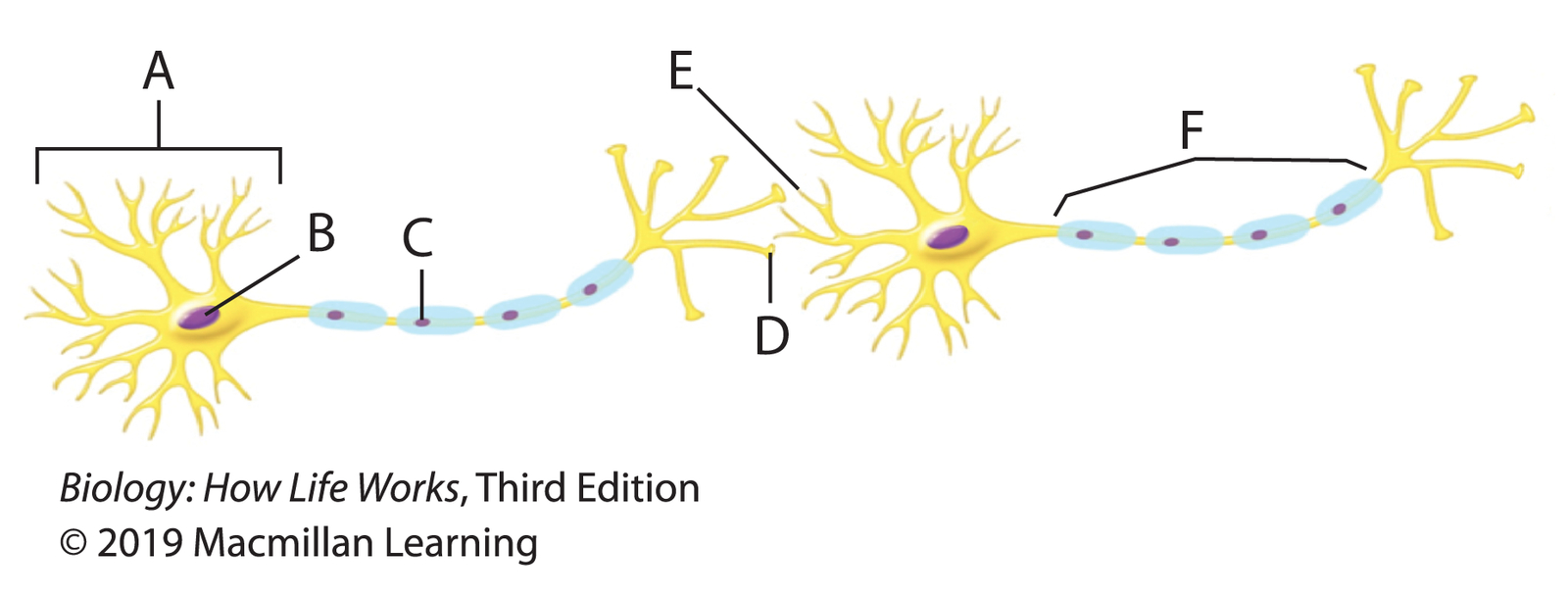
Atropine is a poison that blocks nerve action by binding to acetylcholine (ACh) receptors. Where would you expect to find atropine bound on the figure?
at letter C
at letter E
at letter D
at letter C, letter D, letter E, and letter F
at letter F
at letter E