Ch 18 Pt 2 Internal Protein Breakdown and Fate of Ammonia
 Call Kai
 Learn
Learn Practice Test
 Spaced Repetition
 Match
Match Flashcards
 Knowt Play
1/20

There's no tags or description
Looks like no tags are added yet.
Name | Mastery | Learn | Test | Matching | Spaced | Call with Kai |
|---|
No analytics yet
Send a link to your students to track their progress
21 Terms
ammonia
This harmful compound comes from two places in the body, amino acid breakdown (either dietary or internal protein breakdown) and gut bacteria
T
(T/F) Free ammonia is toxic to animal tissue
Glutamine
Formed when free ammonia is added to glutamate, catalyzed by glutamine synthetase. Excess of this molecule, if not needed for biosynthesis, is transported in the bloodstream for processing to the liver and kidney.
urea
NH4 is disposed of in the form of what?
dietary
(Dietary/muscle) protein is broken down using aminotransferase and glutamate dehydrogenase in the liver
Muscle
(Dietary/muscle) protein is broken down using glutamate and the glucose alanine cycle, in which glutamate transfers an amino group to pyruvate to make alanine and transport it to the liver. It occurs primarily during fasting, prolonged exercise, and starvation
Glucose-Alanine cycle
Working muscles operate anaerobically and rely on glycolysis for energy. This yields pyruvate, which can be converted to alanine for transport to the liver by this process in which glutamate transfers an amino group to pyruvate, making alanine, which is transported to the liver and the amino acid is transferred to alpha ketoglutarate to make pyruvate and glutamate. Glucose is regenerated and returned to the muscle
T
(T/F) The glucose alanine cycle is important because nitrogen is transported safely in the form of alanine, glucose is regenerated and returned to the muscle, and carbon is conserved while ammonia is detoxified
ammonotelic
A type of nitrogen excretion in which amino groups as ammonia are excreted in an aqueous environment. Used most in bony fishes and amphibian larvae

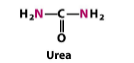
Ureotelic
A type of nitrogen excretion in which amino groups as urea (formed primarily in the mitochondria of the liver cells) are excreted. This conserves water. It is used in many terrestrial vertebrates and sharks.
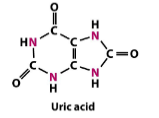
Uricotelic
A type of nitrogen excretion in which amino groups as uric acid are excreted in the form of a paste. Is used in birds and reptiles
Hyperammonemia
Liver disease, kidney failure, urea cycle disorders, and infections can cause this, in which free toxic ammonia builds up in the body (which can cause an increase in brain water content and glutamine accumulation).
T
(T/F) Plants almost always recycle its amino groups
Urea
These are the steps of which cycle?
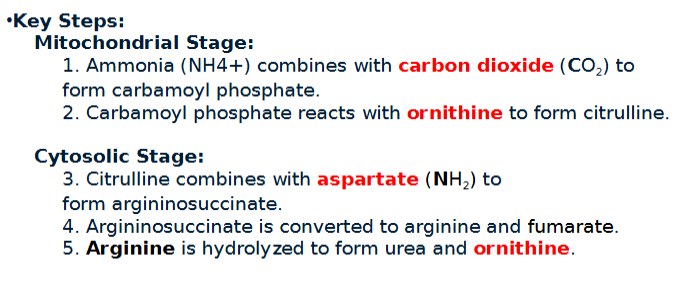
Glutamate dehydrogenase
The first amino group entering the Urea cycle comes from what enzyme that interacts with glutamate?
Acknowledged
Acknowledge the chart. “Ordinarily, Careless Crappers Are Also Frivolous About Urination” Ornithine, Carbamoyl phosphate, Citrulline, Aspartate,
Arginosuccinate, Fumarate, Arginine, Urea
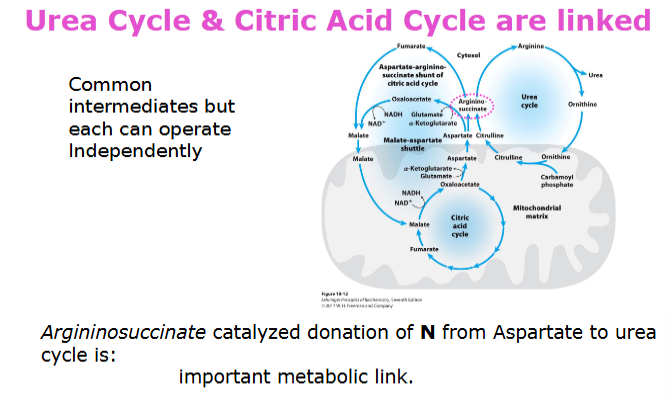
T
(T/F) The Urea cycle has two levels of regulation: 4 enzymes and cabomoyl phosphate synthetase I (expressed higher in starving animals and those on high protein diets) and the regulation of cabomoyl by N-acetylglutamate.
liver
Urea synthesis in mammals takes place primarily in tissues of liver or kidney
aspartate
Which of the amino acids directly donates a nitrogen atom for the formation of
urea during the urea cycle?
T
(T/F) In the urea cycle, ornithine trans-carbamoylase catalyzes the formation of: carbamoyl phosphate and L‑ornithine to form L‑citrulline and inorganic phosphate (Pi)
PLP
Which co-factor does Alanine aminotransferase (ALT) need?