10. Psychophysics
 Call Kai
 Learn
Learn Practice Test
 Spaced Repetition
 Match
Match Flashcards
 Knowt Play
1/6

There's no tags or description
Looks like no tags are added yet.
Name | Mastery | Learn | Test | Matching | Spaced | Call with Kai | Chat |
|---|
No analytics yet
Send a link to your students to track their progress
7 Terms
Psychophysics defintion
The scientific study of the relationship between physical stimuli & psychological responses (i.e. sensations & perceptions)
Physics is used to specify the stimulus (e.g. the number of photons per second per square degree)
We ask the subjects what they perceive (e.g. can you see it? how bright does it look? is it brighter than the patch next to it?)
What are examples of psychophysics in optometric practice?
Visual judgements are critical in two aspects of optometric exam:
Pt makes judgments about stimuli the clinician shows them (“Better 1 or 2? Tell me when they align. Did you see the flash?”)
Clinician makes judgements about the appearance of the eye or the settings of an instrument (With or against motion in retinoscopy or C/D ratio in anterior chamber depth)
In each case, tests are designed to give the most reliable response and to make judgments as easy as possible.
What’re psychophysical method?
Obtaining a quantitative, reliable response from a subject requires a psychophysical method.
A psychophysical method is basically a specific way of presenting stimuli and asking questions to control for subject biases & guessing as far as possible.
What limits our ability to detect & discriminate?
The signal to noise ration (SNR); All visual judgements are made aginst a background of noise & we try to reduce the noise as best we can, but fundamentally it is the signal to noise ratio that limits our ability to detect or discriminate.
a flash, letter, C/D ratio
The statistical nature of a threshold?
The concept of a “threshold” (& its inverse “sensitivity”) is that our perception changes from “not seeing” to “seeing” at one particular value of stimulus. However, there is always variability in this point of transition.
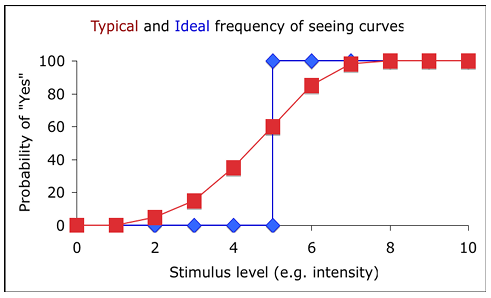
Detection level is described by a statistical distribution, not described by a fixed number. We define threshold as a particular probability level, like seeing 50% (because we are always making noise-limited judgments).
What is an example demonstrating the statistical nature of a threshold?
Detection level is described by a statistical distribution. Threshold is a particular probability level, like 50% seeing (because we are always making noise-limited judgments).
Ask the pt the same question 100 times, “did you see it?” for each 10 levels of the stimulus. There will be some levels where the subject is sometimes seeing it & sometimes not. even though we have done our best to control the stimulus.
Threshold & suprathreshold stimuli?
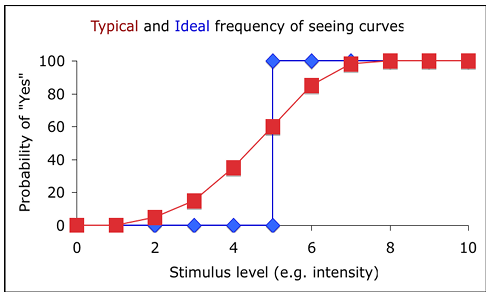
A threshold is the intensity where the pt goes from seeing to non seeing. It is defined statistically, like 50% seeing, because we are always making noise-limited judgments.
A stimulus is “suprathreshold” when it is well above this point, so that it is always visible. Sometimes we want to measure how string it appears to be, to get an estimate of percieved magnitude.
Psychophysical methods give us specific procedures for finding thresholds & suprathreshold magnitudes.