W3 - Management accounting - Decision making under conditions of risk and uncertainty
 Call Kai
 Learn
Learn Practice Test
 Spaced Repetition
 Match
Match Flashcards
 Knowt Play
1/52

There's no tags or description
Looks like no tags are added yet.
Name | Mastery | Learn | Test | Matching | Spaced | Call with Kai |
|---|
No analytics yet
Send a link to your students to track their progress
53 Terms
Where does the rational model come from & how does it view decision making & what do managers do in this model
-neoclassical economics
-views decision making as a logical and structured process aimed at maximising wealth/profit
-managers analyse all options available & choose the best one
what are the key assumptions of the rational model
-decision makers (managers) know exactly what they want to achieve
-decision makers have full information
-decision makers can evaluate alternatives consistently
what is the key limitation of the rational model
assumes logic → doesn’t account for emotion, politics, persuasion, negotiation, inconsistent personal values
state 5 elements of rational decision making model
1)Objective criterion (decision) → goal used to evaluate decisions eg max profit / minimise costs
2) Set of alternative actions → possible decisions available eg launch product / dont launch product
3) state of nature → an event that may occur & is outside the decision makers control eg low demand/high demand
4) set of probabilities →Each state of nature has a probability representing how likely it is to occur → chance of an event happening
5) Possible outcomes → Each combination of, a decision (alternative) and a state of nature produces an outcome →measured using objective criterian
What are the 4 elements of decision making
1) Implement the chosen action → put decision into practice
2) Outcome of action → state of nature is known eg demand is high/low
3)Performance eval →managers evaluate result →match objective?
4)Feedback →helps future decision making
risk v uncertainty. define risk (when it exists)
-possible outcomes = known
-probability of possible outcomes = known
-therefore can analyse decisions mathematically → often comes from historical data
risk v uncertainty. define uncertainty
-possible outcomes = known
-probability of possible outcomes = unknown
-eg launching a new product we know demand can be high, mid, low but cant estimate probability reliably
what are events/states of nature
-things affecting decisions outside decision makers control
what are the 2 types of probabilities and what it entails
-objective probability = mathematical/historical data
-subjective probability = managers judgement/belief →experience/expectations
what does a probability distribution list
-all possible outcomes
-probability of all possible outcomes
advantage of a probability distribution
-gives more info → can recognise uncertainty → could be a loss could be a profit
Limitation of probability distrbution
info overload
What are the 3 key summary measures that help analyse risk and return
1) Expected value (EV) → average expected outcomes
2)Standard deviation (SD) → measures risk
3)Coefficient of Variation (CoV) → measures risk relative to expected return
Expected Value formula
EV=∑(Outcome×Probability)
-choose highest expected value
what does standard deviation show and the formula
-standard deviation measures dispersion of outcomes.
-Outcome = possible result
-EVEVEV = expected value
-Probability = likelihood of the outcome

why cant standard deviation alone calculate risk →
products have diff expected values
Coefficient of Variation Formula
CoV=Standard deviation / Expected value
what does coefficient variation formula measure and what does a higher cov mean
-risk per unit of return
-higher cov = higher risk per unit
what are ev, sd and cov
summary measures of risk and return
why are the summary measures - ev,sd and cov not perfect
-reduce the probability distribution into single numbers → better to analyse prob distribution
what does a decision tree show
Courses of action (c.o.a) → the choices the decision maker can take
Events (states of nature) → uncertain things that may happen
Outcomes → the resulting profit or loss
When is maximax, maximin, & regent criteria used
-they are used when probabilities of states of nature are unknown
-decision making under uncertainty
what does maximin suggest
maximin = worst possible outcomes
maximax define
maximax = best possible outcome will happen
regret criterion define
regret criterion = difference between the payoff of the best decision and the payoff of the chosen decision
-choose the option that minimises the maximum regret
whats the decision rule for
-maximin
-maximax
-regent criteria
largest min pay off
largest max payoff
option w smallest max regret
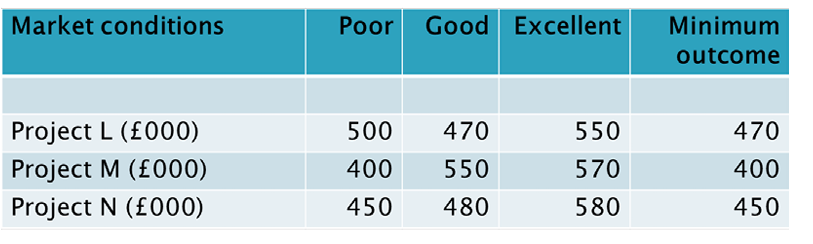
Based on regret criteron which project should be chosen
project N
Whats the role of extra information
to help predict state of nature to make the best decision
benefits / drawbacks of getting info
-reduces uncertainty
-improves decisions
-costs money
define perfect information + example
-info that predicts the future with 100% accuracy
-tells you exactly what state of nature will occur
-eg a consultant who predicts demand w 100% accuracy
define imperfect info
-info that is not perfectly accurate
-eg market research that is 80% accurate
what is the value of perfect info (EVPI) + formula
-increase in expected profit from the perfect info
-EV with info - EV without info
key rule/steps for calculating EV when you have imperfect info
Step 1
Calculate EV for each decision given the prediction
Step 2
Choose the best decision after each prediction
Step 3
Multiply each by the probability of the prediction
key rule/steps for calculating EV when you have perfect info
1⃣ Calculate EV of each option
2⃣ Choose highest EV → EV(no info)
3⃣ Take best payoff in each state
4⃣ Multiply by probabilities → EV(perfect)
5⃣ EVPI = difference
what is cvp
cost volume profit analysis
helps w how many units for breakeven, how profit will change is sales increase, what is the risk of making a loss
break even units formula
Break−even= = Fixed cost / Contribution per unit
break even revenue formula
Break even revenue= Fixed Costs / Contribution margin ratio
What is margin of safety?
Difference between expected sales and break even sales
What is the z-score formula?
z= (σ*x) / μ
What symmetry rule applies to the normal distribution?
P(Z ≥ −a ) = P(Z ≤ a )
If break-even sales are below the mean, what should the probability of breaking even be?
Greater than 50%.
If break-even sales are above the mean, what should the probability of breaking even be?
Less than 50%.
Why do we consider risk attitudes in decision making?
Because decision makers care about utility (satisfaction) not just money
What assumption does Expected Value (EV) make about decision makers?
they are risk neutral
What is a risk-averse decision maker?
What is a risk - neutral decision maker
What is a risk - seeking decision maker
-Someone who prefers less risk and more certainty.
-Only cares about EV and is indifferent towards risk
-Someone who prefers risky decisions with a potential for a larger payoff
What replaces expected value when modelling risk attitudes?
-expected utility
formula for expected utility
EU=∑(Utility×Probability)
Utility function for a risk-averse decision maker?
U(x)= square root V(x)
-Utility increases more slowly than money, meaning additional gains provide diminishing satisfaction.
Utility function for a risk neutral decision maker
U(x)= V(x)
-Utility increases linearly with money, meaning the decision maker cares only about EV.
what is the utility function for a risk seeking decision maker
U(x)=(V(x))2
Utility increases faster than money, making large payoffs very attractive.
Utility increases faster than money, making large payoffs very attractive.
Convert payoffs into utility values using the utility function.
Multiply utility by probabilities.
Sum to obtain expected utility.
Choose the highest EU.
Why is expected utility considered more realistic than expected value?
Because it incorporates individual attitudes toward risk.
What is a key criticism of expected utility theory?
It may not fully capture human psychology or moral considerations.