Olfaction/Taste
 Call Kai
 Learn
Learn Practice Test
 Spaced Repetition
 Match
Match Flashcards
 Knowt Play
1/27

There's no tags or description
Looks like no tags are added yet.
Name | Mastery | Learn | Test | Matching | Spaced | Call with Kai |
|---|
No analytics yet
Send a link to your students to track their progress
28 Terms
List the components of the olfactory system
Components:
Olfactory epithelium
Olfactory bulb
Olfactory cortex
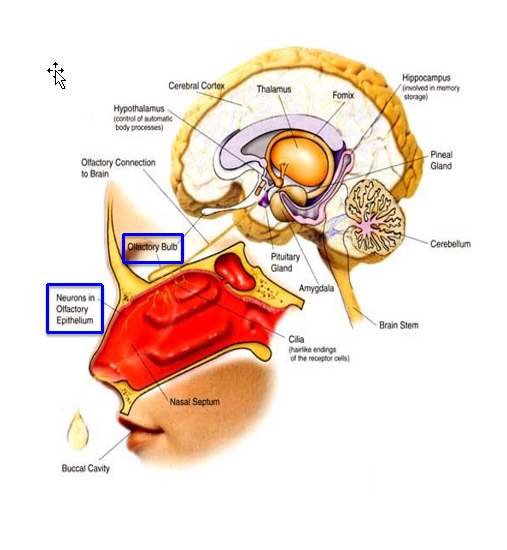
Describe the olfactory epithelium
Location
Mucus composition
Function of basal cells
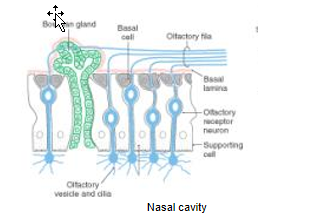
Olfactory epithelium:
Location:
10 cm2 area @ top of the nasal passages
Mucus (covering neuroepithelium) composition:
olfactory receptor neurons (ORNs)
basal cells (ORN progenitor cells)
supporting cells
Bowman glands (secrete mucus)
Function of Basal cells:
ORNs = continually replaced from basal cells and last about 1-2 months
Describe the structure of ORNs
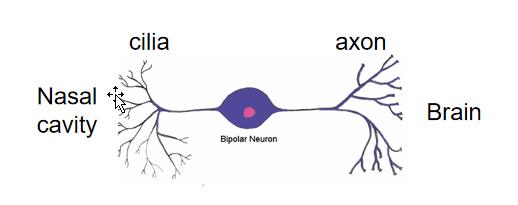
Olfactory Receptor Neurons Structure:
bipolar neurons
contain knoblike olfactory vesicle
nonmotile cilia projecting into mucus
contains olfactory receptors for detection of odorant molecules
axon projecting to olfactory bulb
Describe olfactory receptors
Type
Odor Discrimination prop.
Olfactory Receptors:
Type:
Largest subfamily of G-protein-coupled receptors (900 genes in human but only 357 functional)
Odor Discrimination properties:
each ORN = only one odorant receptor
thus, different ORNs → respond to different odorants
Describe the Combinatory strategy for odorant discrimination
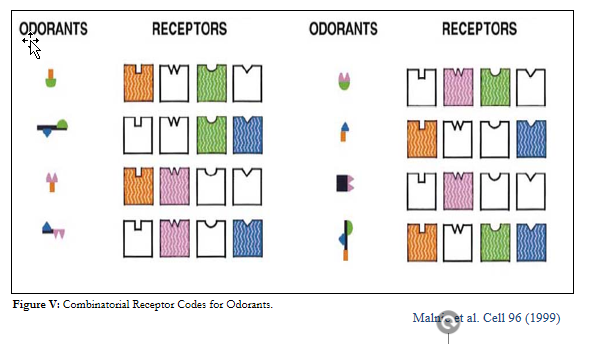
Combinatory strategy:
Each odorant is recognized by specific combination of receptors:
single odorant = recognized by multiple receptors with different affinities
Single receptor = recognize multiple odorants with different affinities
Mech: number of possible receptor combinations is way larger than the number of known chemicals
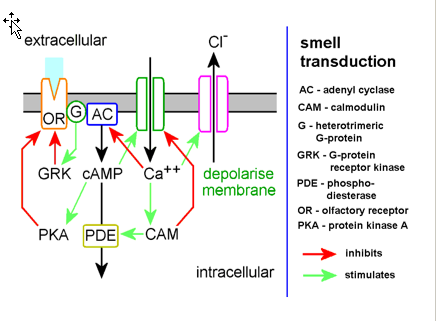
Describe the signal transduction pathway for odor detection
Describe the mechanism for Olfactory Detection & Adaptation
Signal Transduction Pathway
Volatile hydrophobic odorant → binding proteins w/in mucus layer → receptors on cilia of olfactory neurons → Gs/Gq activation
Outcome: Increase [Ca++} → AP generation in activated ORNs → glutamate (excitatory) NT release → OB neurons
Olfactory Detection & Adaptation Mech:
Ca+2 inhibition of activity of cation channel & adenylate cyclase
Desensitization of olfactory receptor by PKA via cAMP
Describe the pathway of ORNs → OB:
Pathway
Odor Discrimination
ORNs → OB:
Pathway:
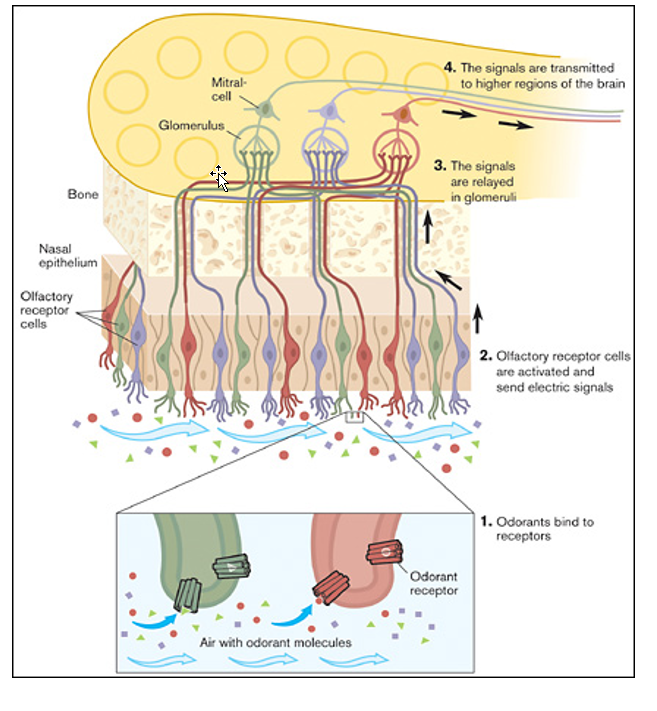
ORNs axons → organized as bundles called fila olfactoria → form CNI → pass through cribiform plate → OB (in ant. cranifal fossa)
ORNS synapses w/ OB in complexes of synapses called olfactory glomeruli
Odor Discrimination:
All ORNs expressing a given receptor converge on only one or two glomeruli
Describe the Olfactory Bulb
Type of neurons
Odor Discrimination Mech
Describe the Olfactory Tract:
What is it?
Contains?
Medial vs Lateral olfactory Stria
Importance?
OB:
Types of Neurons:
Excitatory projection neurons: mitral & tufted (M/T) cells
receive synapse from ORNs
synapse in olfactory cortex
Inhibitory interneurons: periglomerular & granule cells
modulate activity of projection neurons
Odor Discrimination Mech:
via excitatory & inhibitory synapses btw ORNs and OB:
amplify & filter signal generated by high affinity odorant in strongly activated glomeruli
Reduce noise (non-specific signal) by inhibiting activity in weakly activated glomeruli
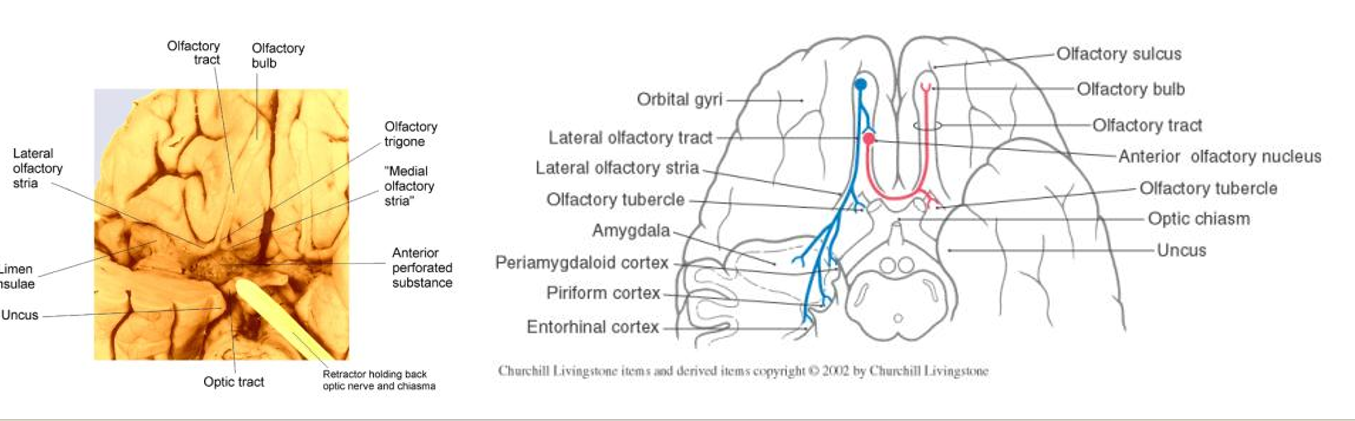
Olfactory Tract:
Connects OB to Brain
Contains:
projections: OB → primary cortex
brain projections → olfactory bulb
medial vs lateral olfactory stria
Medial:
OB axons sends collateral → synapse @ anterior olfactory nucleus → contact Contralateral OB
Lateral:
OB Axons → Continues in Lat. → synapse @ ipsilateral Primary Olfactory Cortex
IMPORTANCE: NO THALAMUS RELAY
List the components of the primary olfactory cortex
Connections of Primary
Describe the Secondary olfactory complex:
Includes
Function
importance of medial orbitofrontal cortex
Components:
anterior olfactory nucleus
olfactory tubercle
amygdala (anterior cortical amygdaloid nucleus)
periamygdaloid cortex
piriform cortex (located in uncus)
lateral entorhinal cortex
Connections:
extensive associational connections w/ each other
extrinsic connections w/
Lateral hypothalamus (feeding behavior),
hippocampus (learning & memory),
olfactory bulb
Secondary olfactory cortex
Secondary Olfactory Complex:
Includes:
orbitofrontal cortex
ventral insular cortex
Function:
discrimination and identification of odors.
Receives Taste Input
medial orbitofrontal cortex
important in integration of olfactory, taste and cues → experience of flavor.
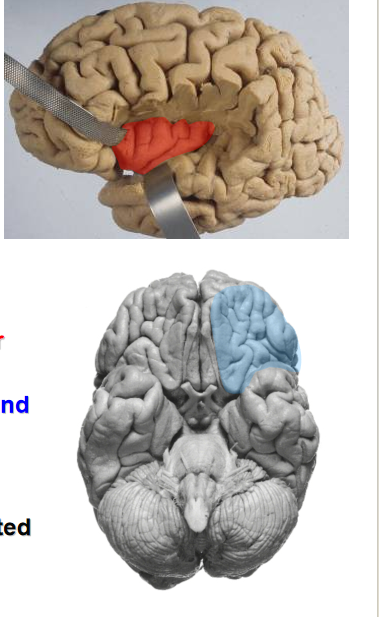
secondary olfactory complex
List the components of gustatory system
Components
Taste buds (receptor cells)
First order taste neurons (CN VII, IX & X)
Solitary nucleus
Thalamus
Gustatory cortex
Primary cortex
Secondary cortex
Associated nuclei
Hypothalamus
Amygdala
Brainstem motor nuclei
Etc.
Draw out a taste bud and its neuron
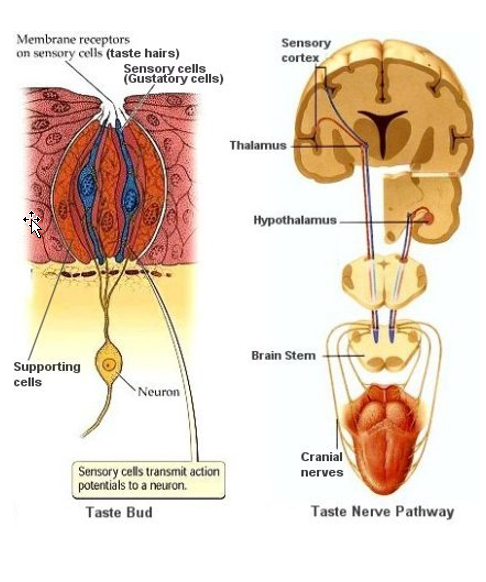
Describe the gustatory system
Detects?
Mech?
gustatory system
Detects 5 basic tastes:
sweet, salty, sour, bitter and umami (savoriness > amino acids).
MECH: Tastants directly stimulate receptor cells in taste buds
located throughout the oropharyngeal cavity.
Describe Taste Buds
What is it?
Taste Transduction Location
Innervation
Turnover Rate
Describe the Location/Function of Taste buds
Taste Buds:
What is it?
complex of supporting cells, basal cells and taste receptor cells (NOT NEURONS!)
Taste Transduction Location:
apical end of receptor cells = covered w/ microvilli where transduction occur.
Innervation:
innervated by >1 nerve afferent fiber
an individual nerve fiber innervate multiple taste buds.
Turnover Rate:
continuous turnover with cycle of about 10-14 days.
New cells are thought to arise from basal cells.
Location:
variable # on tongue, soft palate, oral/laryngeal pharynx, larynx and upper esophagus.
On Tongue:
fungiform, foliate and circumvallate papillae
NOTE: function of extralingual taste buds is not clear, and their number is decreased in adults. They may stimulate brainstem-mediated reflexes associated with feeding
Describe Taste Sensitivity
Location
Unique prop of sweet/unami/bitter
Thresholds
Taste Sensitivity:
Dif. Taste sensation = varies in location:
Sweet: most sensitive @ tip
Sour: edges
Bitter: Back
Salty: Ant. edges of tongue
Sweet, unami, bitter = detected by distinct subsets of taste cells that express different receptors
Some of these cells can also detect sour and salty.
Thresholds:
citric acid: 2mM
salt (NaCl): 10mM
sucrose: 20 mM
strychnine 0.0001mM (bitter>poisonous or noxious are the lowest)
Describe taste transduction
Taste Transduction Pathway:
Some sweet, sour, bitter and unami: tasting compounds used G protein coupled receptors.
Gs/Gq → cAMP,IP3 → Increases [Ca++] → opens/closes ion channels → Ca++ increases → Release NTs towards afferent nerve
Some bitter, salty and sour-tasting compounds
Ion Channels → change move. of ions (Na+, K+, H+) → depolarize membrane/ receptor cell → open voltage-sensitive calcium channel → Release NTs towards afferent nerve
[REVIEW] Afferent Nerve Endings
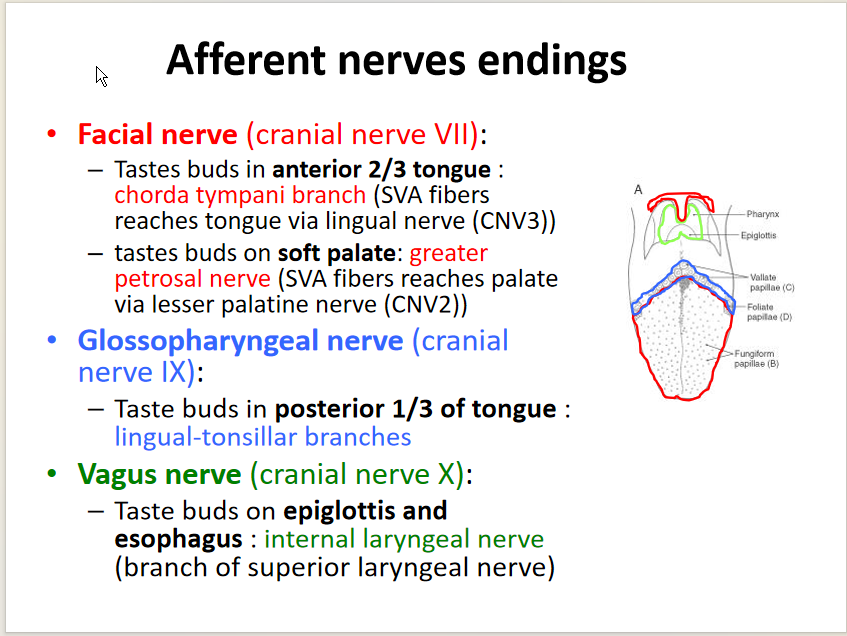
Describe the peripheral taste pathway
Describe Taste-Central Projections
Main Pathway
Other Projections
CN VII → geniculate gnaglia
CN IX → petrosal ganglia
CN X → Inferior Vagal Ganglia
central process enter brainstem and terminate in the solitary nucleus.
Taste Central Projections:
Main:
Rostral solitary nucleus → Ascends Ipsilaterally w/ CTT → VPM (thalamus) → posterior limb of the internal capsule → frontal operculum and anterior insular cortex
This pathway is involved in taste discrimination.
Other Projections:
lateral posterior orbitofrontal cortex (Secondary Gustatory Cortex)
receives inputs from primary taste cortex
Function:
integrates taste, olfactory and visual cues → appreciation of flavor, food reward and control of feeding.
Solitary nucleus → brainstem motor nuclei → control oromotor responses associated with feeding
EX: (tongue movement, swallowing, gaging, coughing etc.).
Some projections to amygdala (emotions, food aversion) and hypothalamus (feeding behavior).
Describe Trigeminal Chemoreception
Function
Mech
Threshold
Pathway
Trigeminal system:
Function:
chemoreception associated w/ ingestion of food and olfaction → localization of flavors.
Responsible for
“other taste experiences”
astringent (cranberries and tea),
pungent (hot peppers and ginger),
fatty, starchy, and various metallic tastes.
“acrid (irritating) smell”
horseradish,
vinegar
ammonia
These experiences are combinations of somatosensory perceptions including pain, touch and temperature.
MECH:
Nerves in nasal/oral cavities, naso/oropharynx → polymodal nociceptive receptors → activated by irritants
(acetic acid in vinegar, capsaicin in chili peppers, etc.).
Transduction via activation of cationic channels, the TRP (transient receptor potential)
TRP family also detects Hot/Cold
(this is why capsaicin and peppers taste “hot” while menthol is “cool”)
Irritants Threshold:
many = recognized as odors or tastes
trigeminal threshold = 100x higher than normal odors/taste
(protective mechanism)
Pathway:
Irritants sensory info → CNV ( to a lesser extent through CNIX and X) → spinal trigeminal nucleus → Contralateral VPM (thalamus) → somatosensory cortex where facial irritation is processed.
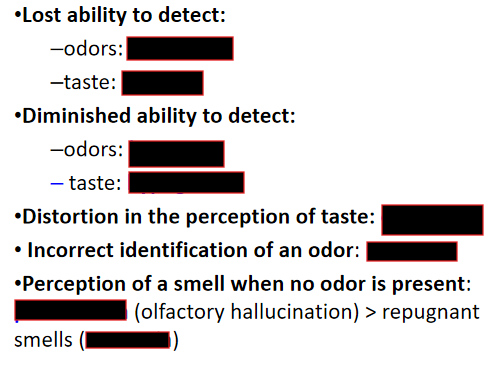
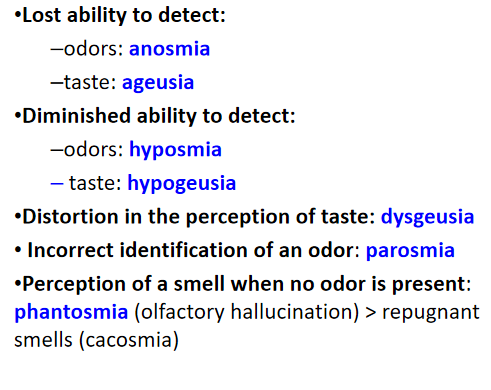
Describe Anosmia or hyposmia
Transient impairment via?
Chronic impairment
Transient impairment due to:
Nasal obstruction
by polips or septal deviations
Inflammation of olfactory epithelium
infections,
allergies,
chemicals like cocaine or smoking
recovery because of adult neurogenesis
Chronic impairment due to:
Aging: ORNs replacemen<degen
Damage to CNI axons
head trauma → damage cribriform plate/ abulsion of OBs
can lead to CSF rhinorrhea & danger of meningitis
Absence/reduced size of OB&tract:
Congenital anosmia
hyposmia / Kallman syndrome
Intracranial lesions
Subfrontal brain tumor
(most frequent reason to test CN1 function)
Neurodegenerative diseases
Alzheimer,
Parkinson
Huntington diseases
Psychiatric diseases:
Schizophrenia
Diabetes
Describe the causes of Phantosmia & gustatory hallucinations
Causes:
seizure activity:
those beginning in uncus (uncinate fits) → olfactory/gustatory auras → precedes full seizure activity.
Psychiatric disorders:
phantosmia → olfactory delusions → believes existence of odor/source does not exist
gustatory hallucinations also exist
Head trauma
Stroke
tumors
migraine
toxic or metabolic abnormalities
Describe parosmia
Causes
Parosmia
Rare condition that has become relatively more widespread since 2020 as a side effect of Covid-19.
Usually, odor is perceived as unpleasant (euosmia if pleasant).
Causes:
damage to ORNs by respiratory infection or exposure to harmful chemicals.
COVID:
infection of sustentacular cells → down regulation of OR/Signal. Pathway genes → effects last even after virus cleared
Head trauma & Parkinson’s disease
Describe causes of ageusia and hypogeusia
ageusia
Bilat. Lesion of CN VII/IX:
rarely encountered
local damage to taste buds:
radiation therapy,
inflammation
infection of tongue
hypogeusia
Neurological damage:
Bell palsy (facial nerve),
multiple sclerosis,
Alzheimer’s disease
Peripheral neuropathy caused by diabetes
Aging
Describe causes of dysgeusia
What is it?
What is it:
distortion in the perceptions of taste (bad taste → metallic)
Causes:
complication of treatment or medication usage,
particularly in radiation therapy and chemotherapy.
result of damage to taste bud receptor cells or afferent nerves
Describe Drug induced Disturbances in taste & smell
Effect
Most Common?
Mech
Drug induced disturbace:
Drugs in every major pharmacological category can impair both taste and smell function.
distortion, alteration, reduction, or presence of tastes or smells.
Dysguesias and parosmias are the most common.
Most of the disturbances due to sensation alteration @ molecular level,
but others may be generally neurotoxic.
Describe Specific Anosmia/ageusia:
MECH
STATs
What are supertasters?
Specific anosmia:
MECH: lower sensitivity to specific odorant b/c lack of functional receptor/ genetic mutation
STATs:
1/1000: insensitive to butyl mercaptan, skunk.
1/10: cannot detect hydrogen cyanide or ethyl mercaptan-added to natural gas.
Specific ageusia:
Mech: lack of functional receptor/mutation
STATs:
30-40% of U.S. population: cannot taste phenylthiocarbamide (PTC) (the bitter compound )
Supertasters:
People who are extremely sensitive to PTC have more taste buds than normal and tend to avoid bitter tasting foods.