Psychology - Research methods
 Call Kai
 Learn
Learn Practice Test
 Spaced Repetition
 Match
Match Flashcards
 Knowt Play
1/101

There's no tags or description
Looks like no tags are added yet.
Name | Mastery | Learn | Test | Matching | Spaced | Call with Kai |
|---|
No analytics yet
Send a link to your students to track their progress
102 Terms
Why are experiments important?
They are the gold standard of research in psychology
they can establish cause + effect relationships and help remove the cause if causing negative effects
What are three characteristics of experiments?
IV - Independant variable, this is the variable you manipulate and change in an experiment
DV - Dependant variable, this is the variable you measure in an experiment
A controlled enviroment, in order to have control we need to identify all the extraneous variables in an enviroment that can influence ppts behaviour and keep the same these are called control variables
Control variables fit into three catagories; ppts variables, researcher variables and enviromental/situational variables
What are the three control variables and how can they impact a researchers experiment?
Ppts variables, mood - biggest influence on behaviour that researchers can’t control, motivation, events in ppts life e.g daily demands
Enviromental variables, other peoples behaviour/moods, heating/lighting/comfort
Researcher variables, treatment of indivduals, ppts bias on age, gender, appearance changing their behaviour
What is a hypothesis?
This a prediction of the outcome of your experiment that you should write before the experiment begins, an experiment should prove/disprove your hypothesis and provide evidance
What are three types of hypothesis?
Null hypothesis
experimental/research hypothesis - non directional
experimental/research hypothesis - directional
What do you not do when writing a hypothesis?
Do not explain why
What is the IV in the stroop test?
What is the DV in the stroop test?
whether the print colour + word meaning match is the experimental condition
correct or incorrect + reaction time in milliseconds
What does the stroop test investigate?
cause + effect relationship, is there a relationship between print colour and word meaning incongurency and time taken to name colour and font
What are the ppts, enviromental and researcher variables in the stroop test?
ppts variables - eyesight, colourblindness, tiredness, focus, mood, motivation
enviromental variables - distractions, lighting
researcher - expectations of results
What is standardisation? how can it be used for the stroop test?
keeping things the same for all ppts
ratio of congruent and incongruent words
equipment setup e.g screen size
room used for testing
the number of words
instructions given to ppts
What is a laboratory study/experiment?
They are in a controlled environment with;
reliable findings
control of extraneous variables
and we can be confident the IV will influence the DV
What are some weaknesses of Lab studies/experiments?
They lack ecological validity where the experiments do not reflect how people act in everyday life
People try to work out what is expected of them in experiments - Demand characteristics
What are field studies/experiments?
experiments in a real world setting
natural behaviour as the person will be in a natural setting
tend not to gain demand characteristics
What are weaknesses of field experiments/studies?
the results are less reliable as the environment is not controlled so we can’t be confident IV is influencing DV
What are Quasi experiments?
These are experiments where the researcher does not choose the IV, the IV “chooses itself”
They take advantage of natural differences between groups of people like age;
Age can influence attitudes, personality, intellectual ability and memory
we cannot randomly allocate ppts
What is one problem with quasi experiments?
there is an issue drawing conclusions because of extraneous variables
the IV is not the only thing that results will measure that will influence the researchers findings
What is another example of a quasi experiment?
social class, people find themselves in either upper, middle or working classes
the DV would be testing intellectual ability whilst the IV would be the different people we test
however, an extraneous variable would be someone’s social capital giving them more opportunities for academic enrichment
What are natural experiments?
they are rarely used by psychologists
they are uncontrolled experiments that run themselves
the experiment won’t choose the IV or DV
the researcher analyses differences in data
What is an example of a natural experiment?
The twin towers terror attack in 2001. Flashbulb memory - where you have a vivid memory of an event that is shocking
People were naturally different distances from the twin towers during the attacks
the researchers developed an IV based on the distance from the towers and a DV based on peoples recollections of the event
What is the issue with natural experiments?
there are so many uncontrollable variables that researchers have to be cautious of about drawing conclusions
they are often unethical and unreliable
what is the idea of experimental designs?
It is about the allocation of ppts to a control and experimental condition
What are independant group designs?
Different ppts will appear under different conditions
What is a repeated measures design?
the same ppts will appear under each condition
What is a matched pairs design?
Same as independant groups but researchers identify shared traits of ppts and pair them up. Then, the pairs are split up and tested in different conditions
How is reliabilty important in an experiment?
Method can be reliable by being standardised so it can be repeatable
findings can be reliable results from experiments are the same each time an experiment is ran.
How is validity important in an experiment?
when we are considering whether a piece of research is valid we are asking whether we have measured what we intended to measure
we could aslo ask is this behaviour a normal representation of life - ecological validity
How can demand characteristics impact validity?
where your ppts try to meet the researchers expectations and try to be a ‘good ppts’ therefore reducing ecological validity
How can investigator effects impact validity?
when the researcher unconsciously passes on their expectations. E.g verbally through tone of voice, facial expressions and gestures. This can be avoided through a set of instructions. This creates demand characteristics
What can we do about investigator effects?
Run blind studies where the researcher does’nt know what the hypothesis is
Drug trials, double blind studies, neither the researcher or ppts knows who is given the drug and who is given the placebo
What is sampling? How are samples created and why?
Sampling is about deciding who will take part in research, researchers will have in mind a target population in mind for example an age group or people of a paticular ethnic group
We cannot conduct research on complete groups so we must take samples that will hopefully represent a target population
Whar are 5 different methods of sampling? What do they depend on?
Samples will take place depending on the resources available
Random
Systematic
Oppurtunity
Volunteer
Stratified
What is random sampling? what are the strengths and weaknesses?
There is a list of all possible ppts as a sample frame
The researcher will randomly select the ppts e.g through an online random name generator
Strength - the researcher does’nt choose their ppts
Weaknesses - there is a chance the sample isn’t representitive , there must therefore be a sample frame
What is systematic sampling? What are the strengths and weaknesses?
List of all ppts, the researcher will then pick every nth ppt
We decide the nth ppts by division, we divide the total number of ppts by the number needed for sample e.g 40 divided by 10 = 4, so we take every 4th ppts
strengths, unbiased sellection
weaknesses, the order of ppts could be biased so the names must be randomised
What is oppurtunity sampling? what are the strengths and weaknesses?
Non random, taking people who are willing and able by “asking them”
Strengths - quick and easy process for researcher, large samples
weaknesses - unrepresentative as the sample is subject to researcher bias
What is volunteer sampling? what are the strengths and weaknesses?
Non random
Researchers will advertise their study and wait for people to sign up
strengths - Eliminates researcher bias, is easier for the researcher and the volunteers will be motivated
weaknesses - unrepresentative of target population, volunteers may have a hidden motive or be more interested or confident
What is stratified sampling? what are the strengths and weaknesses?
Step 1, calculate the % of catagories of ppts in the target population and translate that % in your sample
step 2, use a sampling method like random sampling to create a sample
strengths - unbiased, most representative
weaknesses - it can be more time consuming, have to use external date to work out sample proportions
What are ethics in psychology and how have they been set?
Ethics are an agreed set of rules about how we treat participants whilst conducting research
The code of conduct has been desingned by the British psychological society B.P.S
A psychologist must attain approval from their university to carry out their research
What are the four guiding principle in the B.P.S code of conduct?
Respect
Responsibility
Competance
Integrity
What ethical issues can rise when conducting research?
Informed consent, ppts need to know “as far as possible” what they are letting themselves in for such as the goal and tasks
Right to withdraw, can leave research at any time. Ppts will have to be reminded at the beginning, middle and end, if the ppts decide they don’t want their data used it is withdrawn and destroyed
Debrief, after the experiment the exact nature of the research is explained
What should researchers avoid during their experiments?
Deception, sometimes necessary for the experiment to take place so it must be kept to a minimum (leave out information rather than lie)
No physical harm, or psychological harm e.g excessive stress, anxiety and shame. Making sure ppts leave experiment reletivley the same as when they joined
What rules should researchers uphold when collecting data?
Anonymity, data shouldn’t be identifiable so they must replace name with ppts numbers
Confidentiality, data collected and ppt behaviour should not be discussed with anyone outside research team
What are descriptive statistics?
Mean average
mode
median
range
We calculate these 4, they are measures of central tendancy, they have a single value that represents your data set
Standard deviation, which we interpret
We shouldn’t really draw conclusions from descriptive statistics because our results could’ve arisen by chance
What are inferential statistics and tests?
They allow us to test a hypothesis and decide whether our results are based upon chance or the experiment (IV affecting DV)
There are lots of different inferential statistics tests which one you choose depends on the type of data you have collected
What is nominal data?
It is catagorical data, places ppts into catagories e.g frequency table, where you can count the indivduals in each catagory like hair colour
What is ordinal data?
rating scale data, measure the quality of something on the scale. could be making ppts answer how much they agree from 1-10. It is a subjective measurement
What is interval data?
continuous data which is an objective measurement. The intervals between data are consistant
e.g heart rate measured in BPM or reaction times measured in seconds
What types of research are there, what designs could they be in?
Experiments, an experiment which has an IV influencing the DV
There are 3 experimental designs they could use; independant groups with an unrelated design, matched pairs design and repeated measures design (both of these are related designs
Correlations, looking for an association between two variables, a positive and negative association
What inferential statistic test would you use for unrelated nominal, ordinal and interval data from an experiment?
Chi-squared
Mann Whitney
unrelated T-test
What inferential statistic test would you use for related nominal, ordinal and interval data from an experiment?
sign test
willcoxen
related T-test
What inferential statistic tests would you use for nominal, ordinal and interval data from a correlation?
Chi-squared
Spearman’s Rho
Pearson’s R
give an example of a hypothesis, what are one and two tailed tests?
“Ppts will recall more digits when digits are read out in pairs compared to being read out one at a time” this is a directional hypothesis, it is one tailed and we run a one tailed test on it. For a non directional hypothesis we run a two tailed test, however one tailed hypothesis are easier to use as it’s easier to get a significant result
What do all statistical tests do? What can happen with a significant result?
All statistical tests will test the null hypothesis to see if any observed differences are due to chance, if you get a statistically significant result you may reject the null hypothesis meaning there will be no differences with both conditions and accept your own research hypothesis
What is a significance level, what are the two types of errors?
Before running statistical tests we must choose a significance level (error rate), we are happy to accept this level
optimist error, we reject the null hypothesis and conclude a difference in conditions or an association (type 1 error)
Pessimists error, we accept the nulll hypothesis when we should reject it
What are the two significance levels?
There are two error rates (significance level)
1% significance level, an error occurs 1/100 times, this shows 99% confidence in hypothesis. Only used in drug trials and one off experiments
5% significance level, 5/100 times we run experiment we face error. We are 95% confidant used for standard research
How do we complete a sign test?
we take the numerical value of the least frequent sign and ignore the zeros e.g 2 (This is the S value)
We calculate the N value, this is the total number of ppts minus the number of ppts who got zeros e.g 12
We “ look up” our observed value of S on a critical values table. We look up if it is a one or two tailed hypothesis, it being at significance level 5% and the N value of 12
The we apply this rule to see whether our result is due to chance or not
How can we conclude sign tests?
We can conclude that our statistical test has given us a statistically significant result. Our observed value of S = 2 is equal to the critical values table. We can reject the null hypothesis and accept our one tailed directional hypothesis
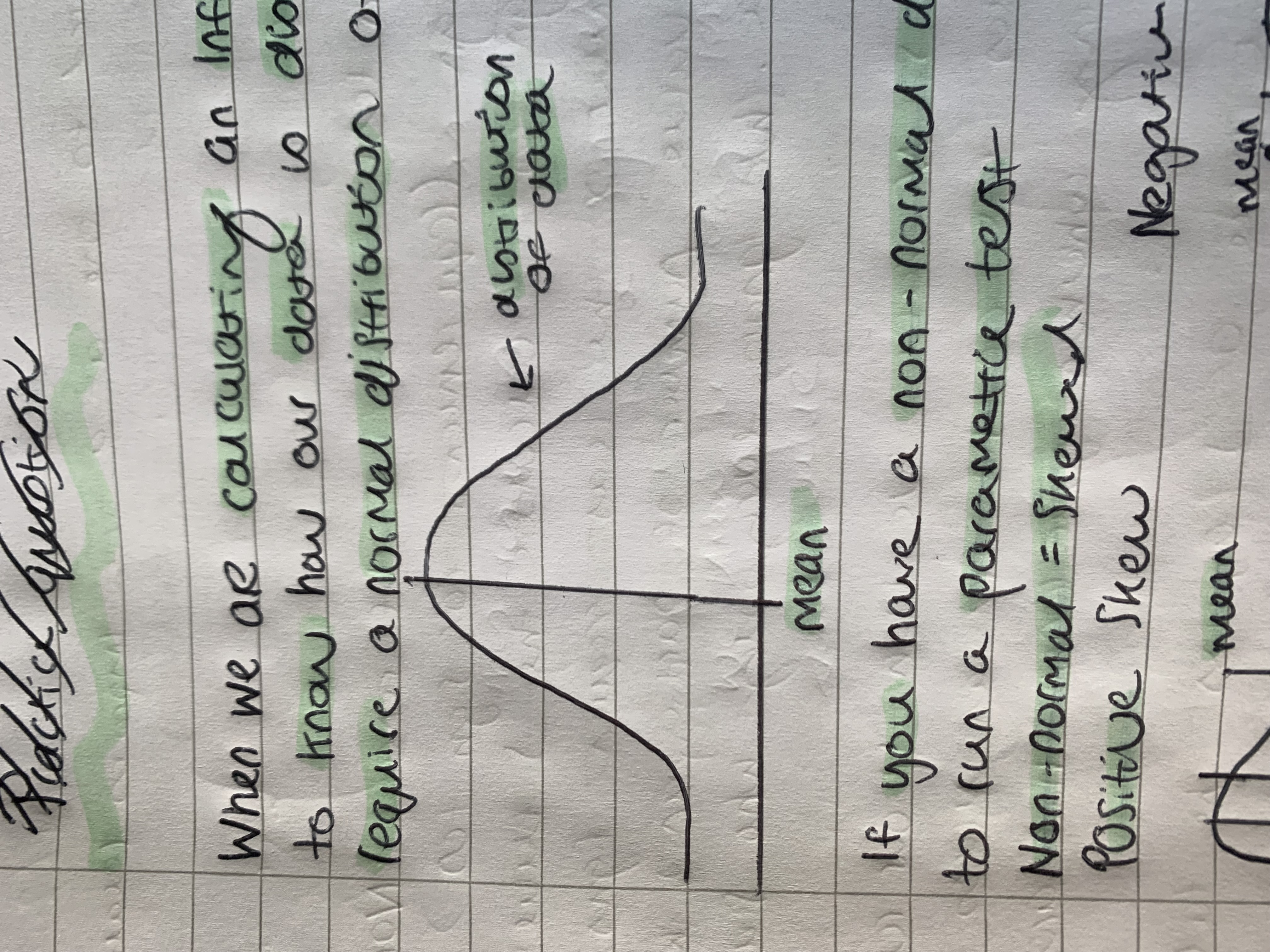
Data distribution, what do parametic tests require?
These tests require a normal distribution of data. Some examples of parametic tests are; T tests, pearson’s R and Chi-squared
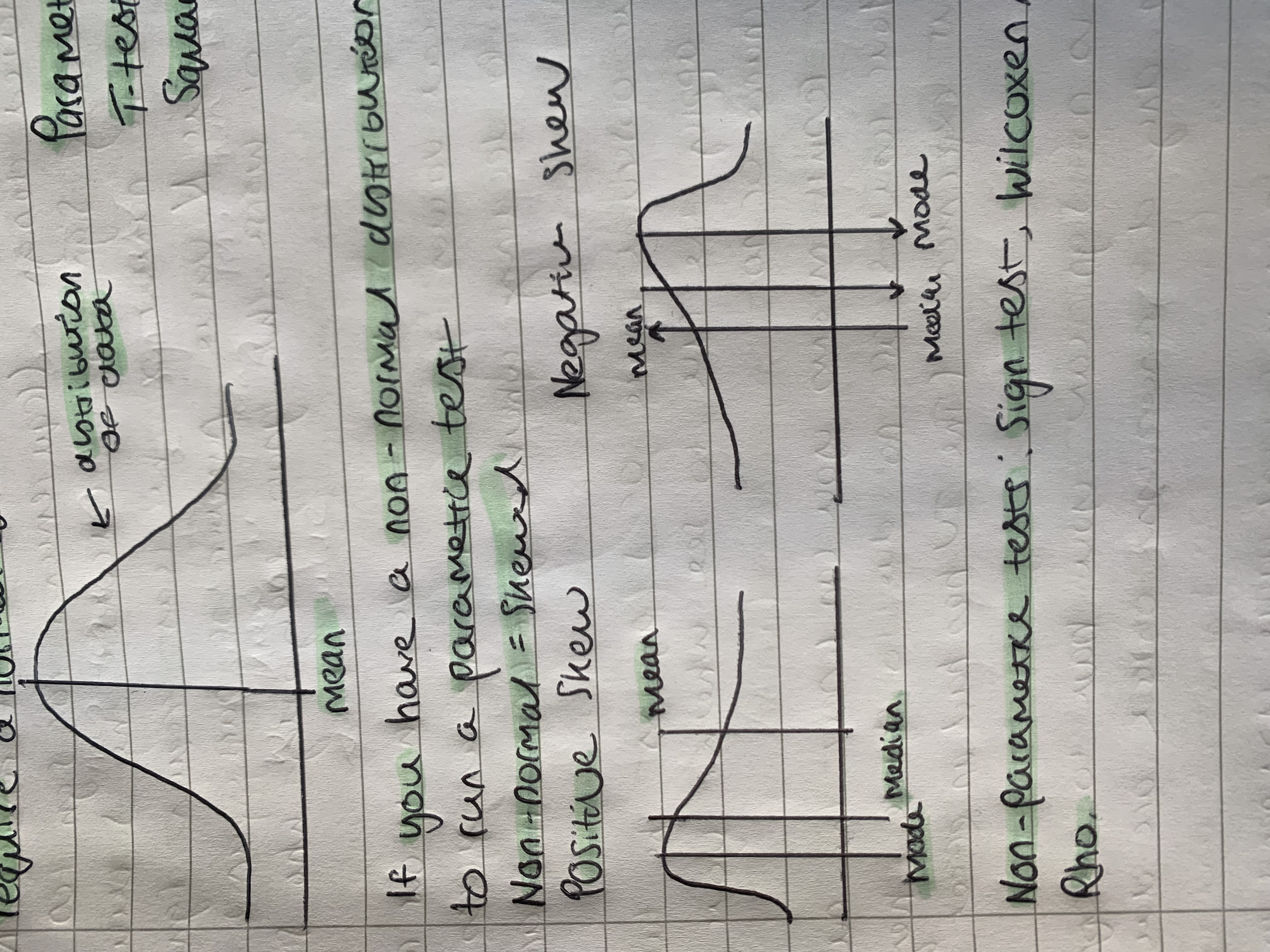
Data distribution, what happens with a skewed distribution of data when running parametric tests?
If you have a skewed portion of data we run a non-parametric test
Non-parametric tests include; sign tests, wilcoxen, Mann Whitney, spearman’s Rho
Some have a positive skew and a negative skew
What are observation studies and what are the two types of observation?
For instance the Bobo doll experiment is a good example of controlled observation done through covert observation and non participant. Behaviour can be samples
covert = ppts are unaware of observation
Overt = pots are aware of observation
What is triangulation?
This is where we use more than one method to research the same topic. If results are the same, we can be more confident of our conclusions e.g we may pair observations with interviews
What types of obervation are there?
naturalistic, everything is left as normal and researchers don’t interfere in any way like in ofsted inspections
Controlled, aspects of environment are manipulated with and IV affecting the DV, mostly done in a lab setting
Covert
Overt
Participant
Non-participant
Usually, psychologists are controlled, convert and non participant
What are unstructured, structured, and behavioural categories?
unstructured, all relevant behaviour is recorded and no systematic plan is made before the observation starts. Useful for a pilot study
Structured, systematic obervation, recording plan is made beforehand meaning behavioural categories are devised and a behavioural sampling method is chosen
Behavioural categories are precise definitions that will be recorded, (operationalism). Behaviour has to be defined so that each observer can be as objective as possible. A tick list is created so the observer can quickly record them
for example making a draft tick list for rats behaviours in skinners experiment
What are sampling procedures?
what are the three types?
continuous observation, not really possible so sampling behaviour is crucial
Event sampling, counting the amount of times a target behaviour occurs in a target individual
Time sampling, recording behaviours in a given time frame, e.g noting a behaviour every 5 minutes
How can we evaluate naturalistic and controlled observation?
Naturalistic
strengths
good ecological validity
Limitations
no control over extraneous variables
Hard to replicate
Controlled
strengths
limits extraneous variables
Improves reliability
Limitations
lacks ecological validity, no natural behaviour
What is an interview?
a structured conversation using open ended questions, they are usually face to face where the interviewer can pick up non-verbal cues
They provide qualities data that can be audio recorded and transcribed either manually or through softwares
Analysis either involves content or thematic analysis
What types of interviews are there?
structured, pre set with open ended questions, asked in a fixed order, e.g market research
Semi-structured, same as the above, but with follow up questions, job interview
Unstructured, no set questions on a particular topic and interaction is free flowing, cognitive interview
How can we evaluate interviews?
Strengths
idiographic; unique experiences are explored
In-depth info
sensitive info can be explored
Starting point for questionnaires
Limitations
only suitable for a small sample
Can’t easily find patterns and trends as it is qualitative data
Subjective data analysis
Takes 1 hour + transcription
What are questionnaires?
self report method which produce quantitative data like %, many are easy to describe data due to technology
Many do rely on honesty
Allow us to analyse data with bar charts, pie charts, etc
They use closed ended questions with forced choice response like yes/no and likert scores 1-10
How can we evaluate questionaries?
Strengths
nomothetic and scientific
Can have very large sample sizes and can be distributed easily
Collecting very reliable data that can be generalised to sample size and they have standardised questions
Limitations
Self report, we rely on others to be honest some may lie for social desirability which reduces the validity of our findings
Reductionist, quantitative data can’t show depth
Cannot be used for sensitive topics
What is thematic analysis?
Conducted on qualitative data and is left as qualitative data, there is no conversion to quantitive data
a method for uncovering the intended meaning in a piece of text/image
How?
By thoroughly reading the text to try and understand what the writer was expressing. This is read 3-4 times
Analysing language and phrases used by ppts and interpreting what they meant
Unlike content analysis there are no coding units
We are looking for themes that come up to the surface, e.g anger, desperation, joy
Once theme is established, we write a text summary explaining the main message by using the themes to support what we say
(Subjective)
How can we evaluate thematic analysis?
Strengths
in-depth analysis provides a holistic picture of someone’s experience
Idiographic, valid
Limitations
subjective interpretation of ppts data meaning analysis may be bias
Non scientific approach, rarely used in psychology
Only can do them in a limited sample and they are not generalisable
What are case studies?
An in-depth analysis on a single individual
it’s an idiographic approach using a variety of methods like brain scans, interviews, observations, and performance tests
usually conducted over a long time e.g 20 years
How can we evaluate case studies?
Strengths
In-depth analysis allows researcher to gain holistic insight
Useful starting point for the future nomothetic approach
Can use abnormal to inform us about the normal
Limitations
can’t replicate
Can’t generalise findings
Researchers may become over-involved work over many years so loss of objectivity and professionalism
What are pilot studies?
small scale studies carried out before the study proper, to test procedures and materiel you want to use
How can pilot studies be used in;
observation
Lab studies
Questionnaires
Interviews
in observations, behavioural categories are clearly defined, data sampling method - event or time intervals? Where to observe from, how to record data?
Lab studies, instructions to your ppts, what variables you need to control. IV and DV, do they work? Trying the task, making sure ppts can do it
Questionnaires, clarity of questions, response choices, format, etc
Interviews, clarity of questions, would it offend someone, is it a comfortable setting?
How can we evaluate pilot studies?
Strengths
saves time and money as we can identify mistakes meaning they shouldn’t come up in the actual experiment
Results are more reliable as method is standardised and replicable
Limitations
could take time and money however
Might lead to unconscious researcher bias, they will try and replicate the results in the study proper that they got in the pilot study
To avoid this we use double blind procedures in the study proper where neither the researcher nor the ppts know the condition they are in
How do we construct psychological reports?
Title, a statement or question that would interest the reader
Abstract, brief outline of your research procedure and findings. Aim, method, findings, and conclusions
Introduction, aim, other peoples research and your hypothesis, references
Method and procedure, writing this in enough detail so someone can replicate your experiment. This includes the experimental design, materials used, ppts who took part, ethical considerations
Findings and results, descriptive and inferential statistics
What else do we include in psychological reports?
Discussion
Explain findings
Relate findings to previous research
Evaluation of study
future research
conclusion
References, Full details of source material referred to in introduction and discussion (reducing playgrism and boosting researchers careers)
How is a harvard reference structured?
Author surname, Initial. (year) book title. City : publisher
Abel, T. (2028) psychology. York : university of York
How do peer reviews work?
It’s a quality control process where we aim to ensure that research that is published is good quality
Researchers who work at universities want to publish their work in an academic journal
These are mostly online and are overviewed by ‘peers’ who are on a board of editors, specialists in fields
Peers decide if research is good by; looking for any errors and mistakes, checking data analysis, checking for plagrism. Is it good quality? Is it worthwhile?
Does peer review work?
Yes
prevents research being published that has errors in it
does work as a plagerism check as the experts in your field have 20/30 years experience and know the area well
No
Board of editors are not unbiased, they will have preferred theories and research methods they don’t want challenged
May be less inclined to publish research that challenges established theories
May be more inclined to publish positive results
What is content analysis? How does it work?
A method for converting qualitive data into quantitive data
How?
By systematically identifying the thoughts, feelings, and behaviours being expressed in text and counting the number of times each one occurs
Each type of thought, feeling, and behaviour is called a coding unit
Before we conduct content analysis we decide on the coding units we are going to use
Thus, coding units are pre-determined
Whats an example of conducting content analysis?
text message analysis research
This is qualitive data analysis in the form of texts and images/emojis
In this case, our experiment is to investigate gender differences in text messages
Example hypothesis; text messages from females will be more emotionally expressive compared to those of males
Pre-determined coding units in this example: exclamation marks, use of emojis, words in caps
Sampling techniques
measuring last 5 texts
texts sent in the last week
randomly selecting 5 text exchanges
How can we evaluate content analysis?
Strengths
Patterns and trends can be established
Standardised coding units mean different comparisons made between groups
Reliability can be established
Coding units decided before means we can test a hypothesis
Limitations
Subjective process, person who analyses data will be biased
unscientific but not as bad as thematic analysis
reductionist, misses out on thoughts and feelings we haven’t pre-determined
Inferential stats table - NUC?
Nominal unrelated - chi squared
Inferential stats table - OUM?
Ordinal unrelated - Mann Whitney
Inferential stats table - IUT?
interval unrelated - unrelated t-test
Inferential stats table - NRS?
Nominal related - sign test
Inferential stats table - ORW?
Ordinal related - Wilcoxen
inferential stats table - IRR?
interval related - related t-test
Inferential stats table - NCC?
Nominal correlation - chi-squared
Inferential stats table - OCS?
ordinal correlation - spearmans rho
inferential stats table - ICP?
interval correlation - Pearsons R
What is counterbalancing?
This is the process in which ppts are split up into half and experience conditions in a different order. This is done to reduce order effects. For example, half the ppts will experience condition A first, and then condition B second. The other half will experience condition B first, and then condition A second. This in turn should reduce the order effects.
What is another term for a directional hypothesis?
One tailed test
What is another term for a non-directional hypothesis?
Two tailed test
What is mundane realism?
This is concerned with whether the task that people do is very reflective of something that they would do in real life e.g could be argued for Peterson + Peterson’s consonant trigram experiment
What is the name for being specific about those variables you are measuring?
Operationalisation
What do you want to be able to reject in research?
The null hypothesis
What is a type 1 error?
When we accept the hypothesis but should reject (we think it is significant but its not). This is known as a FALSE POSITIVE and is most likely to occur if we use p≤0.10 (10%).