Atomic Theory 8 - Ionics
 Call Kai
 Learn
Learn Practice Test
 Spaced Repetition
 Match
Match Flashcards
 Knowt Play
1/22

There's no tags or description
Looks like no tags are added yet.
Name | Mastery | Learn | Test | Matching | Spaced | Call with Kai |
|---|
No analytics yet
Send a link to your students to track their progress
23 Terms
Atomic Radius (covalent radius)
The atomic radius is obtained by getting half the distance between the centres of singly bonded atoms of the same element.
Trends in the periodic table in relation to the atomic radius
Decrease in atomic radius going across a period
Increase in atomic radius going down a group
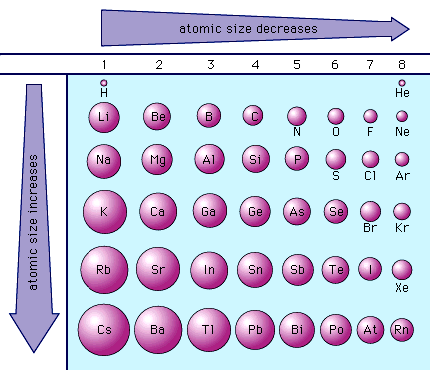
Why does atomic radius DECREASE going ACROSS a period?
An increase in the nuclear charge (number of protons)
No change in the number of shells, hence the screening effect of completed shells remains the same.
The outer electrons are therefore held more closely to the nucleus as the positive nucleus ‘pulls’ the electrons in towards itself which leads to a smaller atomic radius
Why does atomic radius INCREASE going DOWN a group?
An increase in the number of shells
The screening effect of electrons in the full inner shells blocks out some of the ‘pull’ that the nucleus has on the outer electrons.
The outer electrons are further away from the nucleus, so they are less closely held, which leads to a larger atomic radius.
Electronegativity
The relative power of attraction an atom of an element has for the shared pair of electons in a covalent bond
Electronegativity difference between two atoms in an IONIC BOND
Greater or equal to 1.7
Electronegativity difference between two atoms in an POLAR COVALENT BOND
Less then 1.7
Electronegativity difference between two atoms in an SLIGHTLY POLAR COVALENT BOND
Greater than 0, less than 0.5
Electronegativity difference between two atoms in a PURE COVALENT BOND
Equal to 0
Trends in the periodic table in electronegativity values
increase in electronegativity going across a period
Decrease in electronegativity going down a group
Why does electronegativity values INCREASE going ACROSS a period?
an increase in nuclear charge (number of protons increases)
leading to a decrease in atomic radius
With a small atomic radius and a relatively large nuclear charge, the atom has a great attraction for electrons.
Why does electronegativity values DECREASE going DOWN a group?
The addition of extra shells making the atomic radius larger.
The increased screening effect of inner completed shells on outer electrons.
With a large radius the nucleus finds it more difficult to attract electrons.
Cations
When an atom loses electrons, it becomes a positive ion (cation). The number of protons (+) remains the same, but the number of electrons (-) decreases; hence, we get an overall positive charge.
paw-sitive
Anions
When an atom gains electrons, it becomes a negative ion (anion). The number of protons (+) remains the same, but the number of electrons (-) increases; hence, we get an overall negative charge.
Intermolecular
Within one molecule
Intramolecular
Between two or more molecules
Ionic Bond
An ionic bond is formed due to the electrostatic attraction between oppositely charged ions caused by the complete transfer of electrons from one atom to another.
Particles are IONS
Usually between metal (left) and non-metal (right)
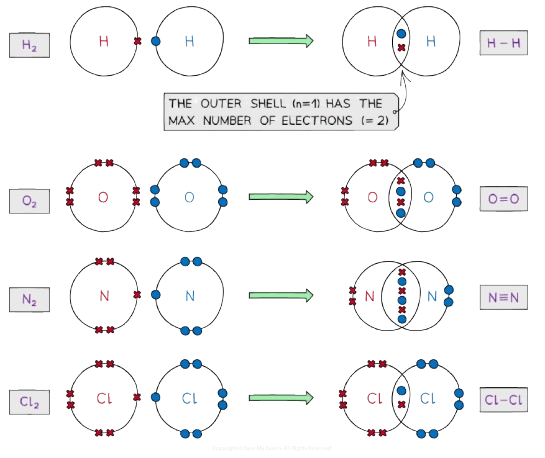
Dot and Cross diagrams
Crystalline stucture of Ionic Compounds
Each ion exerts its charge in all directions around itself and so attracts many of the opposite charged ions to itself.
No molecules are present – no ion belongs specifically to any other ion but to all ions surrounding it
Ionic compounds are made up of an orderly arrangement of oppositely charged ions held together by electrostatic forces. This arrangement give rise to a crystalline structure called a lattice.
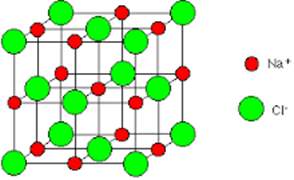
Why are ionic compounds crystalline?
Because they are made up of an orderly arrangement of oppositely charged ions which give rise to a lattice structure.
Why are ionic compounds solid?
There are extremely strong attractions between the oppositely charged ions which hold the ions tightly together giving a solid structure.
Why do ionic compounds have high boiling points/ melting points?
The extremely strong attractions between the oppositely charged ions require large amounts of energy to break, hence ionic compounds have high b.p. and m.p.
General properties of ionic compounds