FSM - Niche tips
 Call Kai
 Learn
Learn Practice Test
 Spaced Repetition
 Match
Match Flashcards
 Knowt Play
1/8

There's no tags or description
Looks like no tags are added yet.
Name | Mastery | Learn | Test | Matching | Spaced | Call with Kai |
|---|
No analytics yet
Send a link to your students to track their progress
9 Terms
Explain why a cubic graph will always have a point of inflection, but a quartic graph, for example, may not.
For a cubic, f''(x) is linear and hence f''(x) = 0 always has a solution. For a quartic, f''(x) is quadratic and hence f''(x) = 0 may not have real solutions.
When is a graph a local maximum and a local minimum?
When the second derivative of a turning/stationary point is:
Negative - Local maximum
Positive - Local Minimum
Given that f is continuous at every value in its domain, justify why f has at
least one root
f(min domain) = ans 1
f(max domain) = ans 2
since f(min) (> or <) 0 ; f(max) (> or <) 0 and f is continuous on (domain)
Therefore f must cross the x axis at least once
Therefore there is at least one root on (domain)
When should you worry in a Newton-Rapson question?
When your x values keep diverging, NOT when x1 is far off from x0 (in 2019 the starting value was 1, the first iteration was 5,045… and the final intercept value was 3,23903.)
The area between the curve y = x2 - 4x + 8 and the x-axis is to be approximated using a series of rectangles of width 1 unit. Explain why the answer will be more accurate on the interval [–1; 3] than on the interval [–1; 2].
The turning point of the graph is (2; 4). At the turning point, the rectangles change from under-approximating to over-approximating so the error cancels out to some extent.
What is the point of LIATE?
Decide which type of function you will differentiating and which function you will be integrating in integration by parts
Differentiate
L - Logs
I - Inverse trig (irrelevant in matric)
A - Algebraic
T - Trig
E - Exponential
Integrate
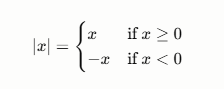
Definition of an absolute value function
Removable discontinuity
(hole)
The limit exists but either f(a) is undefined or f(a) ≠ the limit. Looks like a hole in the graph. Called "removable" because you could redefine f(a) to fill the hole and make it continuous. (both the value of f(x) approaching from both sides are = )
Jump discontinuity
The left and right limits both exist but are not equal. Common in piecewise functions. The graph literally jumps at that point. (lim f(x) coming from one side is not equal to the lim f(x) from the other side)