International financial spillovers
 Call Kai
 Learn
Learn Practice Test
 Spaced Repetition
 Match
Match Flashcards
 Knowt Play
1/16

There's no tags or description
Looks like no tags are added yet.
Name | Mastery | Learn | Test | Matching | Spaced | Call with Kai |
|---|
No analytics yet
Send a link to your students to track their progress
17 Terms
Taper-Tantrum 2013 overview
In May 2013, Fed chairman first raised possibility of reducing its large scale asset purchase programme (QE)
The timing of this surprised markets
shifted investor expectations of MP & QE
Stress lasted for a few months
Affected other markets including EMEs
Taper-Tantrum 2013 - Effects on EMEs
US interest rates rose sharply + treasury yields spiked (1.5% → 3%)
Investors withdrew K from EMEs - Broad-based sell off of EME assets to move to invest in US
Bond yields rose as bond p fell
Stock markets fell
Heterogenous effect
Why was US using QE before TT 2013
During GFC, the Fed reduced its target for short-term interest rates to virtually zero.
No scope to use conventional MP → CB turned to unconventional MP (QE)
Between 2008 and 2012, the Fed initiated 3 aggressive rounds of QE, expanding balance sheet from under $1 trillion → $3 trillion prior to TT. By using QE, the Fed significantly reduced the available supply of these safe assets. This bid up asset prices and compressed term premiums, which successfully forced down long-term yields
Reasons for heterogeneous impact on EMEs
Macroeconomic Fundamentals (MFs)
CA / GDP + R / GDP + Debt / GDP + Inflation
Policy
ER regime + inflation targets
Financial market structure
Capitalization of domestic equity market as a share of GDP + level of foreign investor participation
Amount of K flowing in prior to TT
More in - more out hypothesis
Ahmed et al. (2017) - OV
Focus on MF and how they explain heterogeneity
Also looks at other severe EME-wide financial stress since 1990s
Mexico crisis
Asian Crisi
GFC
35 EMEs
Ahmed et al. (2017) - Regression

Combines all of TT into 1 ‘episode’
Financial variables:
ER depreciation + Depreciation pressure index (includes use of R to mitigate) + change in local currency bond yields + EMBI spread (difference between EME & developed interest rate) + stock market index changes
Xi, j - Set of explanatory var (j) specific to country i
includes MF measured in yr prior to onset of stress event
Ahmed et al. (2017) - Hetero performance
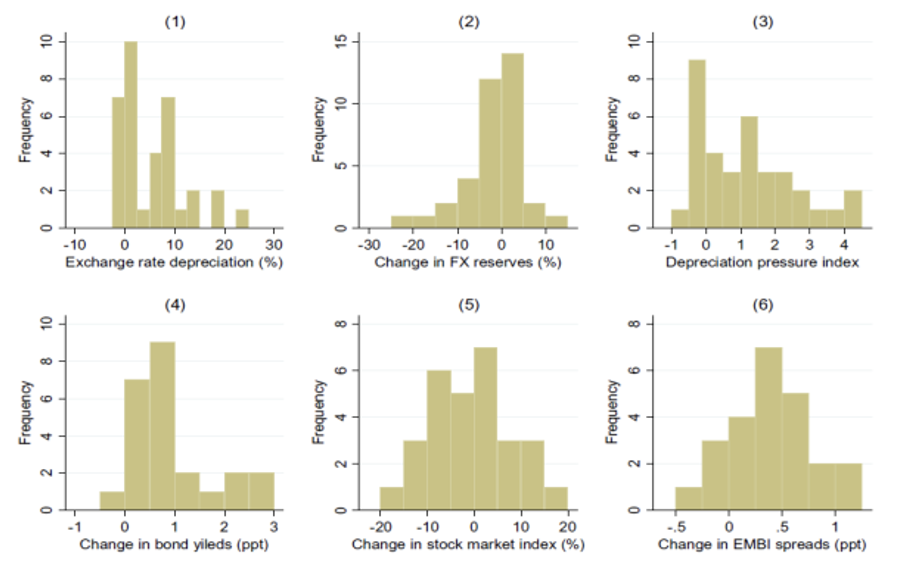
Very heterogenous effects across both countries and variables
Ahmed et al. (2017) - Univariate regression
Doesnt control for anything
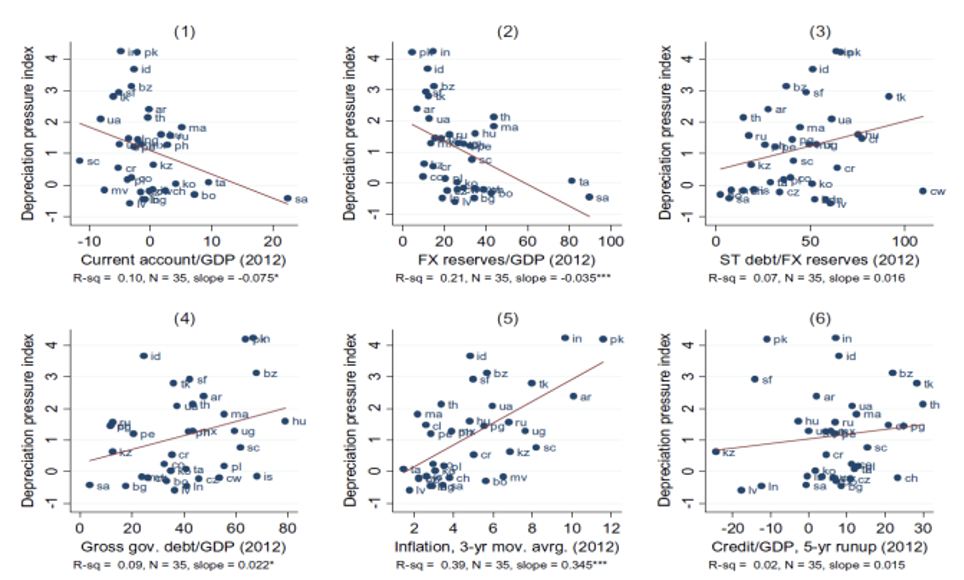
F reserves + CA / GDP + Debt / GDP + Inflation sig
Ahmed et al. (2017) - Multivariate regression results
Variables describing strength of MF matter (sig)
MF on the whole play a key role in explaining heterogeneity of financial performance in EMEs
even when controlling for other factors
Some evidence that more in - more out var also matter
High K inflows pre crisis
Greater ER appreciation prior
Mishra et al. (2014) - OV
Examines the role of macro fundamentals and other factors in the impact of tapering announcements on EMEs’ financial variables using event study approach
Considering ER (against US $), government bond yields, and equity prices
Macro fundamentals cover inflation, fiscal balance/GDP, CA/GDP, and Reserves/GDP
Other factors include financial depth variables (such as stock market capitalization/GDP and bank credit/GDP), EME growth prospects, China’s growth etc.
21 EMEs
Mishra et al. (2014) - Conjecture
Countries with weaker fundamentals are harder hit
Larger ER depreciation
Higher increase in bond yields
Larger fall in equity prices
Mishra et al. (2014) - Event study approach
Use 2-day window around FOMC meetings and release on minutes
Jan 2013 → Jan 2014 period
narrow window reduces possibility that ER or other dependent variables are affected by other factors
Use 2-day change in financial variables as dependent variable
Examine financial market reactions to US MP events considering country characteristics (CC)
CC includes MF
identify negative events from set of 17 possible times
Events associated with ER depreciation + yields increase + equity price falls
Then study which CC influences market reaction
By interacting CC with event dummies
Mishra et al. (2014) - RESULTS
CC matter for market reaction
Strong relevance of MF
E.g. when dependent var is two-day change in ER → Countries with stronger MF (e.g., higher current account balances) had lower depreciation
Countries with deeper financial markets underwent smaller ER depreciation
Similar results to Ahmed et al. (2017)
Covid 19 & portfolio flows in EMEs - OV
C19 created huge volatility in financial markets in EMEs
Sharp unprecedented reversal of portfolio flows
Equity & debt securities
IMF 2020 - data
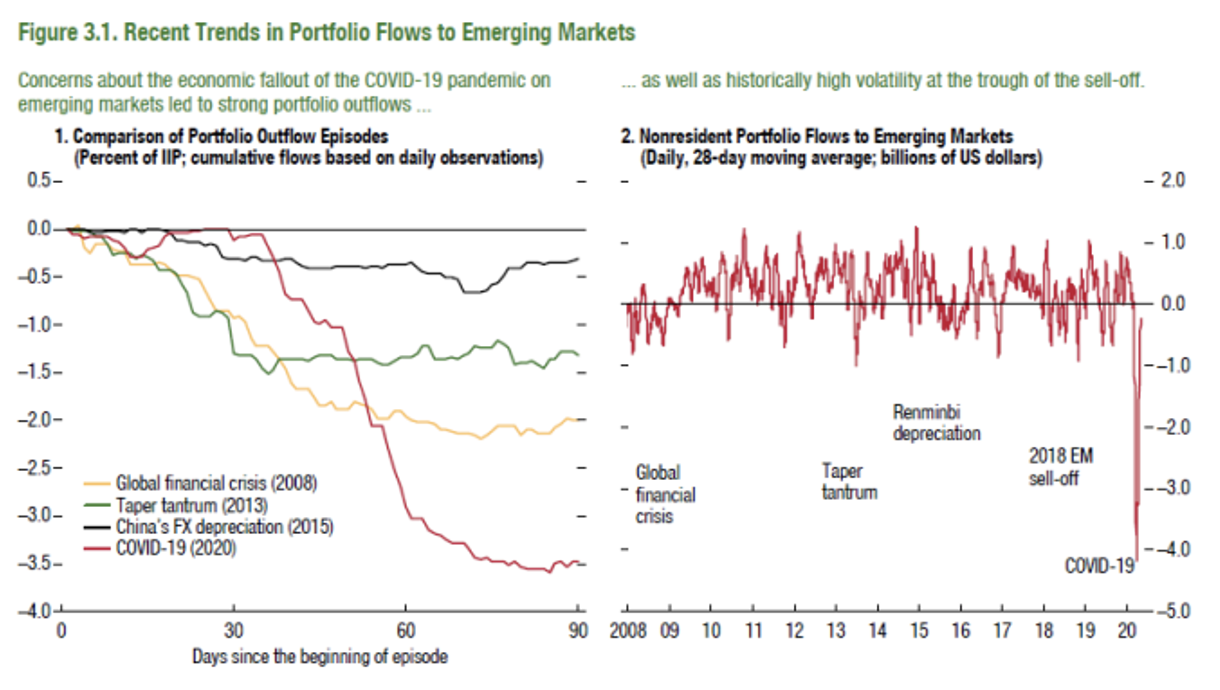
Very high onset of K returning to domestic markets
more than TT or GFC
F investors portfolio flows into EMEs sharply reversed
BUT not sustained
Hofmann et al. (2020) - data
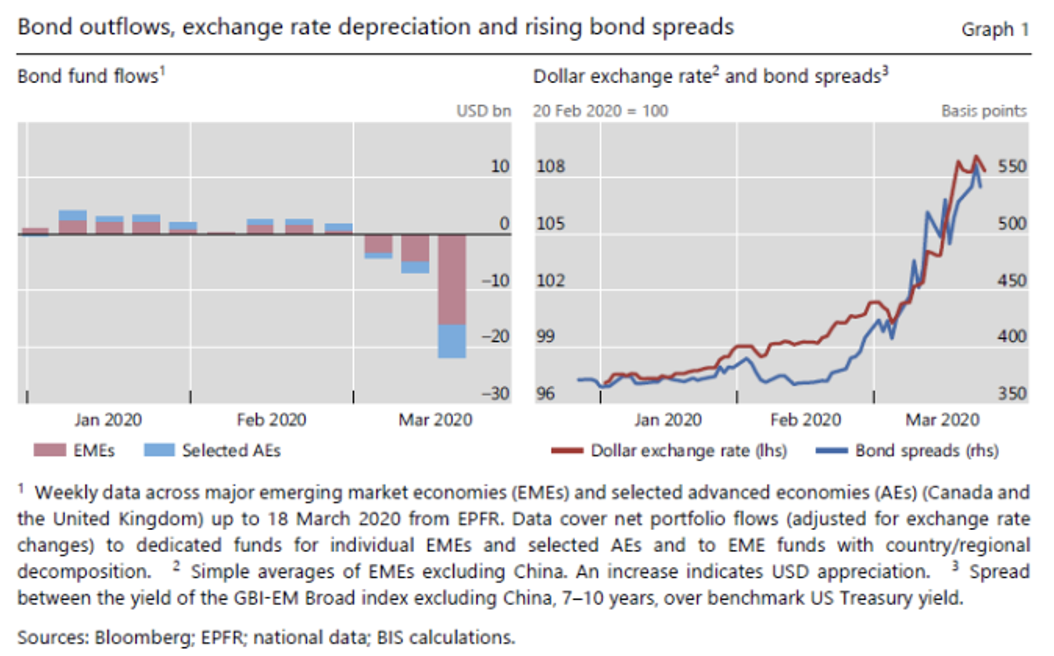
Sharp reduction of K into EME bonds (more than in advanced economies)
Large depreciation of EME currency
Sharp spike in bond spread - investors demanded significantly higher interest rates to hold riskier EME debt during this crisis period
IMF 2020 - results
Large heterogeneity in effects between EMEs
Stronger domestic fundamentals helped mitigate portfolio outflows
although dont always lead to surges in inflows
Greater F investor participation in local currency bond markets may create trade-offs
It can help reduce borrowing costs BUT High Demand leads to price increase and interest rates down
It may also increase price volatility BUT F investors very sensitive to global factors