Eco all
 Call Kai
 Learn
Learn Practice Test
 Spaced Repetition
 Match
Match Flashcards
 Knowt Play
1/172

There's no tags or description
Looks like no tags are added yet.
Name | Mastery | Learn | Test | Matching | Spaced | Call with Kai |
|---|
No analytics yet
Send a link to your students to track their progress
173 Terms
Factors Affecting demand for factors of production
Demand for product produced
Cost of factors of production
Quantity and availability of factors of production
Quality of factors of production
Demand for product produced effect on demand of FOP
Demand of FOP is derived demand which means the demand for FOP depends on the demand for goods and services that they will produce
Cost of FOP
Higher the cost of FOP, the lower the demand tends to be as they will switch to cheaper alternatives cause the firm will make less profit
Quantity and availability of FOP
Greater availability → lower cost → higher demand
Quality of FOP
higher productivity → higher demand
Labor intensive production
High proportion of labor, more than capital
Advantages of Labor intensive
Increase the demand for labor, reducing unemployment, increasing income, improving standards of living
Reduces Unemployment , reduces government spending on unemployment benefits, government have more to spend on health care and education
Labour may be more flexible than machines and able to change skills so are more mobile and able to respond to changes in consumer demand
Disadvantages of Labour intensive
Labour may cost more so increasing total cost
Unreliable so reducing efficiency and productivity increasing average cost reducing supply increasing price and reducing quality
May be protected by trade unions more disruption, delaying production process, won’t be able to meet consumer demand on time
More breaks reducing productivity and efficiency
Less cost effective reducing international competitiveness, reducing exports
Capital Intensive production
Company employs higher proportion of capital in the production process than labour employed
Factors which influence the demand for capital goods
Price of Capital goods
Rise in price of other factors of production like labour
Cut in interest rate
Cut in corporate taxes
Rising disposable income
Advance in technology
Confidence of Firms
Price of capital goods effect on demand for capital goods
If the price of capital goods increase, average cost will increase, so demand for capital goods will decrease
Rise in price of other factors of production like labour effect on demand for capital goods
Increase the demand in capital goods as they are a substitute for capital
Cut in interest rate effect on demand for capital goods
Increase consumption which will encourage firms to expand
Lower cost of borrowing so firms have to pay less interest on the capital increasing firms which can afford capital
Cut in corporate taxes effect on demand for capital goods
More profit to reinvest into the company, increase in capital’s demand
Rising disposable income effect on demand for capital goods
Encourage firms to invest expecting to sell higher output in the future
Advances in technology effect on demand for capital goods
Increase productivity of capital goods so more likely to invest more
Firm’s confidence effect on demand for capital goods
Optimistic about future and expect sales to rise, will invest more so demand for capital will rise
Factors that effect Firm’s choice of capital or labour instensive production
Cost of labour compared to cost of Capital
Types and goods and services provided by the business
Type of organization
Availability of FOP
Size of market
Cost of labour compared to cost of capital effect on type of FOP’s used
Firms will tend to choose capital intensive methods if cost of labour are relatively high
Types of goods and services provided effect on type of FOP;s used
Derived demand, depends on type of goods and services provided
Type of organisation
Smaller organisation → less funds to invest in capital goods → have to choose labour
MNCs and bigger firms → more funds to invest in capital goods → tend to get capital goods
Availability of FOP effect on type of FOP;s used
If country has large workforce available , MNC’s choose to expand there if they are labour intensive as they will be higher skills and qualifications of labour so higher productivity and efficiency reducing average cost
If a country has lower workforce, Firms will have to rely more on capital goods if they can afford it
Size of market effect on type of FOP;s used
Capital goods are used in mass market products, labour used for personalized experiences
Production
Process where firm combines scarce resources of land, labour and capital to make goods and services to satisfy consumer demand
Productivity
Output per worker, measures efficiency in the use of factors of input in the production process,
Importance of higher productivity for an economy
Economies of scale, as higher levels of output help reduce unit costs, reducing prices
Higher profits, used to reinvest in the business and expand
Higher wages, firms can afford to pay higher wages to their workers because of cost saving and higher profits cause of higher productivity, attracting better workers with more skills and qualifications who are even more productive
Improved competitiveness, firm can compete in a global stage
Economic growth, economy moves from inside the PPC to on it, due to higher efficiency, causing economic growth, causing an outward shift of the PPC, raising employment, improving living standards. Higher wages and efficiency also means the government collects more tax revenue which they can use on education and healthcare
How to increase the productivity of labor
Increase wages, increasing motivation of workers
Improving working conditions so reducing stress
Providing training so increasing workers skill so increasing efficiency and productivity
Higher education will increase skills and qualifications of labour so increasing the quality of labour so increasing efficiency and productivity
Buying more capital goods so workers will be working with better equipment
Subsidies worker’s health care so making them fitter and healthier to work
Characteristics of perfect competition
Many buyers and sellers none of which have significant market power to influence the demand or supply of the market
Firms are price takers, firms aren’t determined by firms but by market forces of supply and demand#
No barriers to entry, freedom for new firms to enter or exit the market
Homogenous products, products sold are identical
Both buyers and sellers will have perfect knowledge about the products and prices being charged by the competitors
Each firm only produces small percentage of the overall production in the industry, each firm has a tiny share of the total market supply
Performance of competitive firms
Businesses will charge the same price and price will be the minimum they could charge without going out of the business
Price equal to lowest average cost of producing a good
No firm will risking charging more than the market price as they would make no sales as consumers would switch to cheaper alternative
Firms constantly seeking to gain competitive advantage by improving their products and lowering their price through being more productive
Firms only earn enough profit to keep producing the product
In the short term they may earn more or less than this level of profit which is referred to as normal profit
If demand rises firms will make supernormal or abnormal profit, profit which is above that needed to keep a firm in the market in the long term and attracts new firms to the industry
Their entry of new firms will increase the supply of firms so lowering the price and profits return to normal level
High competition, high efficiency and productivity, low average cost, high supply, low price, high quality, high variety of goods and services, high consumer choices, high standards of livings
High flexibility , firms respond quickly to changes in consumer demand
Monopoly Characteristics
One seller and many buyers
Single supplier of the product in a given market, because of barriers of entry which result in a lack of substitutes and firm has full market share
Price marker, monopolies have significant market power as they control the market supply, charging higher prices while producing lower output
Imperfect Knowledge, customers and rivals have imperfect knowledge cause of monopolists ability to protect its trade secrets protecting monopolies position
Higher barriers to entry,
Barriers of entry
Legal barriers government makes it illegal for other firms to enter the market or patent/ copyright
Scale of Production, economies of scale make low average cost making it hard for other firms to enter the industry as they will be unable to compete with the monopoly
Expensive to set up, large capital needed
Creation of brand loyalty, increasing quality of product and advertising it well so customers will be loyal to the brand
Disadvantages of Monopoly
Inefficient use use of resources due to lack of competition
For profit maximation monopolists restrict output of product and charge higher prices
Fail to respond to changes in consumers tastes and develop new products knowing consumers cant switch to rival firms
High barrier to prevent new firms from entering the market limiting the competition and ensures monopolies charge higher prices
Demand is price inelastic and there are no substitutes, so monopolies can charge higher prices to maximize profit from the low PED and less consumer choices
Lower product quality as there is no incentive for innovation cause no competition.
May Decrease quality to decrease production cost and increase profit margins.
Diseconomies of Scale
Advantages of monopolies
Economies of scale
Higher profit, able to spend on RnD increasing innovation increasing quality
Lower consumer choice will reduce confusion for consumer so less time is wasted looking for better alternative so more leisure time increasing standards of living
If its a natural economy, government may charge lower prices for essential goods
Factors affecting where someone works
Wage Factors
Non wage factors
Wage factors
Wages, level of salary pay or wage for each job attracts workers as the higher the wage rate on offer, the more a person would want a job
Overtime pay, paid to workers who work more than standard working week
Bonus, extra payment given during the year to workers who produce above standard amount
Commission, percentage of the value of the products or services sold
Non wage factors
Job satisfaction,
Type of work
Working condition
Working Hours
Length of holidays
Fringe benefits
Job security
Career prospects
Size of firm
Job satisfaction explained
Someone may enjoy a challenging occupation not boring and workers enjoy what they are doing
Type of work explained
Most people would rather do non manual work rather than manual work as it is less tiring and provides higher pay
Working conditions
Most people prefer to work in a pleasant and safe surrounding with less stress and pressure with friendly colleagues and enjoying regular breaks
Working hours
People tend to avoid jobs which involve very long working hours or unsociable hours
Length of holidays
People prefer regular and long holidays to take a break from their job
Fringe benefits
Extra benefits provided to workers by their employers like subsidized meals, car, laptop, pensions, pensions education for children
Job security
Reduces risk of being redundant and provides continuity and certainty for income which occurs in an occupation which has high demand for the product or long term contracts
Career prospects
Individuals accept low wages at the start of their careers thinking there is a good chance that they will gain promotion to a well paid and interested post
Size of firms
Some people would rather work in small firms to have direct contact with the employer, others would like to work at a big firm as it offers better career prospects
Any question about high pay
Higher education, which will increase the skills and qualifications of workers increasing quality of labour, which will increase worker’s productivity which will increase the demand for labour
Low supply of labour as they are taking a long time to get educated so higher pay
The workers are part of a trade union which has strong bargaining power so power to increase workers pay
Having more responsibility so workers will be compensated with high pay
Government setting minimum wage
Question about low pay
Lower education, lowering the skills and qualifications of workers, lowering quality of labour, lower productivity of labour, increasing demand for labour.
Higher supply of labour due to higher immigration so lower pay
Part of a trade union which has low bargaining power to increase worker’s pay
Demand and supply of labour diagram
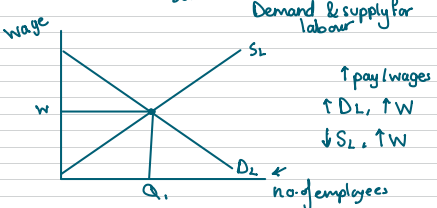
Factors which influence the demand for labour
Demand for product
Price of capital
Productivity of labour
Aggregate Demand in the economy
Demand for product effect on demand for labour
Labour demand is derived demand so labour is demanded for the goods and services it produces not for labour itself so higher demand for products mean higher demand for labour
Price in capital effect on labour
Labour can substitute capital in the production process so if capital is more expensive, firms will switch to the cheaper alternative which is labour
Productivity of labour
Demand for labour increases as productivity increases
Aggregate demand in the economy
During period of economic growth, demand for goods and services increase so higher demand for labour due to labour being derived demand
Factors on supply of labour
The size of the labour force
Length of Qualifications and training required to do the job
Working hours and Risk
Wage or Non wage benefits
Size of labour force effect on demand
If there are Fewer workers firms will find it difficult to find workers
Length of Qualifications and training required to do the job
Longer time means less workers available to do the job who are actually qualified
Working hours or risk
Higher risks and working hours mean less people willing to do the job
Wages or non wage factors
Encourage people to switch from one job to another
Trade unions
Group of workers who exist to protect the rights of workers and improve their pay and working conditions, workers join by paying weekly, monthly, or yearly fees.
Role of trade unions
Strong collective bargaining power as they negotiate on behalf of the workers to increase wages and improve working conditions and reduce working hours
Protect and improve workers rights through industrial actions like strikes
Persuade the government to pass legislation in favor of workers such as fixing the national minimum wage
Providing financial and legal support to workers who may have been unfairly dismissed
Ensuring equipment is safe to use
Provide information about a range of issues to their members like pensions
Help with education and training for workers as well as increasing the demand for the products produced by labour to increase the demand for labour
Basis of wage claims
The worker is working hard and being more productive
Increased profit so they are able to afford paying higher wages as the workers are likely to have contributes
Comparability argument: worker should receive higher pay to keep their pay in line with similar workers
Increased cost of living to maintain purchasing power and real income
Factors affecting the strength of a trade union
Economic activity,
Number of members
Level of skill
Consistent Demand for product
Government legislation
Economic activity effect on trade union strength
If output and input in a country are increasing, most industries are doing well and so should be able to improve the pay and conditions of workers and keep its workers, firms more likely to agree to requests of higher pay and working conditions
Members effect on trade union strength
More funds to fund its activities
Skill effect on trade union strength
Difficult to replace skilled workers with other skilled ones, and expensive to train unskilled workers
Consistent demand for product effect on trade union strength
Goods which are essential to consumers so strong position to bargain
Favorable Government legislation
Union will be in a stronger position if laws allow trade unions to take industrial actions
Industrial action
Workers disrupt production to put pressure on employers to agree to their demand
Industrial actions include
Overtime ban: refusing to work longer than contracted hours
Strikes: refusing to work
Work to rule: only undertaking tasks required in their contract
Discrimination effect on pay
Group of workers treated unfavorably in terms of employment, wage rate, training received, promotional opportunities lowering demand for them lowering pay
National minimum wage
Lowest amount a firm can pay its workers as set by the government
Effects of national minimum wage
Can cause unemployment since the supply of workers at this rate exceeds the demand for labour
Can raise wage rate and employment as higher wage rate will increase workers motivation and productivity.
Higher demand so increased demand for labour
How can government change wage rate?
Raising national minimum wages which will increase the pay of low paid worker
Improve education which will raise the wages of skilled workers as the demand for them will increase, MNCS may also be attracted increasing job opportunities
Government could affect immigration and make it easier for foreign people to work, increasing the supply for labour, which will reduce wages
Anti discrimination laws which will increase career prospects of and wages of disadvantaged people
Changes in earning overtime in working life (7)
Level of education
Years of experience, inexperienced workers earn less
Time spent at the firm, increase as more time is spent
Some people may choose to take on more responsibility for more pay
Some people may switch employers for more pay
After workers reach the peak of their career, their salaries likely remain constant
After retirement, earnings fall and they are dependent on pensions
Why do different jobs have different pay?
Abilities and Qualifications
Risk involved
Unsociable hours
Lack of info about other jobs and wages
Labour immobility
Fringe benefits
Abilities and qualifications explained wage rate
Jobs require more skills and qualifications mean higher pay
Risk explained wage rate
Paid more for the risk they undertake
Unsociable hours explained wage rate
Paid more for night shifts and other unsociable hours
Lack of info explained wage rate
Work for less wage cause they don’t know other jobs with higher wages
Labour immobility
How easily workers can switch between jobs, high labour immobility means workers can easily switch to other high paying jobs, labour immobility means they cant easily switch cause they dont have the skills and oppurtunitites to move to high paying jobs
Fringe benefits effect on wage rate
Jobs which offer high fringe rate often have low wages
Why might skilled workers earn more than unskilled?
Shorter supply as they need training and qualifications
Inelastic supply and demand
More productive
Stronger bargaining power
Likely to work in tertiary sector
May be more mobile
Why skilled workers may earn less?
Less experience and less promoted position
Declining industries
May place more importance on non-wage factors
Skilled workers in poor countries may have less income than unskilled workers in rich countries
Difference in pay between public and private sector
Public sector usually earn more than private sector, but sometimes private sector earn more cause public sector can be compensated with job security and pension prospects
Male vs Female paygap
Males usually paid higher as women tend to go for jobs with less skill required then men jobs
Women take career breaks to raise children which cause less experience and career prospects
More women work part time than full time
Discrimination
Different sectors pay gap
Primary earn less cause they produce low value output and tend to require less skills and qualification
As the economy develops first the demand for secondary sector workers increase then tertiary sector workers
Determinants of elasticity of labour
Proportion of labour in total cost
Ease in which labour can be substituted with capital
Elasticity of demand for the product produced
Time period
Proportion of labour in total cost effect on labour elasticity
If labour contributes to a large percentage of total costs, firms would notice even a small change more as it would cost a large change costs so elastic demand
Ease of which machines can be substituted with capital effect on elasticity of labour
If it easier to replace workers with machines then demand would be elastic
Elasticity of demand for product produced effect on elasticity of labour
the more elastic the demand of the product, the more the fall in demand for it if the price of it increases due to increased cost of production so demand for labour will fall, making its demand elastic
Time period effect on elasticity of labour explained
Demand for labour is more inelastic in the short term as firms have less of a time period to alter their methods of production
Detriments of elasticity of supply of labour
Qualifications and skills required
Length of training period
Level of employment
Mobility of labour
Degree of vocation
Time period
Qualifications and skills required affect on elasticity of supply of labour
More qualifications and skills needed, the more inelastic the supply will be as it will take years to take the qualification needed
Length of training period affect on elasticity of supply of labour
Inelastic as takes longer to finish the training
Level of employment affect on elasticity of supply of labour
If most of the labour force are already employed, the supply of labour for any occupation will be inelastic and employers will have to raise price significantly to attract more workers and encourage the workers employed in other occupations to switch their jobs
The mobility of labour affect on elasticity of supply of labour
The easier it is to switch jobs, the easier it will be for the employer to recruit more workers when increasing the wage rate as the supply will be elastic
Degree of vocation affect on elasticity of supply of labour
The stronger the attachment to their jobs the more inelastic the supply of labour will be
Time period affect on elasticity of supply of labour
Supply of labour becomes more elastic over time for workers to notice changes in wages and gain any qualifications and undertake any training needed for the new job
Geographical immobility
Difficult to move from one country to another
Occupational Immobility
Difficult to switch from one job to another