Caries Classification and Associated Follow-ups
 View linked note
 Call Kai
 Learn
Learn Practice Test
 Spaced Repetition
 Match
Match Flashcards
 Knowt Play
1/40

Earn XP
Description and Tags
These flashcards cover essential vocabulary and definitions related to caries classification, diagnosis, and treatment.
Name | Mastery | Learn | Test | Matching | Spaced | Call with Kai |
|---|
No analytics yet
Send a link to your students to track their progress
41 Terms
Caries Staging
The process of classifying caries based on severity and extent.
Infected Dentin
Dentin that has been impacted by caries and is subject to decay.
ICDAS
International Caries Detection and Assessment System, used for caries classification.
Cervical Burnout
An artifact seen in radiographs, characterized by diffuse radiolucency between the cementoenamel junction and alveolar crest.
Mach Band Effect
A visual illusion caused by contrast enhancement that makes edges appear darker, commonly seen near enamel/dentin interfaces.
Initial Caries
The earliest clinically detectable lesion compatible with mild demineralization, typically limited to enamel.
Moderate Caries
Visible signs of enamel breakdown or moderate demineralization of dentin.
Advanced Caries
Fully cavitated enamel with exposed dentin; dentinal lesions are deeply demineralized.
Severe Caries
Extends through enamel, dentin, and more than half the distance toward the pulp.
Radiopaque Materials
Materials that appear white or light gray on dental X-rays due to high density, like amalgam and metal crowns.
Radiolucent Materials
Materials that appear darker on X-rays because they allow more X-rays to pass through, such as some resins.
Caries Risk Factors
Factors that increase the likelihood of developing dental caries.
Post and Core
Dental restoration where a post replaces missing tooth structure in the canal, and a crown is placed on top.
Gutta Percha
A rubber-like material used to fill root canals after endodontic therapy.
Caries Management System (ICCMS)
A risk-based caries management system used to classify and manage caries effectively.
H1
A notation likely used to classify specific findings in dental imaging.
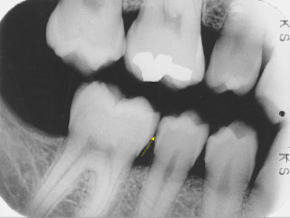
E1
outer half of enamel
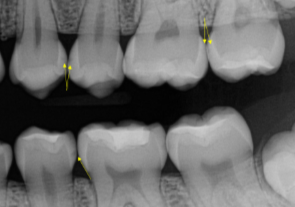
E2
inner half of enamel with or without dentin involvement
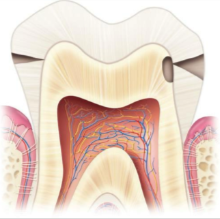
D1
outer 1/3 of dentin
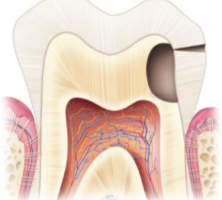
D2
reaches middle 1/3 of dentin
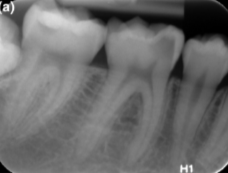
D3
reaches inner 1/3 of dentin
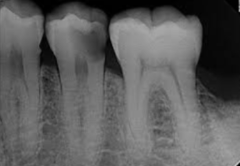
excessive gross decay
reaches pulp
images are…
an underestimation of the real decay
cervical burnout is mistaken for decay why?
in radiographs due to the loss of tooth structure at the cervical area, creating a shadow effect that resembles caries.
Mach band effect is confused with caries why?
It occurs in radiographs where adjacent areas of differing densities create an optical illusion, leading to misinterpretation of the boundaries of carious lesions.
get rid of mach band effect
adjust viewing conditions
compare with other angles
analyze lesion borders
use clinical examination
cross check with risk factors
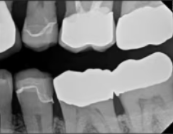
13
ceramic restoration most likely milled in office
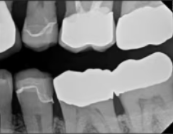
14
PFM and gutta percha
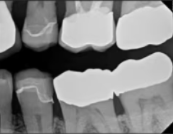
15, 18 ,19
gold crowns with smooth contours and level of radiopacity
material density
highest to lowest
Zirconia
gold
PFM
Stainless Steel
Emax/porcelain
occlusal class ! amalgam
stays between marginal ridges NO interproximal
Class II Amalgam fillings
are cavity restorations that involve the proximal surfaces of posterior teeth, requiring precision to maintain contact with adjacent teeth.
Think II surfaces mostly occlusal and interproximal
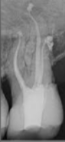
gutta percha and sealer
gutta percha is the rubber like filler material in the roots canal and the sealer is part of the little puffs
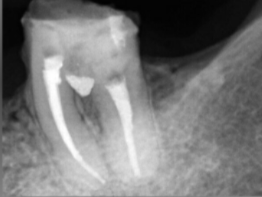
Mineral Trioxide Aggregate
biocompatible material used for dental pulp capping and root-end fillings, known for its sealing properties and ability to promote tissue regeneration.
filling material
used in restorative dentistry to repair cavities and restore tooth function. ranges in viscosity that affects radiopacity, high viscosity=radiolucency low viscosity=radiopaque
layering technique
using multiple steps and layers of different materials in a restoration
post and core
used when not enough crown in retained and a retention point needs to be made
dental implants
screwed in permanent restoration. can hold one crown or assist a bridge.
zygomatic implants
made when not enough bone is retained for a traditional implant and are anchored in the zygomatic bone to provide stability and support for prosthetic teeth.
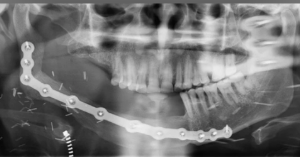
surgical plates, screws and vascular clips