Final partial exam for POLISCI
 Call Kai
 Learn
Learn Practice Test
 Spaced Repetition
 Match
Match Flashcards
 Knowt Play
1/53

There's no tags or description
Looks like no tags are added yet.
Name | Mastery | Learn | Test | Matching | Spaced | Call with Kai |
|---|
No analytics yet
Send a link to your students to track their progress
54 Terms
Activists
Voluntary contributors to the party
they are considered the minority group, while the median voter is considered the majority group.
The leader will focus more on the median voter instead of the activists since the activists already support the party/ leader.
Cadre Party
Party with low membership dominated by professional politicians.
Low membership
Party leaders dominate
Relatively advantageous for adopting policy proposals able to obtain broad electoral support
EXAMPLES: UK Conservative Party in 19th cen., Germany’s Free Democratic Party today.
Mass Party
Party with a broad membership with high internal participation
suffered the most from a trend in recent decades in the West: the decline in (fee-paying) party members.
EXAMPLE: most 20th cen Socialist/ Social Democratic parties (Socialist Party in France/ Germany’s Social-Democratic Party)
Militant Party
Party with low membership with high internal participation.
FEW MEMBERS but are VERY committed + actively mobilized.
EXAMPLE: Fascist parties like Italy, Communist parties like the Bolchevik Party in Russia, MOST GREEN PARTIES!
Endogenous Party
A party formed from INSIDE elections and assemblies.
Formed from within elections and assemblies, as collective candidacies and legislative coalitions
Which may become permanent organizations.
Exogenous Party
A party formed from outside existing institutions with the support of previously existing groups.
On the basis of new policy proposals on some issues
EXAMPLES: National Society of Pottery Workers, National Union of Agricultural Workers, National Union of Mineworkers.
Firm (or Cartel) Party
Party with low membership relying heavily on state resources + media.
Office Seeking
A politician’s motivation for running for office.
Oligarchy
Dominating professional politicians within a party
Policy Seeking
An activist’s or interest group’s motivation for supporting a party
Political Party
An organization to compete for power and provide public policy
Politicians
Candidates and officeholders making a living off politics
Vote Seeking
A politicians’ motivation for running for election.
Convergence
A strategy by which parties approach each other around the median voter’s position in the policy or ideology space.
Distance
Spatial representation of the difference between voters’ preferences and policy proposals/ “positions”
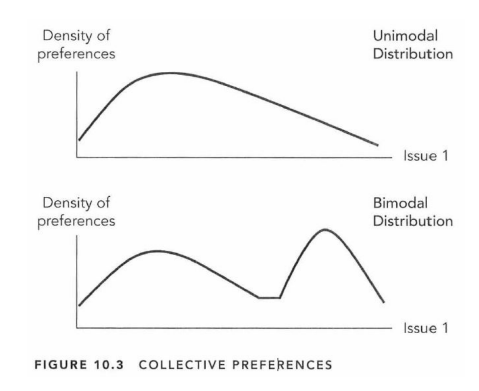
Distribution of preferences
A set of probabilities of having a voter at every ideal point.
Ideal Point
a voter’s preferred policy position
Incumbent advantage
asymmetry in electoral competition between the government and the opposition.
The incumbent party in gov can gain an advantage in electoral competition by either hiding or providing information on its record to obtain credibility.
The incumbents name is easily recognizable to the voters
More experience in the job
Median voter
the voter with fewer than half of voters’ ideal points on each side in the policy space.
Party identification
Voters’ motivation to vote for a party on past performance rather than current issues.
(retrospective voters)
Status quo
The existing policy, which is the usual reference for alternative proposals.
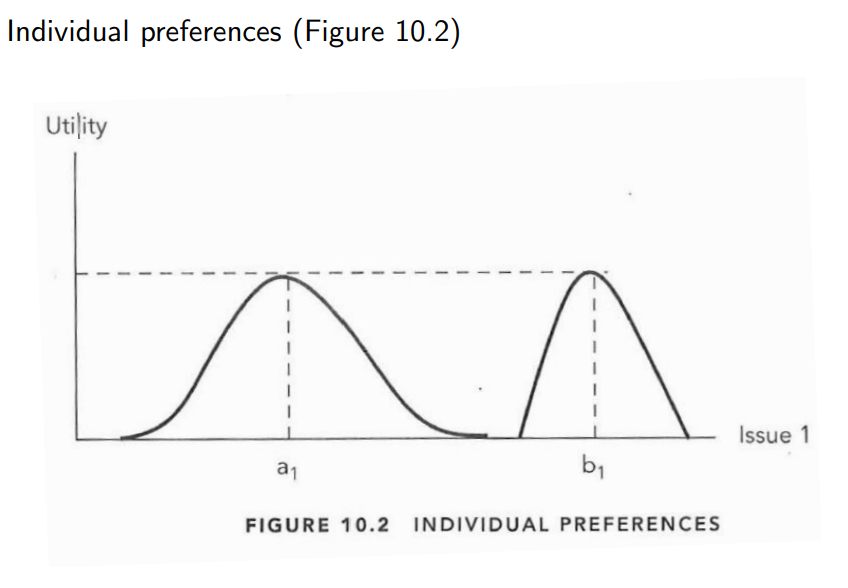
Voter’s curve of preference
On a single dimension, a single-peaked, symmetrical shape around the voter’s ideal point!
Single-peaked: you have ONE IDEAL POINT for a policy and ur utility (satisfaction) decreases as you move away from that point.
Symmetrical: ur utility decreases equally on either side as you move away from the ideal point
Fragmentation
# of political parties weighted by their sizes
the opposite of “concentration.”
Ideology
An encompassing simplification of a high # of issue policies.
A SYSTEM OF BELIEFS + VALUES
Why do we need ideologies?
Because words like “progressivism”, “conservativism”, “liberalism”, etc., synthesize the complexity of values and beliefs
They’re also easier to communicate
Reduce information costs
PROS/ CONS of Ideologies
PROS: There is a logic to systems of belief.
The same party cannot easily strongly advocate against global warming (left-wing) AND oppose gay marriage (right-wing)
CONS: We may agree with party X on issue 1, but with party Y on issue 2
Left-Right
Ideological representation of party policy positions on a spatial basis.
Multiparty system
A system in which multiple parties obtain seats and share government
One party RARELY wins over 50% of the votes/ seats, so coalition governments are common
The public agenda is broadened.
Party System
Profile of electoral competition based on the number of parties and their ideological distance.
Polarization
Relative distances between parties weighted by their sizes
Two-party system
A system in which only two parties compete for government.
One party wins and forms a government.
They’re RARE!
Tends to focus on a few issues in electoral competition
EXAMPLE: US (UK, Canada, Australia, all have two main parties, but multiple parties in Parliament!)
Absolute Majority
More than half the votes
50% + 1
Dependence on irrelevant alternatives
The winner depends on the candidates that don’t win
Usually, during the second round of the majority run-off
Majority runoff
Absolute majority in the first round. If nobody obtains it, the two most-voted-for candidates advance to round 2.
Other candidates still matter in round 2 bc the two remaining candidates need to win the vote of those who were eliminated in round 1.
How might we ensure that the winner obtains an absolute majorty?
MAJORITY RUNOFF!!
Which system is more likely to elect a president supported by the median voter? Plurality OR Majority runoff?
MAJORITY RUNOFF!!
It….
Guarantees that the winning candidate has over 50% (50% + 1) of the votes and thus the median voter IN the second round.
Prevents the elction of the least preferred candidate by design! (winner of the 2nd round is at least the lesser of the two evils)
Plurality/ Relative Majorty
The HIGHEST number of votes (even despite it not reaching 50%, short of a majority)
Representation
The election of people to act in the voters’ interests
Simple Majority
Just one more than half the votes
50% + 1
Super/ Qualified Majority
2/3, 3/4, etc…
some other threshold beyond 1/2
Unanimity Rule
The agreement of all voters is required.
In homogeneous communities w/ very few ppl, unanimity is commonly practiced!
Some large + heterogeneous communities/ organizations impose unanimity.
ACCEPTING NEW MEMBERS INTO NATO
ACCEPTING NEW MEMBERS INTO EU
PROS: Anyone can veto (block) a decision if they disagree
CONS: Can lead to paralysis + make governance slow + difficult.
Districting (Apportionment)
Distribution of seats among different electoral districts
Assembly size
Total number of seats in an assembly
Ballot
Form of voting to select parties and individual candidates
Magnitude
Number of seats to be elected in a district
Majority Rule
First past the post, or the winner takes all.
Micro-mega rule
Large parties prefer small districts (less competition)
Small parties prefer large districts (proportional representation)
Mixed electoral system
Some seats are elected by majority rule + others by proportional representation
Multi-seat district
A district with a magnitude larger than one
Proportional Representation
Each party receives a proportion of assembly seats that roughly corresponds to its proportion of votes.
EXAMPLE: if a party obtains 10% of votes, it also obtains roughly 10% of seats.
Its ONLY possible in multi-seat electoral districts.
Single-seat elections
A district with a magnitude equaling one.
What are the best ways to accommodate heterogeneous preferences + different interests under one set of political institutions?
Federalism
(Some) Decentralization of power that falls short of federalism
Coalition governments: govs supported by 2+ parties with somewhat different ideologies that are forced to compromise in order to reach a majority in the legislature that appoints the leader/ prime minister.
Large assemblies
Proportional representation
What characterizes assemblies?
Total # of seats (“assembly size”)
Larger communities/ countries have larger assemblies.
(More impractical bc its difficult to debate + negotiate efficiently in larger groups)
# of seats per district (“district magnitude”)
The electoral system/ formula:
Majority: US, UK, France, India
Proportional: Spain, Sweden
Mixed: Germany, Italy, Mexico, S. Africa
Ballot:
Personal Representation: US, UK, India
Party Representation: Spain, most Central + S. America
What does proportional representation encourage?
More parties to run bc they can get SOME seats, (whereas plurality rule it’s “either you win that one seat or not” so it concentrates the vote around two parties)
Voters can be given more choices
Minorities are more likely to be included in the assembly bc parties want their candidates to look like the district.