oat orgo unit 1
 Call Kai
 Learn
Learn Practice Test
 Spaced Repetition
 Match
Match Flashcards
 Knowt Play
1/70

Earn XP
Description and Tags
password unlocked TO ALL BITCOIN
Name | Mastery | Learn | Test | Matching | Spaced | Call with Kai |
|---|
No analytics yet
Send a link to your students to track their progress
71 Terms
molecular formula
shows the number of atoms in each part of the compound, but doesn’t indicate structure.
Example: C5H12 = pentane
condensed formula
Specifies order of attachment and distinguishes compound structure.
Example: CH3CH2CH2CH2CH3 = pentane
structural formula
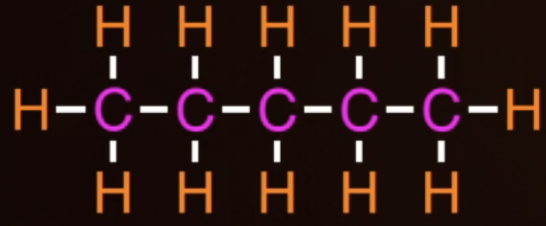
shows bonds between atoms (Lewis Structure)
image is Pentane structure
bond line notation
Better depiction, easier to compare large molecule structures
Vertex = carbon atom
Hydrogens = implied when bonded to carbon
Charged carbons form 3 bonds
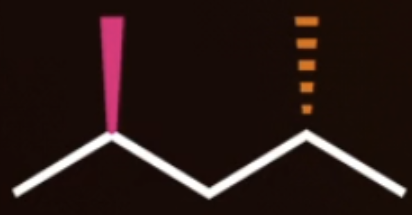
Wedge = coming out of page, dash = going into page
Functional groups - non carbon atoms indicated by element symbol
Heteroatom - any atom in an organic molecule that isn’t C or H
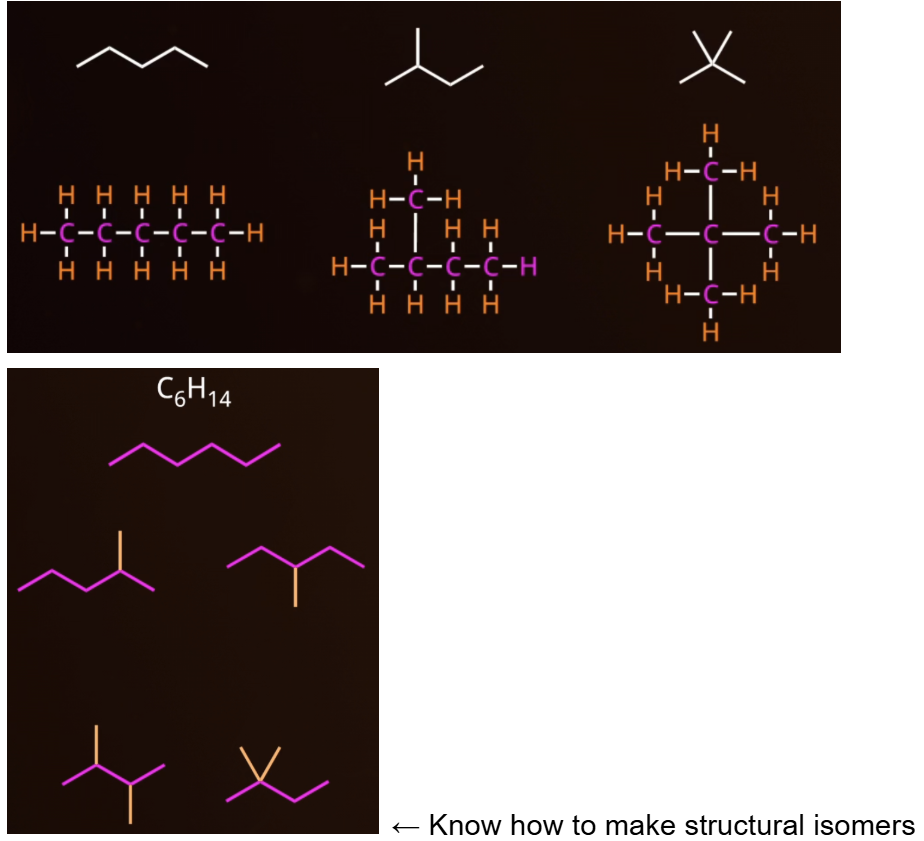
structural / constitutional isomers
same formula, different connectivity
degrees of unsaturation
sum of all pi bonds in an organic molecule (double/triple bonds, rings), which tells you how many hydrogens are absent compared to a structure with the same number of carbons and no pi bonds.
s, p, d, f
order of orbitals
2
# of electrons in each orbital
periodic table row
corresponds with orbital number (Ex: row 2 = 2s and 2p)
filling shells rule
all orbitals receive one electron before any receive two
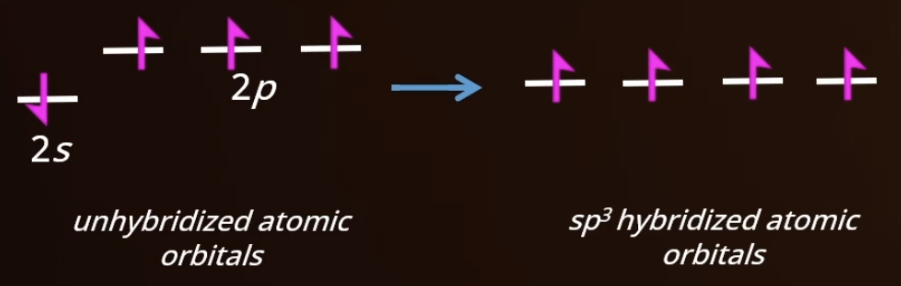
hybridization example
1 s and 3 p orbitals are combined to form 4 sp3 orbitals
electron domains
a lone pair or bond (single, double, triple = one domain). Number of domains = steric number.
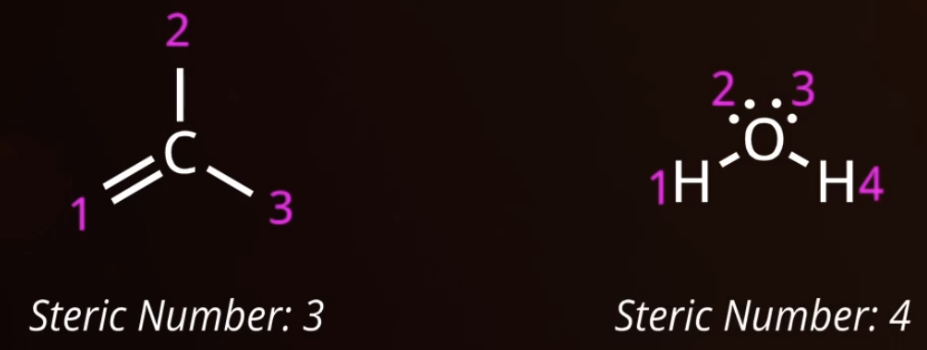
sp3 orbitals
four electron domains, no unhybridized p orbitals, 25% “s” character
sp2 orbitals
three electron domains, one unhybridized p orbital (allows for pi bond), 33.3% “s” character
sp orbitals
two electron domains, two unhybridized p orbitals (allows for 2 pi bonds), 50% “s” character
covalent bonds
atomic orbitals overlap and two atoms share a pair of electrons
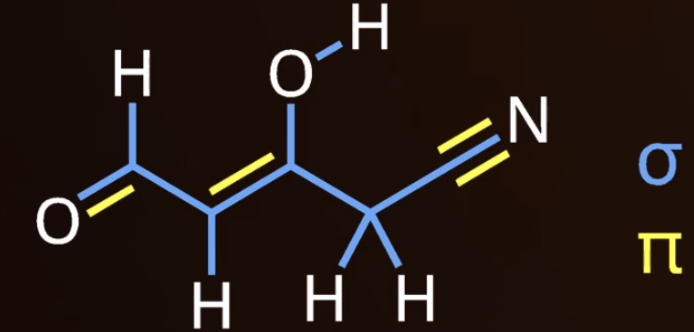
Sigma and pi bonds
Sigma and pi bonds
Sigma bonds - formed by direct overlap of s orbitals and/or hybridized orbitals.
Pi bonds - Formed by lateral overlap of UNHYBRIDYZED p orbitals
All single bonds are sigma
Double bonds are one sigma and one pi
Triple bonds are one sigma and two pi
nonpolar bonds
Atoms share electrons equally, and occurs when bonded atoms share similar electronegativity.
polar bonds
Atoms share electrons unequally, and occurs when bonded atoms have different electronegativity (more electronegative attracts electrons, arrow points toward more electronegative atom)
ionic bonds
One atom transfers an electron to another atom
bond strength
Single < Double < Triple
bond length
Single > Double > Triple
molecular geometry factors
central atom hybridization
central atom electron domain
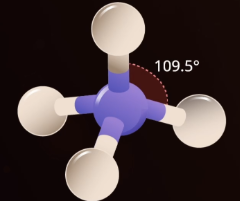
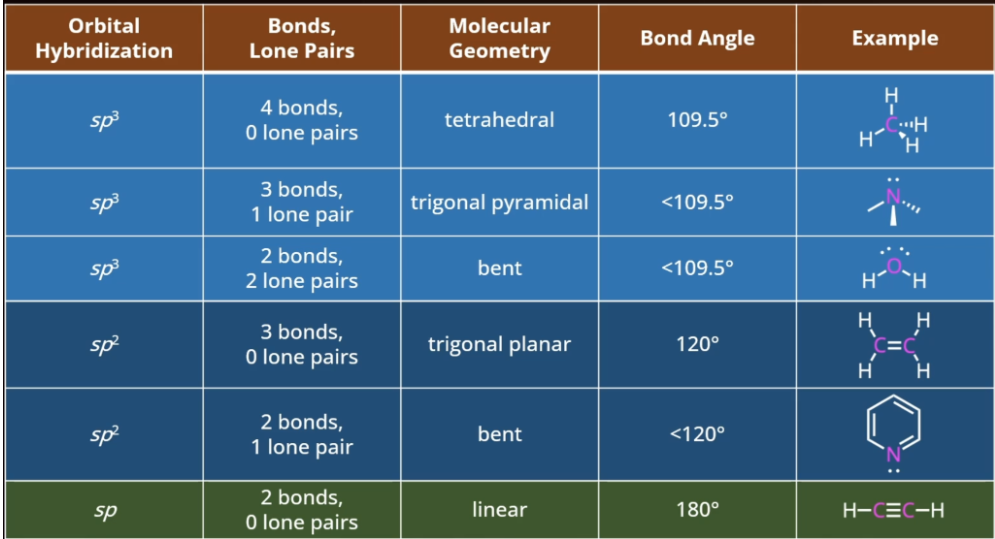
tetrahedral geometry
sp3, 4 bonds, 0 lone pairs, 109.5o angles, methane
trigonal pyramidal geometry
sp3, 3 bonds, 1 lone pair, < 109.5o angles, ammonia
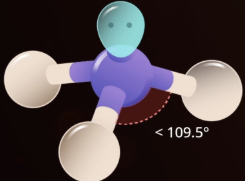
sp3 bent geometry
sp3, 2 bonds, 2 lone pairs, < 109.5o angles, water
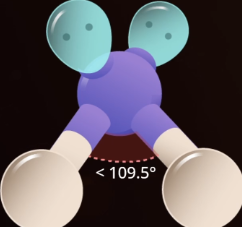
trigonal planar geometry
sp2, 3 bonds, 0 lone pairs, 120o angles, formaldehyde
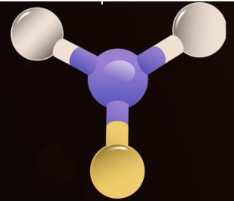
sp2 bent geometry
sp2, 2 bonds, 1 lone pair, < 120o angles, pyridine
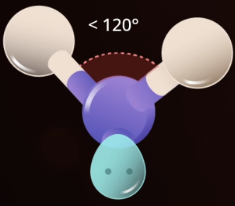
linear geometry
sp, 2 bonds, 0 lone pairs, 180o angles, acetylene
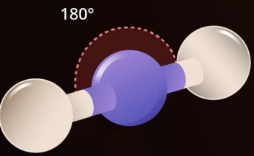
cations and radicals
do not contribute to molecular geometry; still trigonal planar.
molecular geometry summary table
resonance
The delocalization of electrons across p orbitals.
For an atom to participate in __________, it must contain overlapping p orbitals.
__________ increases stability.
Charge of the molecule must be preserved.
Lone pair ←→ pi bond resonance
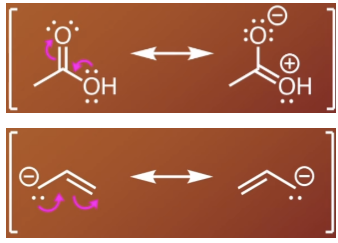
pi bond ←→ pi bond resonance
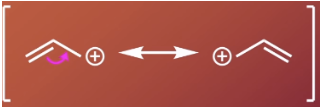
conjugated ring resonance
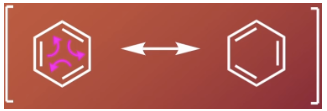
resonance RULES
Maintain the same skeleton (no breaking sigma bonds).
All structures must have valid Lewis structures (periodic table rows 1&2 can not have expanded octets).
All structures must have the same net charge.
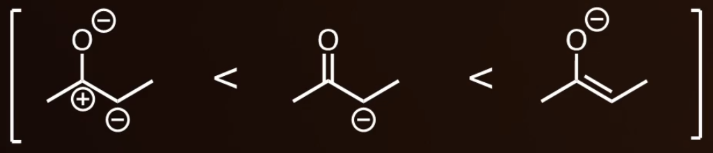
resonance hybrids
combination of all possible resonance structures.
Represents the distribution of electron density
Structures with more stability contribute more to resonance hybrids.
If an atom's lone pair is delocalized through resonance, it does not contribute to total electron domains.
factors that increase resonance contribution
Maximized # of complete octets
Minimized # of formal charges
Negative charges on more electronegative atoms
Positive charges on less electronegative atoms
Electron withdrawing halogens stabilize negative charge.
partial positives and negatives
represented with δ- and δ+
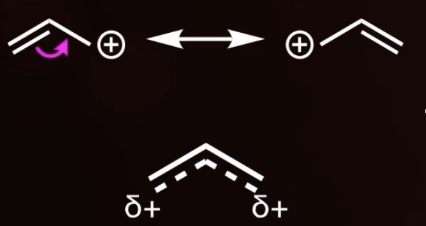
resonance hybrid images
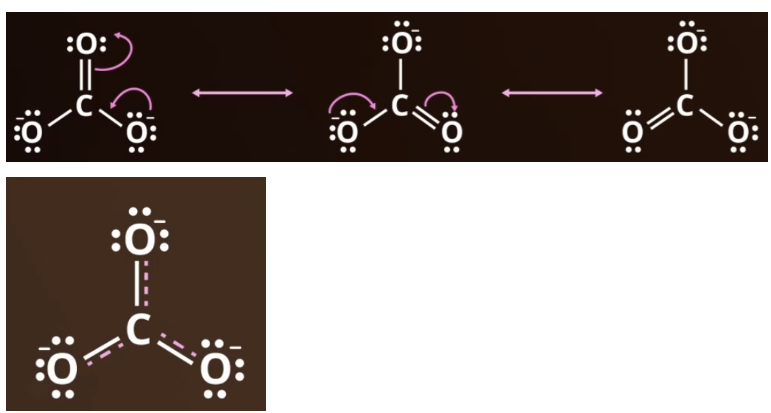
resonance structures example

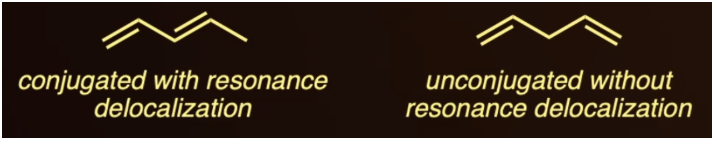
conjugation
more conjugated = more stable molecule
3 definitions of acids and bases
Arrhenius, Bronsted Lowry, and Lewis
Arrhenius acid and base
Acid - Produces H+ in aqueous solutions.
Example - HCl
Base - Produces OH- in aqueous solutions.
Example - NaOH
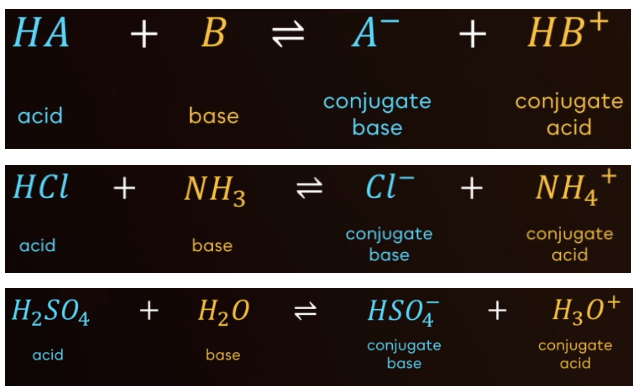
Bronsted Lowry acid and base
Acid - H+ donor
Examples - HCl, NH4+, HOAc
Base - H+ acceptor
Examples - NaOH, NH3, OAc-.
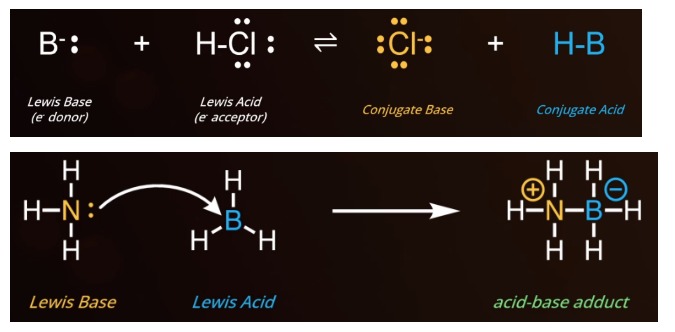
Lewis acid and base
Acid - Electron pair acceptor (electrophile)
Base - Electron pair donor (nucleophile)
water
can act as a base or an acid (amphoteric)
Ka = [H+][A-] / [HA]
Acid dissociation constant
[H+] = concentration of hydrogen or hydronium.
[A-] = concentration of conjugate base.
[HA] = concentration of remaining undissociated acid.
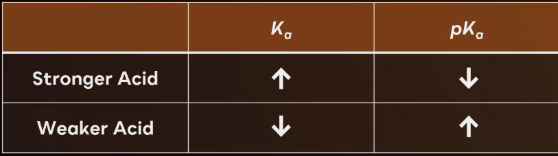
Larger Ka = acid dissolves/dissociates more
>1 = strong acid
<1 = weak acid
pKa = -log(Ka)
pKa goes down as Ka goes up.
lower pKa = stronger acid
Ka and pKa image
solution protonation
pH > pKa → deprotonated solution (H is removed)
pH < pKa → protonated solution (H stays on)
equilibrium
determined by pKa of acid and conjugate acid. ____________ favors the formation of the weaker acid (higher pKa)
CARDIO acronym (the order matters)
Used for ranking acid strength
Charge
Atom
Resonance Delocalization
Induction
Orbital Hybridization
Charge (CARDIO)
More positive charge = stronger acid = more likely to let go of protons.
Strength: H3O+ > H2O > OH- > O2-.
Atom (CARDIO)
Acidity changes based on periodic table rows and columns. Down and to the right on PT makes a stronger acid and more stable anion. Find the conjugate base and look specifically at the atom carrying the negative charge.
Columns - going down the column increases acidity. HI > HBr > HCl > HF.
Rows - going to the right within a row increases acidity. HF > H2O > NH3 > CH4.
Resonance delocalization (CARDIO)
Molecules with more resonance structures are more acidic because they can balance out charges (meaning conjugate base is more stable).
Induction (CARDIO)
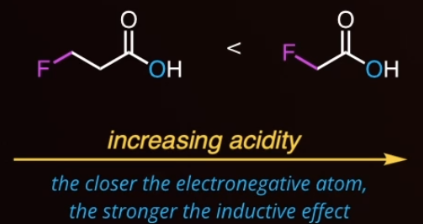
Highly electronegative atoms connected to carbons can stabilize the conjugate base due to pulling electrons toward itself, which increases acidity/stability.
The closer the electronegative atom is to the negatively charged atom in the conjugate base, the more stable it is.
More substituents also increases acidity (3F > 1F)
Orbital hybridization (CARDIO)
Greater “s” character increases acidity. sp > sp2 > sp3 because in sp hybridized carbons, the atom connected to the carbon is closer to the nucleus of the carbon (closer = attraction is stronger)
INTRAmolecular forces
Forces between atoms within the SAME molecule. Important for understanding molecule structure.
INTERmolecular forces
Forces between SEPARATE neighboring molecules. Important for studying molecule interactions.
London Dispersion Forces (LDFs)
present in all molecules, made of temporary dipoles that form due to randomized electron movement.
Molecules with more electrons experience more significant ________________.
The weakest type of intermolecular force.
This is the only force present in nonpolar molecules.
Dipole dipole interactions
arise from polar covalent bonds (EN difference between 0.5 and 1.7; higher difference = stronger interaction)
Partial positive and negative charges will attract molecules together.
Hydrogen bond
Very strong D/D interaction; only occurs if NH, OH, or FH bonds are present.
Partial + on H, partial - on N, O, or F.
Ion ion interaction
Cation interacts with anion. Ions bear a full + or - charge, resulting in a very strong force. More charge = stronger interaction.
IMF strength ranking
Ion ion > H bond > Dipole dipole > LDF
Solubility
molecules dissolve best in solvents with the same type of IMFs (“like dissolves like”)
Example: hexane dissolves well in benzene because both are only capable of LDFs.
Example: Lengthening a hydrocarbon chain attached to an OH DECREASES solubility because C-H is nonpolar while C-O is polar
Factors that increase melting/boiling point
Stronger IMFs
Larger molecule size
Less branching
More symmetricality*
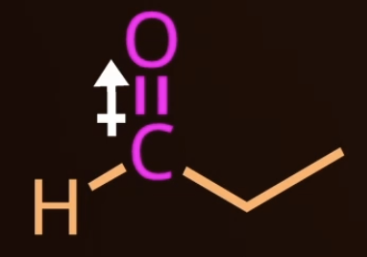
Arrows
show movement of electrons, sometimes resulting in charges on atoms. They can originate at a bond or atom, and can form either a new bond, a lone pair, or radicals.
double headed arrow
depicts TWO electrons moving.

single headed arrow
depicts ONE electron moving.

poop intermolecular force
when the atoms of your nose are attracted to the smell of poop