Final for CPSY 4331 from study guide
 Call Kai
 Learn
Learn Practice Test
 Spaced Repetition
 Match
Match Flashcards
 Knowt Play
1/69

There's no tags or description
Looks like no tags are added yet.
Name | Mastery | Learn | Test | Matching | Spaced | Call with Kai |
|---|
No analytics yet
Send a link to your students to track their progress
70 Terms
What are the developmental origins of the self-concept? How do children develop self-perceptions?
1-2m: repeated acts centered on their bodies (thumb-sucking)
4-8m: repeat actions centered on the environment (delight in making the mobile move)
Habituate to one's own body
Protest when social exchanges are disrupted.
18-24m: recognize self in the mirror (rouge test)
2-3 yrs: use of language to refer to self (me and mine).
What changes occur in self‑description and self‑understanding?
Preschool and early school age→ physical features, preferences, possessions, social characteristics, competencies.
By age 8-10→ more complex descriptions- focus on abilities and interpersonal attributes.
Adolescence+--> more abstract and psychological, more aware of multiple selves, eventually more coherent and integrated.
How has research by Eder (1990) added to our understanding of young children’s self-concepts?
Eder→ preschoolers have psychological conceptions of self long before they can express this in trait-like terms.
Tested via a procedure that does not require advanced verbal skills.
What is meant by self‑esteem as a multifaceted construct?
Self-esteem→ evaluation of one’s worth as a person based on assessment of the qualities that make up self-concept.
Multifaceted construct because it can be from many different sources, like academic, social, and physical.
How does self‑esteem change during elementary school and into adolescence? What influences these changes?
Ages 4-7→ self evaluations center on
Social acceptance, task/competence, is often overly positive and unrealistic.
Ages 8-10→ self evaluations center on
Physical, academic, and social competence
Self-esteem typically declines somewhat because of social comparison and more realistic appraisals.
Changes in self-esteem→
Early adolescence: more differentiated and more emphasis on interpersonal relations
Adolescence→ inclusion of romantic appeal and quality of close friendships.
What is the role of praise in self-esteem?
Mueller and Dweck study→ received praise because of intelligence and other from effort, then offered them a challenging task and an easy one.
Intelligent praised kids opted for the easy one (avoid mistakes)
Effort praise kids opted for the challenge (opportunity to learn)
Kids praised for intelligence→ fixed mindset
Lost motivation and enjoyment in the activity
Avoided challenging tasks
Kids praised for effort→ growth mindset
Sought out challenge and increased effort and perseverance
Define identity and explain Erikson’s perspectives on identity formation.
psychosocial development over the life span. How our self-concept develops over time.
Development is cumulative/build on one another.
Involves vital involvement→ how you relate to the world and how the world relates to you. Interaction of biological characteristics, psychological elements, and cultural context.
Development includes a balance, needed for healthy adaptation.
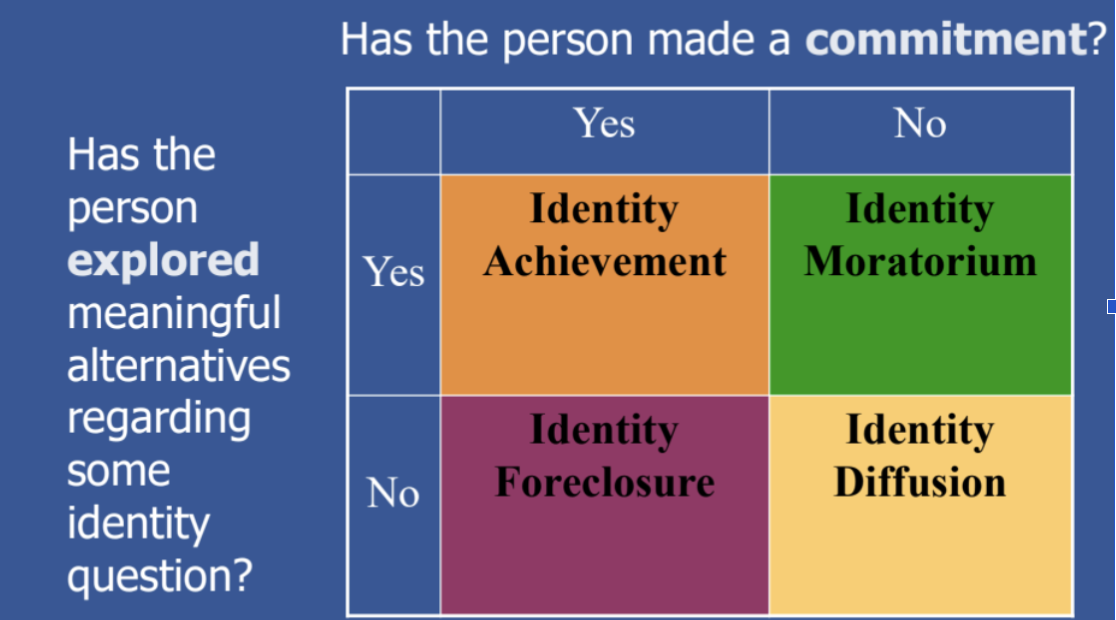
Marcia’s four stages of identity:
Findings:
People move towards commitment: either foreclosure or achievement
moratorium = exploring options
Time of heightened anxiety, but not a bad thing (college)
What is known about the development of ethnic identity?
By 3m: look longer at faces of own race (if mainly exposed to own race)
9m: associate positive emotions with the same-race faces
Implicit biases appear in early childhood
A doll study which show preferences for white dolls.
How to improve this?
Talk to kids about race
Adolescence- the most active period of ethnic-identity development
Unexmained→ values, characteristics of the dominant culture
Ethnic idenity search→ exploring one's own ethnicity, questioning the majority culture.
Ethnic identity achievement→ integration of minority and mainstream culture, openness, and confidence about one’s ethnic identity.
What is the role of parents and peers in the development of ethnic identity?
Parents play a major role in ethnic identity because they can help impart knowledge about cultural traditions, instilling pride, and preparing children for the hardships that can accompany minority status.
What is the theory of mind, and what role does it play in social development? Describe contributions to individual differences in social understanding.
ToM→ understanding that people are beings with mental states that are not always accessible to others and that often guide their behavior.
Developing this is a critical step in the movement toward social competence. Without it, social interactions would often be misunderstood and lead to brief and ineffective social interactions.
Can predict children’s current and later social competence with peers and friends.
Stereotype
label applied to members of a racial, ethnic, or religious group without appreciation that individuals within the group are different from each other.
By age 3, white kids identified that African Americans' faces are angrier than white faces.
Stereotype consciousness
meaning that they knew that people hold racial and ethnic stereotypes
Show this by age 10, agree with statements that “white people think black people are not smart.”
Prejudice
set of attitudes by which an individual defines all members of a group negatively.
Children who think about others in terms of stereotypes are more likely to have a prejudice against them.
Evident by time, they are 5 and can peak b/w ages 5 and 7.
7-9 begin to appreciate the ways that different groups are similar.
Explain how children develop stereotypes and prejudice, and how they can be reduced.
Increase contact b/w members of groups who are or could be prejudiced toward each other in a positive and nonthreatening context.
Have adults point out the individual characteristics of members of the other group.
School norms encourage students to be inclusive of other groups, successfully promoting positive outgroup attitudes, especially when paired with an inclusive person.
Minimizing stereotypes in media like TV, books, and movies.
Describe gender differences in behavior, interests, and activities in childhood.
Girls are more physically and neurobiolgically advanced at birth, excel early in verbal skills, and are more nurturing towards younger children. Boys have more mature muscular development and are more aggressive.
Mature faster→ girls.
Children exhibit gender-typed stereotyped preferences as early as age 1.
Girls tend to conform less strictly to gender-role stereotypes than do boys, possibly because parents and teachers exert greater pressure on boys to adhere to the masculine role.
Girls may also imitate the male role because it has higher status and privilege. Although some boys and girls receive support for cross-gender behavior, most are encouraged to behave according to traditional stereotypes.
Differences are quite small.
Age 2, boys engage in risker behavior.
Boys have stronger visual-spatial abilities than girls, which allow them to read maps, aim at targets, and manipulate objects in space more easily.
Girls tend to have better verbal skills than boys.
Girls are better than boys at recongizing and processing facial expressions.
Display sadness more and can control their emotions better than boys.
Girls tend to be oriented toward interpersonal relationships more than boys.
Boys play is more physically active than girls.
DIfferences in girls’ and boys’ play behvior also reflected in their toy choice.
By the time they were 1 years old, girls looked at dolls more than boys did, and difference was even stronger by the time they were 1 ½.
Even the pretend play of boys and girls differs: for girls, socio-dramatic play focuses on domestic situations like cooking, taking care of, whereas boys is more fantasy play involving action and adventure.
Differ in the type of leisure activities they prefer.
Boys like shooting, boxing, playing on a team, fishing.
Girls liked sewing, cooking, dancing,
Books girls prefer romcoms and boys like horror stories and violent adventures.
Explain what is meant by gender intensification in adolescence.
Many boys and girls partipate in activites in both genders.
In adolescence, gender intenstification is observed.
With the onset of puberty, young people shift toward more typical gender-typed patterns of behavior.
Gender roles are likely to intensify when adults become parents. Traditional gender roles.
Discuss stability and gender differences in gender typing.
Individuals who are strongly masculine or feminime at one age tend to continue to be strongly masculine or feminine as they age.
Longitudinal study in U.S, boys who were interested in competitive games and activities that required gross motor skills and girls who were interested in noncompetivie games cooking, sewing, and reading were involved in similar activites as adults.
Stability was strong when children’s characteristics were congrument with gender sterotypes.
When children do not act in gender-typed ways in childhood, researchers have found is stable.
From a biological perspective, discuss the evolutionary theory of gender development
Evolutionary theory stresses the principles of natural selcetion and adaption.
Limitations: testing this is hard, applies to females and males in groups but does not explain individual differences among them, not account for rapid changes in gender roles due to technology. Cross-cultural research showing considerable variability in gender roles across cultures has challenged its assumptions.
Linked to genetic determinism rather than interactive position that embraces the role of enviorment.
From a biological perspective, discuss the evolutionary theory of gender development and the role of hormones,
Hormones are also biological contributors to genetic differences and gender typing.
Hormones associated with sexual characterisitcs and reproductive functions are present in differeing concentrations in m and f beginning in infancy.
If high estrogen levels like girly things if high testosterone they like boy things.
From a biological perspective, discuss the evolutionary theory of gender development and the role of the brain
Male and female brains are more similar than different.
Researchers have found that female brains, on average, the ratio of grey matter to white matter is larger than in males’ brains, especially in social brain regions.
Women tend to be more social.
Amygdala→ difference here in processing emotions.
Men have a bigger one.
Females exhibit stronger empathic responses than males.
Women also show more sustained responses than men in the amygdala to familiar negative images which in turn is linked with higher levels of mood disorders.
From a biological perspective, discuss the evolutionary theory of gender development and the role of genetics in gender
Genetics of gender
They found that 1,349 genes that are expressed differently in the brain of men compared to women, providing the strongest evidence to date that sex differnces in the brain are gentically programmed.
Describe gender-schema theory and the research evidence that supports this perspective.
Gender-schema theory→ the view that children develop schemas, or native theories, that help them organize and structure their experience related to gender differnces and gender roles.
Children develop schemas based on their own percpetions and the information that parents, peers, and cultural stereotypes provide.
Use these gender schemas to evaulate and explain behavior.
Compare and contrast cognitive developmental theory, social cognitive theory, and gender-schema theories of gender development.
Gender-schema theory→ the view that children develop schemas, or native theories, that help them organize and structure their experience related to gender differnces and gender roles.
Suggest that children need only basic inforamtion about gender, such as identification of the sexes, to begin forming and following rules about it.
This one is correct.
Social cogntive theory→ Kohlberg’s theory that children use physical and behavioral clues to differentiate gender roles and to gender type themselves very early in life.
Cognitive development theory predicts that achievement of gender constancy influences children’s gender-types choices and therefore ebfore the 5 to 7 year age period, the children should have little preferences for gender-appropriate activities.
Summarize the findings regarding parents’ influences on children’s gender development. Be sure to include the research on gender development for boys and girls of different ages when the father is absent.
Parents have a strong influence on children’s early gender typing.
Start by the name whether its very girly or boyish.
Consistent with evolutionary theory, which emphasizes strength and competitiveness in males and nurturance in females (Geary, 2015), parents describe their newborn daughters as smaller, softer, cuter, more delicate, and more finely featured than they describe their sons.
Treat sons and daughters differently.
Tend to be more verbally responsive with daughters than with sons, they talk more to girls in infancy and at older ages and use more supportive and directive speech.
They are harsher with boys.
Fathers show preference for sons and after the baby is born, fathers are more likely to play with son especially when the baby is a first born.
When the father is absent:
The absence of a male model and the lack of opportunities for children to interact with a man might also lead to difficulties developing a gender idenity and role.
Boys may experience more challenges.
The effects on girls in childhood is minimal
In adolescence, there are some differences between girls with fathers present versus absent in terms of their behavior with the opposite sex.
Ealier the father left the greater the risk of teen pregnancy.
Describe the influence of other agents of socialization on children’s gender development, including siblings
Siblings influence children's gender choices, attiutdes, and behavior.
Younger siblings gender typing was indeed related to their older siblings’ attriubtes, even more strongly than to their parents’.
Sex of the sibling matters too.
Children with sisters tend to develop more feminine qualities
Children with brothers tend to develop more masculine qualities.
Describe the influence of other agents of socialization on children’s gender development, including peers
Peers serve as modles and enforcers of society’s gender-role standards and are major influence on children’s gender-typed behavior by the time they enter school.
Children were more likely to play with a gender netural toy or cross-gender toy after observing a same-gender model do so.
Peers reacted strongly when children violated appropriate gender-role behavior patterns.
Play with others of the same sex.
Gender segregation continues through childhood into adolescence.
Describe the influence of other agents of socialization on children’s gender development, including media.
Books tend to portray female and male roles in a gender biased way.
Tv: males are more likely to be aggressive. While females are warmer, happy, and more emotional.
Females are the victims.
Stereotypes are a concern because children tend to watch actors of their own gender on TV.
Their gener schemas guide the specifc programs children watch, and what they view shapes their gender beliefs- creating an endless cycle of gender typing and sterotyping.
Positive gender role models is sports on TV.
Discuss the role of the school in terms of school culture in gender development.
School culture→ most of the time
Men hold power and women make the culture, in the beginning to favor girls.
Girls will try and make themselves look weaker and dumber by not trying in competitive sports or lying about the grade they got on a test.
Discuss the role of the school in terms of teacher attitudes in gender development
Teachers’ attitudes and behavior→
Boys interact with female teachers they play more feminine activities.
Teachers can minimize or maximize the gender divisions in their classroom by the ways they organize and talk to the children.
Discuss the role of the school in terms of behaviors in gender development.
Males are more likely to go into math related major even though they are similar in math abilities.
Children believe that math is for boys. And boys think they are better at it.
Girls only think of themselves as good at language because they are supposed to be good at it.
Teachers encourage boys in math more than girls.
Nature vs Nurture:
The impact of one can mitigate or influence the impact of the other.
Just as the effects of biology can be influenced by culture and socialization, the influence of socialization can be impacted by biology.
Psychoanalytic theory
Freud, the focus is on how parents serve as moral socializers. Before age 3, no superego. Parents’ job is to surrogate the superego.
Compliance through power assertion, guilt, and shame. Power assertion hinders moral reasoning. Love withdrawal is unrelated to moral reasoning. Induction helps moral reasoning.
Piaget’s Cognitive development theory
parents do not promote, and they will slow down moral development. Equal-status peer relationships foster moral development.
Premoral (minimal concern for rules)--> Moral realism (age 5), rules are sacred and unalterable, belief in immanent justice. → Moral reciprocity (age 11), rules are arbitrary and flexible.
Piaget underestimated children’s capacities. Young children DO consider intentions when judging behavior. Children are also willing to question the rules.
Social learning theory
parents as social models.
Children’s moral reasoning resembles their parents’. It also helps foster growth through words and actions.
Describe and evaluate Turiel’s social domain theory
morality is one of the several strands or domains of children’s social knowledge, which also include knowledge about social norms and conventions, and concerns about privacy and personal choices.
Describe and evaluate Social-convention domain
involves the social expectations and regularities that help facilitate smooth and efficient functioning of a social system.
Ex: norms for table manners, modes of greeting, and other forms of etiquette.
To study this, they asked them how wrong the child thinks it would be to hit someone, to lie, steal, or cheat. They see these as moral violations.
Describe and evaluate psychological domain
reflects an understanding of self and others as psychological systems and includes some issues:
Personal issues: that only affect the self.
Ex: like preferences and choices about one’s body, privacy, choice of friends, and recreational activities.
Prudential issues: immediate physical consequences for the self, such as safety, comfort, and health.
Psychological issues→ involve beliefs and knowledge of self and others and choices about revealing aspects of oneself to others.
Self-regulation
the ability of children to inhibit impulses and behave in accordance with social and moral rules in the absence of external control.
describe what is known about individual differences in self-regulation.
Some kids are early self-regulators have a stronger sense of moral self, they endorse and internalize parental values and rules, and they make conscious efforts to control their behaviors even when it requires giving up or postponing pleasurable outcomes.
Differences can also be related to how parents facilitate children’s development of self-regulation.
Related to conscience
Individual differences in moral behavior are also related to children’s temperament.
Discuss the role of parents and teachers
when kids are a little older, their moral judgements are advanced if their parents initiate discussion about other people’s feelings, use disciplinary techniques that involve reasoning and explanation, and promote discussion.
Helps them think about their actions and the implications of their actions for the welfare of others. Most effective when highlighting the consequences.
Most effective if it is domain-appropriate, which focuses on the harm or injury caused by moral transgression.
Also depends on how well the message fits the child’s developmental level.
Does not stop at the end of childhood.
Authoritative parents are most likely to establish clear and legitimate boundaries between the moral, conventional, and personal issues for their kids.
Authoritarian parents treat their children’s transgressions like cursing, putting thier elbows on the table as if they were moral transgressions, and treat personal issues, like clothing or hairstyles, as if they were social-conventional issues.
Permissive parents are likely to treat all issues as personal.
Discuss the role of siblings and peers in children’s development of moral and social conventional reasoning.
turn-taking difficulties, disputes, social exclusion, teasing, taunting, and hurting one another are all opportunities for learning these rules.
Children also talk to each other about their problems, which helps them learn about moral rules and concepts, and their experiences of friendship, loyalty, and betrayal provide highly emotional forums for moral learning.
Are children consistent in their moral behavior over time and across situations? Provide examples to back up your answer.
Moral and Prosocial behavior overall increases with age→ less egocentrism, more perspective taking.
Specific behaviors emerges at different ages:
Empathy emerges early: crying in response to hearing other babies cry.
Helping and sharing emerge slowly in preschool/early school age years
Lying increases with age
Emerges after false belief understanding
Initally to avoid responsibility
Prosocial behavior
voluntary behavior intended to benefit another person
Sharing, caring, comforting, cooperating, helping, sympathizing, and performing random acts of kindness.
Describe changes and stability in the development of prosocial behavior. Are there gender differences in prosocial behavior?
Individual differences in prosocial behavior appear early in childhood and are quite stable as children develop. And is relatively stable in adolescence. If they start off helpful and kind they are likely to continue this way.
Gender differences
Girls display more of these characteristics of prosocial behavior than boys do. Girls are more empathetic and have more capacity to experience the emotions that others feel, esp as they get older.
Men are more prosocial in extreme situations like making life-risking rescues from floods or mountaintops.
Describe the biological factors that help us understand individual differences in moral and prosocial behavior development.
Heredity: identical twins more similar than fraternal twins in:
Empathetic responses
Negative emotionality (sadness, guilt, shame)
Externalizing behavior (lack of self-regulation, aggression)
Temperament:
Fearfulness associated with greater likelihood of displaying guilt/shame (breaking toy experiment)
Describe the cognitive factors that help us understand individual differences in moral and prosocial behavior development.
Role taking: understanding another’s perspective perdicts prosocial behavior (and less antisocial behavior)
Empathy: experiencing others’ emotions predict prosocial behavior (esp. >8yrs)
Moral reasoning: complexity of reasoning about moral dilemmas correlated (+) with moral behavior
Describe the socialization factors that help us understand individual differences in moral and prosocial behavior development.
Secure attachment: increase compliance, self-regulation, empathy
Parenting is especially influential for moral development in children with inhibited temperament.
Most effective when message matches their actions.
Discipline strategy: induction- reasoning that stimulates children to consider:
Negative effects of wrongdoing for others and self
How to change behavior for the better in the future.
Discuss the role of empathy and perspective-taking in prosocial behavior.
Encourages children to understand other people’s feelings (empathy)
Enhances role-taking (how they would feel in the situation)
Implies specific strageies to guide behavior (internalization of moral behavior)
Hostile aggression
directed at hurting someone
Aggression
aimed at hurting someone
Instrumental aggression
directed at obtaining something desirable
relational aggression
directed at harming someone’s relationships.
Describe patterns in aggression in relation in preschool
Aggression in preschool→
Young: responding to parents are caregivers exerting authority.
Older: responding to peer, sibling conflict.
Looks like:
Unfocused temper tantrums decrease over time.
Young preschoolers: instrumental (toys, possessions)
Older preschoolers: less physical and more verbal aggression.
How often?
Frequency of aggression and length of disputes decreases between 2 and 5 years of age.
Increased emotion regulation, language capacity.
Describe patterns in aggression in relation to gender and stability over time.
Aggression is stable over time for both boys and girls.
But only a small number of highly aggressive kids maintain this throughout their whole childhood.
Describe patterns in aggression in middle childhood
Responding to perceived threats, insults
Looks like: physical aggression, acting out behavior tends to decrease, verbal, relational aggression more common
Who’s doing it? Minority of children are responsible for majority of aggression.
Describe patterns in aggression in adolescence
What does it look like and how often?
Physical fighting and other aggression continues to decline
But serious violent offenses rise up 12-20 because..
Most violent teens show an increase in aggression and they are bigger, stronger, and have weapons.
Indirect anger- theft, truancy, substance abuse increasing.
Discuss the biological origins of aggression, including what is known about genetics
Researchers in one study found that mothers’ ratings of their 18-month-olds’ physical aggression were more similar for identical twins than nonidentiucal twins, suggesting a genetic predisposition is involved.
But the influence of genetics may play a more powerful role in when children are raised in a safe, stable environment.
Discuss the biological origins of aggression, including what is known about temperament
If have difficult temperament in the first year of life then they are more hostile as preschoolers.
Impulsive temperaments predict aggressiveness.
If they lack self control at a young age they are more likely to become aggressive at an early age and remain so.
Preschool children with less inhibited temperaments score higher on a combined measure of physical and relational aggression in elementary school.
Discuss the biological origins of aggression, including what is known about the brain
Links have been found between aggression and neurotransmitters
Serotonin→ one neurotransmitter that is involved in regulating the activity of the endocrine glands
Affects attention and emotional states and may be involved with aggression.
Men and woman with poor impulse control and high rates of criminality, explosive aggression, and impulsive violence also have low CNS serotonin.
Low levels of serotonin have higher physcial aggression.
Discuss the biological origins of aggression, including what is known about hormones
Testosterone is linked to aggression.
Discuss the biological origins of aggression, including what is known about prenatal conditions.
Conditions in the prenatal environment that lead to physical problems in the child can also increase the likelihood of later antisocial behaviour.
Like smoking, cocaine (become more aggressive if exposed to this)
Discuss parental influences on the development of aggression, including parent-child interactions
First opportunities for children to learn how to act. Begin in infancy. Less likely to become aggressive if they establish secure relationships with parents
If parents are warm then less likely to be aggressive
If controlling then stable aggressive behavior over time.
Parent’s attitudes toward aggression are important.
Discuss parental influences on the development of aggression, including abusive parenting,
Increases aggression and antisocial behavior.
Discuss parental influences on the development of aggression, including the coercion model
Parents and children train each other by means of cycles of mutually coercive behavior.
1st parents interfere with children’s ongoing activity, like turn off the TV or scold them for not finishing homework.
2nd kids respond by complaining, whining, and protesting; they conterattack and defy the parents.
3rd parents give in to the children’s complaints and stop scolding and demanding. From the kid’s viewpoint this is a small victory because their counteroffenses worked.
4th turn of the cycle, children stop their defiance and noncompliance.
Discuss parental influences on the development of aggression, including parents as providers of opportunities for aggression.
Shape their children’s aggressive development through their management of the children’s activities.
The failure of these parents to monitor their children’s whereabouts, activities, and social contacts can increase the children’s aggressive behavior.
Parents who act as gatekeepers can keep their children away from harmful influences that increase their aggression.
Kids are more likely to develop aggressive patterns of behavior if their parents are unaware of their activities and make no effort to prevent negative experiences.
Describe the role of peers as contributors to aggression.
Can learn from peers.
Peer rejection is a painful and unwelcome experience for children and those who are rejected become more aggressive over time.
If the peer group supports relational aggression, adolescents become increasingly mean in this way.
Deviancy training→ amplification of aggression that occurs when adolescents are with and learn from aggressive peers.
Describe the role of neighborhoods as contributors to aggression
Can pick it up here. Adults living in neighboorhoods with high levels of poverty and unemployment tend to be more aggressive.
Exposure to violence increases their aggressive tendencies.
Describe the role of media as contributors to aggression.
Exposure to TV violence contributes to children’s aggressive behavior.
Exposure to violent media also may affect children more if they believe it portrays real events.
Describe the role of culture as contributors to aggression.
Varies around the world.
Societies that placed a high value on hierarchy, status, and power also had higher levels of aggression than cultures in which members cooperated voluntarily and had high levels of egalitarian commitment.
Describe social cognitive influences on aggression development, including the role of hostile attribution bias.
Cognitive encoding, interpretation, and understanding guide children’s social behavior and affect decision-making in potentially aggressive situations.
Social information-processing theory: Children come to a social situation with a set of neural capabilities that have been honed over time and are represented in memory.
Their response to something depends on how they process these cues.
First, they encode the cues: aggressive children do not notice the full range of cues because of their poor attentional and encoding skills.
2nd they interpret the cues as intentional and threatening or accidental and harmless.
Hostile attribution bias→ tendency to interpret neutral or ambiguous social behavior of another person as being hostile.
Interpret cues as being mean.