Back And Vertebral Column (EXAM 1)

0.0(0)
Studied by 0 people
call kaiCall Kai
learnLearn
examPractice Test
spaced repetitionSpaced Repetition
heart puzzleMatch
flashcardsFlashcards
GameKnowt Play
Card Sorting

1/80

encourage image

There's no tags or description

Looks like no tags are added yet.

Last updated 10:29 PM on 6/16/26
Name
Mastery
Learn
Test
Matching
Spaced
Call with Kai

No analytics yet

Send a link to your students to track their progress

81 Terms

1
New cards

Where is the Mid-vertebral line?

Overlying the spinous processes of the vertebrae/ posterior median line
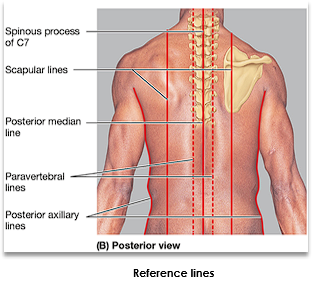
<p>Overlying the spinous processes of the vertebrae/ posterior median line</p>
2
New cards

Where is the scapular line?

Passes through the inferior angle of the scapula.
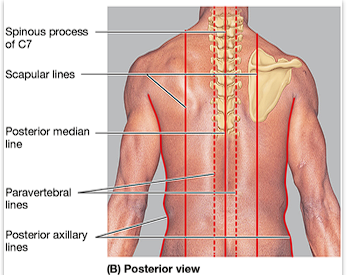
<p>Passes through the inferior angle of the scapula.</p>
3
New cards

Where is the triangle of auscultation?

Boundaries include:

  • latissimus dorsi (inferior)

  • trapezius (medial)

  • scapula (lateral)

  • rhomboid major, facial sheet, 6th and 7th ribs, intercostal space (Anterior/ floor)
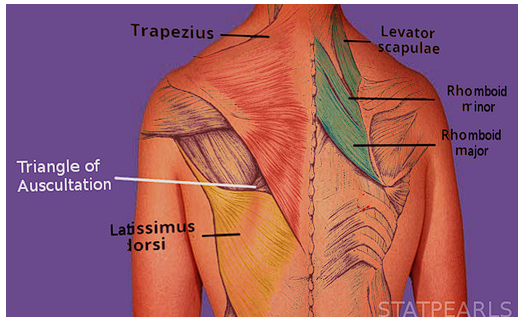
<p>Boundaries include: </p><ul><li><p>latissimus dorsi (inferior)</p></li><li><p>trapezius (medial)</p></li><li><p>scapula (lateral)</p></li><li><p>rhomboid major, facial sheet, 6th and 7th ribs, intercostal space (Anterior/ floor)</p></li></ul><p></p>
4
New cards

Where is the vertebral prominens?

The prominent spinous process of C7
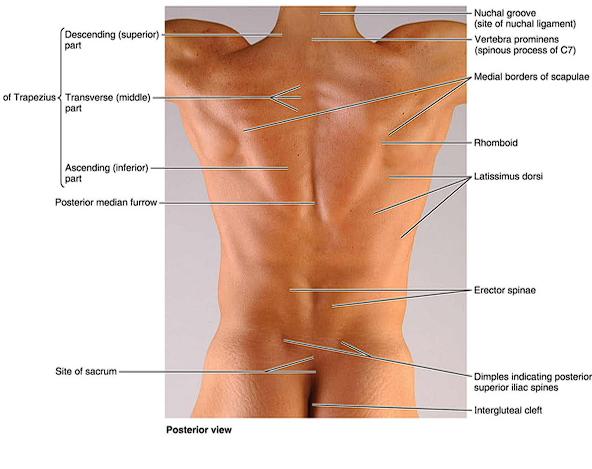
<p>The prominent spinous process of C7</p>
5
New cards

Where is the vertebral furrow?

  • landmark that indicates the location of the vertebral spines

  • erector spinae muscles lie on both sides
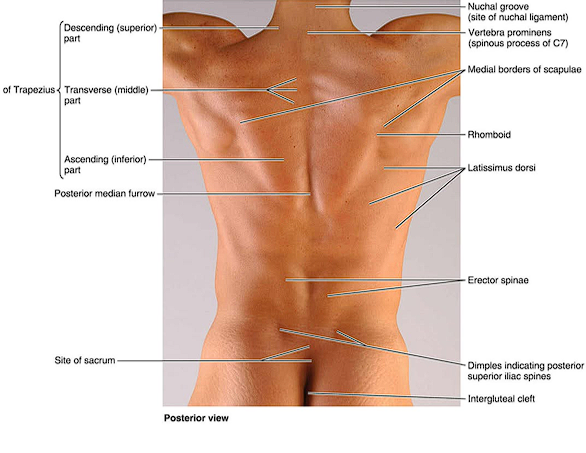
<ul><li><p>landmark that indicates the location of the vertebral spines</p></li><li><p>erector spinae muscles lie on both sides</p></li></ul><p></p>
6
New cards

Describe the major muscles associated with the superficial muscles/ Extrinsic back muscles, what they contribute to, and nerve supply

  • Trapezius

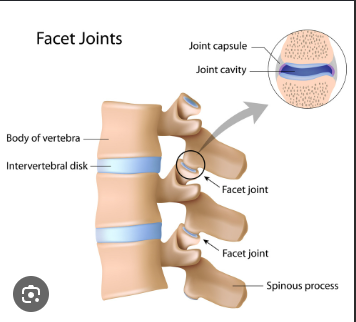
  • Latissimus dorsi

  • Levator scapulae

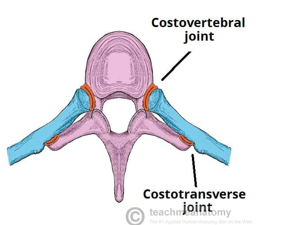
  • Rhomboid major

  • Rhomboid minor.

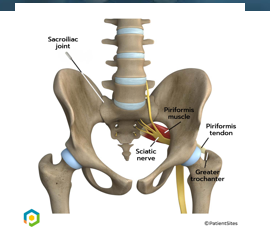
(superficial to deep)

  • Connect upper limbs to the trunk and assist in upper limb movement via scapula and humerus

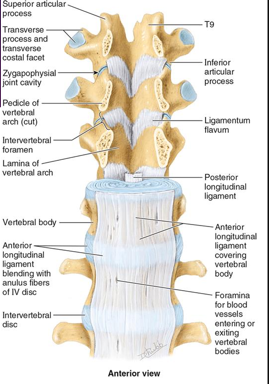
  • Ventral rami of spinal nerves (brachial plexus branches). EXCEPTION: trapezius= spinal accessory nerve (CN XI)

7
New cards

Describe the Innervation and actions of the Trapezius

  • C7-T12 vertebrae

  • Action: elevates, retracts, depresses, and upwardly rotates scapula

  • innervation: Motor: spinal accessory nerve (CN XI)
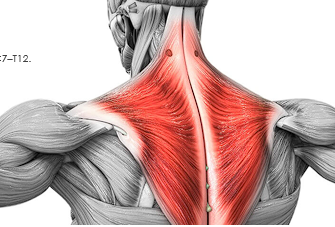
<ul><li><p>C7-T12 vertebrae</p></li><li><p>Action: elevates, retracts, depresses, and upwardly rotates scapula</p></li><li><p>innervation: Motor: <span style="color: red;">spinal accessory nerve</span> (CN XI)</p></li></ul><p></p>
8
New cards

Describe the Innervation and actions of the Levator scapulae muscle

  • C1-C4 vertebrae

  • Action: Elevation and downward rotation of the scapula

  • Innervation: Dorsal scapular nerve (C5), branches from C4-C5 ventral rami
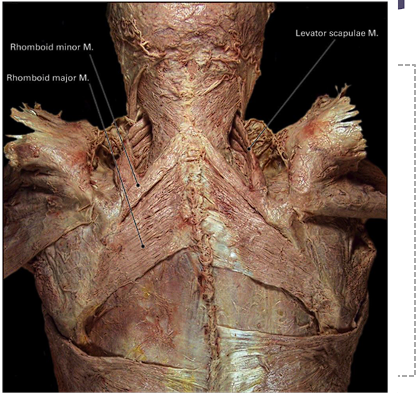
<ul><li><p>C1-C4 vertebrae</p></li><li><p>Action: Elevation and downward rotation of the scapula</p></li><li><p>Innervation: Dorsal scapular nerve (C5), branches from C4-C5 ventral rami</p></li></ul><p></p>
9
New cards

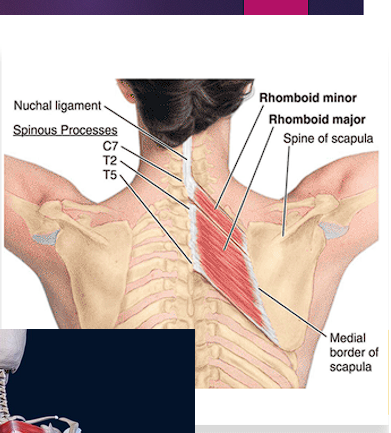
Describe the Innervation and actions of the Rhomboid major and minor

  • minor: C7-T1 vertebrae

  • Major: T2-T5

  • Action: retraction of the scapula

  • Innervation: Dorsal scapular nerve

<ul><li><p>minor: C7-T1 vertebrae</p></li><li><p>Major: T2-T5</p></li><li><p>Action: retraction of the scapula</p></li><li><p>Innervation: <span style="color: red;">Dorsal scapular nerve</span></p></li></ul><p></p>
10
New cards

Describe the Innervation and actions of the latissimus dorsi muscle

  • T7-sacrum

  • Action: Adduction, extension, and medial rotation of the humerus at the glenohumeral joint

  • Innervation: Thoracodorsal nerve (C6-C8)
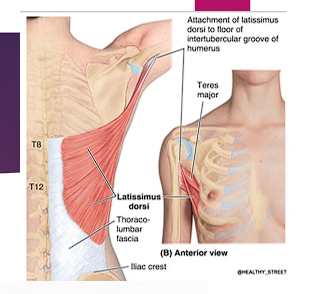
<ul><li><p>T7-sacrum</p></li><li><p>Action: Adduction, extension, and medial rotation of the humerus at the glenohumeral joint</p></li><li><p>Innervation: <span style="color: red;">Thoracodorsal nerve</span> (C6-C8)</p></li></ul><p></p>
11
New cards

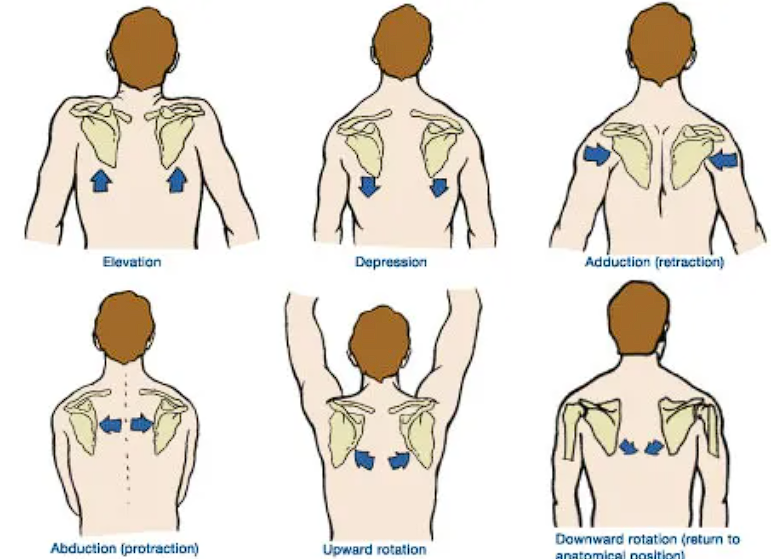
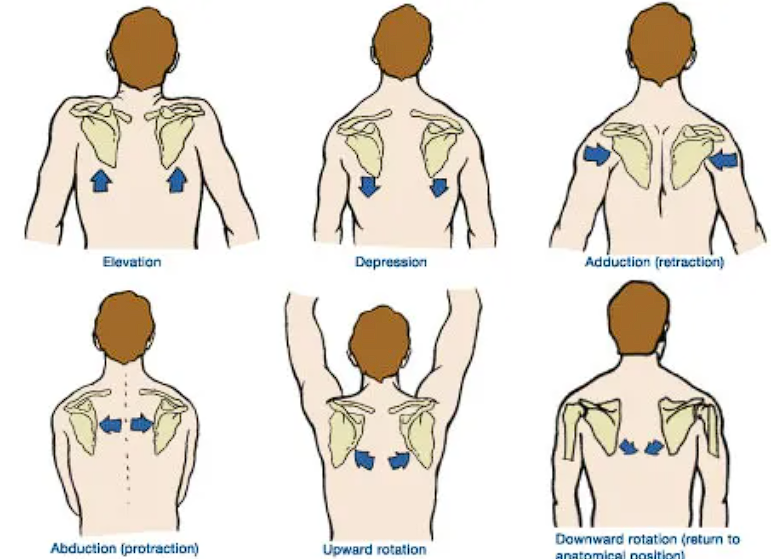
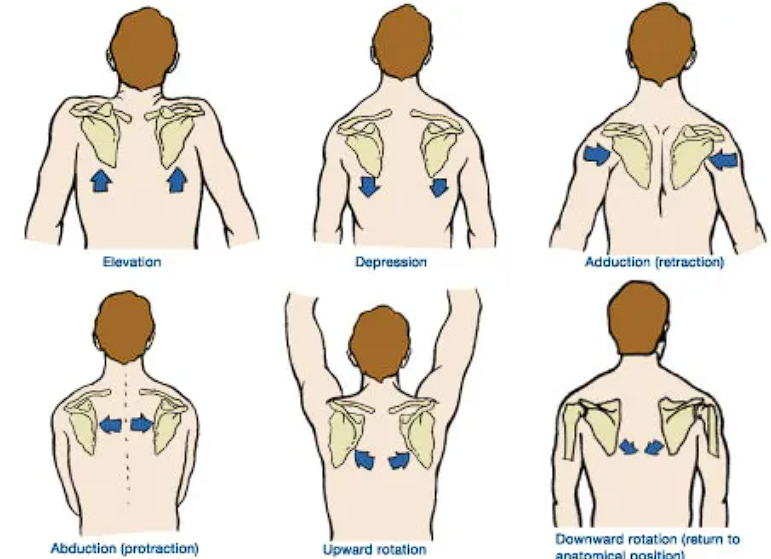
List the scapular movements

  • Elevation

  • Depression

  • Protraction (abduction)

  • Retraction (adduction)

  • Rotation

<ul><li><p>Elevation</p></li><li><p>Depression</p></li><li><p>Protraction (abduction)</p></li><li><p>Retraction (adduction)</p></li><li><p>Rotation</p></li></ul><p></p>
12
New cards

Describe scapular elevation

Scapula moves superiorly (as in shrugging the shoulder)
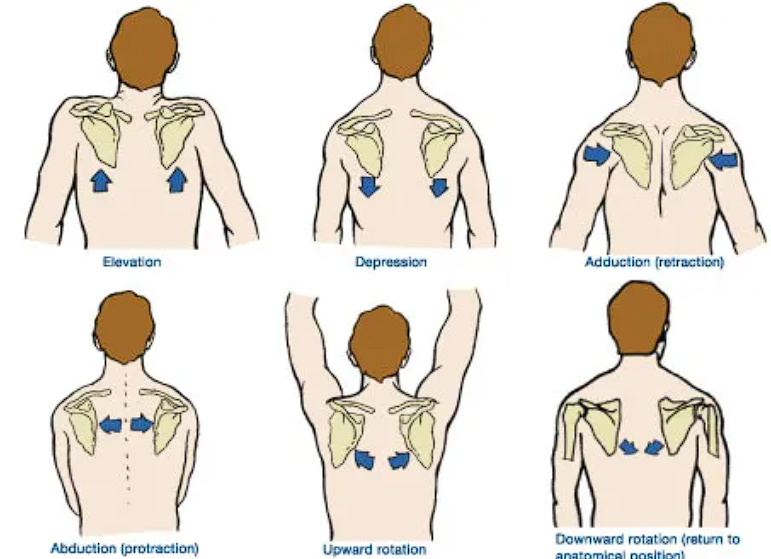
<p>Scapula moves superiorly (as in shrugging the shoulder)</p>
13
New cards

Describe Scapular depression

scapula moves inferiorly
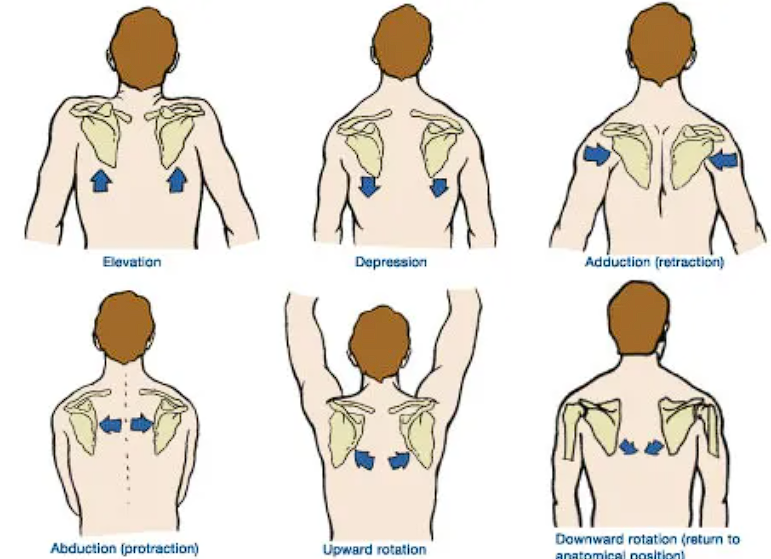
<p>scapula moves inferiorly </p>
14
New cards

Describe scapular protraction (abduction)

scapula moves away from the middle
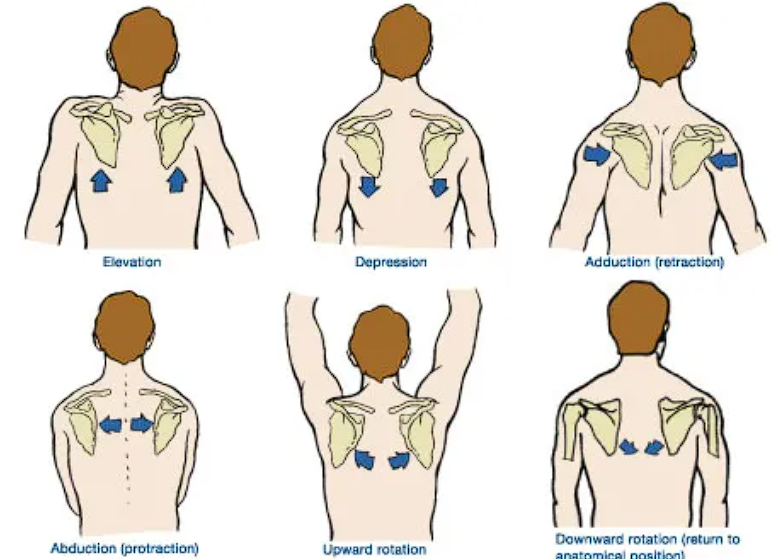
<p>scapula moves away from the middle</p>
15
New cards

Describe scapular retraction (adduction)

scapula moves away toward the midline
<p>scapula moves away toward the midline</p>
16
New cards

Describe scapular rotation

defined by the direction that the glenoid fossa faces (glenoid fossa faces superiorly for upward rotation and inferiorly for downward rotation)
<p>defined by the direction that the glenoid fossa faces (glenoid fossa faces superiorly for upward rotation and inferiorly for downward rotation)</p>
17
New cards

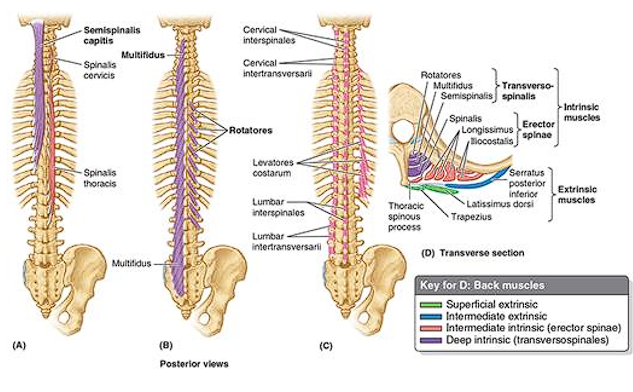
What muscles are considered the deep back muscles/ Intrinsic back muscles (superficial → intermediate → deep), what are they innervated by, and what are they responsible for?

  • Splenicus capitus and cervicis

  • Erector spinae

  • Transversospinalis, Suboccipital muscles

  • Innervated by dorsal (posterior) rami of spinal nerve at each vertebral level

  • Responsible for maintaining posture

18
New cards

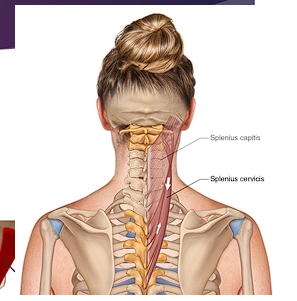
Describe the location, Innervation, and actions of the splenius capitusa and cervicis muscle

  • Located deep to the Levator scapulae and rhomboid muscles, and superficial to erector spinae muscles

  • Action:

    • Bilateral contraction: extension of the head and neck

    • unilateral contraction: lateral flexion and rotation of the head and neck

  • Innervation:

    • segmentally innervated by dorsal rami

<ul><li><p>Located deep to the Levator scapulae and rhomboid muscles, and superficial to erector spinae muscles</p></li><li><p>Action:</p><ul><li><p>Bilateral contraction: extension of the head and neck</p></li><li><p>unilateral contraction: lateral flexion and rotation of the head and neck</p></li></ul></li><li><p>Innervation:</p><ul><li><p>segmentally innervated by <span style="color: red;">dorsal rami</span></p></li></ul></li></ul><p></p>
19
New cards

What are the major groups of deep back muscles of the splenius?

Splenius capitis and Splenius Cervicis

20
New cards

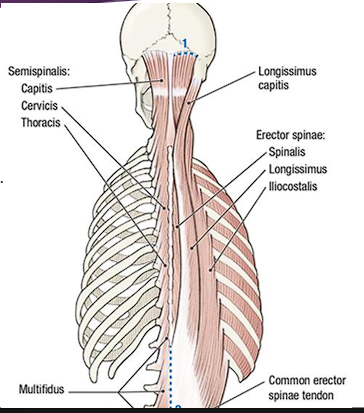
Describe the location, Innervation and actions of the Erector spinae muscles

  • Long muscles of the back, paraspinal muscles

Action:

  • Bilateral contraction: extension of the vertebral column and control of posture

  • Unilateral contraction: lateral flexion of vertebral column

Innervation:

  • segmentally innervated by dorsal rami

<ul><li><p>Long muscles of the back, paraspinal muscles</p></li></ul><p>Action:</p><ul><li><p>Bilateral contraction: extension of the vertebral column and control of posture</p></li><li><p>Unilateral contraction: lateral flexion of vertebral column</p></li></ul><p>Innervation:</p><ul><li><p>segmentally innervated by <span style="color: red;">dorsal rami</span></p></li></ul><p></p>
21
New cards

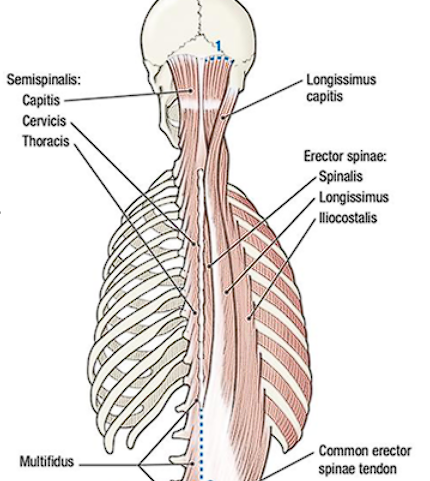
What are the major groups of deep muscles for the Erector spinae muscles?

From lateral to medial: Iliocostalis, Longissimus, Spinalis
<p>From lateral to medial:<span> </span><span style="color: red;">Iliocostalis, Longissimus, Spinalis</span></p>
22
New cards

Describe the location, Innervation, and actions of the transversospinalis muscles

  • located deep to the erector spinae muscles

Action:

  • Stabilization

  • Bilateral contraction: extension of the vertebral column

  • Unilateral contraction: rotation of vertebral column to the contralateral side of the contracting transversospinalis muscle

Innervation:

  • segmentally innervated by dorsal rami

<ul><li><p>located deep to the erector spinae muscles</p></li></ul><p>Action:</p><ul><li><p>Stabilization</p></li><li><p>Bilateral contraction: extension of the vertebral column</p></li><li><p>Unilateral contraction: rotation of vertebral column to the contralateral side of the contracting transversospinalis muscle</p></li></ul><p>Innervation:</p><ul><li><p>segmentally innervated by <span style="color: red;">dorsal rami</span></p></li></ul><p></p>
23
New cards

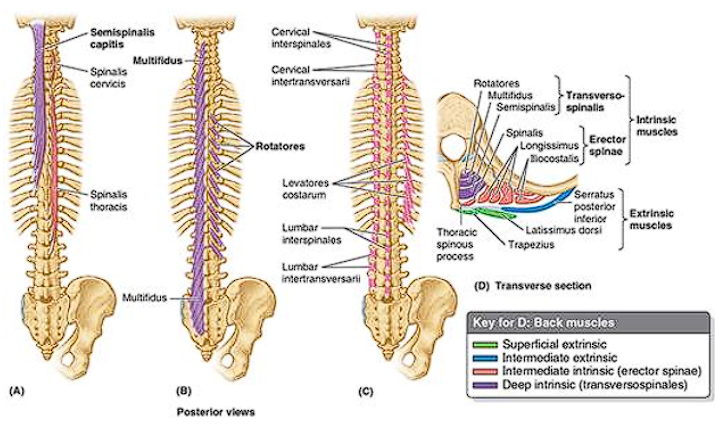
What are the major groups of deep muscles for the Transversospinalis muscles?

From superficial to deep: semispinalis, multifidus, and rotators
<p>From superficial to deep: <span style="color: red;">semispinalis, multifidus, and rotators</span></p>
24
New cards

Describe the location, Innervation, and actions of the suboccipital muscles

  • Located inferior to the occipital bone and deep to the semispinalis capitis muscle

Action:

  • Mainly postural muscles

  • May contribute to extension and rotation of the head

Innervation:

  • Dorsal ramus of C1 spinal nerve (suboccipital nerve)
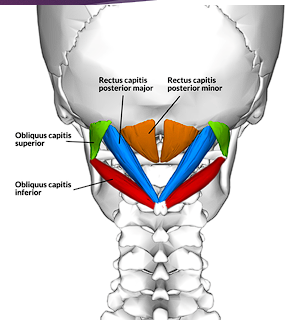
<ul><li><p>Located inferior to the occipital bone and deep to the semispinalis capitis muscle</p></li></ul><p>Action:</p><ul><li><p>Mainly postural muscles</p></li><li><p>May contribute to extension and rotation of the head</p></li></ul><p>Innervation:</p><ul><li><p><span style="color: red;">Dorsal ramus </span>of C1 spinal nerve (suboccipital nerve)</p></li></ul><p></p>
25
New cards

What are the major groups of deep muscles for the suboccipital muscles?

  • Rectus capitis posterior major and minor

  • Obliquus capitis superior and inferior
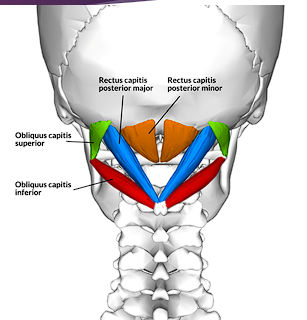
<ul><li><p><span style="color: red;">Rectus capitis</span> posterior major and minor</p></li><li><p><span style="color: red;">Obliquus capitis</span> superior and inferior</p></li></ul><p></p>
26
New cards

Explain the role of intrinsic back muscles in maintaining posture and facilitating movements of the vertebral column

Maintain posture, provide stabilization, extend the vertebral column/head/neck via bilateral contraction, and cause lateral flexion/rotation via unilateral contraction.

27
New cards

Describe the anatomical boundaries and contents of the suboccipital triangle

  • Superomedial- Rectus capitis posterior major

  • Superolateral- obliquus capitis superior

  • Inferior- obliquus capitis inferior

  • Floor- Posterior antlanto-occipital membrane and posterior arch of the C1 (atlas)

  • Roof- Semispinalis capitus

  • Vertebral artery, suboccipital nerve, greater occipital nerve
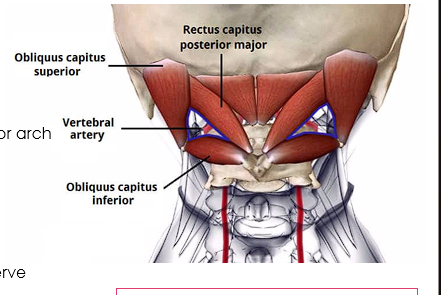
<ul><li><p><span style="color: rgb(255, 255, 255);">Superomedial</span>- <span style="color: red;">Rectus capitis posterior major</span></p></li><li><p><span style="color: rgb(255, 254, 254);">Superolateral</span>- <span style="color: red;">obliquus capitis superior</span></p></li><li><p>Inferior-<span style="color: red;"> obliquus capitis inferior</span></p></li><li><p>Floor- <span style="color: red;">Posterior antlanto-occipital</span> membrane and posterior arch of the C1 (atlas)</p></li><li><p>Roof- <span style="color: red;">Semispinalis capitus</span></p></li></ul><p></p><ul><li><p>Vertebral artery, suboccipital nerve, greater occipital nerve</p></li></ul><p></p>
28
New cards

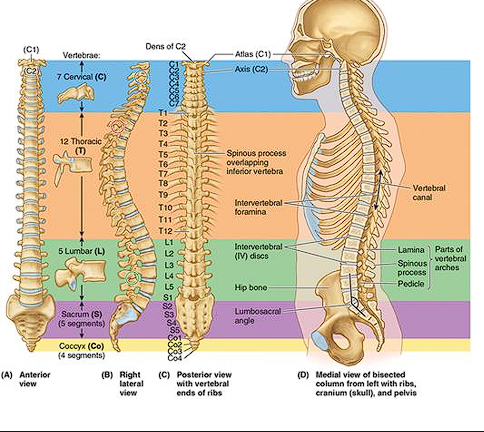
List the regions and number of vertebrae that compose the vertebral column

  • Cervical (7)

  • Thoracic (12)

  • Lumbar (5)

  • Sacral (5)

  • Coccygeal (4 segments that fuse into one solid bone)

  • 33 vertebrae

<ul><li><p>Cervical (7)</p></li><li><p>Thoracic (12)</p></li><li><p>Lumbar (5)</p></li><li><p>Sacral (5)</p></li><li><p>Coccygeal (4 segments that fuse into one solid bone)</p></li><li><p>33 vertebrae </p></li></ul><p></p>
29
New cards

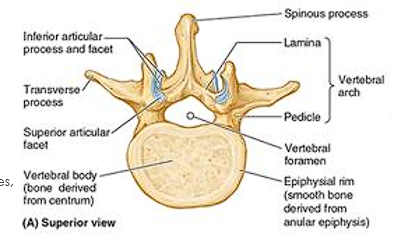
Describe the structural components of the vertebral body

  • Anterior more massive part

  • Gives strength to the vertebral column and support body weight

  • Size increase as column descends

  • Trabecular bone containing red marrow

  • Surround by a thin external layer of compact bone
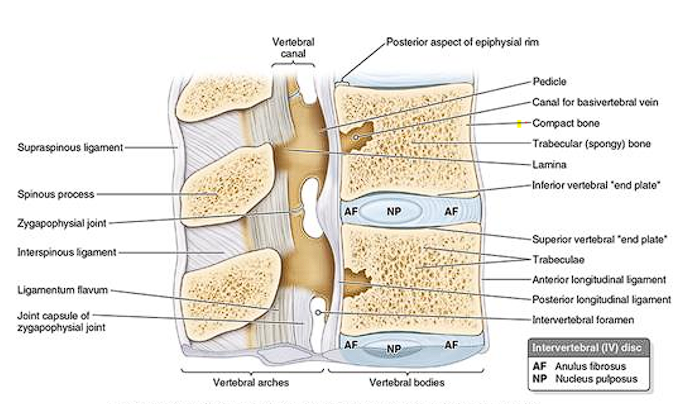
<ul><li><p>Anterior more massive part</p></li><li><p>Gives strength to the vertebral column and support body weight</p></li><li><p>Size increase as column descends</p></li><li><p>Trabecular bone containing red marrow</p></li><li><p>Surround by a thin external layer of compact bone </p></li></ul><p></p>
30
New cards

Describe the structural components of the vertebral arch

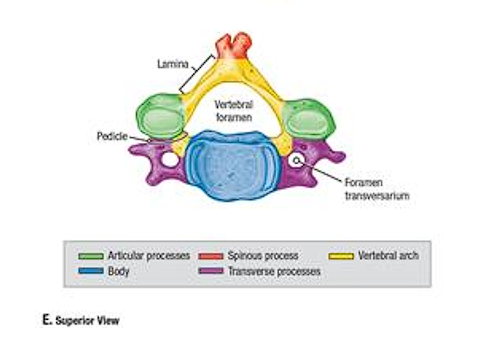
  • Posterior to the body

  • 2 pedicles: Right and Left. Short, cylindrical process. Project posteriorly

  • 2 Lamina: Broad, flat bones. Connect transverse and spinous processes
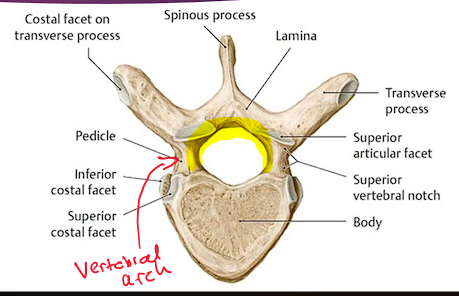
<ul><li><p>Posterior to the body</p></li><li><p>2 <span style="color: red;">pedicles</span>: Right and Left. Short, cylindrical process. Project posteriorly</p></li><li><p>2 <span style="color: red;">Lamina</span>: Broad, flat bones. Connect transverse and spinous processes</p></li></ul><p></p>
31
New cards

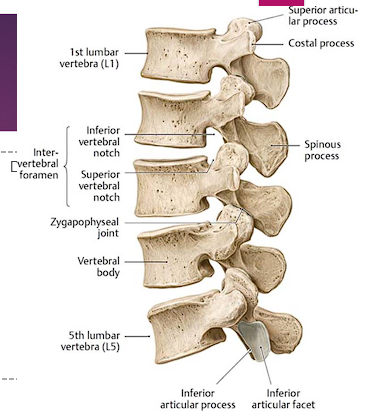
Describe the structural components of the vertebral processes

  • Arise from vertebral arch

  • Spinous process (1)- Posterior projecting tip, easily palpated

  • Transverse process (2)- lateral

  • Articular process (4)

    • 2 superior and 2 inferior

    • Facet

    • Zygapophyseal (facet joint)

<ul><li><p>Arise from vertebral arch</p></li><li><p><span style="color: red;">Spinous process (1)</span>- Posterior projecting tip, easily palpated</p></li><li><p><span style="color: red;">Transverse process (2)</span>- lateral</p></li><li><p><span style="color: red;">Articular process (4)</span></p><ul><li><p>2 superior and 2 inferior</p></li><li><p>Facet</p></li><li><p>Zygapophyseal (facet joint)</p></li></ul></li></ul><p></p>
32
New cards

The transverse process and spinous process provide attachment to what muscles and what do they serve as ?

  • Deep muscles

  • Serve as a lever to facilitate the muscles to change position

33
New cards

Describe the structural components of the vertebral foramen

  • Formed from the vertebral arch and posterior surface of the vertebral body

  • contains Spinal cord

<ul><li><p>Formed from the vertebral arch and posterior surface of the vertebral body</p></li><li><p>contains Spinal cord</p></li></ul><p></p>
34
New cards

What anatomical features are unique in respect to the cervical spine?

  • Atlas (C1)

  • Axis (C2)

  • C7

35
New cards

What anatomical features are unique in respect to the thoracic spine?

  • T1

  • T2

36
New cards

What anatomical features are unique in respect to the Lumbar spine?

  • Accessory process

  • Mammillary process

37
New cards

What anatomical features are unique in respect to the sacrum?

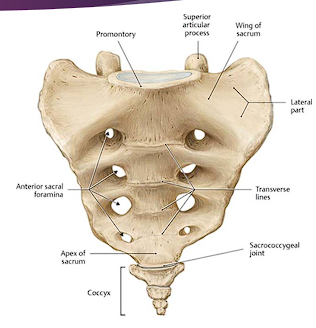
  • Sacral foramen

  • sacral promontory

  • Sacral canal

  • Sacral hiatus

38
New cards

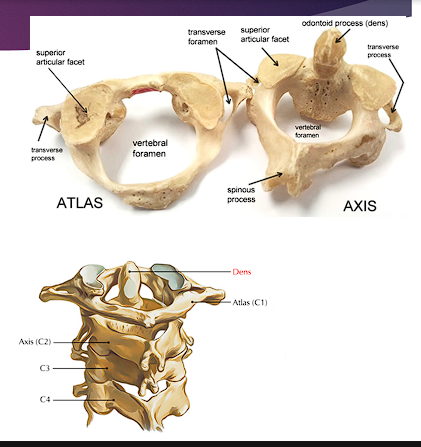
Describe the features of the Atlas (C1)

  • Atypical

  • Supports the skull, allows nodding movement

  • Articulates with the skull (occipital condyles)

  • Ring, kidney shaped

  • LACKS spinous process and body

  • Nod up and down

<ul><li><p><span style="color: red;">Atypical</span></p></li><li><p>Supports the skull, allows <span style="color: red;">nodding movement</span></p></li><li><p>Articulates with the skull (occipital condyles)</p></li><li><p>Ring, kidney shaped</p></li><li><p><span style="color: red;">LACKS spinous process and body</span></p></li><li><p>Nod up and down</p></li></ul><p></p>
39
New cards

Describe the features of the Axis (C2)

  • Strongest cervical vertebrae- carries cranium

  • Dens (odontoid process)

    • Attachment for transverse, apical, and alar ligaments

  • Bifid spinous process

  • Provides rotational movement (through it articulates with C1)
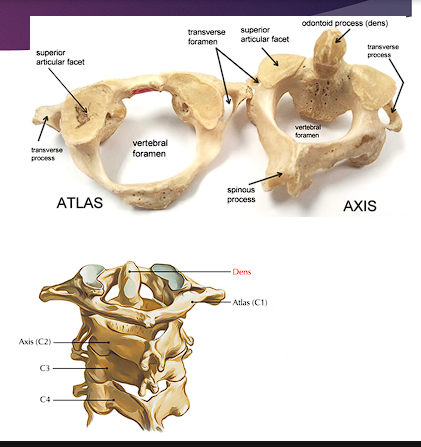
<ul><li><p>Strongest cervical vertebrae- carries cranium</p></li><li><p><span style="color: red;">Dens (odontoid process)</span></p><ul><li><p>Attachment for transverse, apical, and alar ligaments</p></li></ul></li><li><p><span style="color: red;">Bifid spinous process</span></p></li><li><p>Provides <span style="color: red;">rotational movement</span> (through it articulates with C1)</p></li></ul><p></p>
40
New cards

Describe the features of C7

  • Long spinous process

  • Spinous process is NOT BIFED

  • Larger body

  • Smaller transverse foramen

  • Palpable bulge on back of neck

    • Transmits only small accessory veins

<ul><li><p>Long spinous process</p></li><li><p>Spinous process is NOT BIFED</p></li><li><p>Larger body</p></li><li><p>Smaller transverse foramen</p></li><li><p>Palpable bulge on back of neck</p><ul><li><p>Transmits only small accessory veins</p></li></ul></li></ul><p></p>
41
New cards

Describe the features of T1

  • Atypical

  • Long almost horizontal spinous process

  • Complete costal facet on the superior edge of its body for the 1st rib

  • Demifacet on its inferior edge that contributes to the articular surface of 2nd rib

  • Spinous process is elongated and resembles that a cervical vertebrae

42
New cards

Describe the features of T12

  • Mammillary process (small tubercle)

  • Transitions in characteristics

    • Superior half-thoracic characteristics

      • Rotary movement

    • Inferior half-lumbar characteristics

      • Permit flexion and extension

    • Most commonly fractured vertebrae

43
New cards

Describe the accessory process of the lumbar spine

Attachment for the intertransversarii muscles
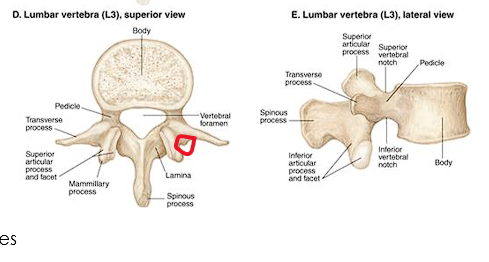
<p>Attachment for the intertransversarii muscles</p>
44
New cards

Describe the Mammillary process of the lumbar spine

  • Posteriorly located

  • Attachment of Multifidus and intertransversarii muscles
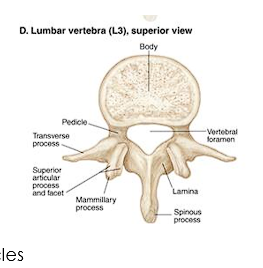
<ul><li><p>Posteriorly located</p></li><li><p>Attachment of Multifidus and intertransversarii muscles</p></li></ul><p></p>
45
New cards

Describe the features of the sacral foramen

  • 4 pairs

  • Exit of the posterior and anterior rami of the spinal nerves

  • Anterior (pelvic) are larger than posterior (dorsal) ones
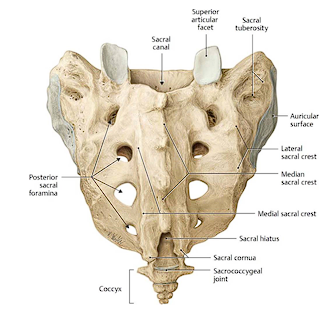
<ul><li><p>4 pairs</p></li><li><p>Exit of the posterior and anterior rami of the spinal nerves</p></li><li><p>Anterior (pelvic) are larger than posterior (dorsal) ones</p></li></ul><p></p>
46
New cards

Describe the features of the sacral promontroy

  • Anterior projecting edge of the body of S1

  • L. mountain ridge

  • Important OB landmark

<ul><li><p>Anterior projecting edge of the body of S1</p></li><li><p><span style="color: red;">L. mountain ridge</span></p></li><li><p>Important OB landmark</p></li></ul><p></p>
47
New cards

Describe the features of the sacral canal

  • Continuation of the vertebral canal in the sacrum

  • Contains the Cauda equina

    • bundle of spinal nerve roots arising inferior to the L1 vertebrae
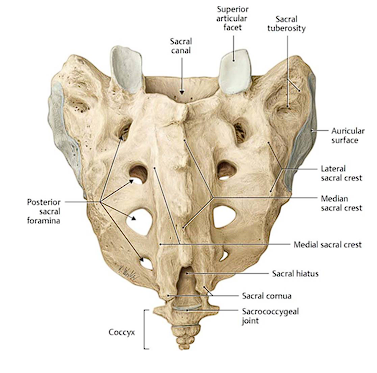
<ul><li><p>Continuation of the vertebral canal in the sacrum</p></li><li><p>Contains the Cauda equina</p><ul><li><p>bundle of spinal nerve roots arising inferior to the L1 vertebrae</p></li></ul></li></ul><p></p>
48
New cards

Describe the features of the sacral hiatus

  • U shaped

  • leads into the sacral canal

  • Between sacral cornua, inferior to median sacral crest

  • Provides access to the epidural space

  • Used in OB, pediatric procedure, and chronic pain management
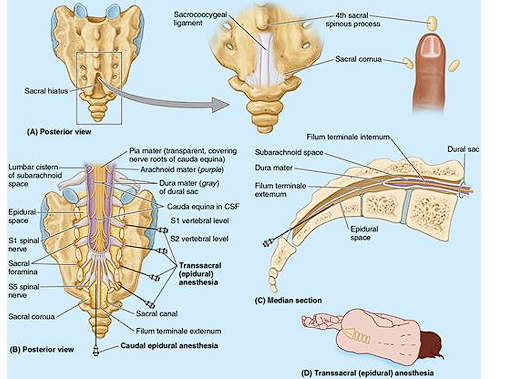
<ul><li><p>U shaped</p></li><li><p>leads into the sacral canal</p></li><li><p>Between sacral cornua, inferior to median sacral crest</p></li><li><p>Provides access to the epidural space</p></li><li><p>Used in OB, pediatric procedure, and chronic pain management</p></li></ul><p></p>
49
New cards

Describe the features of the coccyx

  • Tailbone

  • Triangular bone

  • Remnant of the embryonic tail-like cauda eminence

  • Last 3 coccygeal vertebra fuse during midlife forms beak-like coccyx

  • Provides attachments for parts of the gluteus maximus and coccygeus muscles and anococcygeal ligament

50
New cards

What is the functional significance of primary (Kyphotic) curvature

  • Thoracic and Sacral

  • Develop in the fetal period

  • Concave anteriorly

  • Retain through life

  • Abnormal curvature-kyphosis, excessive kyphosis
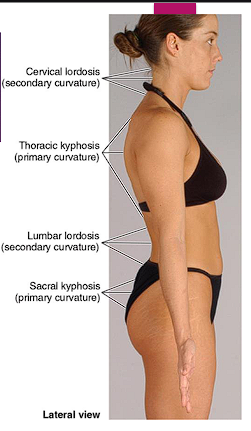
<ul><li><p><span style="color: red;">Thoracic and Sacral</span> </p></li><li><p>Develop in the fetal period</p></li><li><p>Concave anteriorly </p></li><li><p>Retain through life</p></li><li><p>Abnormal curvature-kyphosis, excessive kyphosis</p></li></ul><p></p>
51
New cards

What is the functional significance of secondary (Lordotic) curvature

  • Cervical and Lumbar

  • Develop postnatal period

  • Concave posteriorly

  • Abnormal curvature-lordosis, excessive lordosis
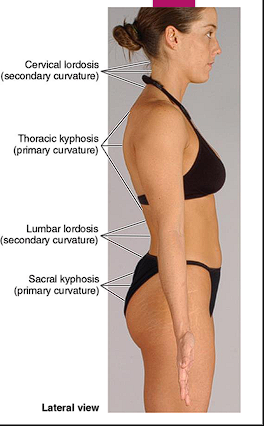
<ul><li><p><span style="color: red;">Cervical and Lumbar</span></p></li><li><p>Develop postnatal period</p></li><li><p>Concave posteriorly</p></li><li><p>Abnormal curvature-lordosis, excessive lordosis</p></li></ul><p></p>
52
New cards

Compare and contrast the characteristics of the five regions of the vertebral column

As the vertebral column descends, bodies increase in size to handle increased weight-bearing. The size of the vertebral canal changes relative to the diameter of the spinal cord.

53
New cards

Describe the features of the annulus fibrosis of the disc

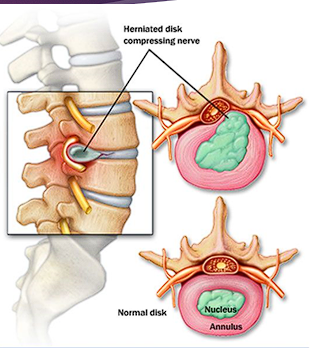
  • Bulging fibrous ring

  • Consists of concentric lamellae of fibrocartilage

  • Insert into smooth rounded epiphysial rims on the articular surface

  • Thinner posteriorly, may be incomplete in an adult in the cervical region

  • Decreasingly vascularized centrally

  • Outer third receives sensory innervation
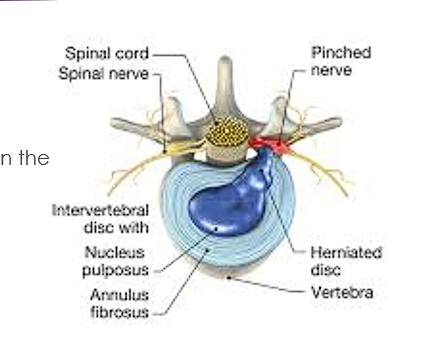
<ul><li><p><span style="color: red;">Bulging fibrous ring</span></p></li><li><p>Consists of concentric lamellae of fibrocartilage</p></li><li><p>Insert into smooth rounded epiphysial rims on the articular surface</p></li><li><p>Thinner posteriorly, may be incomplete in an adult in the cervical region</p></li><li><p><span style="color: red;">Decreasingly vascularized centrally</span></p></li><li><p><span style="color: red;">Outer third receives sensory innervation</span></p></li></ul><p></p>
54
New cards

Describe the features of the nucleus pulposus of the disc

  • Central core of disc (jelly like center)

  • At birth-88% water, more cartilage than fiber

  • Responsible for the flexibility and resilience of the disc and column

  • Becomes broader when compressed

  • Thinner when tensed or stretched

<ul><li><p>Central core of disc (jelly like center)</p></li><li><p>At birth-88% water, more cartilage than fiber</p></li><li><p>Responsible for the flexibility and resilience of the disc and column</p></li><li><p>Becomes broader when compressed</p></li><li><p>Thinner when tensed or stretched</p></li></ul><p></p>
55
New cards

Describe the features of the craniovertebral joints

  • 2 sets- atlanto-occipital joints and atlanto-axial joints

  • Synovial joints that have no IV discs

  • Wider range of movement than the rest of the vertebral column

  • Articulations involve the occipital condyles, atlas, axis
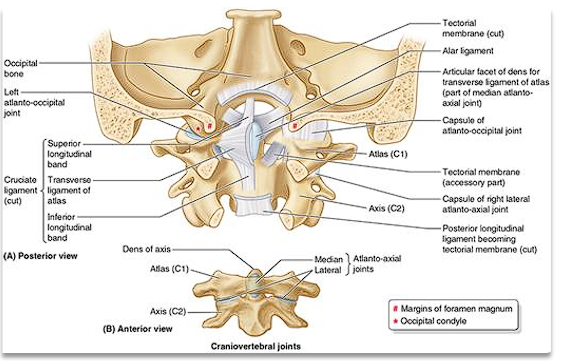
<ul><li><p><span style="font-family: &quot;Century Gothic&quot;;">2 sets- <strong>atlanto-occipital joints </strong>and <strong>atlanto-axial joints</strong></span></p></li></ul><ul><li><p><strong>Synovial joints that have no IV discs</strong></p></li></ul><ul><li><p><span style="font-family: &quot;Century Gothic&quot;;">Wider range of movement than the rest of the vertebral column</span></p></li></ul><ul><li><p><span style="font-family: &quot;Century Gothic&quot;;">Articulations involve the occipital condyles, atlas, axis</span></p></li></ul><p></p>
56
New cards

What joints are associated with Craniovertebral joints

  • Atlanto-Occipital joints

  • Atlanto-axial joints

57
New cards

What are the features of Atlanto-Occipital joints

  • Between atlas (C1) and occipital bone of the cranium

  • Synovial joint of condyloid type-thin, loose capsules

  • Permit nodding of the head (extension and flexion) the “YES” motion

  • Permit sideways tilting of the head (lateral flexion)
<ul><li><p><span style="font-family: &quot;Century Gothic&quot;;">Between atlas (C1) and occipital bone of the cranium</span></p></li><li><p><strong>Synovial joint of condyloid type-thin, loose capsules</strong></p></li><li><p><span style="font-family: &quot;Century Gothic&quot;;">Permit nodding of the head (<strong>extension and flexion</strong>) <strong>the </strong></span><span style="font-family: &quot;Century Gothic&quot;; color: red;"><strong>“YES” motion</strong></span></p></li><li><p><span style="font-family: &quot;Century Gothic&quot;;">Permit <strong>sideways tilting </strong>of the head (lateral flexion)</span></p></li></ul><p></p>
58
New cards

What are the features of the Atlanto-axial joints

  • Between the atlas (C1) and axis (C2)

  • 3 articulations (2 lateral and 1 median)

  • Lateral- gliding type synovial joints

  • Median- pivotal joint

  • Permits rotating head side to side- saying “no” (rotation)
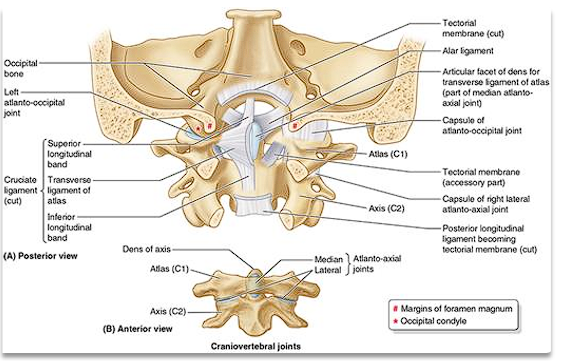
<ul><li><p><span style="font-family: &quot;Century Gothic&quot;;">Between the atlas (C1) and axis (C2)</span></p></li></ul><ul><li><p><span style="font-family: &quot;Century Gothic&quot;;">3 articulations (2 lateral and 1 median)</span></p></li></ul><ul><li><p><span style="color: red;"><strong>Lateral</strong></span><span style="font-family: &quot;Century Gothic&quot;;"><strong>-</strong> gliding type synovial joints</span></p></li></ul><ul><li><p><span style="color: red;"><strong>Median</strong></span>- pivotal joint</p></li></ul><ul><li><p><span style="font-family: &quot;Century Gothic&quot;;">Permits rotating head side to side- </span><span style="font-family: &quot;Century Gothic&quot;; color: red;"><strong>saying “no” </strong></span><span style="font-family: &quot;Century Gothic&quot;;"><strong>(rotation)</strong></span></p></li></ul><p></p>
59
New cards

Describe the features of Uncovertebral Joints (joints of Luschka)

  • Between uncinate process of the lower vertebrae and the body of the vertebrae above

  • Found ONLY in the cervical spine (typically C3-7)

  • Lateral and posterolateral margins of IV discs

  • Considered synovial joint

  • Clefts (degenerative spaces)

    • Degenerative spaces in the discs occupied by extracellular fluid

  • Clinical correlation:

    • Sites of bone spur (osteophyte) formation neck pain
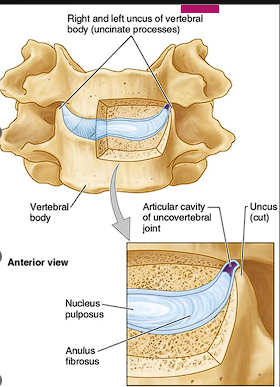
<ul><li><p><span style="font-family: &quot;Century Gothic&quot;;">Between uncinate process of the lower vertebrae and the body of the vertebrae above</span></p></li></ul><ul><li><p><strong>Found </strong><span style="color: red;"><strong>ONLY in the cervical spine </strong></span><strong>(typically </strong><span style="font-family: &quot;Century Gothic&quot;; color: red;"><strong>C3-7</strong></span><span style="font-family: &quot;Century Gothic&quot;;"><strong>)</strong></span></p></li></ul><ul><li><p><span style="font-family: &quot;Century Gothic&quot;;">Lateral and posterolateral margins of IV discs</span></p></li></ul><ul><li><p><span style="color: red;"><strong>Considered synovial joint</strong></span></p></li></ul><ul><li><p><span style="font-family: &quot;Century Gothic&quot;; color: red;">Clefts (degenerative spaces)</span></p><ul><li><p><span style="font-family: &quot;Century Gothic&quot;;">Degenerative spaces in the discs occupied by extracellular fluid</span></p></li></ul></li><li><p><strong>Clinical correlation:</strong></p><ul><li><p><span style="font-family: &quot;Century Gothic&quot;;">Sites of bone spur (osteophyte) formation neck pain</span></p></li></ul></li></ul><p></p>
60
New cards

Describe the features of Zygapophysial joints (facets) (joints of vertebral arches)

  • Plane synovial  joints between the superior and  inferior articular processes of adjacent vertebrae

  • Surrounded by a thin joint capsule

    • Thin and loose in cervical region= movement

    • Attached to the margins of the articular surfaces of the articular processes

  • Accessory ligaments unite the laminae, transverse processes, spinous processes to help stabilize the joint

  • Permit gliding movements between articular processes

  • Enable vertebral flexion, extension and limit rotation

  • Innervated by articular branches from the medial branches of the posterior rami of the spinal nerves

    • Each joint is supplied by 2 nerves

<ul><li><p><span style="font-family: &quot;Century Gothic&quot;;">Plane synovial&nbsp; joints between the superior and&nbsp; inferior articular processes of adjacent vertebrae</span></p></li><li><p><span style="font-family: &quot;Century Gothic&quot;;">Surrounded by a thin joint capsule</span></p><ul><li><p><span style="font-family: &quot;Century Gothic&quot;;">Thin and loose in cervical region= movement</span></p></li><li><p><span style="font-family: &quot;Century Gothic&quot;;">Attached to the margins of the articular surfaces of the articular processes</span></p></li></ul></li><li><p><span style="font-family: &quot;Century Gothic&quot;;">Accessory ligaments unite the laminae, transverse processes, spinous processes to help stabilize the joint</span></p></li><li><p><span style="font-family: &quot;Century Gothic&quot;; color: red;">Permit gliding movements </span><span style="font-family: &quot;Century Gothic&quot;;">between articular processes</span></p></li><li><p><span style="font-family: &quot;Century Gothic&quot;;">Enable </span><span style="font-family: &quot;Century Gothic&quot;; color: red;">vertebral flexion, extension and limit rotation</span></p></li><li><p><span style="color: red;"><strong>Innervated by articular branches from the medial branches of the posterior rami of the spinal nerves</strong></span></p><ul><li><p><span style="font-family: &quot;Century Gothic&quot;;">Each joint is supplied by 2 nerves</span></p></li></ul></li></ul><p></p>
61
New cards

Describe the features of intervertebral joints

  • Fibrocartilaginous symphysis (secondary cartilaginous joints)

  • Between vertebral bodies of adjacent vertebrae

  • The intervertebral disc forms the connection between the bodies
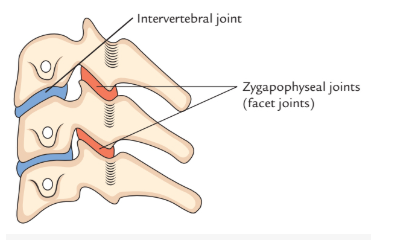
<ul><li><p><span style="font-family: &quot;Century Gothic&quot;;">Fibrocartilaginous symphysis (secondary cartilaginous joints)</span></p></li><li><p><span style="font-family: &quot;Century Gothic&quot;;">Between vertebral bodies of adjacent vertebrae</span></p></li><li><p><span style="font-family: &quot;Century Gothic&quot;;">The intervertebral disc forms the connection between the bodies</span></p></li></ul><p></p>
62
New cards

Describe the features of costovertebral joints

  • Joints of the head of the ribs

  • Supported by multiple ligaments

  • Synovial plane joint

  • Joints of Head of ribs

    • Slight gliding

<ul><li><p><span style="font-family: &quot;Century Gothic&quot;;">Joints of the </span><span style="font-family: &quot;Century Gothic&quot;; color: red;"><strong>head of the ribs</strong></span><span style="font-family: &quot;Century Gothic&quot;;"><strong> </strong></span></p></li><li><p><span style="font-family: &quot;Century Gothic&quot;;">Supported by multiple ligaments</span></p></li><li><p><span style="font-family: &quot;Century Gothic&quot;;">Synovial plane joint</span></p></li><li><p><strong>Joints of Head of ribs</strong></p><ul><li><p><span style="font-family: &quot;Century Gothic&quot;;">Slight gliding</span></p></li></ul></li></ul><p></p>
63
New cards

Describe the features of Lumbosacral joint

  • Articulation between L5 and S1

  • Intervertebral symphysis and Zygapophyseal (facet) synovial joint

  • Highly weight bearing transition point between lumbar and sacrum

  • High stress at the lumbosacral angle

  • Clinical correlation:

    • Common site of herniated disc, spondylolisthesis, degenerative changes
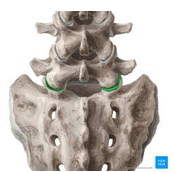
<ul><li><p><span style="font-family: &quot;Century Gothic&quot;;">Articulation between L5 and S1</span></p></li><li><p><span style="color: red;"><strong>Intervertebral symphysis </strong>and <strong>Zygapophyseal </strong></span><span style="font-family: &quot;Century Gothic&quot;; color: red;">(facet) <strong>synovial joint</strong></span></p></li><li><p><span style="font-family: &quot;Century Gothic&quot;;">Highly weight bearing transition point between lumbar and sacrum</span></p></li><li><p><span style="font-family: &quot;Century Gothic&quot;;">High stress at the lumbosacral angle</span></p></li><li><p><strong>Clinical correlation:</strong></p><ul><li><p><span style="font-family: &quot;Century Gothic&quot;;">Common site of herniated disc, spondylolisthesis, degenerative changes</span></p></li></ul></li></ul><p></p>
64
New cards

Describe the features of the Sacroiliac joints

  • Joint of the pelvic girdle

  • Between auricular surface of the sacrum and ilium

  • Strong, weight bearing joints

  • Anterior synovial joint-, covered with articular cartilage

  • Transfers weight from spine to the pelvis to the lower limbs

  • Provides stability

  • Very limited mobility

    • Slight gliding and rotary movement

    • Due to interlocking of articulating bones and ligaments

  • Clinical correlation

    • SI joint dysfunction

    • Sacroilitis

<ul><li><p><span style="font-family: &quot;Century Gothic&quot;;">Joint of the pelvic girdle</span></p></li><li><p><span style="font-family: &quot;Century Gothic&quot;;">Between auricular surface of the</span><span style="font-family: &quot;Century Gothic&quot;; color: red;"> <strong>sacrum and ilium</strong></span></p></li><li><p><span style="font-family: &quot;Century Gothic&quot;;">Strong, weight bearing joints</span></p></li><li><p><span style="color: red;"><strong>Anterior synovial joint-</strong></span>, covered with articular cartilage</p></li><li><p><span style="font-family: &quot;Century Gothic&quot;;">Transfers weight from spine to the pelvis to the lower limbs</span></p></li><li><p><span style="font-family: &quot;Century Gothic&quot;;">Provides stability</span></p></li><li><p><span style="font-family: &quot;Century Gothic&quot;;">Very </span><span style="color: red;"><strong>limited mobility</strong></span></p><ul><li><p><span style="color: red;"><strong>Slight gliding and rotary movement</strong></span></p></li><li><p><span style="font-family: &quot;Century Gothic&quot;;">Due to interlocking of articulating bones and ligaments </span></p></li></ul><p></p></li><li><p><span style="font-family: &quot;Century Gothic&quot;;"><strong>Clinical correlation</strong></span></p><ul><li><p><span style="font-family: &quot;Century Gothic&quot;;">SI joint dysfunction</span></p></li><li><p><span style="font-family: &quot;Century Gothic&quot;;">Sacroilitis </span></p></li></ul></li></ul><p></p>
65
New cards

Describe the features of the Sacrococcygeal joints

  • Articulation between sacrum and coccyx

  • Symphysis

  • Become partially or completely fused with age (sometimes)

  • Allows very limited movement

    • Slight flexion/extension of the coccyx during sitting, defecation, childbirth
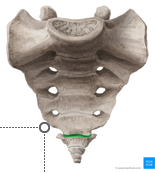
<ul><li><p><span style="font-family: &quot;Century Gothic&quot;;">Articulation between sacrum and coccyx</span></p></li><li><p><span style="font-family: &quot;Century Gothic&quot;; color: red;">Symphysis</span></p></li><li><p><span style="font-family: &quot;Century Gothic&quot;;">Become partially or completely fused with age (sometimes)</span></p></li><li><p><span style="font-family: &quot;Century Gothic&quot;;">Allows very limited movement</span></p><ul><li><p><span style="font-family: &quot;Century Gothic&quot;; color: red;">Slight flexion/extension</span><span style="font-family: &quot;Century Gothic&quot;;"> of the coccyx during sitting, defecation, childbirth</span></p></li></ul></li></ul><p></p>
66
New cards

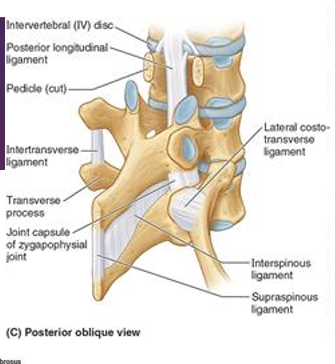
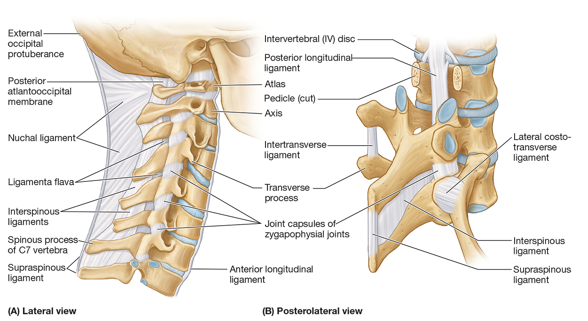
Describe the Anterior longitudinal ligament

  • Strong, broad fibrous band

  • On anterior surface of vertebral column

  • Attaches to the vertebral bodies and intervertebral discs

  • Extends from sacrum to C1 and occipital bone

  • Maintain stability of the joints between the vertebral bodies

  • Prevents hyperextension of vertebra column

  • ONLY ligament that limits extension

<ul><li><p><span style="font-family: &quot;Century Gothic&quot;;">Strong, <strong>broad </strong>fibrous band</span></p></li><li><p><span style="font-family: &quot;Century Gothic&quot;;">On anterior surface of vertebral column</span></p></li><li><p><span style="font-family: &quot;Century Gothic&quot;;">Attaches to the <strong>vertebral bodies and intervertebral discs</strong></span></p></li><li><p><strong>Extends from sacrum to C1 and occipital bone</strong></p></li><li><p><strong>Maintain stability</strong> of the joints between the vertebral bodies</p></li><li><p><span style="color: red;"><strong>Prevents hyperextension</strong></span> of vertebra column</p></li><li><p><span style="color: red;"><strong><u>ONLY</u></strong></span><strong> ligament that</strong><span style="color: red;"><strong> limits extension</strong></span></p></li></ul><p></p>
67
New cards

Describe the posterior longitudinal ligament

  • Narrow, weaker

  • Runs within vertebral canal along the posterior aspect of the vertebral bodies

  • Supports the IV discs posteriorly

  • Helps prevent/redirect posterior herniation of the nucleus pulposus

  • Weakly resists hyperflexion

<ul><li><p><span style="color: red;"><strong>Narrow, weaker</strong></span></p></li><li><p><span style="font-family: &quot;Century Gothic&quot;;">Runs </span><strong>within </strong><span style="font-family: &quot;Century Gothic&quot;;">vertebral canal along the <strong>posterior aspect </strong>of the vertebral bodies</span></p></li><li><p><span style="font-family: &quot;Century Gothic&quot;;">Supports the IV discs posteriorly</span></p></li><li><p><span style="color: red;"><strong>Helps prevent/redirect posterior herniation</strong></span><strong> of the nucleus pulposus</strong></p></li><li><p><strong>Weakly resists hyperflexion</strong></p></li></ul><p></p>
68
New cards

Describe the ligamentum flavum (accessory ligaments of IV joints)

  • Broad, pale, yellow elastic fibrous tissue

  • Extends from lamina above to the lamina below

  • Forms the posterior wall  of the vertebral canal

  • Limiting abrupt flexion of the vertebral column, prevents injury to the IV discs

  • Preserve normal curvature, Assist with straightening after flexing (standing up)

  • Cervical Region- thin

  • Thoracic Region Thicker

  • Lumbar- Thickest

<ul><li><p><strong>Broad, pale,</strong><span style="color: yellow;"><strong> yellow elastic </strong></span><strong>fibrous tissue</strong></p></li><li><p><strong>Extends from lamina above to the lamina below</strong></p></li><li><p><span style="font-family: &quot;Century Gothic&quot;;">Forms the <strong>posterior wall&nbsp; </strong>of the vertebral canal</span></p></li><li><p><span style="color: red;"><strong>Limiting abrupt flexion</strong></span><strong> </strong>of the vertebral column, prevents injury to the IV discs</p></li><li><p><span style="color: red;"><strong>Preserve normal curvature</strong></span>, <span style="color: red;"><strong>Assist with straightening</strong></span> after flexing (standing up)</p></li><li><p><span style="font-family: &quot;Century Gothic&quot;;">Cervical Region- thin</span></p></li><li><p><span style="font-family: &quot;Century Gothic&quot;;">Thoracic Region Thicker</span></p></li><li><p><span style="font-family: &quot;Century Gothic&quot;;">Lumbar- Thickest</span></p></li></ul><p></p>
69
New cards

Describe the Interspinous ligament (Accessory ligament of IV joints)

  • Weak, thin

  • Connect adjoining spinous processes

  • Attach to the root to the apex of each spinous process

  • Limits flexion

70
New cards

Describe the Supraspinous ligament (Accessory ligament of IV joints)

  • Strong, cord-like band

  • Connects tips of spinous process from C7 to sacrum

  • Limits flexion

<ul><li><p><span style="font-family: &quot;Century Gothic&quot;;">Strong, cord-like band</span></p></li><li><p><span style="font-family: &quot;Century Gothic&quot;; color: red;">Connects tips of spinous process</span><span style="font-family: &quot;Century Gothic&quot;;"> from C7 to sacrum</span></p></li><li><p><span style="font-family: &quot;Century Gothic&quot;;">Limits flexion</span></p></li></ul><p></p>
71
New cards

Describe the Nuchal ligament (Accessory ligament of IV joints) (ligaments of neck)

  • Merges with the supraspinous at the back of the neck

  • Strongest median ligament of the neck

  • Extends from external occipital proturbance and posterior border of the foramen magnum to the spinous process in the cervical vertebrae (C2 to C7)

  • Replaces the supraspinous ligament in the cervical region

  • Provides muscle attachment

  • Helps support the head and limit cervical flexion
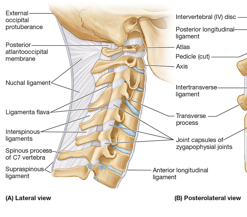
<ul><li><p><span style="font-family: &quot;Century Gothic&quot;;">Merges with the supraspinous at the back of the neck</span></p></li><li><p><span style="color: red;"><strong>Strongest</strong> median ligament of the neck</span></p></li><li><p><span style="font-family: &quot;Century Gothic&quot;;">Extends from <strong>external occipital proturbance </strong>and posterior border of <strong>the foramen magnum </strong>to the spinous process in the cervical vertebrae (C2 to C7)</span></p></li><li><p><span style="color: red;"><strong>Replaces the supraspinous ligament</strong></span><strong> </strong>in the cervical region</p></li><li><p><span style="font-family: &quot;Century Gothic&quot;;">Provides muscle attachment</span></p></li><li><p><span style="font-family: &quot;Century Gothic&quot;;">Helps </span><strong>support the head and limit cervical flexion</strong></p></li></ul><p></p>
72
New cards

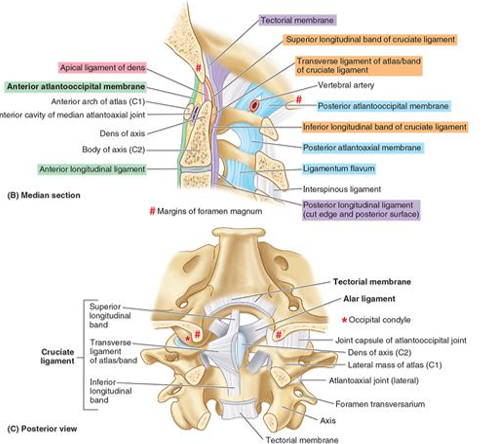
Describe the structure of the cruciate ligament (Cruciform ligament) (ligaments of neck)

  • Transverse ligament of Atlas

    • Horizontal, strong band

    • Attaches to the medial tubercles on the lateral masses of C1

    • Passes posterior to the dens (odontoid process of C2)

    • Holds dens against anterior aspect of the atlas

    • Prevents anterior displacement of C1 on C2- stabilizes the atlanto-axial joint

  • Longitudinal bands (superior and inferior)

    • Vertical, Weaker

    • Pass from transverse ligament to occipital bone superiorly and to the body of C2 inferiorly

    • Stabilizes the atlanto-axial joint

<ul><li><p><span style="color: red;"><strong>Transverse ligament of Atlas</strong></span></p><ul><li><p><span style="color: red;"><strong>Horizontal</strong></span>,<span style="color: red;"> strong band</span></p></li><li><p><span style="font-family: &quot;Century Gothic&quot;;">Attaches to the medial tubercles on the lateral masses of C1</span></p></li><li><p><span style="font-family: &quot;Century Gothic&quot;;">Passes posterior to the dens (odontoid process of C2)</span></p></li><li><p><strong>Holds dens against anterior aspect of the atlas</strong></p></li><li><p><span style="font-family: &quot;Century Gothic&quot;;">Prevents anterior displacement of C1 on C2- <strong>stabilizes the atlanto-axial joint</strong></span></p></li></ul></li><li><p><span style="font-family: &quot;Century Gothic&quot;; color: red;"><strong>Longitudinal bands (superior and inferior)</strong></span></p><ul><li><p><span style="font-family: &quot;Century Gothic&quot;; color: red;">Vertical, Weaker</span></p></li><li><p><span style="font-family: &quot;Century Gothic&quot;;">Pass from transverse ligament to occipital bone superiorly and to the body of C2 inferiorly</span></p></li><li><p><strong>Stabilizes the atlanto-axial joint</strong></p></li></ul></li></ul><p></p>
73
New cards

Describe the Alar ligament (ligaments of neck)

  • Short, rounded cords

  • Attach the cranium to C1

  • Extend from the sides of the dens to the lateral margins of foramen magnum

  • Prevent excessive rotation at the joint
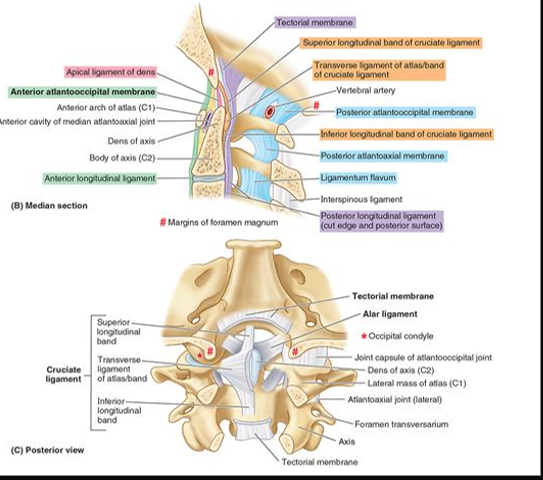
<ul><li><p><span style="font-family: &quot;Century Gothic&quot;;">Short, rounded cords</span></p></li><li><p><span style="font-family: &quot;Century Gothic&quot;;">Attach the cranium to C1</span></p></li><li><p><span style="font-family: &quot;Century Gothic&quot;;">Extend from the sides of the dens to the <u>lateral</u> margins of foramen magnum</span></p></li><li><p><span style="color: red;"><strong>Prevent excessive rotation at the joint</strong></span></p></li></ul><p></p>
74
New cards

Describe the Apical ligament of Dens (ligaments of neck)

  • small, fibrous cord-like

  • Extends from tip of dens to anterior edge of foramen magnum

  • Stabilizes the dens by attachment to the occipital bone
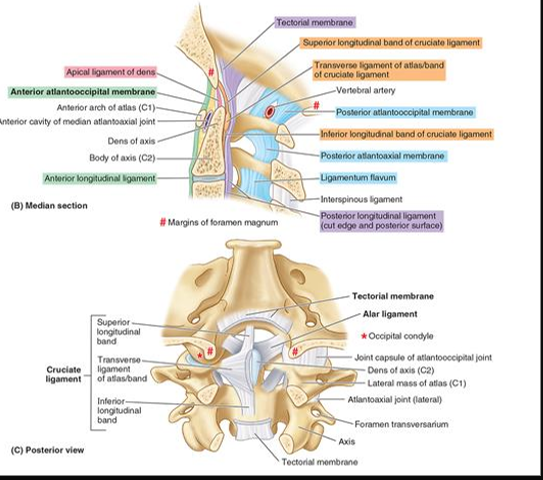
<ul><li><p><span style="font-family: &quot;Century Gothic&quot;;">small, fibrous cord-like</span></p></li><li><p><span style="font-family: &quot;Century Gothic&quot;;">Extends from</span><span style="font-family: &quot;Century Gothic&quot;; color: red;"> tip of dens to</span><span style="font-family: &quot;Century Gothic&quot;;"> anterior edge of</span><span style="font-family: &quot;Century Gothic&quot;; color: red;"> foramen magnum</span></p></li><li><p><span style="font-family: &quot;Century Gothic&quot;; color: red;">Stabilizes the dens </span><span style="font-family: &quot;Century Gothic&quot;;">by attachment to the occipital bone</span></p></li></ul><p></p>
75
New cards

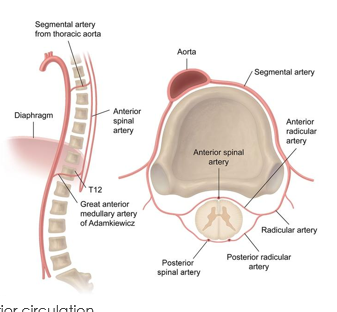
The Spine is supplied by the….

Vertebral artery system (longitudinal source)

76
New cards

Describe the segmental arteries

  • Enter through intervertebral foramen at each level and then splits into vertebral body supply and spinal cord branches

  • Intercostal branch

  • Lumbar branch

  • Sacral branch

<ul><li><p><strong>Enter through intervertebral foramen at each level and then splits into vertebral body supply and spinal cord branches</strong></p></li><li><p><span style="font-family: &quot;Century Gothic&quot;;">Intercostal branch</span></p></li><li><p><span style="font-family: &quot;Century Gothic&quot;;">Lumbar branch</span></p></li><li><p><span style="font-family: &quot;Century Gothic&quot;;">Sacral branch</span></p></li></ul><p></p>
77
New cards

Describe the vertebral arteries of the Cervical spine

  • Arise from subclavian artery

  • Ascends through the transverse foramina (C6C1)

  • Supplies cervical vertebrae, spinal cord (spinal branches), posterior circulation

78
New cards

Describe the vertebral arteries of the thoracic spine

  • Posterior intercostal arteries (same as segmental arteries)

    • From thoracic aortal

    • Each level gives

      • Vertebral body branches

      • Spinal branches (enter intervertebral foramina
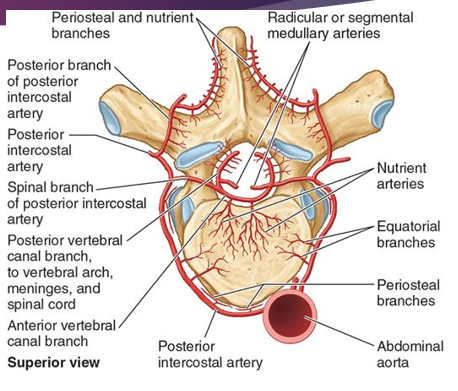
<ul><li><p><strong>Posterior intercostal arteries (same as segmental arteries)</strong></p><ul><li><p><span style="font-family: &quot;Century Gothic&quot;;">From thoracic aortal</span></p></li><li><p><span style="font-family: &quot;Century Gothic&quot;;">Each level gives</span></p><ul><li><p><span style="font-family: &quot;Century Gothic&quot;;">Vertebral body branches</span></p></li><li><p><span style="font-family: &quot;Century Gothic&quot;;">Spinal branches (enter intervertebral foramina</span></p></li></ul></li></ul></li></ul><p></p>
79
New cards

Describe the vertebral arteries of the Lumbar spine

  • Lumbar arteries

    • Direct branches of abdominal aortal

    • Supplies vertebral bodies, discs, spinal canal
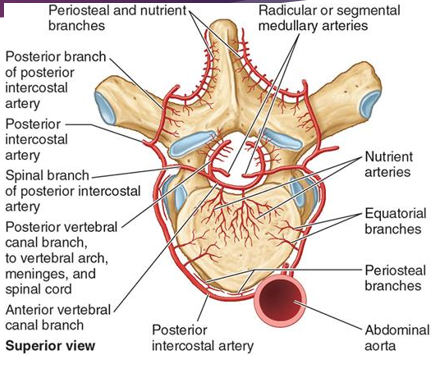
<ul><li><p><span style="color: red;"><strong>Lumbar arteries</strong></span></p><ul><li><p><span style="font-family: &quot;Century Gothic&quot;;">Direct branches of abdominal aortal</span></p></li><li><p><span style="font-family: &quot;Century Gothic&quot;;">Supplies vertebral bodies, discs, spinal canal</span></p></li></ul></li></ul><p></p>
80
New cards

Describe the vertebral arteries of the Sacral spine

  • Lateral sacral arteries

    • From iliac artery

    • Supplies: sacrum, cauda equina region

81
New cards

Describe the costotransverse joint

  • Slight gliding

  • Rotation

  • Elevation and depression

  • Articulates with tubercle of the rib