Operations Management
 Call Kai
 Learn
Learn Practice Test
 Spaced Repetition
 Match
Match Flashcards
 Knowt Play
1/61

Earn XP
Description and Tags
Flashcards covering key concepts in operations management.
Name | Mastery | Learn | Test | Matching | Spaced | Call with Kai |
|---|
No analytics yet
Send a link to your students to track their progress
62 Terms
Inputs
Resources used in the process of production
adv of just in time
minimal impact on enviroment thus improving business reputation, reduces storage costs and costs associated with waste
disadv of jit
discounts from bulk buying supplies may be reduced, delivery costs may increase due to more frequent deliveries, busiess may fail to meet customer demand from lack of reserve stock and thus damage business reputation, production may be brought to a halt is suppliers are unreliable and fail to deliver correct materials at the right time
materials requirement planning
a computer based inventory management system designed to assist the operations manager with scheduling and placing orders for materials
adv of materials requirement planning
accurate ordering of quantities required prevents need for excessive storage and thus associated expenses, determining exact materials required reduces chance that production will halt due to insufficient materials or organisational errors, improves business reputation by having minimal impact on the environment
disadv of materials requirement planning
time consuming to constantly update and maintain the materials plan, implementing and maintaining the materials plan can incur costs
forecasting advs
informed decisions about materials can improve a business’s ability to meet customer demand which improves its reputation, can reduce the cost of storage as it prevents the need for a large space to store materials, forecasting prevents excessive ordering of materials which reduces amount of stock wasted and therefore improving business reputation by having minimal impact on the environment
forecasting disadvantages
business may be unable to meet unexpected increases in customer demand which can damage their reputation, time consuming to analyse historical data and market trends, businesses may need to hire employees specifically for forecasting which incurs training and wage costs
adv of master production schedule
prevents business from producing excessive amount of products which reduces wastage of stock thus improving reputation olf business by having minimal environmental impact, can provide employees with clear schedule of operations including timeline and quantity of production targets, by determining production targets businesses are more likely to meet custmer demand which can increase sales and a business net profit figures, by determining specific details about how production will occur it is less likely production will halt and time is wasted due to an organisational error
6 types of inputs include micro defs
raw materials, capital equipment (machinery and property necessary to conduct operations), labour (work, efforts and skills of people involved in the operations function), information (knowlege and skills to enact operations system and produce final products), time, money
forecasting
is a materials planning tool that relies on data from the past and present and analysis of trends to attempt to determine future events. A business needs to forecast the quantity and timing ofr demand for its good or service and then match supply with demand
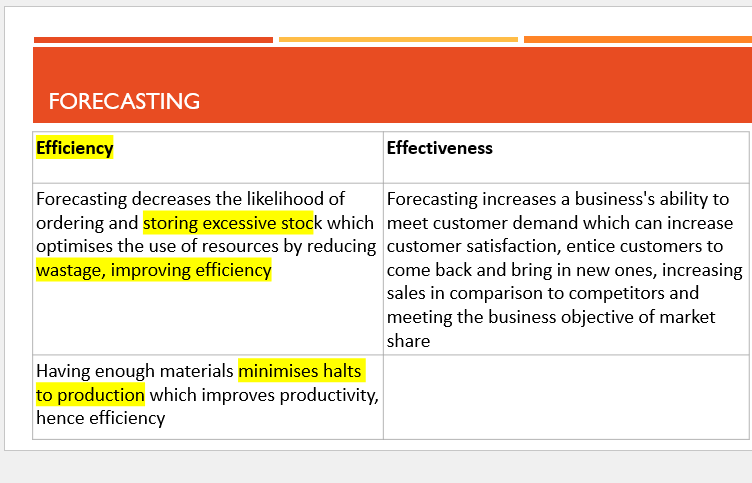
forecasting for efficiency
having enough materials minimises halts to production which improves productivity, hence efficiency
master production schedule
statement of what a business intends to produce in what quantities over a set time frame, taking into account forecast customer demand and production costs
Transformation Process
The conversion of inputs into outputs, which are goods or services delivered to consumers.
Outputs
the final good or service that is delivered to the consumer
Efficiency
A measure of how well an organization uses its resources (inputs) to achieve their objectives (outputs)
yakult raw materials
probiotic (LCS strain), water, flavouring, skim milk powder, sugars (sucrose and dextrose)
capital equiptment for yakult
robotic arm, fermentation tanks, printer, cold storage facility
yakult labour e.g
employees manually add ingredients into production process, employees conduct quality control at various states, an employee is stationed at every production stage to ensure all is running correctly
Effectiveness
measures how well a business is able to achieve its objectives and is achieved when the production of a good or service meets the needs of the customer
process of making yakult
fermentation of shirota strain
making of plastic bottles using 3 injection moulding machines
packaging of bottles
cold chain delivery
output
yakult- 65 ml (in 5 or 10 pack), yakult lite - 65 ml (in 5 pack)
characterists of product for manufacturing business compared to service business (OUTPUT)
manufacturing business product is a tangible good, therefore storage is required. Whereas, service business product is intangible therefore lower costs of storage as product is not physically held
uniformity of product (process) for mb compared to service bujsiness
For mb - standardised product, whereas for service business it is tailored to the individual needs of the customer
employee input characterists of mb and service business
MB is capital intensive (higher use of equiptment than human labour). WHereas, service business is labour intensive (service relies more on human labour than equiptment)
raw material requirements characteristics (input) for mb vs service
MB there are high levels of raw materials required to ensure uninterrupted production. Whereas in a service business there are low raw material requirements for a non physical output
characterists of mb vs service for customer contact by employees (PROCESS)
in MB low customer contact as goods are distributed through retailers. Whereas for service business, high contact with customers as performance of service occurs at point of contact
productivity
is the amount of outputs in relation to the inputs used measured over a period of time
competitiveness
the business’s ability to match or better its rivals in a given market by lowering costs, improving quality or increasing their speed of delivery
Just in Time (JIT)
An inventory management system aiming to avoid holding any stock (either as inputs or finished goods). it is about ordering the right amount of raw materials at the right time in the right place
Total Quality Management (TQM)
A continuous improvement process that emphasizes quality and customer satisfaction, involving all members of an organization.
Quality Control (QC)
A reactive approach where products are checked for defects during production to ensure standards are met.
Quality Assurance (QA)
A proactive process ensuring that the quality standards are met consistently throughout production.
Lean Management
A systematic approach to eliminating waste and improving customer value in all aspects of operations.
Corporate Social Responsibility (CSR)
A commitment by organizations to operate ethically and sustainably, considering the environmental and social impacts of their business practices.
Global Sourcing
The practice of seeking the most cost-efficient inputs from various countries to reduce overall production costs.
Automated Production Line
A process where raw materials enter and finished products leave with little or no human intervention.
advantages of production line (3)
improves the speed of production and increase productivity by using machinery that performs repetitive tasks, decreases the need for human labour thus reducing costs, increases accuracy and consistency and reduces human error producing a high quality product
disadv of automated production line (disadv)
very expensive to purchase, high maintenance costs to keep equiptment functioning efficiently, technology requires upgrading constantly to maintain competitiveness, and employees have to be trained to use the technology
Computer-Aided Design (CAD)
a program that facilitates creation and modification of diagrams, models ande protypes
adv of computed aided design
decreases the need for human labour and therefore reduces costs, improves the speed of production and increase productivity as designs can be drafted and re-drafted easily, increases accuracy and consistency and reduces human error as the software is able to accurately calculate and draw in 3D, reduces waste as designs can be modified without wasting paper and saves time as the designer doesn’t have to start design from scratch
disadv of computer aided design
cost of purchasing software increases the costs of the business, cost of continually upgrading software increases the costs of the business
Computer-Aided Manufacturing (CAM)
involves the control of machinery, tools and equiptment through a computer
efficiency of cam
cam does not require machinery to be manually reset by humans which reduces the amount of time and labour from resources used in operations which improves productivity and efficiency
computer aided manufacture advantages
improves the speed of production and increases productivity using computers to control production, decreases the need for human labour and therefore reduces costs, increases accurary and consistency and reduces human error as computers will follow instructions as they have been programmed
computer aided manufacture (CAM) disadv
very expensive to purchase technoogy to control production, breakdowns cause production delays and lower productivity, high maintenance costs to keep equiptment functioning efficiently
Robotics
programmable machines that are capable of performing specified tasks. These specialised machines can be programmed to efficiently complete specialised tasks with high levels of precision and accuracy within a business’s operations
robotics adv (3)
increases accuracy and consistency and reduces human error as computers will follow instructions as they have been programmed, TIME: improves the speed of production and increases productivity using computers to control production, MONEY: decreases the need for human labour and therefore reduces costs
robotics disadvantages
TIME: breakdowns cause production delays and lower productivity MONEY: very expensive to purchase technology to control production, high maintenance costs to keep equiptment functioning efficiently
Artificial Intelligence (AI)
involves using computerised systems to simulate human intelligence and mimic human behaviour
AI advantages
TIME: Ai can perform functions much faster than humans, MONEY: tasks that would have previously required human labour can be removed which reduces wage expenses EMPLOYEE: Ai can remove tedious tasks for employees which can improve job satisfaction
AI disadvantages
the business may develop a poor reputation if Ai makes numerous employees redundant, MONEY: there are high initial set up costs associated with purchasing and installing AI, it may be costly to recalibrate and maintain AI
online services
are services that are provided via the internet
advantages of online services
employees may experience increased job satisfaction if the online service removes tedious or boring tasks from their workloads, online services can process bookings faster than employees, can process orders accurately and provide increased customer convenience which may improve a business’ reputation
disadvantages of online services
if the platform providing the online service experiences technical difficulties it may disrupt the businesses operations MONEY: may be expenses associated with training employees to navigate the online platform used to provide services, may be high initial establishment costs for a business that develops its own platform to to provide online services
Waste Minimization
A strategy aimed at reducing the amount of unwanted resources produced during operations to improve efficiency.
Pull Strategy
A lean management principle where production is driven by customer demand to avoid excess inventory.
One-Piece Flow
A production strategy that focuses on processing one unit at a time through each stage to increase efficiency.
Takt Time
A method for synchronizing production steps to meet customer demand at a consistent pace.
Zero Defects
A strategy aimed at eliminating errors in production to enhance quality and minimize waste.
materials management strategies
forecasting, master production schedule, materials requirement planning, just in time