PHSC final review
 Call Kai
 Learn
Learn Practice Test
 Spaced Repetition
 Match
Match Flashcards
 Knowt Play
1/103

There's no tags or description
Looks like no tags are added yet.
Name | Mastery | Learn | Test | Matching | Spaced | Call with Kai |
|---|
No analytics yet
Send a link to your students to track their progress
104 Terms
Why ¼ factor for solar radiation flux in one layer model
S is the insolation that hits the Earth at any given moment, but the Earth is spherical and so as radiation hits one given spot its spread over ¼ of the Earths surface; earth a sphere account of per time per area units
Atmosphere emits both upwards and downwards in one layer model
The reason it emits both upward and downward is that the Stefan-Boltzmann law tells us how much energy a blackbody will radiate per area per time. A layer of atmosphere has area that can emit both on its top and on its bottom.
Negative feedback
regulatory process caused by perturbation of system that functions to return system to stable state
Positive feedback
intensification of deviation, as perturbation only sets into motion more reactions that push system further from stable state
Ice-Albedo Feedback
It describes how changes in ice cover affect the planet's temperature. Ice and snow have a high albedo, meaning they reflect a significant amount of incoming solar radiation back into space. This self-reinforcing climate process can in rising temperatures melt white ice and snow (high albedo), exposing darker ocean or land (low albedo) underneath. These darker surfaces absorb more solar heat, causing further warming and melting, creating a cycle that accelerates polar warming and sea ice loss. Or cause snow ball earth with high albedo.
Water-Vapor feedback
The fact that water vapor is a strong greenhouse gas means that the more water vapor you have in the atmosphere, the stronger the greenhouse effect, and the more greenhouse warming you get.
Water vapor increases strongly to increase in temp
The temperature doesn’t have to increase by very much in order to cause the saturation water vapor pressure to increase by a lot, which then increases moisture, increasing heat retention, warmer air holds more moisture
Cirrus
high wispy clouds that can precede storms but do not lead to precipitation themselves
Stratus
low clouds that form at a constant layer and stretch for large horizontal distances and can be associated with light rain
Cumulus
low levels, look like cotton balls, are not associated with rain, and often (but not always) come in 1D or 2D patterns
alto-
prefix to mean high (altocumulus, high cumulus)
nimbus
rainstorm fixutre
circostratus
cirrus/ stratus mix
cirrcocumulus
cirrus and cumulus
cumulonibus
rainstorm cumulus
altocumulus
high culumulus
altostratus
high stratus
nimbostratus
rainy stratus
stratocumulus
stratus and culumulus
fog
very low
Shortwave cloud radiative effect
effect of clouds on shortwave radiation at the top of the atmosphere = upward shortwave radiation at the top of the atmosphere when there are no clear
clouds - the upward shortwave radiation at the top of the atmosphere when there are clouds
Cloud albedo
clouds bright and reflect shortwave light, whiteness means they reflect most waves. The tropical convective clouds (deep cumulus and cumulonimbus clouds), which extend to high in the atmosphere. Low clouds (decks of stratus) off the coast of Peru and at high latitudes. These low clouds cover much more of the planet than high tropical clouds. The shortwave cloud radiative effect is much larger over ocean than land because the albedo of ocean is much lower than that of land.
Longwave cloud radiative effect
clouds have strong greenhouse effect, that the longwave cloud radiative effect is positive in all normal situations. radiative effect is that it tends to be larger for high clouds than for low clouds. The reason is that the atmosphere gets colder as you go higher up. No clear disinction between land and ocean as in short waves, still concentrated around tropics
In the global mean, the longwave cloud radiative effect is
+30 W m ́2, bc radiation coming from cloud less than that coming from surface, meaning less radiation lost in space when there is cloud
The net cloud radiative effect
Sum of the shortwave and longwave cloud radiative effects
global mean, the net cloud radiative effect
-20 W m ́2, so clouds have a net cooling effect on the climate.
The main places where clouds have a positive net cloud radiative effect
ice sheets and deserts, both of which have high surface albedos so the shortwave cloud radiative effect is small.
In most places clouds have a cooling effect
especially over oceans. The large stratus deck off the coast of Peru really stands out.
Clouds are the largest source of uncertainty in forecasts of climate.
Clouds are very hard to model in Global Climate Models because they are small relative to the size of the typical model grid, which has a horizontal dimension of about 100 km. Since small changes in clouds cause huge changes in the radative balance and clouds are hard to model
GCM
Global Climate Models (GCMs) are the main tool we use to forecast the climate. Solve the partial differential equations for fluid flow (fluid moving around, which carries heat with it) and radiative transfer for the atmosphere and ocean on a planet like Earth, typically used by specifying some change in greenhouse forcing and seeing how the climate responds
How GCM’s work
break the atmosphere and ocean up into little boxes called gridboxes such that each model variable, like temperature, pressure, and humidity only has values at these boxes. Versions of the equations are then developed that relate the values of variables on each gridbox to each other and can step them forward in time.
What type of computers are GCMs run on
Supercomputers
Why clouds are difficult for GCM
They are comparatively much smaller and more sensitive to smaller things than the GCM can account for, so cloud like variables are put in place instead of clouds based on observation and theory
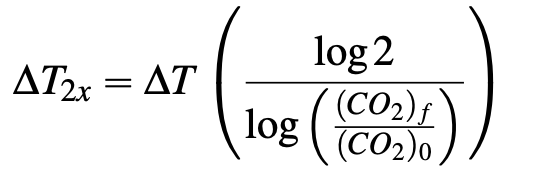
climate sensitivity
the change in global-mean surface temperature
due to some radiative forcing. It is often quantified as ∆T2x
∆T2x
GCM as climate senstivity models
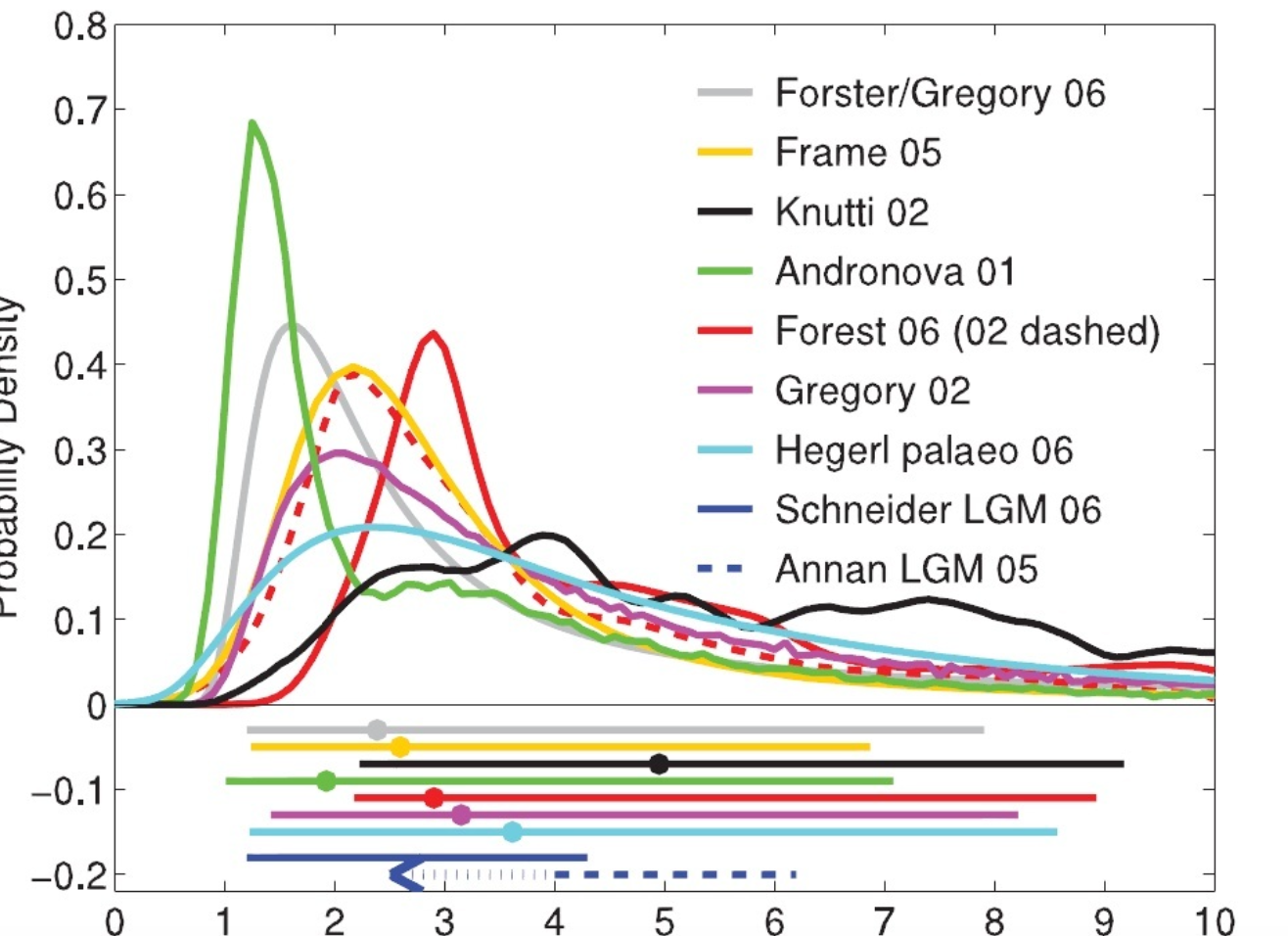
Not completely independent from one another so we might not expect the GCM climate sensitivity estimates to reflect the full possible range of climate sensitivity, could do all possible simulations but still wont reflect real world
Paleoclimate record to estime climate sensitivity
While we have good records for these factors there may be other influencing factors we cant account for
Different estimations of climate sensitivity
The first thing to notice from the figure is that we can’t constrain the climate sensitivity very well!
Cost-Benefit Analysis
C = C0e^λT
The larger the discount rate
the bigger the future cost
Discount rate
λ
low discount rate
the cost is lower than benefit
e
water vapor pressure,
water vapor pressure
es
saturation vapor pressure, max amount of water vapor in the air
Wet Bulb Temp
is the measure of the lowest temperature that can be reached by evaporating water into the air, ability of the surrounding air to absorb moisture. It is an important concept in determining relative humidity and is often used in weather forecasting and tells how temp feels to people
Global warming as a threat multiplier
intensifying already intense climate, leading to resource stressors that can impact national conflicts
How many calories humans need
2000 C
calorie
The amount of heat needed to raise 1g of water 1c
Extinction
when all members of a species die out do that species no longer exist, origination often counter balances
Mass extinction
when origination is less than extinction rate, 75% or more of all species die out over a few million years
How many mass exctinctions
5 left mark in geological record and though causes unknown linked to climactic events, currently could argue that extinction underway due to human impact on climate
weather
short term conditions in atmosphere, highly variable on timescale and locality
Climate
long-term average of weather condtions
E (exa)
10^18
P (peta)
10^15
T (tera)
10^12
G (giga)
10^9
M (mega)
10^6
k (kilo)
10³
h (hecto)
10²
da (deka)
10^1
d (deci)
10^-1
c (centi)
10^-2
m (mili)
10^-3
u (micro)
10^-6
n (nano)
10^-9
p (pico)
10^-12
f (femto)
10^-15
a (atto)
10^-18
Th earth has warmed how much roughly over past few hundred years
1.2 C
Why cant we look back at past climatic events?
Because despite fluctuations that have had the earth colder and warmer, the current rise of temperature is unprecedented and makes it difficult
Photosynthesis
6CO2 6H2O ---> C6H12O6 6O2
aerobic respirations
C6H12O6 6O2 ---> 6CO2 6H2O
Where tree bark comes froms
Carbon atoms are the bulk of trees, bulk of the plant mass of any plant is carbom
CO2 in atmopshere during glacial periods
170 and 280 ppm
CO2 before industrial rev
480 ppm
Current CO2
410 ppm
Electromagnetic radiation
suns energy that reaches Earth through waves of light, propagating oscillation in electrical magnetic fields, everything has electromagnetic radiation but type depends of temperature and properties
Speed of wavelength
C= λ (wavelength) ν (frequency)
visible light
very small part of possible wavelegnths (400-750nm), suns emissions are mostly visible or near infrared
Ultraviolet
shorter wavelength/more energy than visible light
Infrared
longer wavelength/less energy than visible light, usually refered to as longwave radiation, it is the type of wavelength the Earth emits
Sun’s luminosity
Is not having impact on global warming, though the Sun is heating up slowly it is on a timescale that has no impact on human civilization
Insolation at Earths distance from the sun
S0 = L/4πd2, W m^-2
L
Suns luminosity in W
d
distance from the sun in m
Current insolation of Earth
S0=1361 W m -²
eccentricity
is the ovalness of the planets orbit, now that it is at 0.0167 this leads to an insolation difference of 7% larger when Earth is closer to the sun in January than when furthest in July
Obliquity (tilt)
currently 23.5 degrees, cause for seasons as when a given hemisphere is pointed toward the sun it is summer when it is pointed away it is in winter, w/o tilt no seasons
Solsitces
when the tilt is directly at/away from the sun
Equinox
when the tilt is between being directly at/away from the sun
Solar Zenith Angle
Angle that the sun is from vertical at given location, S= S0cosθz, depends on latitude and declination
Solar Zenith Angle
Zenith Angle = latitude - declination
declination for winter solstice
-23.5
declination for summer solstice
23.5
Albedo
ratio of reflected light to incoming light — Earth is about 0.3. Things such as ice have higher albedo than ocean leading to ice-albedo feedback, albedo depends on wavelength of light
Blackbody Radiation
perfect emitters and absorbers of electromagnetic radiation
Plank function
function by which blackbodies emit wavelengths, hotter bodies emit more radiation and have peak emission at shorter wavelengths
Wien’s displacement law
The decrease in the wavelength of peak emission (λm) as a function of temperature
λmT = b
b = 2897 μm K.