Media n Politics final exam review
 Call Kai
 Learn
Learn Practice Test
 Spaced Repetition
 Match
Match Flashcards
 Knowt Play
1/41

There's no tags or description
Looks like no tags are added yet.
Name | Mastery | Learn | Test | Matching | Spaced | Call with Kai |
|---|
No analytics yet
Send a link to your students to track their progress
42 Terms
What is the history and motivation for study of media effects?
‘Great scare’
Everyone is scared, brainwashed, etc
the desire to look into this
Minimal vs. not-so-minimal effects
Minimal effects
Changed completely to the other side
Not-so-minimal effects
Need more background in public opinon
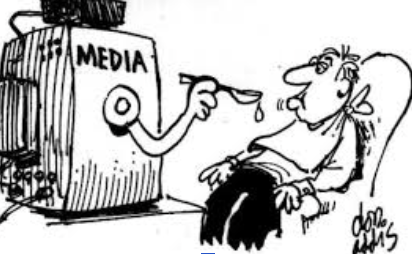
Hypodermic needle model
If you want to control the public, needle it in them; ‘Mid-1940s-WWII’
Propaganda! The belief that the public will take it on face value
Assume a passive audience that accepts the message at face value
Early studies of voting and schools of thought
(Columbia vs. Michigan)
Lazarsfeld et al. 1944; Berelson et al. 1954
“A person thinks politically, as he is, socially. Social characteristics determine political preference.”
Psychological (Michigan)
‘American voter’ model (Campbell et al. 1960)
Central role of partisanship
It is something more like you're socialized by family, childhood, background, on how they're going to vote
BOTH HAVE PANEL MODEL
Both rely on two big ideas: why we see minimal effects
selective exposure and strong predisposition
Primary reasons why effects are difficult to uncover
The mass public is not a monolithic whole
Acknowledging that the mass public is different is important
Therefore, two primary reasons why diffcult to uncover:
Inadequate measures on many variables (Bartels: “Most notable embarrassments of social science”)
Reoccurring problems in media research
Disconnect between scholarly work and practitioner beliefs
The tension between them lowkey still occurs today
Keep forgetting politics is marginal for most
Need to pay attention to types of effects• What is an effect? Is a small effect in reality a
big deal?
Statistical vs. substantive significance
Measurement
Sources of news differ, as does the content!
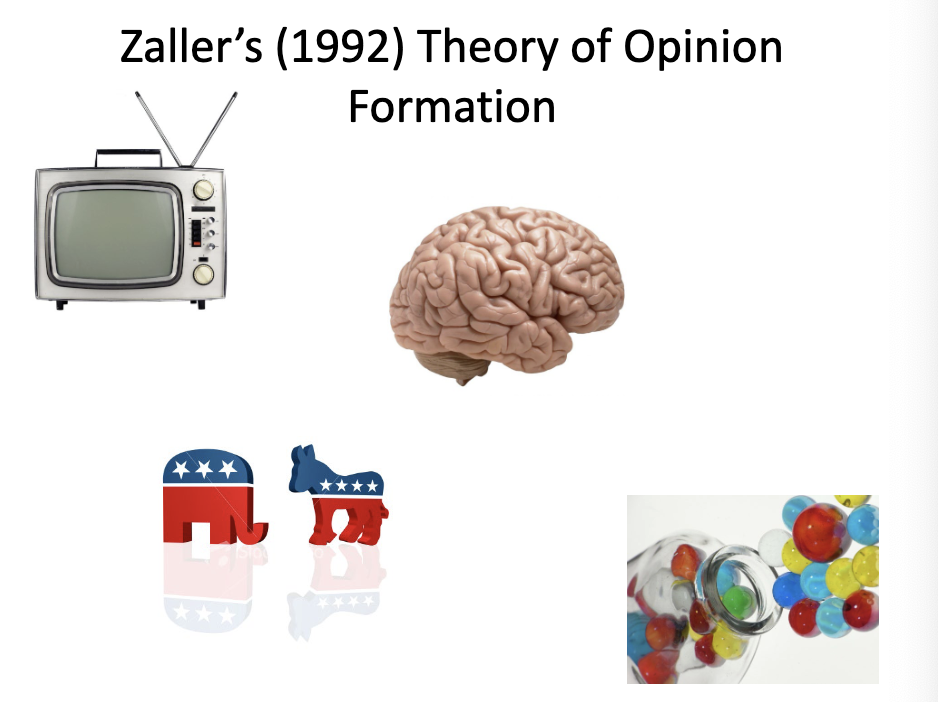
Zaller’s opinion formation model
(RAS Model)
need to be exposed to message (professor added this)
given exposure, need to receive message
depends on attention and cognitive ability
Just because a message is received, it doesn’t mean it is accepted
When asked questions, citizens sample immediately salient considerations
Zaller 1996. “The Myth Revised” in Mutz et al. Political Persuasion and Attitude
Change. What does it argue?
Media can strongly influence public opinion, but the effects depend on elite consensus and individual awareness.
Elite consensus vs. elite conflict is crucial
This is the biggest point in this chapter:
When elites agree (consensus):
→ Media sends a one-sided message
→ Public opinion is strongly shaped and more uniformWhen elites disagree (conflict):
→ Media presents competing frames
→ Public opinion becomes divided and less predictable
So media influence depends on what political elites are saying, not just the media itself.
The non attitude—Converse
Flip-flopping
Citizens flip-flop on their political opinion, especially as the general public does not focus on it, have less strong thoughts on it
Inconsitented
Zaller is trying to explain it / help reduce the issue
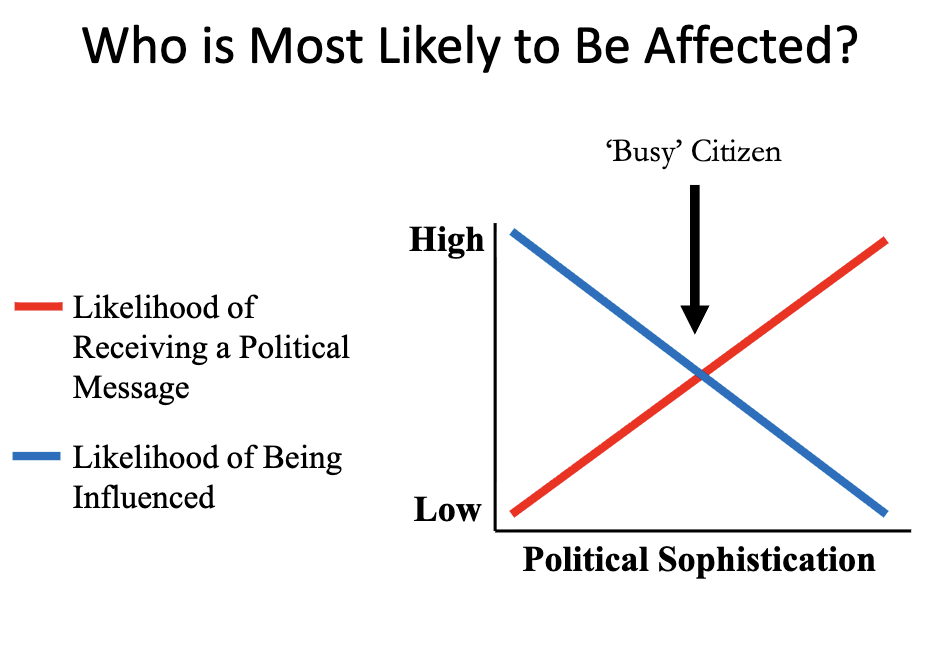
Politically savvy individuals are more likely to…
be exposed and to receive more information
Political Novices are most likely to…
be influenced by media messages
Especially as they have fewer opinions and can more easily receive it and accept the message
Politically moderate in a sophisticated area will fall under the
X
Zaller’s types of news events
Zaller’s theory of media influence
What has to happen for the media to influence citizens? (Zaller)
Measurement problems in assessing media influence
What was watched?
How to measure exposure?
Laboratory experiments (internal validity)
Observational studies (external validity)
Quasi-experiments: A newspaper goes on strike, and we are removing that information from the general, so research decides to use that and compare it to citizens who did have a newspaper
Reception
Problems with self-report
Cognitive processing:
Memory vs. on-line models (Lodge et. al)
Online progress is taking it in and using that information and getting rid of it
Memory take in the information and wait and use it with other infomraion to decide
Example: manipulation issue guest member, we were going to hire someone; have to make a recall of information
Need- to -evaluate (Jarvis & Petty)
Types of media effects and when/where we should expect to find them
Measuring content of news
Easier for some media than others:
Newspapers
National network news
Advertising
Local television
Social media feeds
Bartels 1993. “Messages Received: The Political Impact of Media Exposure.”American Political Science Review 87: 267-285.
Entman, Robert. 1989. “How the Media Affect What People Think: An Information Processing Approach.” Journal of Politics.
Agenda-setting,
Mass media shapes over views of what is important on the national scene
“Mass media don’t tell us what to think, but what to think about.”
One of the reasons why authoritarian regimes try to flood the zone, if there are a lot of messages, people look at
Is it agenda -setting power srucnk? More fragmented
ex: Fox News covers different types of news,
The media is not the only one to set the agenda; peers and family
Priming
Altering the considerations people use to make decisions
Vote choice = economy, healthcare, education, war, and human rights
A prime is making a conceration more
“Iyengar & Kinder- “by calling attention to some matters while ignoring others, television news influences the standard by which government, presidents, policies, and candidates for public office are judged.
Assumes media emphasis increases accessibility
“If the news constantly focuses on the economy (inflation, jobs, gas prices), people are more likely to judge a president or candidate based mainly on economic performance—rather than healthcare, education, or human rights.”
Framing
Entman (1993) – “to frame is to select some aspects of a perceived reality and make them more salient in a communicating text, in such a way as to promote a particular problem definition, causal interpretation, moral evaluation, and/or treatment recommendation for the item described.”
The frame is core to understanding an event–what the problem is, who is responsible for it, and who should be fixing it, and why
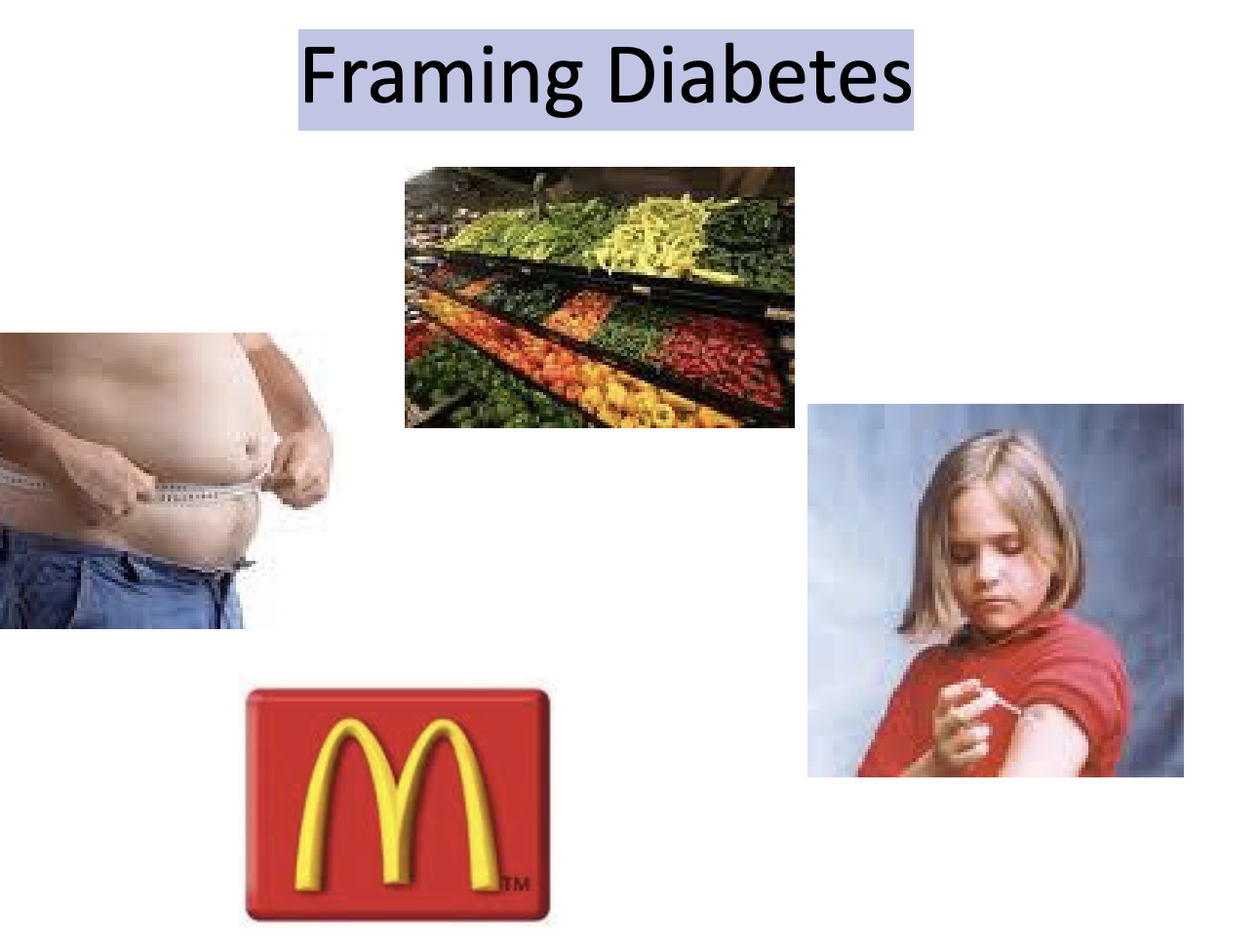
ex: Framing Diabetes
What you think about it will change if talking about children, fast food, obesity, who is responsible changes within the frame
one of the most important methods media effects/influence people’s thoughts One
Framing: episodic vs. thematic, equivalency, and issue
Iyengar episodic (portrait) vs. thematic (landscape)
thematic frames tend to pull back the view and show the strucures vs episodic where it frames the indivdual
Critical of having an episodic contextual framing—Can help diminish the structural issues
One portrait focuses on one person
quantitative work could fall under episodic, but Iyengar draws attention to the fact that television news is more likely to focus on the episodic view, and he agrues that this could be dangerous, it is much more indiuval and less structural , its so and so fault but if we look at the thematic frame looks more the background and better understanding of the issue
Landscape looking at that person with a background
Framing: episodic vs. thematic, equivalency, and issue
Equivalency frames (Tversky & Kahneman):
quantitative, mathematically equivalent, saying something like 90% surival rate or 10% death rate
People respond more to threats
Emphasis or issue frames– Nelson, Clawson & Oxley example
the framing of on what the American public not/may agree on, protest/street marching of the KK
citizens respond differently if we are talking about freedom of speech vs public order (not equivalent frames, but will have very very different reactions)
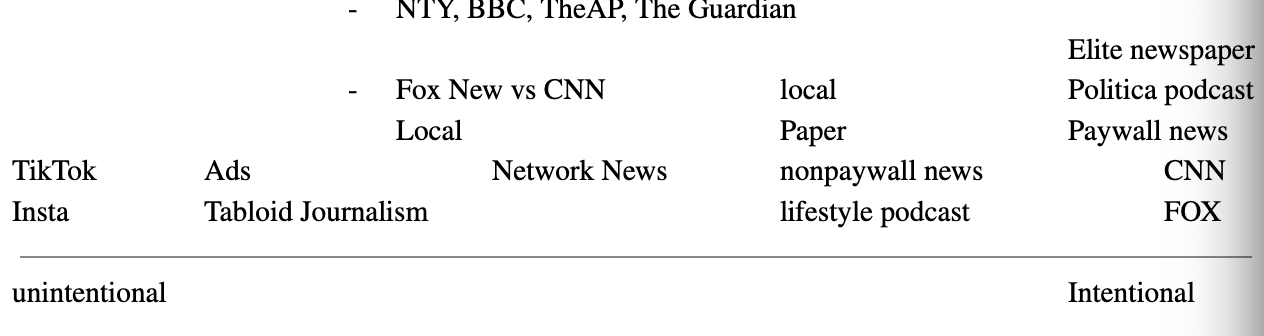
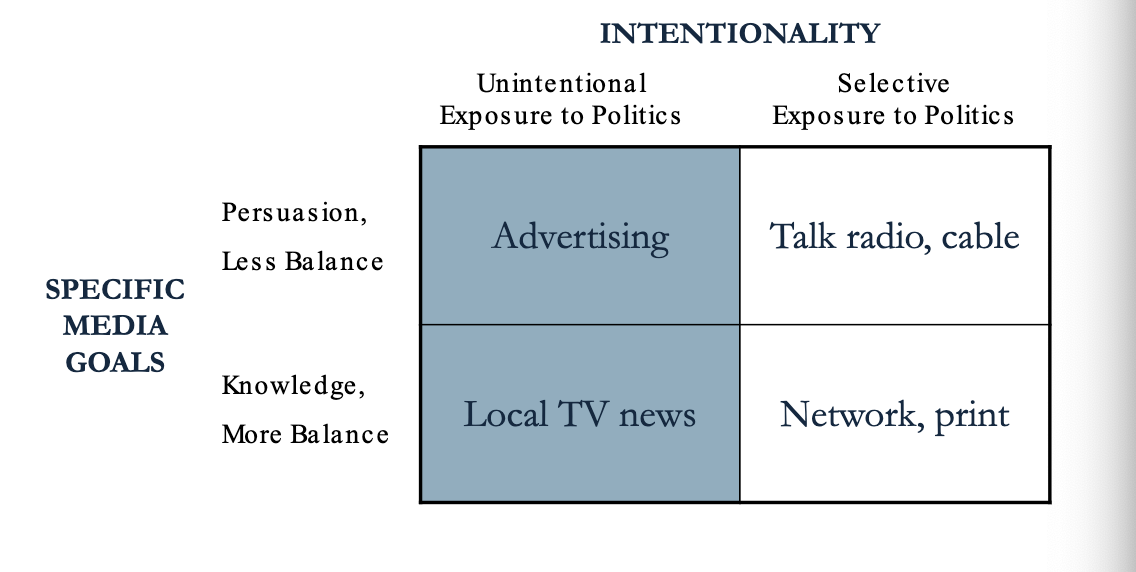
unintentional exposure to politics vs intentional or selective exposure to politics
put as many media outlets on the spectrum
Intentionality of Exposure and Specific Media Goals
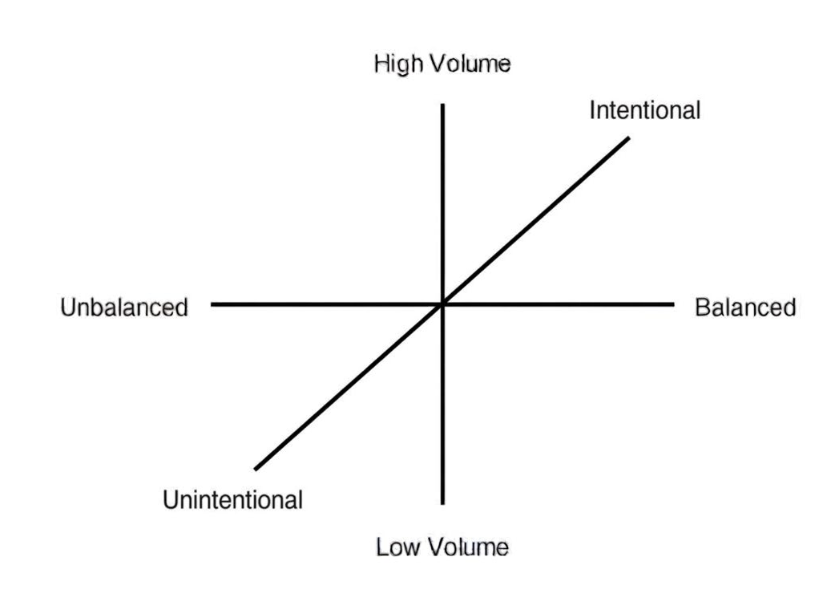
Adding the third dimension of intentionality,
Experiments (lab, field, quasi) & survey types: advantages/disadvantages and example of each
Soft vs. hard news – the audiences, and advantages and disadvantages of each
Soft news drama pulls people 1980s started, until the early 2000s political scientist largely ignored the
political scientist (are the atteive people, so..) do not watch soft news as their primary source, USA Today, etc not being their primary source
may not have occurred to them that people use it as their primary method in getting news
“Sex, Lies, & War: How Soft News Brings Foreign Policy to the Inattentive Public” (Baum 2002)
Some issues easily packaged as compelling human dramas
For the politically uninterested, incidental exposure
Capitalize on this human drama its good business
For the politically uninterested, unintentional exposure really matters; therefore, Baum argues that the public does not need to read the elite sources to get some political cues
What counts as “soft news”
techinally there is no actually d
Prior vs. Baum argument and evidence regarding soft news
Converse’s notion of non-attitudes and how Zaller’s theory partially explains them
Types of citizens and how/why media will affect people differently
General versus specific types of knowledge and the role of the message environment in each
Tactics and problems with measuring knowledge
Knowledge gap and differential effects of information on citizens
Advantages and disadvantages of different types of media and platforms
Prior’s argument about post-broadcast democracy
Role of intentionality/control and goal and how it shapes media effects
Coverage of polarization and how it matters
Digital media and how sorting may contribute to polarization
Post-social media information environments