9 Chapter leadership vs management
0.0(0)
Studied by 1 person Call Kai
 Learn
Learn Practice Test
 Spaced Repetition
 Match
Match Flashcards
 Knowt Play
Card Sorting
1/14

Earn XP
Description and Tags
Last updated 7:38 PM on 6/26/23
Name | Mastery | Learn | Test | Matching | Spaced | Call with Kai |
|---|
No analytics yet
Send a link to your students to track their progress
15 Terms
1
New cards
Leadership
process by which a person exerts influence over other people and inspires, motivates, and directs their activities to achieve group or organizational goals
2
New cards
Manager
Looks after day-to-day operations:
* Planning
* Organizing
* Controlling
* Leading (coordinating)
\
* Planning
* Organizing
* Controlling
* Leading (coordinating)
\
3
New cards
**Leader**
individual able to exert influence over other people to help achieve goals
4
New cards
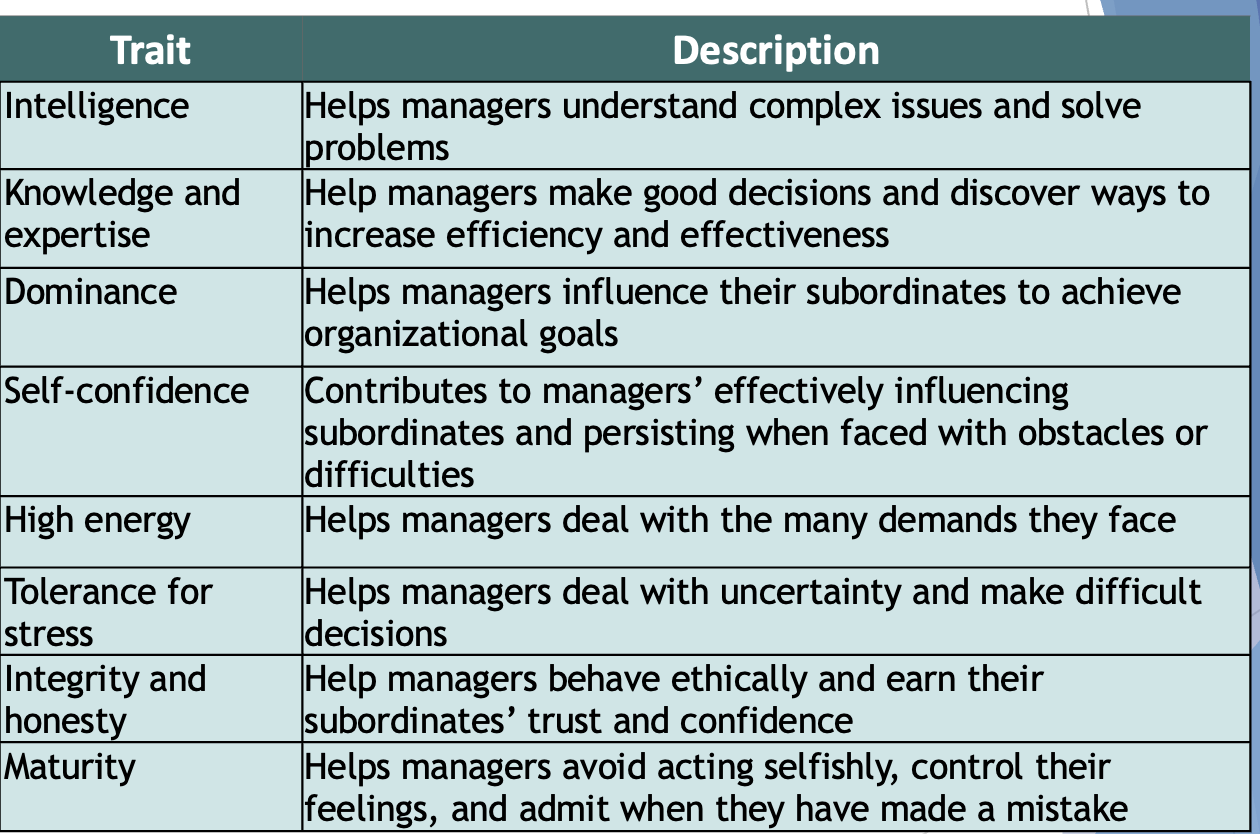
Trait Model of Leadership
is a model that claims certain traits are vital for effective leadership, such as intelligence, confidence, determination, integrity, and sociability. This theory suggests that individuals with these traits are more likely to become successful leaders.
5
New cards
Behavioural Model of Leadership
an approach used by companies to better understand and predict consumer actions:
1- **Consideration (employee-centered) behaviours:**
managers show care, trust and respect towards subordinates
\
2- **Initiating structure (production–oriented) behaviours:** leaders define and structure their role and the roles of their subordinates in order to achieve organizational goals
\
1- **Consideration (employee-centered) behaviours:**
managers show care, trust and respect towards subordinates
\
2- **Initiating structure (production–oriented) behaviours:** leaders define and structure their role and the roles of their subordinates in order to achieve organizational goals
\
6
New cards
Situational (contingency) Model of Leadership
every situation that requires leadership is different and requires a specific type of leader. The favorability of a situation depends on how much influence and power you have as a leader.
7
New cards
Visionary Model of Leadership
focuses on creating a vision for the future and inspiring others to make it a reality
8
New cards
manager vs leadership
* Managers promote stability, whereas leaders push for change
* Managers implement vision and strategy, leaders provide it
* Managers are appointed, leaders can be appointed or emerge organically
* Managers implement vision and strategy, leaders provide it
* Managers are appointed, leaders can be appointed or emerge organically
9
New cards
**Personal leadership style**
specific ways a manager chooses to influence others and how they approach planning, organizing and controlling
10
New cards
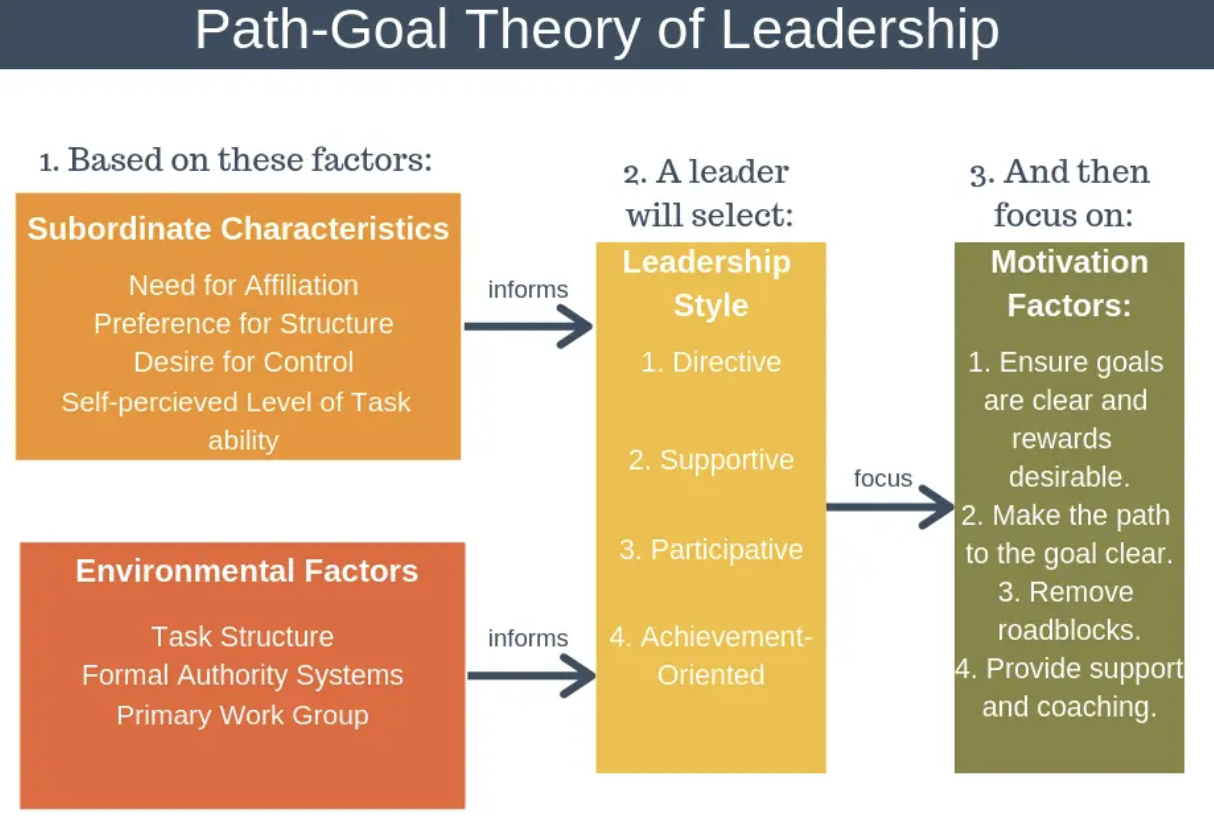
Path-Goal theory and its different styles
determine an appropriate leadership style, depending on the situation and the people they're leading. It's based on four leadership styles: supportive, directive, participative, and achievement-oriented.
11
New cards
4 type leadership styles
Behaviours that leaders can use to motivate subordinates:
1-***Directive behaviours:*** setting goals, assigning tasks, showing subordinates how to complete tasks, and taking concrete steps to improve performance
2- ***Supportive behaviours:*** expressing concern for subordinates and looking out for their best interests
3- ***Participative behaviours:*** give subordinates a say in matters and decisions that affect them
4- ***Achievement-oriented behaviours:*** motivate subordinates to perform at the highest level possible
1-***Directive behaviours:*** setting goals, assigning tasks, showing subordinates how to complete tasks, and taking concrete steps to improve performance
2- ***Supportive behaviours:*** expressing concern for subordinates and looking out for their best interests
3- ***Participative behaviours:*** give subordinates a say in matters and decisions that affect them
4- ***Achievement-oriented behaviours:*** motivate subordinates to perform at the highest level possible
12
New cards
Visionary Model of Leadership
Employees are motivated by leaders who espouse a strong, compelling vision for the organization
13
New cards
Transactional Leadership (Visionary Model of Leadership)
leadership style where leaders rely on rewards and punishments to achieve optimal job performance from their subordinates
14
New cards
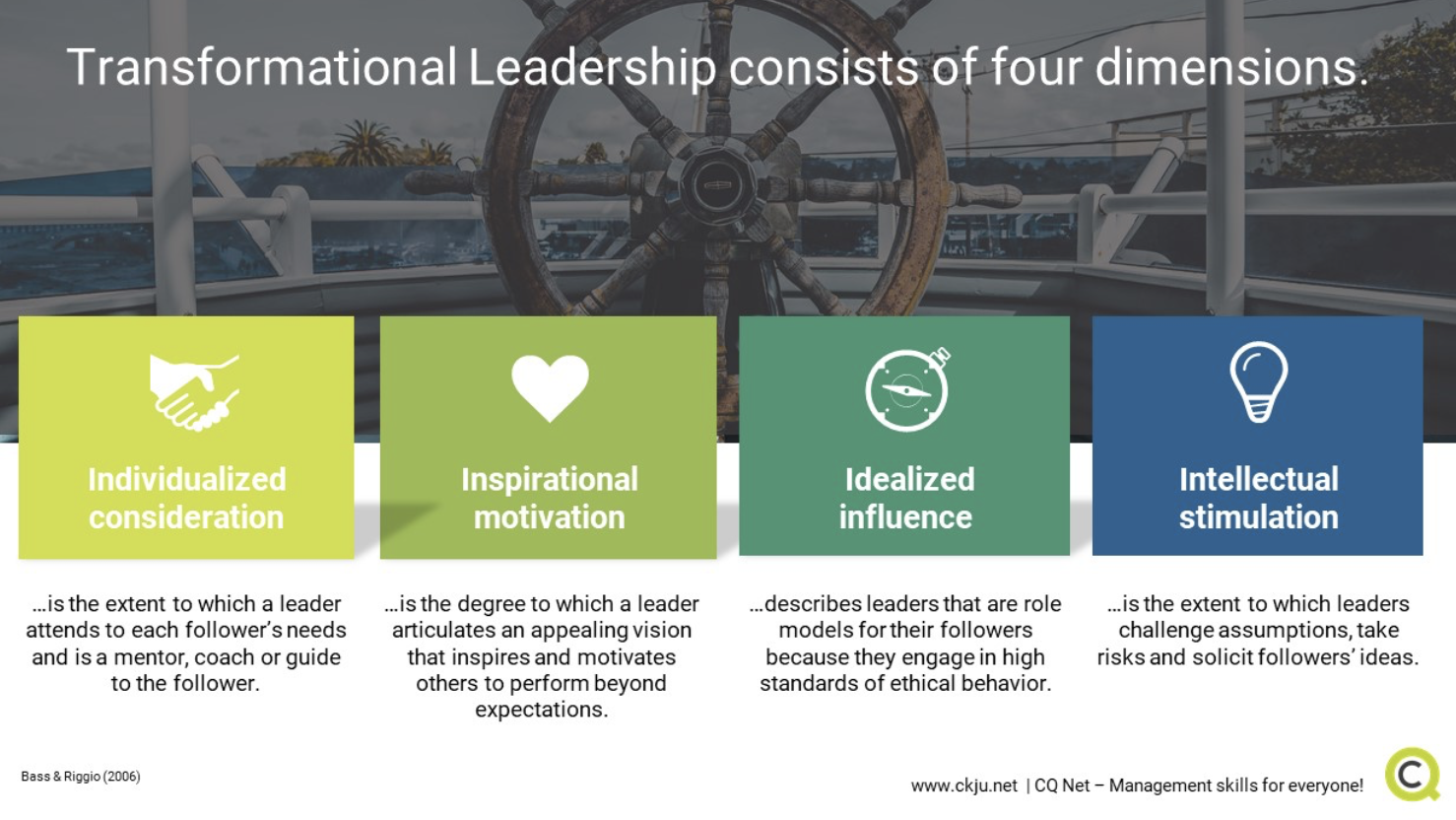
Transformational (4 I’d) model (Visionary Model of Leadership)
**To make** subordinates aware of the importance of their jobs and performance to the organization:
1- **I**dealized influence (Charisma): leader acts as a role model
2- **I**nspirational motivation: Provides compelling vision and sense of mission
3- **I**ntellectual stimulation: Stimulates the intelligence of subordinates, Inspires subordinates to exceed standards
4- **I**ndividualized consideration: Shows consideration for personal growth needs of subordinates
1- **I**dealized influence (Charisma): leader acts as a role model
2- **I**nspirational motivation: Provides compelling vision and sense of mission
3- **I**ntellectual stimulation: Stimulates the intelligence of subordinates, Inspires subordinates to exceed standards
4- **I**ndividualized consideration: Shows consideration for personal growth needs of subordinates
15
New cards
ways to transform subordinates (transformational model)
\
1\.Subordinates have increased awareness of the importance of their jobs and high performance to the organization as a whole
2\.Subordinates are made aware of their own needs for growth, development, and accomplishment
3\.Subordinates work for the good of the organization as a whole, not just for their own personal gain or benefit
1\.Subordinates have increased awareness of the importance of their jobs and high performance to the organization as a whole
2\.Subordinates are made aware of their own needs for growth, development, and accomplishment
3\.Subordinates work for the good of the organization as a whole, not just for their own personal gain or benefit