FRNSC 485 EXAM
 Call Kai
 Learn
Learn Practice Test
 Spaced Repetition
 Match
Match Flashcards
 Knowt Play
1/69

Earn XP
Description and Tags
Name | Mastery | Learn | Test | Matching | Spaced | Call with Kai |
|---|
No analytics yet
Send a link to your students to track their progress
70 Terms
American Academy of Forensic Sciences
Shortened to AAFS, this is actually an international organization for forensic scientists. They are responsible for publishing the journal of forensic science (JFS) and are divided up into many sections
International Association for Identification
Shortened to IAI. Began as an organization devoted to latent fingerprint identification and has developed into an interdisciplinary forensic science org. It’s still the primary org for latent print examiners. The research of this group tends to lean towards the more investigative side of forensics.
Chartered Society of Forensic Sciences
Shorted to CSOFS. This org is based in Europe, but covers about 60 countries. It is noted for Professional Certifications and is divided into 3 sections.

European Network of Forensic Science Institutes
Shortened to ENFSI. They are recognized by the EU as the sole voice of forensic sciences in Europe. They’re notable for developing the best practices and guidelines. They are divided into a multitude of working groups.

Asian Forensic Sciences Network
Shortened to AFSN. They are responsible for publishing Forensic Asia and Drug Net Asia. Notable for standards development and divided into several work groups.
International Association of Forensic Sciences
Shortened to IAFS. This is more of an event than an organization. It happens triennially (every 3 years) and the meeting country/host rotates.

California Association of Criminalists
Shortened to CAC. This is an organization that covers membership from California and other Western states. It is the most active and influential regional organization. It is noted for salary surveys.
3
According to the notes, Pennsylvania is covered under at least how many US Regional Forensic Science organizations?
Clandestine Laboratory Investigating Chemists
Shortened to CLIC. This is an international organization for sharing information between chemists analyzing seized drugs and evidence from clandestine labs.
American Society of Crime Lab Directors
Shortened to ASCLD. This is an organization for directors and supervisors of forensic labs specializing in management training, inter-lab communication, quality assurance, and identifying research needs.
ANSI National Accreditation Board
Shortened to ANAB. This currently is the primary accrediting body for forensics labs in the United States. It is aligned with the ISO 17025 Quality Assurance standard
International Organization for Standardization
Shortened to ISO. This is the non-governmental international standards-setting body. The ISO 17025 standard has been additionally modified for forensic laboratories, and is also a laboratory accreditation standards.

American Association for Laboratory Accreditation
Shortened to A2LA. This is a quality standards organization that accredits testing laboratories of all types of forensic labs. It offers an ISO 17025 aligned accreditation program for forensic laboratories.

American Board from Criminalistics
Shortened to ABC. Offers certification in comprehensive criminalistics, and offers discipline-specific certifications in subjects such as molecular biology, drug chemistry, etc.
National Institute of Standards and Technology
Shortened for NIST. This organization sets standards for measurement and calibration. It was chosen to lead the reform efforts in 2009.
Office of Scientific Area Committees
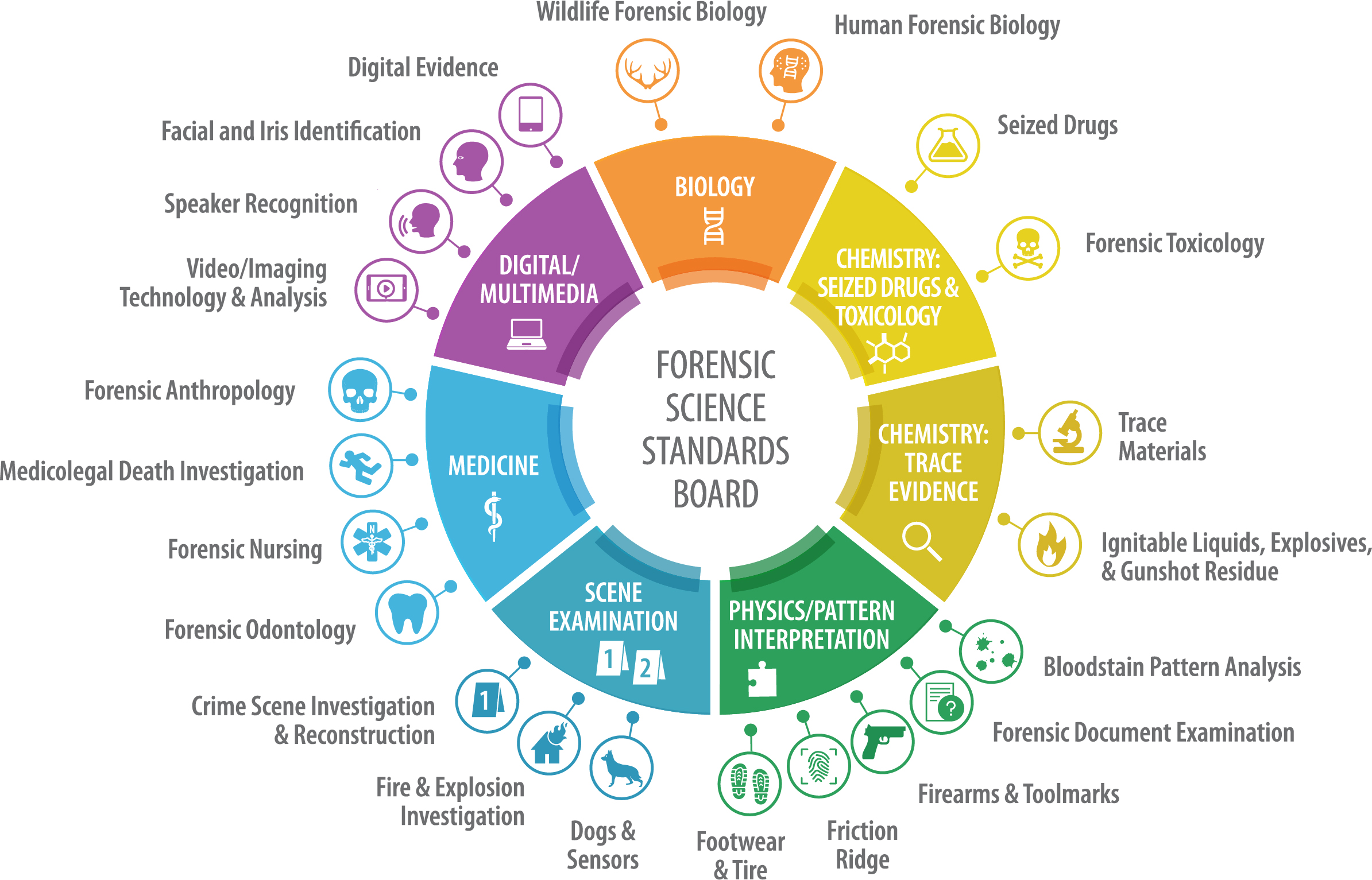
Shortened to OSAC. This is composed of 25 committees comprised of over 500 top forensic experts. They evaluate and approve forensic standards from Standards Development Organizations, or SDOs.
American Society of Testing and Materials
Shortened to ASTM. It is an international organization dedicated to the development of voluntary standards for testing.
National Institute of Justice
Shortened to NIJ. It supports research and advancement in every area of the criminal justice system.

Bloodborne Pathogens
What is the most likely safety hazard you will encounter in the laboratory?
Acute Exposure Effects
These are the result of short-term exposure at high doses
Chronic Exposure Effects
These are the result of long-term exposure at low doses
Used syringes
Due to being an extraordinary hazard for analysts, many forensic labs won’t accept these as evidence, or they limit submissions to homicide investigations
Modified Griess test
For many years, one component of this test (used to detect nitrite residues in gunshot residues) wasn’t discovered as carcinogenic. Since the 1990’s, this test has been modified. While the component is still toxic, it is not carcinogenic.
Engineered Controls
Biosafety cabinets, fume hoods, and glove boxes are all examples of these, which are designed to provide a barrier or interlock between the user and the hazard.
Warning
The purpose of this is to alert workers of potential hazards that they may or may not be aware of. They can be visual or audible.
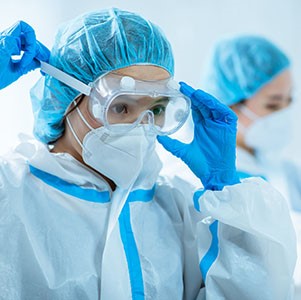
Personal Protective Equipment
Shortened to PPE. This is similar to engineered controls, but the only difference is that this is worn.
Occupational Safety and Health Administration Act
Shortened to OSHA. This act passed in 1970 and it required employers to meet specific safety standards, identify workplace hazards, and provide protective equipment to employees. In short, it codified the right to a safe workplace.

False
True or False? Everyone, labs and individuals, follow OSHA guidelines
National Fire Protection Association
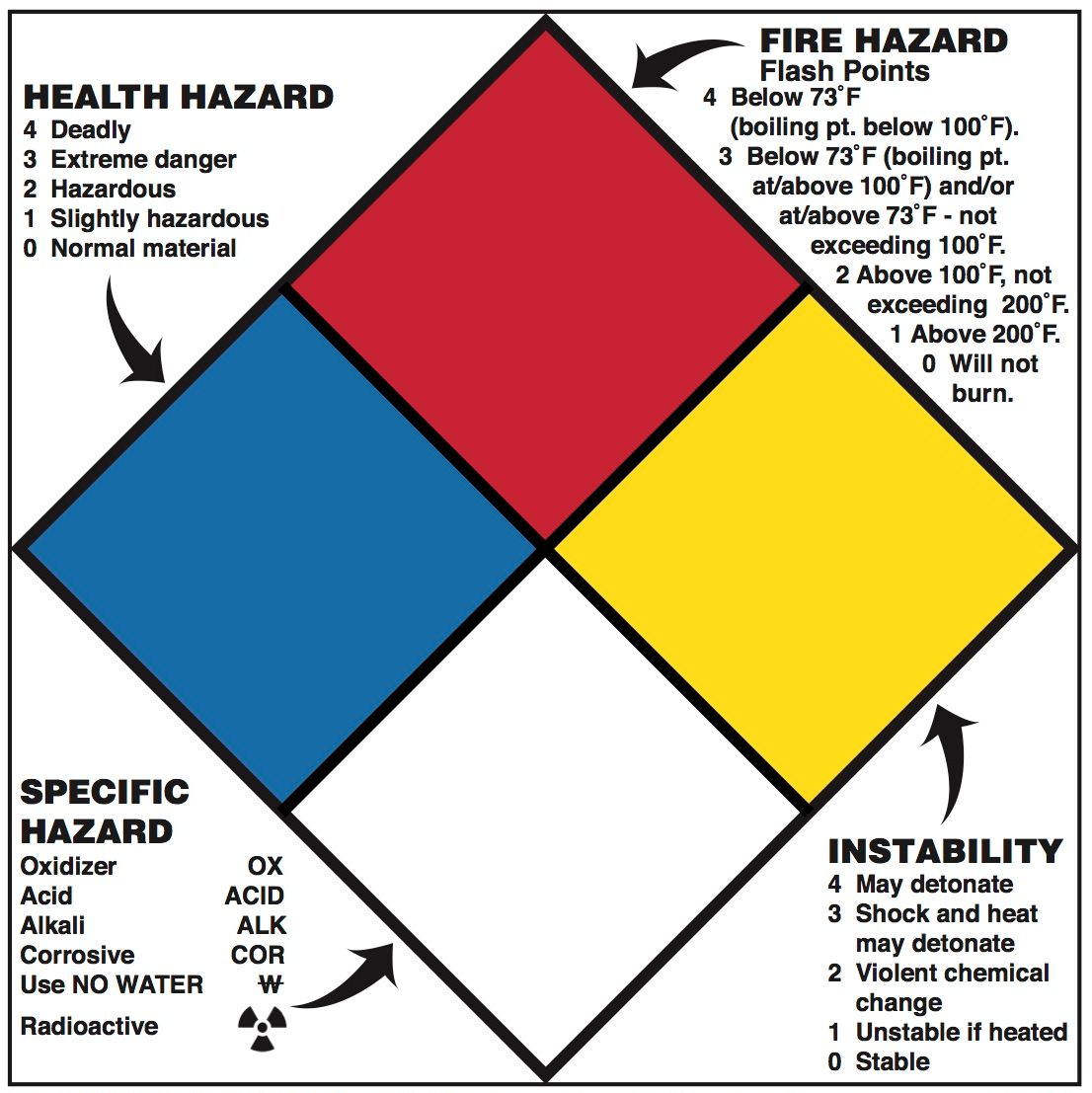
Shortened to NFPA, this system was developed in 1896 to uniformly communicate safety hazards in the laboratory and elsewhere.
Global Harmonized System
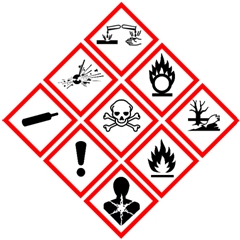
Shortened to GHS. In 2003, it was developed to classify hazards. It consists of 9 universal pictogram symbols in a diamond shape.
Safety Data Sheets
Manufacturers, distributors, and importers of chemicals are required by OSHA to distribute these, shortened to SDS. These catalog the chemical and physical properties of the respective substance(s).
True
True or False? Not all carcinogens cause cancer in all people all the time. Doses vary.
Particulates
This is the type of respiratory hazard that contains suspended particles that can become trapped in the lungs.
Vapors
This is the type of respiratory hazard that contains hazardous solvents, corrosives, and aerosols.
Dust/pollen mask
This type of mask is suitable for contamination control only, and should not be worn when working with chemicals
KN95
This type of mask blocks 95% of all particles 0.3 micrometers or smaller. It is suitable for many particular hazards, but not suitable for vapors.
Cuts
Gloves made from Kevlar of chain mail provide resistance to?
True
True or false? You can store acids and bases in the same corrosive cabinet.
Every 90 days
How often should biological and chemical waste be disposed of?
Blue plastic drainpipe
How can you identify a lab sink?
False
True or False? It’s safer to buy chemicals in bulk to prevent spills and other hazards.
True
True or False? You should only clean up spills if the respiratory hazard can be mitigated
Boxcutter
To avoid striking a live electrical wire during bullet extraction, what tool should be used for the best result and to prevent injury?
Quality Assurance
Refers to the procedures and policies that have been established by the lab management to ensure that the analytical results are accurate and reliable
Quality Control
Refers to the policies and procedures employed by the lab to ensure that QA procedures are being implemented appropriately and effectively
Rework (defectives)
A product that doesn’t pass QC standards. This type can be repaired, but it will take time and money.
Scrap
A product that doesn’t pass QC standards. This type is impossible to repair and must be disposed of.
Quality Manager
This person is responsible for the development and implementation of a QA/QC program in a forensic laboratory.
Quality Manual
Part of the quality system that outlines the quality goals and lab-wide quality practices
Procedure Manual
Part of a quality system that contains instructions for specific tasks (especially for discipline)
Work Instructions
This is an optional part of a quality system. It provides specific details not described in the SOP/procedure manual.
Quality Records
Part of a quality system that documents activities performed in said quality system.
Internal proficiency test
A part of proficiency testing that is prepared by the lab
External Test
A part of proficiency testing that is prepared by an outside accredited provider.
Open Test
A part of proficiency testing where the analyst knows they are being tested
Blind Test
A part of proficiency testing where the analyst does not know they are being tested.
Specificity
The ability of a method to unequivocally assess (identify, quantitate, classify, or compare) a single analyte under routine conditions
Selectivity
The ability of a method to assess an analyte in the presence of other (potentially interfering) components
Accuracy
Describes the closeness of method’s measurements to a specific (“true”) value. A measure of systematic errors.
Precision
Describes the the closeness of a method’s measurements to each other. A measure of random errors.
Robustness
A measure of a method’s capacity to remain unaffected by small, but deliberate variations in parameters.
Process Creep
The accumulation of small tasks becomes unwieldy and the tedium and sheer volume of steps draws attention away from the major quality goals.
Process Failure Mode and Effects Analysis
Shortened to PFMEA, this was developed in the late 1950s by the US military/NASA as a tool for evaluating the reliability of a process. It’s also an effective tool to identify potential problems with a lab procedure.
Workplace Discrimination
This generally exists when an employer treats an applicant or employee less favorably merely because of someone’s race, gender, sexuality, etc.
Family and Medical Leave Act
Shortened to FMLA, this entitles eligible employees of covered employees to take unpaid, job-protected leave to care for specified family and medical reasons.
Americans with Disabilities Act
Shortened to ADA. This requires that employers must provide people with disabilities an equal opportunity to benefit the employment-related opportunities available to everyone.
Time Study
A process where each step in a workplace process is monitored over a sampling period. The average time to complete each step in the process is analyzed to determine areas where the most efficiency gains can be made.
Pareto Principle
Approximately 80% of outcomes arise from 20% of causes. OR approximately 80% of errors come from 20% of sources. Provides a pathway towards the most effective solutions to problem by providing a structured approach with quantification and ranking
Bias
A particular tendency, trend, inclination, feeling, or opinion, especially one that is preconceived or unreasoned
Case Integration
This process ensures that the analytical process interfaces with the needs of the larger investigation. Steps are taken outside the normal scope of crime scene processing and lab analysis to ensure the evidence is properly collected, analyzed, and interpreted in order to align with the highest priority investigative questions.