Chromatography (Add to when doing PPQs)
 Call Kai
 Learn
Learn Practice Test
 Spaced Repetition
 Match
Match Flashcards
 Knowt Play
1/36

There's no tags or description
Looks like no tags are added yet.
Name | Mastery | Learn | Test | Matching | Spaced | Call with Kai |
|---|
No analytics yet
Send a link to your students to track their progress
37 Terms
What is chromatography?
A technique to both separate and identify the components in a sample
What does the separation of compounds depend on?
The solubility of compounds in the mobile phase
The adsorption in the stationary phase
What is the stationary phase?
This phase doesn’t move
Compounds in the mixture are attracted (adsorbed) to it and slowed own
Can be a solid or a liquid
What is the mobile phase?
This phase moves
The more soluble compounds in the mixture are carried faster as the mobile phase moves
Can be a liquid or gas
Why are different compounds in a mixture able to be separated?
Components will have different affinities for the mobile and stationary phases
This means they will have different Rf values/retention times
What does components adsorbing to the surface of the stationary phase mean?
Components will form weak intermolecular forces with the surface of the stationary phase
What is the solvent front?
The distance the solvent moves up the TLC plate
What is used as the TLC plate stationary phase?
Aluminium oxide/alumina gel
Silicon dioxide/silica gel
Why is the line of a TLC plate drawn in pencil?
If drawn i ink, the ink would separate as it is a mixture of dyes and mix with the components
Why are spots not put too close together on the pencil line?
Spots may merge as they travel up the plate
Why is the solvent level below the pencil line?
The samples would dissolve in the solvent before they could travel up the plate
Why must you use only very small spots of sample?
If the spots are too large they cannot be carried by the solvent leading to elongated smudges
Why is the TLC plate removed before the solvent reaches the top?
To allow us to have a clear reference to calculate Rf values
If the solvent reaches the top, it can’t go any further so we don’t actually know how far the solvent front would have reaches and therefore cannot calculate an accurate Rf value
Why does the TLC chamber/jar need a lid?
To have a saturated atmosphere of solvent vapour
This prevents the TLC plat drying as the solvents normally used in TLC are volatile and evaporate easily
Why should we wear gloves when handling a TLC plate?
To prevent contamination of the plate with chemicals from our hands
How can we visualise invisible spots on TLC plates?
We can use UV light
For amino acids, we can use ninhydrin which stains them purple
Why is ninhydrin dangerous to use as a stain?
It’s carcinogenic
How is the affinity of a component to stationary and mobile phases determined?
Determine by the intermolecular forces
A compound that has permanent dipole dipole forces (or even better, hydrogen bonding) between molecules will be more strongly adsorbed to a stationary phase with these same IMFs more than a compounds with only van der Waals forces
What does a component being more soluble in the mobile phase mean?
Components that are more soluble in the mobile phase will have a greater Rf value and less retention
This means the components will move further up the plate
What does a component being more strongly adsorbed to the stationary phase mean?
Components with a greater adsorption to the stationary phase don’t travel far from the pencil line
They will have a smaller Rf value and will have a greater retention
What is two direction chromatography?
You separate the components the same way as in normal chromatography in one solvent
You then turn the TLC plate 90o clockwise or anticlockwise and separate the components again with a different solvent
Why is two direction chromatography useful?
Two components in a mixture may not separate in one solvent because they have similar Rf values and therefore they have the same solubility in the mobile phase
Using two way chromatography allows us to be able to separate these components by using a different solvent that a mixture of components will not have the same solubility in
What is column chromatography?
Used to purify, separate and collect individual chemical compounds from mixtures of compounds
What is another name for the stationary phase is column chromatpgraphy?
Adsorbent
What compound is the stationary phase in column chromatography?
Silica gel, aluminium oxide or zeolite
What is the glass wool at the bottom of the chromatography column for?
Keeps the stationary phase in place
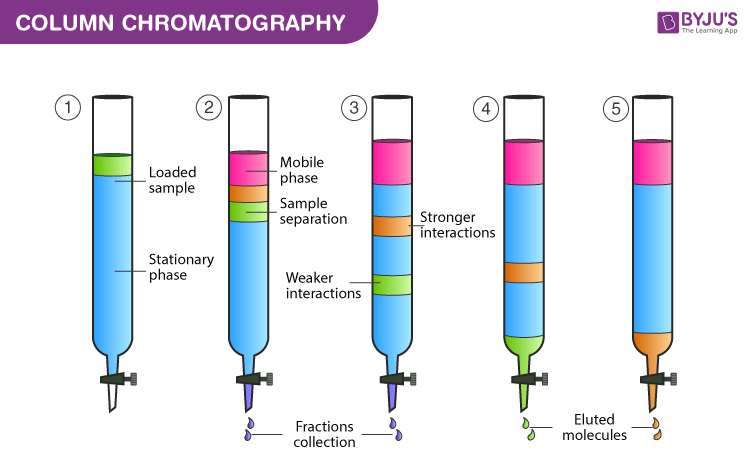
What is the setup for column chromatography and how does it work?
The stationary phase and mixture of compounds are added to the column
The mobile phase is then added on top
As the mobile phase moves down, components in the mixture that are more soluble in the mobile phase/less absorbed to the stationary phase will move down the column further and faster than components less soluble/more adsorbed
We can then collect the samples from the column separately
How can we analyse our sample collected from column chromatography if the components are colourless?
A detector can be used
At the baseline, the graph produced by the detector is flat
When detecting a component, a peak is produced and it flattens out again when all of that component is collected
Separate sample have different retention times so we can use this to detect the samples separately as they produce distinct peaks
What happens to components that are more soluble in the mobile phase in column chromatography?
More soluble components will elute (exit) the column faster
They will have a shorter retention time
What happens to components more strongly adsorbed to the stationary phase in column chromatography?
They elute (exit) the column the column later
They have a longer retention time
What is gas chromatography useful for?
Volatile mixtures
What happens in gas chromatography?
A column is packed with a solid or a solid coated by a liquid
This packed column is the stationary phase
An inert carrier gas like argon (or another noble gas) is passed through the column pressure at high temperature
The gas is the mobile phase
There is then a detector which will produce peaks for each sample
What is retention time of components affected by is gas chromatography?
The greater the retention by the stationary phase the longer the retention time
The more soluble the component is in the mobile phase (carrier gas) the shorter the retention time
How can we identify chemical components of a mixture in gas chromatography?
The retention time of compounds separated can be compared to a database of known retention times
What do the peaks of a detector in gas chromatography tell us?
The quantity of each sample (given by the peak area)
The number of components in the sample (number of peaks)
How can gas chromatography be combined with mass spectrometry?
Mass spectra of separated components can be compared to the spectra of pure samples and give the m/z ratio (an indication of Mr)
Why should we use a fume cupboard during TLC chromatography?
The volatile solvent is toxic