O&S
 Call Kai
 Learn
Learn Practice Test
 Spaced Repetition
 Match
Match Flashcards
 Knowt Play
1/54

Earn XP
Description and Tags
Organization & strategy economics
Name | Mastery | Learn | Test | Matching | Spaced | Call with Kai |
|---|
No analytics yet
Send a link to your students to track their progress
55 Terms
Economies of scale
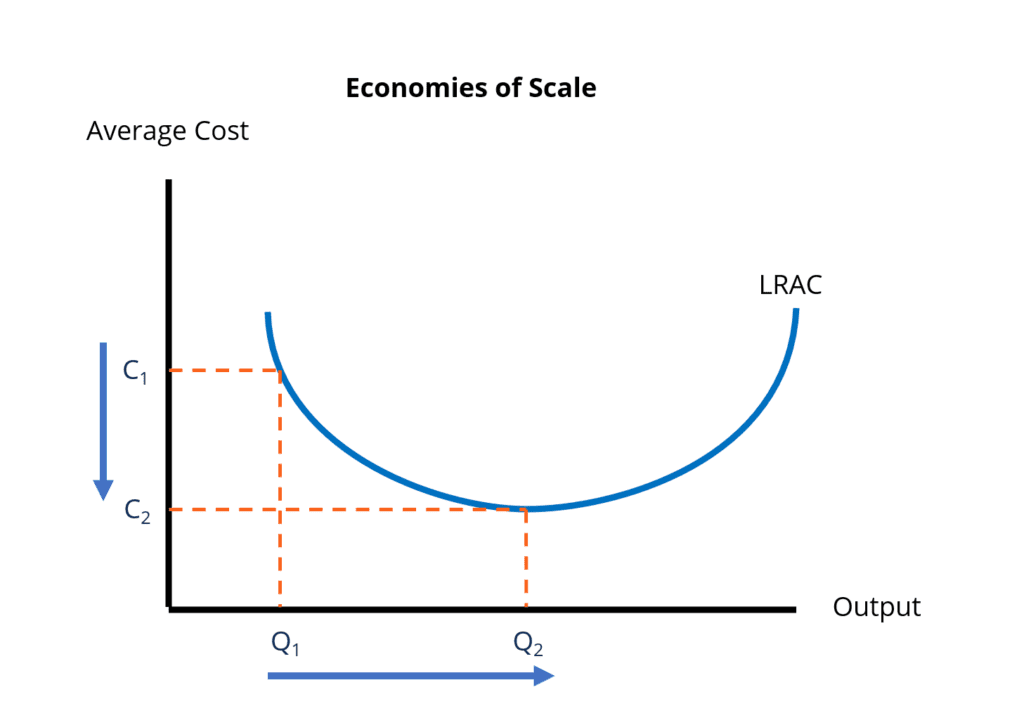
producing more = lower average cost per unit produced (cost of production decreases); - slope
capital intensive production processes more likely to display economies of scale & scope than labor/materials intensive processes
diseconomies of scale
average cost is increasing (marginal cost must exceed average cost; aka + slope) when production increases
may occur for large firms due to high labor costs, agency problems, dilution of specialized resources
average cost vs. marginal cost equations
AC=TC/Q (total costs divided by quantity)
MC=dTC/dQ (derive total cost equation wrt quantity)
mc=additional costs incurred if firm produces 1 more unit of output
average cost curve
economies of scope
total cost of producing 2 different products or services is lower when they’re produced by 1 firm (together) than separate firms.
average costs dec if goods are produced in a combination
capital intensive production processes more likely to display economies of scale & scope than labor/materials intensive processes
Specialized resources/spreading specialized resources too thin; diluting
specialized resources=advantage for the firm
“If a specialized input is a source of advantage for a firm & firm attempts to expand operations w/out duplicating input, the expansion may overburden the specialized input.
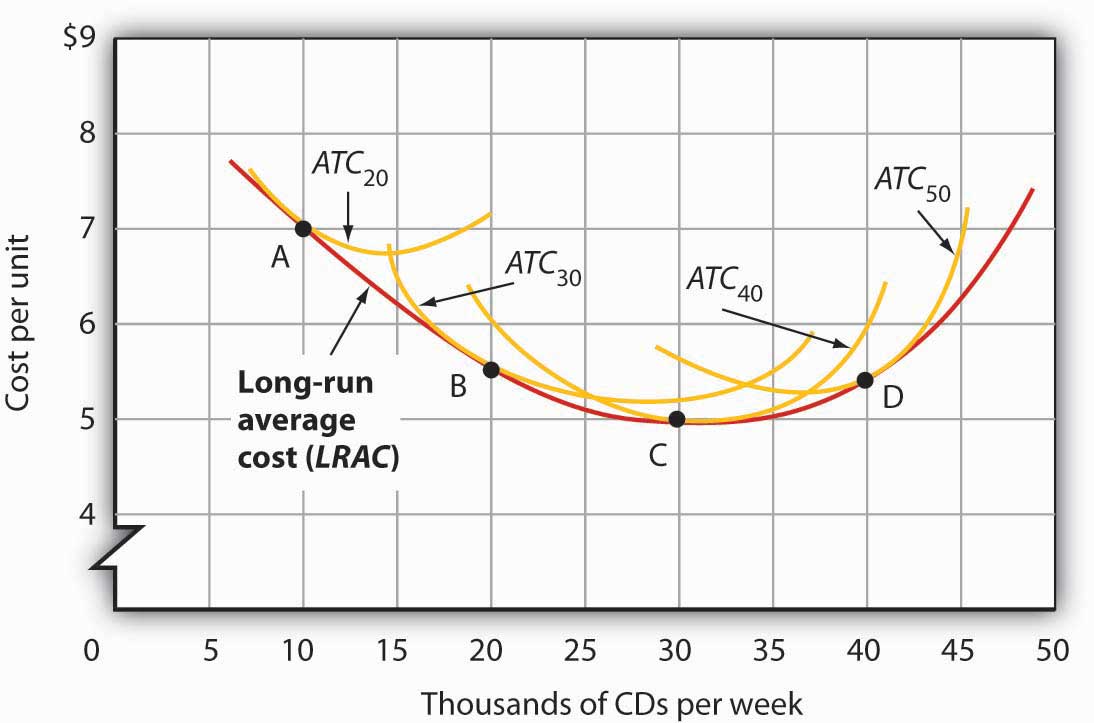
short-run average cost curves are U-shaped & after min efficient scale (bottom of u), output goes into the region of increasing average costs
minimum efficient scale
quantity at which firm reaches its lowest AC
affects firm size
the lowest pt on the AC curve (min)
derive AC wrt q
AC curve of firm that adapts its production strategies to the scale of production
sources of economies of scale
logistics
density
advertising
productivity of inputs
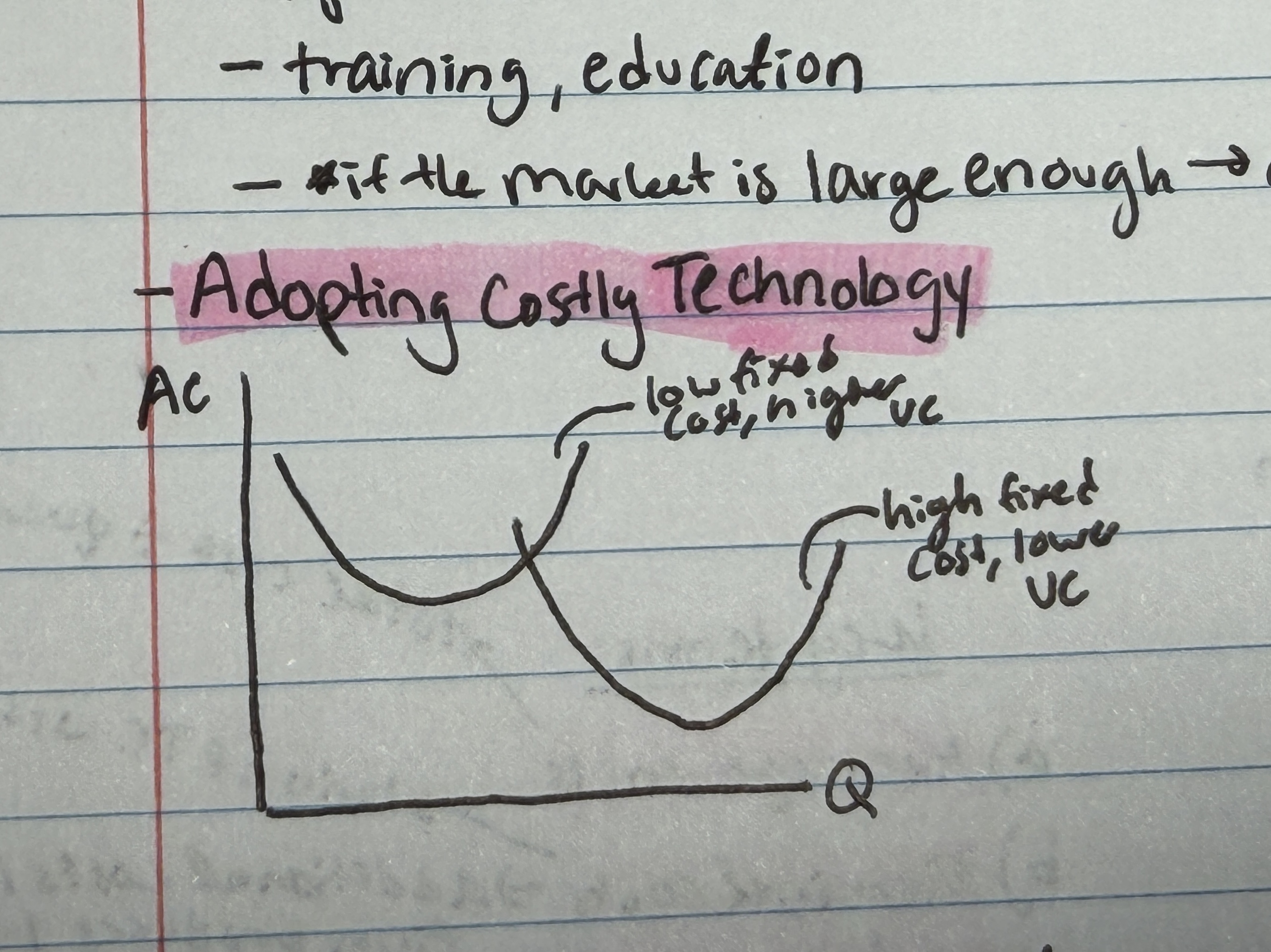
*important source of economies of scope & scale = spreading of indivisible fixed costs
average cost curve for adopting costly technology
reasons for economies of scope
shared technology
shared inputs
production process
why do world’s largest firms tend to be conglomerates?
economies of scope in non technical market (management systems applied to multiple industries)
Internal capital market (firm use their own money from successful activities to finance projects/R&D; “firm acts as banker for its own projects")
works due to: better info/monitoring/lowerrequiredrol?
cash rich business profits taken into cash poor business to invest in it without needing external sources of revenue
why do economies of scale not lead to dominant firms?
price drops w quantity
scale economies taper off (as a firm produces more, marginal cost may rise again; u shape) OR sometimes economies of scale are external (groups of firms may benefit from scale more than the individual firm)
market for corporate control (goals of each group may not align as each ones tries for its own control (principal agent problems)
economies of scale associated with inventory management, marketing expenses & purchasing
large scale marketing efforts have lower costs per message
cost of large-scale research ventures can be spread out over more output
*note: firm size can limit innovation (large firms less flexible, disadvantage to small firms)
diversified firm
firm that produces for multiple markets
successful diversification typically occurs for businesses related by tech/markets; unrelated diversification = unsuccessful
levels of integration
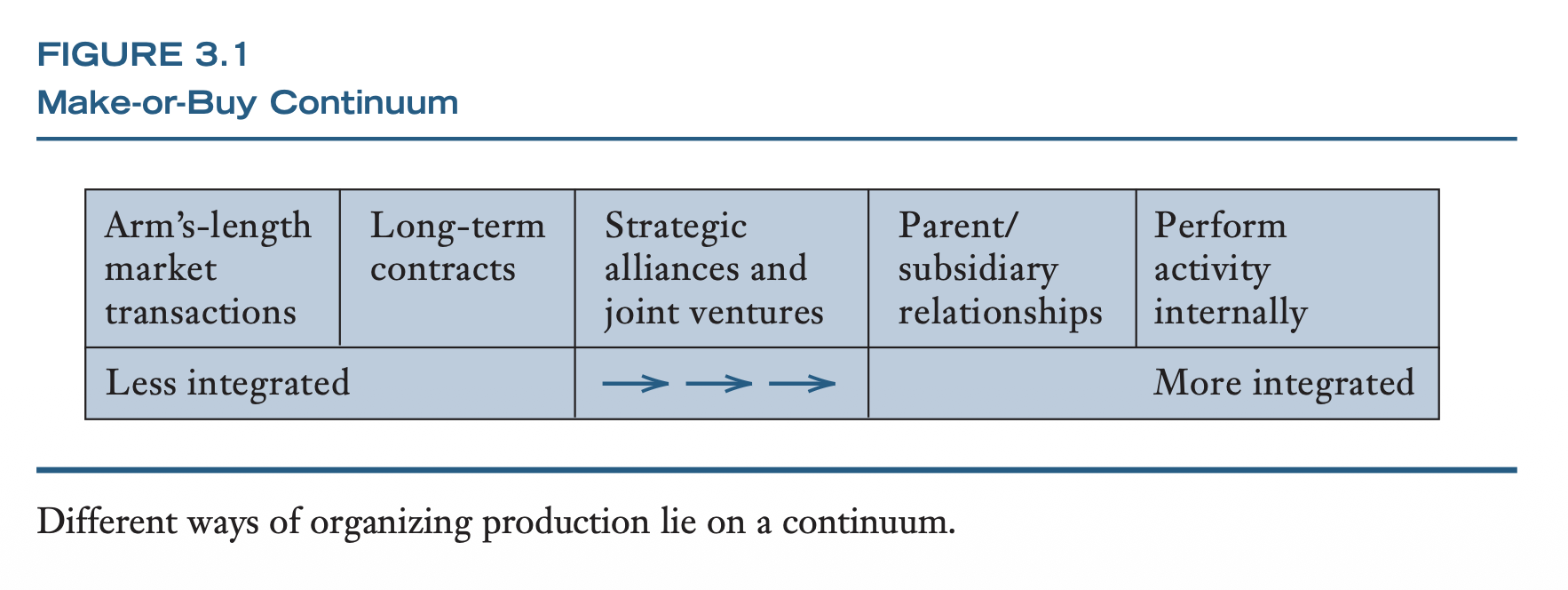
make or buy decision/integration decision
firm considers making an intermediate product instead of buying it from independent firms in the market
aka acquire inputs from other firms or make them in-house
supply chain
chain that links firms trough transactions of intermediate goods (firms that buy inputs from selling firms)
horizontal integration
firm merges w other firm that performs the same activities
contract issues/ contracts are always incomplete
logistics of buyer & seller must align
physical requirements: if an input doesn’t comply w/ specifications it cannot be used
sequence: order of the production process
other issues:
contract doesn’t describe all possible scenarios & cannot always be enforced
difficult to measure (quality)
asymmetric information
relationship-specific investment
adjusting production based on buyer’s demands
→ once a relationship-specific investment has been made, the manufacturer is exposed to renegotiation
arms-length transaction risks
ALT=purely buy on market from another firm no contract, @ market price
leaks of private info, knock offs that inc competition
rent vs. quasi rent
rent= value of og deal
quasi-rent=value of deal succeeding over deal failing (bargaining space)
consequences of holdup problems
firms renegotiate often
firms invest in alternative uses for their inputs
firms cut quality
Property Rights Theory
residual right of control: if a contract is unclear, the owners decides
contracts cannot predict everything, therefore when unforeseen circumstances occur, ownership matters (whoever controls the asset has the power)
helps to decide transaction problems & ambiguous contracts
PRT establishes that vertical integration is desirable when 1 firm’s investment in relationship specific asset has a greater impact on the value chain than the other firm investment/they make greater relationship-specific investment
PRT suggests that governance of an activity should fall to managers whose decisions hv the greatest impact on performance of the activity
forward integration
upstream [seller] owns assets of downstream [buyer]
backward integration
downstream [buyer] owns assets of the upstream [seller]
governance problems w in the firm
managers are self interested
managers influence costs (budget lobbying, etc)
uniform organizational design (more integration=less optimal organization)
technical-agency cost tradeoff
integration decision depends on asset specificity; are costs lower under integration or market activity?
vertical integration more attractive:
less costly to conduct vertical activities than market transaction
assets are highly relationship-specific
outside market agents cannot achieve economies of scale
firm’s product market is very large in scale
technical efficiency
is the firm using the most cost efficient production techniques
agency efficiency
the extent to which the firm’s production/admin costs are inc by transactions & coordination costs of market exchange or/vs agency/influence costs of vertical integration
transaction costs of producing under vert. integration - transaction costs under market transaction
franchise
managers exploit local market knowledge
decision making of franchise incentivized by profits, centralized scale economies/expertise (big established brand), contractable transactions
tapered integration
firm supplies part of its input requirements itself & relies on market exchange for the rest
competition
firms are competitors when they produce substitute (goods that satisfy the same need) goods
Close substitutes
similar occasions for use
similar performance characteristics
sold in same geographic market
cross price elasticity [competitor identification]
nyx= (change in quantitygoody/quantitygoody)/(changepricegoodx/pricegoodx)
when this >0, the goods are substitutes
definition: goods x&y are substitutes when an inc in the price of good x = inc in quantity sold of good y
2 mistakes:
may observe + relation when there is no causal effect
dont observe + relation when there actually is
competitor identification
diversion analysis=calculate market shares of customers’ 2nd preferred product
geographic identification=consumer travel patterns
the market
consists of buyers & sellers for a good or service
defining the market
when all competitors are identified, the market is defined
SSNIP criterion
small but significant non transitory increase in price
if there is a price increase, then the market is defined, if not there is substantial competition from other producers
market concentration
definition: the # & relative size of firms in a market
more firms=less market concentration
relative size= n = size firms is not the same as 1 very big firm & n-1 small firms
important bc: key determinant of market structure: monopoly, oligopoly, monopolisticcomp, perfcomp (market structure then determines market outcomes: innovation, prices, profits, productivity)
n-firm concentration ratio
the combined market share of the N largest firms
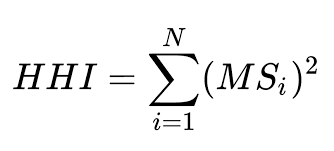
Herfindahl Index
sum of squared market shares
what determines market concentration?
product cost function
market size/demand
barriers to entry
product differentiation
SCP [structure-conduct-performance paradigm]
market structure [concentration] affects conduct [strategy] which affects performance [market outcomes]
structure
market concentration, entry barriers, product diff
conduct
pricing, advertising, production capacity, collusion, R&D
performance
price-cost margin (lower in more competitive markets bc the price is closer to MC)
profitability
innovative performance: # of patents
*traditionally high profits = market power = low market performance (less competition, more concentration & high market concentration=bad for consumers)
collusion hypothesis: + relationship between concentration & profitability = evidence of collusion/abuse of power designed to enhance profit
chicago school
criticizes SCP
conduct & performance affect structure
conduct:
collusion, innovation, blockading entry
performance:
more efficient firms are more profitable & grow larger
high profits attract new entrants
positive view on profits: efficiency hypothesis
+ relationship between concentration & profitability reflects a natural tendency for profitable = efficient firms & therefore industry dominant
Porter’s 5 forces analysis
entry [threat of entry]
internal rivalry
substitutes [growth leads to business-stealing]
supplier power (to inc prices)
indirect = few/1 supplier, many buyers (due to market structure)
direct = 1-1 contracting, suppliers have contractual power
buyer power (to dec prices)
indirect = many suppliers but only 1 buyer (due to market structure)
direct = a contract restricting the seller to only sell to this 1 buyer
environment (encompassing the 5 forces analysis)
political/legal (taxes,policies, gov stability)
economic (interest rates, inflation, wages)
social & cultural (demographics, norms, values, lifestyles)
technological
Principal-agent relationship
principal hires/contracts an agent to make decisions/take action that affect the principal
ex: shareholders hire a CEO to run the firm
principal-agent problem
2 main conditions
the objectives of the principal & agent differ
the actions of the agent are hard to observe (asymmetric information); shirking
examples
shareholder & ceo
voters & politicians
solutions to principal-agent problems
bureaucracy
monitor employees & gather information to reduce information asymmetry gap
performance-based incentives PBI
try to align the objectives of principals & agents by “paying for performance”
barriers to PBI
risk, ppl are risk averse
must be paid a risk premium
Certainty equivalent CE
certain amt that makes the individual indifferent between taking the risk & certain amount
**PBI can improve effort, but agents must be compensated for risk
risk premium
difference between the expected value of the risk & the CE