Benzenes
 Call Kai
 Learn
Learn Practice Test
 Spaced Repetition
 Match
Match Flashcards
 Knowt Play
1/21

There's no tags or description
Looks like no tags are added yet.
Name | Mastery | Learn | Test | Matching | Spaced | Call with Kai |
|---|
No analytics yet
Send a link to your students to track their progress
22 Terms
sp2
hybridization of benzenes
sp2 hybridization
planar/ flat
cyclic
conjugated
aromacity
follows Huckle’s rule
Characteristics of benzene
Huckle’s rule
states that a planar, fully conjugated, cyclic molecule is aromatic if it contains 4n + 2
4n=(pi)(e-)
anti-aromatic
electrophilic aromatic substitution (EAS)
A reaction where an electrophile replaces a hydrogen on a benzene ring.
A substitution pattern on aromatic ring
NO₂⁺ (nitronium ion).
the electrophile in nitration?
To keep aromatic stability.
Why does benzene undergo substitution instead of addition?
Hydrogen (H)
In EAS, what is replaced on benzene?
Cl⁺ or Br⁺
the electrophile in halogenation
Ortho, Meta, Para
position naming of the two groups in a disubstituted aromatic ring
Ortho (-o)
1,2 position
Meta (-m)
1,3 position
Para (-p)
1,4 position
phenol
benzaldehyde
benzoic acid
3 IUPAC recognized parent names when naming
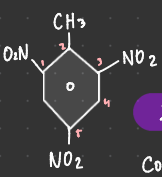
trinitrotoluene or TNT
Halogenation
Possible reaction that can happen in Benzenes
Halogenation
where a hydrogen atom on the benzene ring is replaced by a halogen (Cl, Br)
in the presence of a Lewis acid catalyst (FeCl3, FeBr3, AlCl3, AlBr3).
This reaction produces aryl halides (e.g., chlorobenzene, bromobenzene)
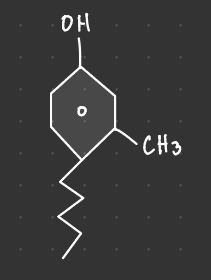
amylmetacresol a.k.a strepsils
“amyl”
a 5C chain
catechol
resorcinol
hydroquinone
di-hydroxy benzenes
naphthalene
anthracene
phenanthrene
Multi-benzene structures
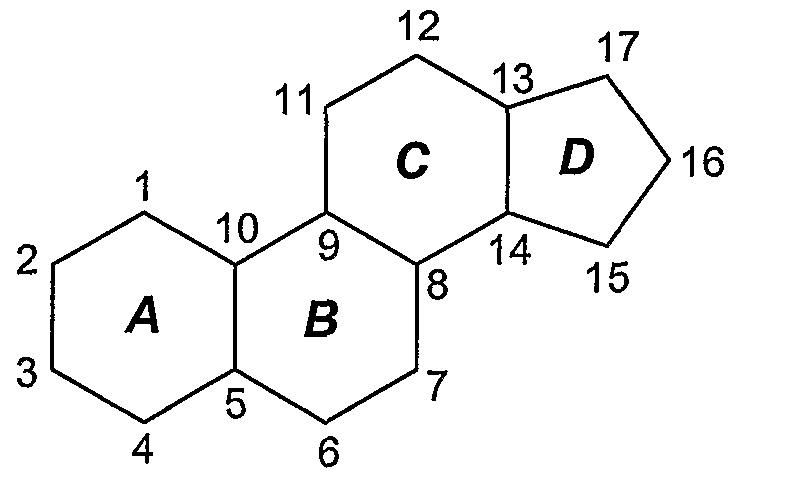
Cyclopentanoperhydrophenanthrene ring
A fused four-ring structure (3 hexane rings + 1 pentane ring) that forms the basic steroid nucleus found in compounds like cholesterol, steroid hormones, and bile acids.