450 chapt 4
 Call Kai
 Learn
Learn Practice Test
 Spaced Repetition
 Match
Match Flashcards
 Knowt Play
1/91

There's no tags or description
Looks like no tags are added yet.
Name | Mastery | Learn | Test | Matching | Spaced | Call with Kai |
|---|
No analytics yet
Send a link to your students to track their progress
92 Terms
What is the main job of the network layer?
The primary function of the network layer is to facilitate the transfer of data (also known as datagrams) from one host to another across various networks by determining the best path for the data to travel.
What is a datagram?
A datagram refers to a formatted unit of data that is transmitted at the network layer. It is essentially a packet containing the necessary information for routing from the source to the destination node.
What do routers do in the network layer?
Routers operate at the network layer to analyze the headers of incoming packets (datagrams) and then forward them toward their next destination based on the routing information contained in the packet.
What is forwarding?
Forwarding is the process of directing a packet from an input port on a router to the appropriate output port based on the destination address in the packet.
What is routing?
Routing involves determining the optimal path for a packet to travel from its source to its destination. This includes maintaining and updating routing tables to reflect changes in the network.
Key difference between forwarding and routing?
Forwarding is a local decision made inside the router to pass packets to the next hop, while routing encompasses global path planning that decides the overall direction packets should take across the entire network.
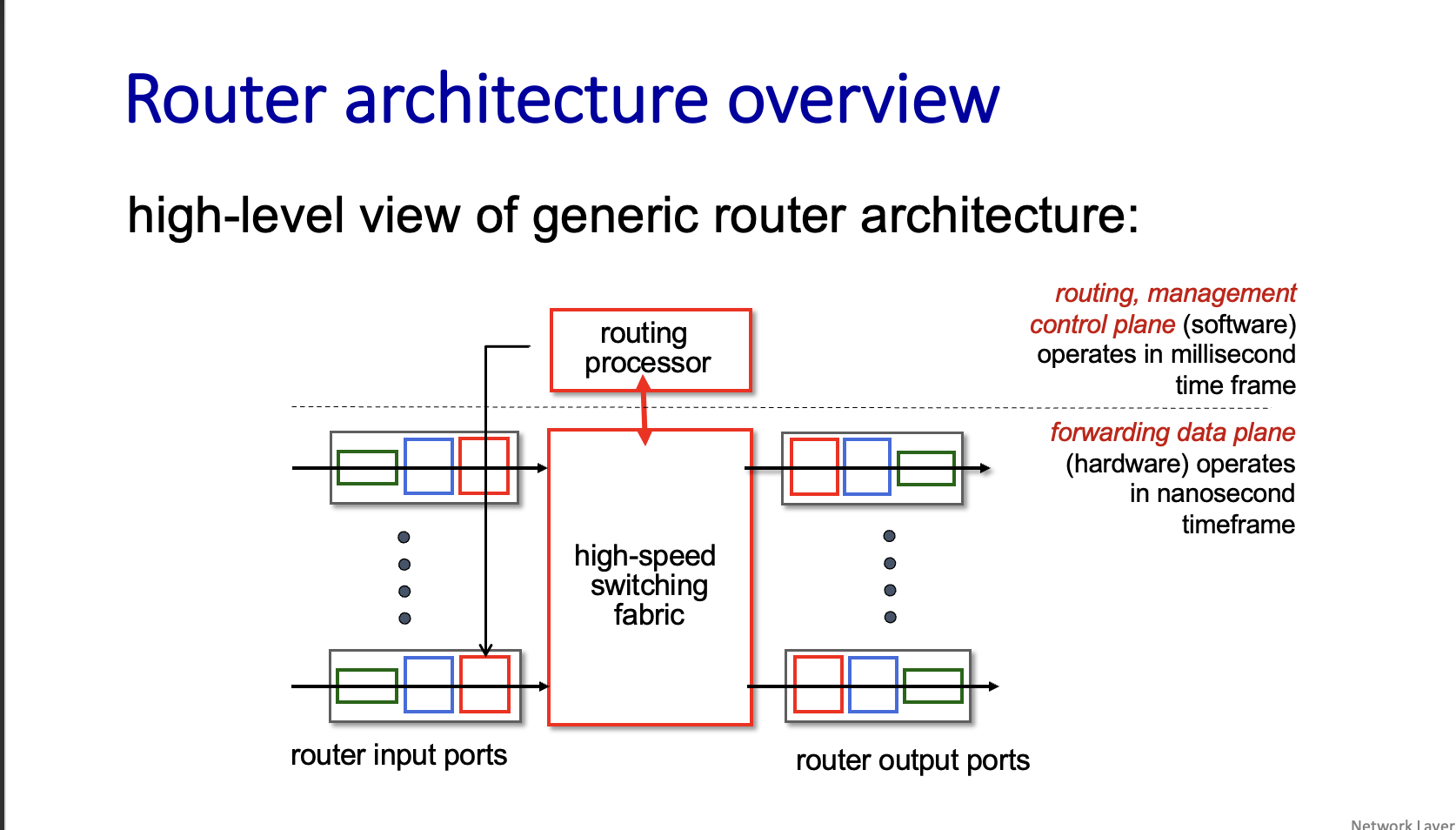
What is the data plane?
The data plane is responsible for the actual movement of packets through the router and involves making instantaneous decisions related to packet forwarding.
What is the control plane?
The control plane manages the routing process, determining optimal paths across the network, and reacts to network changes.
Two types of control plane?
The two main types of control plane are: Traditional (where routing decisions are made independently by each router) and Software-Defined Networking (SDN) (where a central controller dictates routing decisions for the entire network).
What is the Internet’s service model?
The Internet operates on a 'best-effort delivery' model, meaning it attempts to deliver packets but does not guarantee successful delivery, timely delivery, or ordered packet arrival.
Which layer uses IP addresses?
→ Network layer
2. What does a router mainly do?
→ Forwards packets between networks (chooses path and sends data)
What does 'best-effort' mean?
'Best-effort' signifies that the network does not provide any assurances regarding the guaranteed delivery of packets, the time it takes for packets to travel, or the order in which they will arrive.
3. What is stored in a forwarding table?
→ Destination IP → next hop (where to send the packet next)
4. Name two routing protocols
→ OSPF and BGP
5. What protocol is used for error reporting?
ICMP
Does the Internet guarantee bandwidth or timing?
The Internet does not provide guarantees regarding the amount of bandwidth that will be available or the timing of packet delivery.
What are the main parts of a router?
The main components of a router include input ports (where packets enter), switching fabric (the mechanism for directing packets), output ports (where packets exit), and the routing processor (which makes routing decisions and maintains routing tables).
What is switching fabric?
The switching fabric is the internal architecture of a router that transfers packets from the input ports to the appropriate output ports based on the forwarding logic.
Why does queuing happen in routers?
Queuing occurs when packets arrive at a router faster than they can be processed or sent out, leading to temporary storage of packets until they can be forwarded.
What is HOL (Head-of-Line) blocking?
Head-of-Line (HOL) blocking happens when a packet at the front of a queue is unable to be sent, preventing subsequent packets behind it from being processed, which causes delays.
What happens when buffers are full?
When a router's buffer is full, any new arriving packets are discarded or dropped, resulting in packet loss.
What is FCFS (FIFO)?
FCFS (First-Come, First-Served) is a queuing method where packets are processed and sent in the exact order they arrive at the router.
What is priority scheduling?
Priority scheduling is a method where packets with higher priority are forwarded before lower priority packets, allowing critical data to be transmitted with precedence.
What is round robin?
Round robin is a scheduling algorithm in which each queue is given time to send packets in turn, rotating through available queues to ensure equitable access.
What is weighted fair queuing?
Weighted fair queuing is a scheduling method where bandwidth is allocated to different flows based on predefined weights, ensuring that higher-priority flows receive more bandwidth.
What is an IP address?
An IP address is a unique 32-bit identifier assigned to each device or interface on a network, allowing it to be located and communicated with.
What is a subnet?
A subnet is a segmented portion of a network that allows a group of devices to communicate with one another directly without the need for a router.
What is CIDR?
CIDR (Classless Inter-Domain Routing) is a flexible IP addressing approach that allows for variable-length subnet masking using the format a.b.c.d/x, where x indicates the number of bits used for the network portion.
What does DHCP do?
DHCP (Dynamic Host Configuration Protocol) automates the process of assigning IP addresses to devices on a network, eliminating the need for manual configuration.
What is the DHCP process?
The DHCP process consists of four main steps: Discover (client searches for a DHCP server), Offer (server provides an IP address), Request (client requests the offered IP), and ACK (the server acknowledges the assignment of the IP).
What is NAT?
NAT (Network Address Translation) is a technique that enables multiple devices on a local network to share a single public IP address for internet access.
Why is NAT used?
NAT is employed to conserve IP address space and enhance security by obscuring the internal IP addresses from external networks.
What does NAT modify?
NAT modifies both the source IP address and possibly the port numbers of packets to match the public address used for sending and receiving data.
Why was IPv6 created?
IPv6 was developed in response to the exhaustion of available IPv4 addresses, providing a vastly larger address space to accommodate the growing number of devices.
Key difference IPv6 vs IPv4?
The primary distinction between IPv6 and IPv4 is that IPv6 utilizes 128-bit addresses, significantly increasing the number of unique addresses available compared to the 32-bit addresses of IPv4.
What is tunneling?
Tunneling is a technique used to encapsulate IPv6 packets within IPv4 packets, enabling transmission of IPv6 traffic over IPv4 networks.
What is longest prefix matching?
Longest prefix matching is a routing strategy in which the entry in the routing table with the greatest number of matching bits is chosen as the best route for a packet.
What is 'match + action'?
'Match + action' refers to a framework in network processing where specific fields in the packet headers are matched against rules, and associated actions (such as forward, drop, or modify) are executed based on those matches.
What is a flow?
A flow is defined as a collection of packets that share specific attributes in their headers, such as source and destination IP addresses and port numbers.
What is the 'IP hourglass'?
The 'IP hourglass' refers to the structural concept that IP acts as a central protocol connecting disparate network layers and technologies, emphasizing its role in end-to-end communication across different architectures.
What is the end-to-end argument?
The end-to-end argument posits that application functionality should ideally be implemented at the endpoints of a network (the hosts) rather than within the network itself, to optimize efficiency and adaptability.
Memory trick for Forwarding?
To remember forwarding, think of it as quick and local packet processing: 'Forwarding = fast + local.'
Memory trick for Routing?
Routing can be simplified as determining the path a packet should take: 'Routing = path planning.'
Memory trick for Data plane?
Think of the data plane as the active handling of packets: 'Data plane = action.'
Memory trick for Control plane?
The control plane is about decision-making: 'Control plane = decision.'
Memory trick for NAT?
NAT is about IP sharing: 'NAT = many devices → one IP.'
Memory trick for DHCP?
DHCP simplifies IP assignment: 'DHCP = automatic IP.'
Memory trick for Best effort?
The idea of no guarantees in delivery can be recalled as 'Best effort = no guarantee.'
analogy for network layer functions
analogy: taking a trip
forwarding: process of getting through single interchange
routing: process of planning trip from source to destination
simplicity of mechanism
§has allowed Internet to be widely deployed adopted
provisioning of bandwidth allows
§sufficient provisioning of bandwidth allows performance of real-time applications (e.g., interactive voice, video) to be “good enough” for “most of the time”
switching rate
rate at which packets can be transfer from inputs to outputs
•often measured as multiple of input/output line rate
•N inputs: switching rate N times line rate desirable
three major types of switching fabrics
memory bus and interconnection network
Q: How does a network get the subnet part of an IP address?
A network is assigned a block of IP addresses from its ISP, which comes from the ISP’s allocated address space.
Q: How does a host get an IP address within its network (host part)?
Either manually configured by a system admin, OR
Automatically using DHCP (Dynamic Host Configuration Protocol)
👉 DHCP is the main one (plug-and-play)
Q: How does a network get an IP address for itself (network part)?
It gets a block of IP addresses from its ISP (Internet Service Provider)
The ISP gets those addresses from ICANN / regional registries
IP protocol
IP protocol
• datagram format
• addressing
• packet handling conventions
ICMP protocol
ICMP protocol
• error reporting
• router “signaling”
Path-selection algorithms:
implemented in
•routing protocols (OSPF, BGP)
•SDN controller
What is a middlebox?
A network device that performs functions beyond simple packet forwarding (unlike a standard router).
generalized forwarding
•match: pattern values in packet header fields
•actions: for matched packet: drop, forward, modify, matched packet or send matched packet to controller
•priority: disambiguate overlapping patterns
•counters: #bytes and #packets
output port queueing
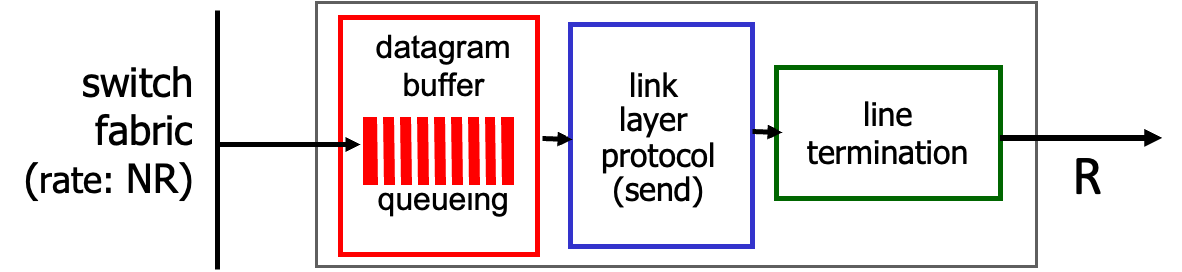
buffer → link layer prootcol → line termination →
Buffering
required when datagrams arrive from fabric faster than link transmission rate
Scheduling disciplinef
chooses among queued datagrams for transmission
Why are middleboxes used?
To improve security, performance, and functionality in the network.
Give examples of middleboxes.
NAT, firewalls, IDS, load balancers, caches.
What does NAT do?
Translates private IP addresses to a public IP address.
Where is NAT commonly used?
Home networks, cellular networks, and institutional networks.
What is a firewall?
A device that blocks or allows traffic based on security rules.
What is an IDS (Intrusion Detection System)?
A system that monitors network traffic for suspicious activity.
Where are firewalls and IDS used?
Corporate, institutional, and ISP networks.
What is a load balancer?
A device that distributes traffic across multiple servers.
Why use a load balancer?
To improve performance and reliability.
Where are load balancers used?
Corporate networks, service providers, data centers, mobile networks.
What is a cache?
A system that stores frequently accessed data to reduce delay.
Where are caches used?
Service providers, mobile networks, and CDNs.
What are application-specific middleboxes?
Devices designed for specific services like CDNs or streaming.
Where are application-specific middleboxes used?
Service providers, institutional networks, and CDNs.
What are the main roles of middleboxes?
Address translation, security, load balancing, and caching.
router architect
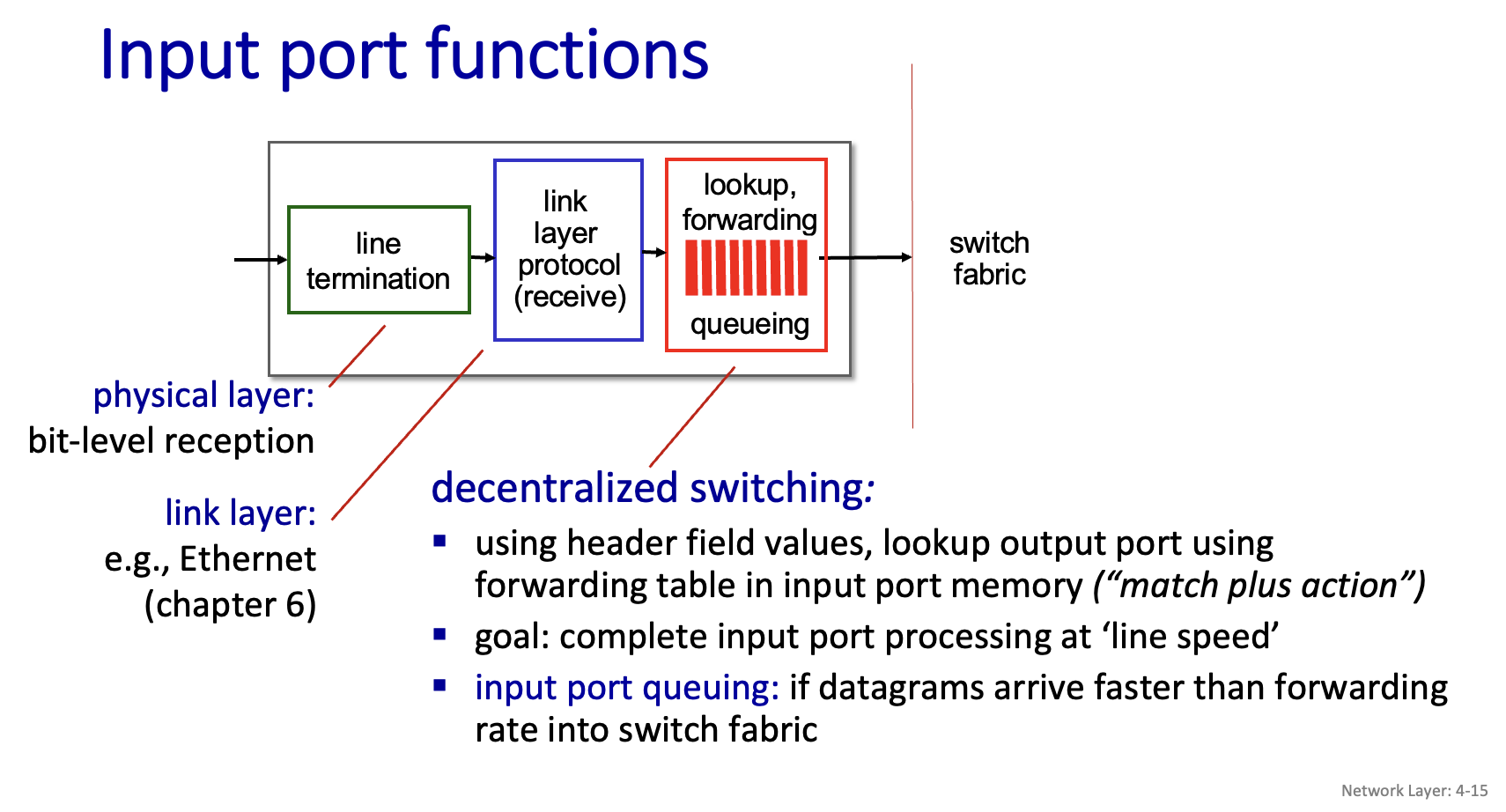
inport port funcs
Q: What are the 4 DHCP steps?
A:
Discover → client broadcasts: “is there a DHCP server?”
Offer → server replies: “here’s an IP”
Request → client says: “I want this IP”
ACK → server confirms: “you got it”
Q: Why is DHCP discover a broadcast?
A: Because the client doesn’t know the server’s IP yet
Q: What is the DHCP process?
A: Discover → Offer → Request → ACK
What does DHCP Discover do?
Finds available DHCP servers.
What does DHCP Offer do?
Proposes an IP address.
What does DHCP Request do?
Client accepts the offered IP.
What does DHCP ACK do?
Server confirms the IP assignment.