Dialectical Behavior Therapy (DBT)
 Call Kai
 Learn
Learn Practice Test
 Spaced Repetition
 Match
Match Flashcards
 Knowt Play
1/44

There's no tags or description
Looks like no tags are added yet.
Name | Mastery | Learn | Test | Matching | Spaced | Call with Kai |
|---|
No analytics yet
Send a link to your students to track their progress
45 Terms
Dialectical Behavior Therapy (DBT)
a modified form of CBT that teaches clients how to live in the moment, cope effectively with difficult situations and crises, regulate emotions, and improve interpersonal relationships.
Dialectical Behavior Therapy (DBT)
teaches specific skills in mindfulness, distress tolerance, emotion regulation, and interpersonal effectiveness to help people build a life worth living.
Dialectical Behavior Therapy (DBT)
It was initially developed for individuals with a diagnosis of borderline personality disorder but is now being used for many different disorders.
Borderline Personality Disorder (BPD)
a mental health condition characterized by intense, unstable emotions, impulsivity, distorted self-image, and tumultuous relationships, often driven by a severe fear of abandonment
Marsha Linehan
Psychologist ______ ______ developed and researched DBT in the 1980s as a treatment for clients with borderline personality disorder.
biosocial theory of personality functioning
The foundation for DBT is the _____ ______ ______ ____ _____ _____ , which views difficulties with emotion regulation and the other problems described above as stemming from the interaction of biological and environmental factors
vulnerability to experiencing intense negative emotions
Specifically, the main biological factor is a ________________________ , while the environmental factors refer to a chronic invalidating environment.
chronic invalidating environment.
Specifically, the main biological factor is a vulnerability to experiencing intense negative emotions, while the environmental factors refer to a __________ ______________ _____________.
weakness
An invalidating environment may consist of others telling the person that their experiences, thoughts, and feelings are wrong, which leads to attributing one's own emotional reactions as a sign of ______.
The Wise Mind in DBT
represents the integration of reason (reasonable mind) and emotion (emotional mind).
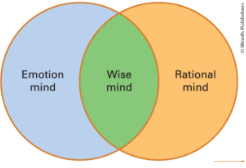
The Wise Mind in DBT
It's a state of being where one can access both logic and feelings to make balanced decisions.
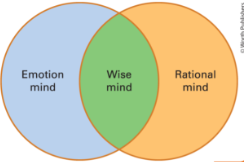
The Wise Mind in DBT
allows for intuitive understanding and a sense of knowing what's right in a given situation, blending intellect with emotional awareness.
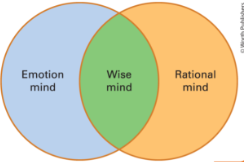
The Four Modules in Dialectical Behavior Therapy
Mindfulness (2 weeks)
Distress tolerance (6 or more weeks)
Emotion regulation (6 or more weeks)
Interpersonal effectiveness (6 or more weeks)
2 weeks
How Many Weeks is Mindfulness?
Mindfulness (2 weeks)
Learning how to become aware of the present moment without judgement
6 weeks or more
How many weeks is distress tolerance, emotion regulation, and interpersonal effectiveness?
Distress tolerance (6 or more weeks)
Accepting reality as it is and learning to effectively manage adversity
Emotion regulation (6 or more)
Understanding and reducing vulnerability to strong emotions
Interpersonal effectiveness (6 or more)
Developing skills for cultivating and maintaining interpersonal relationships
Mindfulness (2 weeks)
It teaches individuals to observe their thoughts, feelings, and sensations without getting swept away by them.
stay grounded
By practicing mindfulness, individuals learn to increase their ability to ___ _______ and respond effectively to life's challenges.
Distress Tolerance
skills are designed to help individuals manage intense emotional states without resorting to destructive or impulsive behaviors
Distress Tolerance
It provides strategies for surviving crises, accepting reality as it is, and finding ways to cope with overwhelming emotions.
These skills are essential for navigating difficult situations without making them worse.
Crisis Survival Skills in the Distress Tolerance Module of DBT
Self-soothing
T.I.P.P. skills
S.T.O.P skills
Pros and Cons
Radical Acceptance
Distraction
Improving the moment
Self-soothing
Alleviating distress through comforting and nurturing oneself when experiencing a crisis. Clients assemble a kit of self-soothing material for the five senses (e.g., favorite music, photos of loved ones, soft blanket, coffee, scented candle) that they access to mentally ground themselves when experiencing a crisis.
T.I.P.P. skills
Using Temperature (e.g., cold water), Intense exercise, Paced breathing, or Progressive muscle relaxation to reduce intense emotional arousal.
S.T.O.P skills
Learning to respond to crises in the following way:
Stop and do nothing instead of the typical reaction,
Take a step back and a deep breath,
Observe what's happening in the situation,
Proceed using mindfulness and acceptance skills.
Pros and Cons
Taking a moment to think logically (perhaps making a list of pros and cons) about the situation and next steps so that decisions are made thoughtfully and carefully, rather than impulsively and based on strong emotions.
Radical Acceptance
Observing the situation as it is without judgment or trying to change it (i.e., "It is what it is"), and understanding that some things are simply out of our control.
Distraction
Temporarily doing something else until the client is able to more calmly approach the crisis situation. This might involve physically leaving a location, or engaging in an action such as calling a friend or playing with pets.
Improving the moment
Using other strategies to get through the crisis, such as trying to find a sense of purpose in the crisis, praying, using muscle relaxation, and breaking the crisis down into parts that can be addressed one at a time.
Emotion Regulation
aim to help individuals understand and manage their emotional experiences.
Emotion Regulation
It teaches techniques for identifying and labeling emotions, reducing emotional vulnerability, and increasing positive emotional experiences.
intensity and frequency
By improving emotion regulation, individuals can reduce the _____ ___ ______ of problematic emotional reactions.
Interpersonal Effectiveness
focus on improving communication and relationship skills.
Interpersonal Effectiveness
It teaches individuals how to assert their needs, set boundaries, and maintain healthy relationships.
Interpersonal Effectiveness
These skills are crucial for navigating social situations and building fulfilling connections with others.
DEAR MAN: Steps That Help You Strike Efficient Communication
'D' stands for describe
'E' stands for express
'A' stands for assert
'R' stands for reinforce
'M' stands for Mindful
‘A' stands for appear/act confident
'N' stands for negotiating
'D' stands for describe
Make use of facts, Don't Elaborate on unnecessary things, Emphasise on issues.
'E' stands for express
Explain how things are affecting you personally and professionally.
A' stands for assert
Assert factors that you wish to see in the near future.
'R' stands for reinforce
Instead of insulting other individuals, Reward them! It will create a happy bond.
'M' stands for Mindful
Don't get sidelined by your past experiences. Don't put forth your past grievances in any way.
A' stands for appear/act confident
Embrace confidence in every possible way.
'N' stands for negotiating
Not every person might agree with your plea. So, does it mean you leave the conversation? Instead Stay and hear the Other person out