Efficiency (1)
 Call Kai
 Learn
Learn Practice Test
 Spaced Repetition
 Match
Match Flashcards
 Knowt Play
1/6

There's no tags or description
Looks like no tags are added yet.
Name | Mastery | Learn | Test | Matching | Spaced | Call with Kai |
|---|
No analytics yet
Send a link to your students to track their progress
7 Terms
Allocative efficiency
Occurs at the level of output where average revenue = marginal cost (AR = MC)
At this point, resources are allocated in a way that consumers and producers receive the maximum possible benefit
No one can be made better off without making someone else worse off
There is no excess demand or supply
Productive efficiency
Occurs at the level of output where marginal cost = average cost (MC=AC)
At this point, average costs are minimised
There is no wastage of scarce resources and there is a high level of factor productivity
Dynamic Efficiency
Long-term efficiency is a result of innovation as a firm reinvests its profits
It results in improvements to manufacturing methods
This lowers both the short-run and long-run average total costs
X - inefficiency
Occurs when a firm lacks the incentive to control production costs. Slack occurs as a consequence
The ATC is higher than it should be
It often occurs in an industry if there is a lack of competition or in a firm that is not accountable for making a loss (e.g. some government owned companies)
What are market structures ?
Market structures are the characteristics of the market in which a firm or industry operates
These characteristics typically include
The number of buyers
The number and size of firms. The market's concentration ratio
The type of product in the market (homogenous -Products sold by competing firms are identical and indistinguishable from each other or differentiated -Unique products that are substantively (or perceived to be) different from competitors products )
The types of barriers to entry and exit
The degree of competition
What can market structures be separated into ?
Perfect competition - A market structure in which individual firms have no market power due to the amount of competition & are unable to influence the price
Imperfect competition - Market structures where firms do have some market power and can influence prices i.e.monopolistic, oligopoly & monopoly
Imperfect competition includes the following market structures
Monopolistic
Oligopoly
Monopoly
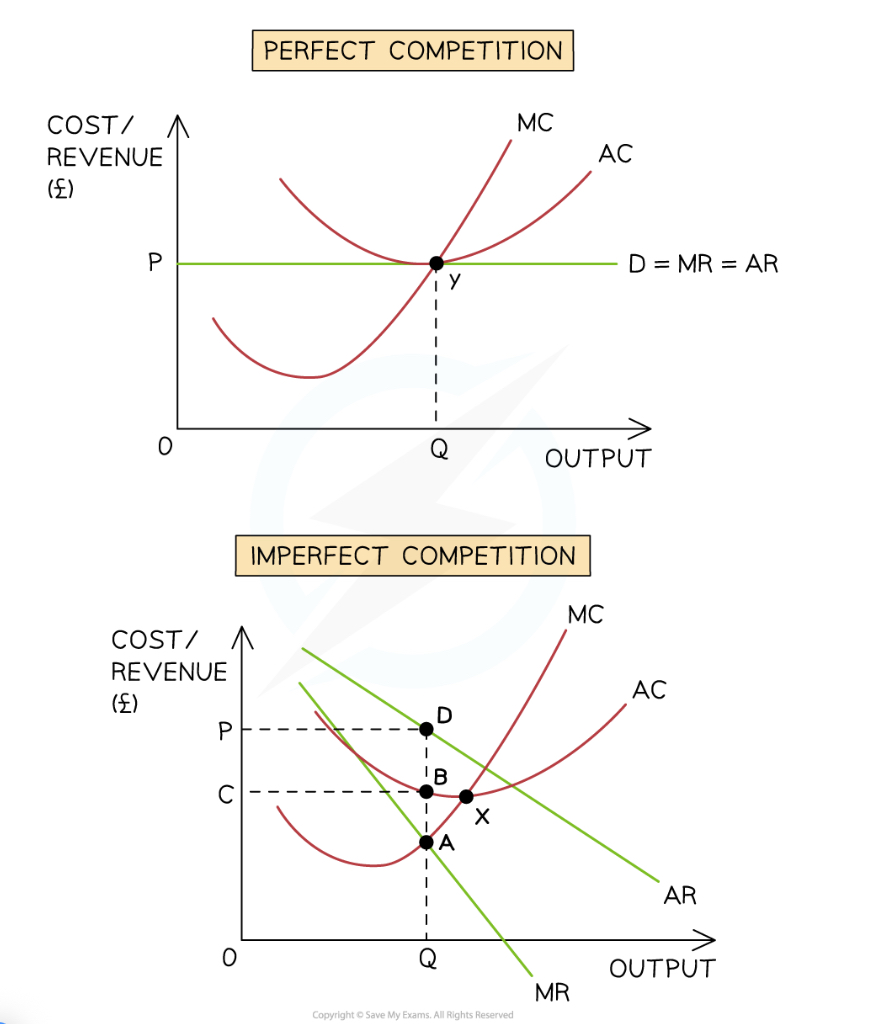
A perfectly competitive market on the top which experiences allocative and productive efficiency. An imperfect market on the bottom in which inefficiencies exist at the profit maximisation level of output
Perfectly competitive market diagram observations
The firm produces at the profit maximisation level of output, where MC=MR (Y)
The firm is productively efficient as MC=AC at this level of output
The firm is allocatively efficient as AR (P)=MC
The firm is unlikely to experience dynamic efficiency as it is unlikely to have supernormal profits to reinvest
Imperfectly competitive market diagram observations
The firm produces at the profit maximisation level of output, where MC=MR (A)
The firm is not productively efficient as AC > MC at this level of output (B-A)
Productive efficiency would occur at point E, where MC=AC
The firm is not allocatively efficient as AR (P) > MC at this level of output (D-A)
Allocative efficiency would occur where AR=MC
The firm is likely to experience dynamic efficiency as it will be able to reinvest its profits so as to increase innovation