Biology Chapter 3 - Plant and Animal Functioning Systems
 Call Kai
 Learn
Learn Practice Test
 Spaced Repetition
 Match
Match Flashcards
 Knowt Play
1/123

There's no tags or description
Looks like no tags are added yet.
Name | Mastery | Learn | Test | Matching | Spaced | Call with Kai |
|---|
No analytics yet
Send a link to your students to track their progress
124 Terms
What two things do organism's require?
An input of energy and matter
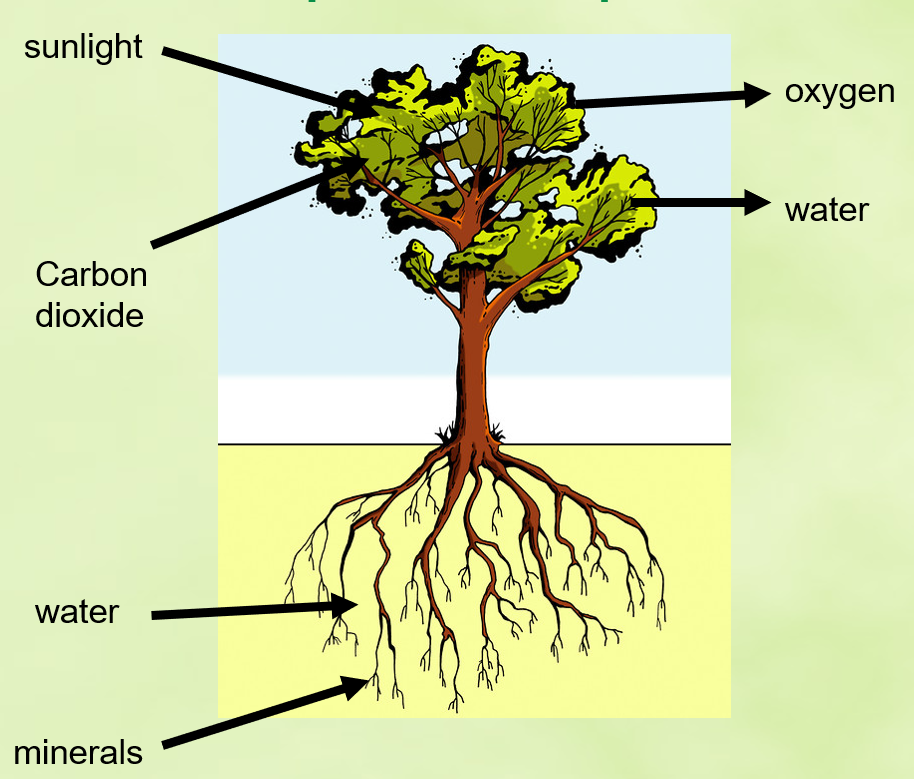
Nutritional requirements of plants
- Sunlight (energy)
- CO2
- Water
- Minerals including Nitrogen (N), Phosphorus (P) and Potassium (K)
Plant inputs and outputs
Photosynthesis equation
6CO2 + 6H2O + light energy --> C6H12O6 + 6O2 + excess water
How do substances move through smaller plants like moss?
By diffusing from cell to cell
What 4 things make up large multicellular plants (and animals)?
Cells-->tissues-->organs-->systems
Tissues
Groups of similar cells which have a similar function
Organ
Structure made up of several types of tissues that perform a particular function
System
Made up of several interrelated organs and together perform a specific function
Example of a plant vs animal system (and its parts)
ANIMAL:
Individual cell: muscle cell
Tissue: Cardiac muscle
Organ: Heart
System: Circulatory system
PLANT:
Individual cell: Palisade cell
Tissue: Photosynthetic tissue
Organ: Leaf
System: Shoot (transport mechanisms for water, starch and minerals)
Why does diffusion not occur in larger plants?
Because it is too inefficient for such large and complex structures and needs
Vascular plants
Plants that have vascular tissue, includes ferns, conifers and flowering plants
6 main functions of plant tissues
Transport - E.g. Vascular tissues, roots and root hairs for absorption of nutrients and water
Photosynthesis - E.g. Leaves
Storage - E.g. Roots
Growth - E.g. Root tip, shoot tip, lateral bud
Reproduction - E.g. Fruit, seeds, flowers
Anchoring - E.g. Primary and lateral roots
Two systems in Plants
Root system and shoot system
Shoot system
All part of the plant above ground. Functions include:
- Transportation of resources
- Absorption of oxygen and carbon dioxide
- Photosynthesis
- Reproduction
Root system
All parts of the plant below ground. Functions include:
- Supporting and anchoring the plant
- Absorbing water and nutrients from the soil
- Storage of energy/materials, mainly starch
Why do some plants drop their leaves during winter?
Because with the lack of ability to photosynthesise due to low/no sunlight, plants must rely on stored starch in their roots to survive, and they can't support leaves on this limited supply
What substances can be transported in a plant?
Carbohydrates, water, mineral ions
Vascular tissue
Specialised tissues in some plants involved in transporting water and nutrients to different parts of a plant. Arranged in bundles in the roots, stems and leaves and is made up of majorly xylem and phloem
How is water absorbed into plant roots?
Plants store large concentrations of ions in their roots, which draws water down its concentration gradient into the roots through osmosis
How are mineral ions absorbed into plant roots?
Either by facilitated diffusion or active transport
Root hairs
Found mainly behind the root tip, and increase the surface area of the roots outermost surface (epidermis) to speed up absorption of water and mineral ions
What is the role of air spaces in soil?
They provide oxygen for the root cells to use to respirate. If the soil is waterlogged, root respiration cannot occur and the roots and therefore the plant dies
Two types of root systems
Taproot system - Contain one major root with possible branches off. Good for deep penetration for water access and strong structural support E.g. carrots
Fibrous root system - Lack one main root, instead have a dense network of thread-like roots that maximise surface area but provide little anchorage E.g. grasses
Xylem
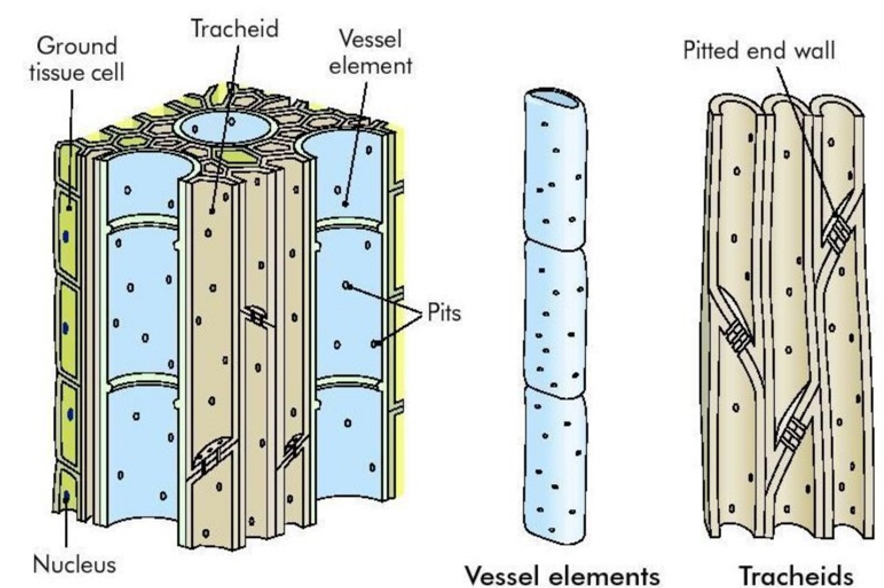
Portion of vascular tissue responsible for transporting water from the plant's roots to its leaves and other areas. Contains tracheids and xylem vessel elements that together make up the wood of a tree and are made up of lignin (dead cells)
Tracheids
Dead cells with woody cellulose walls that elongate and overlap at the ends. Tracheids alone are found in ferns and conifers (pine trees).
Xylem vessels/Xylem vessel elements
Long continuous tubes made of dead cells whose walls have broken down. Flowering plants have both tracheids and xylem vessel elements
Xylem structures comparison
Woody tissue
Mostly made up of dead xylem tissue that transports water as well as providing structural support
Transpiration
How water is lost from leaves through the stromata in the leaf epidermis.
The Transpiration Pull
The force arising from the evaporation of water transmitted down the xylem. Water moves up a plant's xylem to take the place of water that has been lost, carrying some minerals with it up the plant. Driven by the sun's energy (heat).
Path water takes through a plant.
Diffuses through osmosis into root cells, then drawn into xylem vessels and pulled up them by the transpiration pull of water evaporating from the plant's leaves. It then diffuses into the air spaces surrounding the cells in the leaf, where much of it evaporates and escapes through the stromata.
Cuticle
Waterproof wax layer on the top leaves, contains no stromata to limit water loss from top of the leaves.
Stromata (singular stroma)
Pores in leaves that open and close at different times of day for oxygen-carbon exchange. Most water is lost (transpired) through these pores.
Transpiration stream
The continuous column of water through a plant
What 3 things assist movement of water through the xylem?
Cohesion of water molecules, the capillary effect and root pressure.
Cohesion of water molecules
Water molecules are attracted to each other due to their polar nature, and as water is lost through transpiration, the cohesive force of the evaporating molecules pull other molecules up to replace them.
Capillary Effect
Water rises higher in small tubes due to the attractive forces (adhesion) between the water molecules and the xylem vessel wall. Smaller tubes = more capillary action
Root pressure
Water entering root hairs by osmosis pushes other water molecules ahead of it
Leaf structure
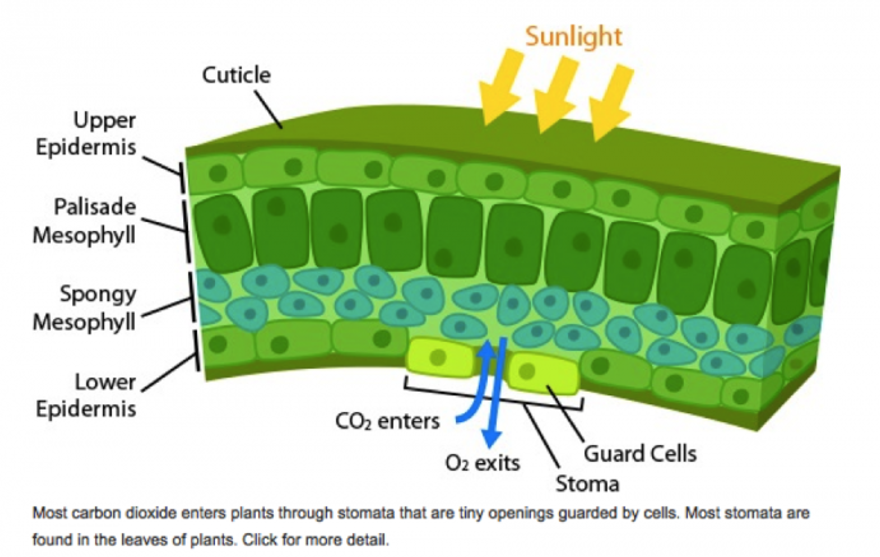
How do substances move around a leaf for photosynthesis?
Water - Needed by mesophyll for photosynthesis, obtained by xylem from roots via osmosis and lost via transpiration
CO2 - Enters leaf through stromata and diffuses down its concentration gradient into air spaces, then across membrane into mesophyll cells
Oxygen - Diffuses out through stromata
Glucose - Either used in respiration, converted to starch and stored or converted into sucrose and transported to other parts of the plant
Sucrose
A complex glucose (organic substance) made in the leaves of plants, composed of glucose & fructose
Phloem
Living vascular tissue that transports sugar and organic substances from the leaves where they are synthesised to other areas for usage or storage
Sinks
Locations in a plant where nutrients are stored, e.g. fruit, roots
Translocation
Transport of organic material throughout a plant by the phloem, typically from storage sites to other areas for use.
Vascular tissue in the stem
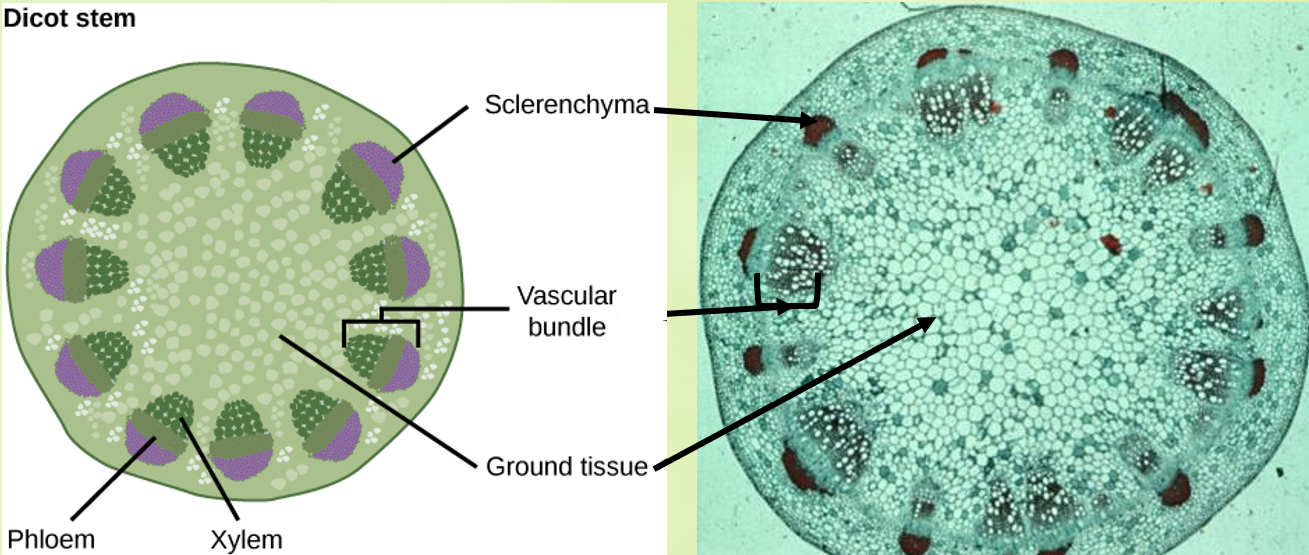
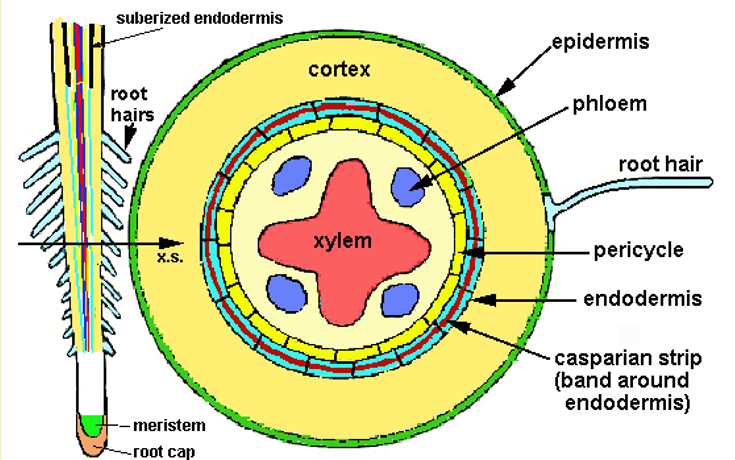
Vascular tissue in the root
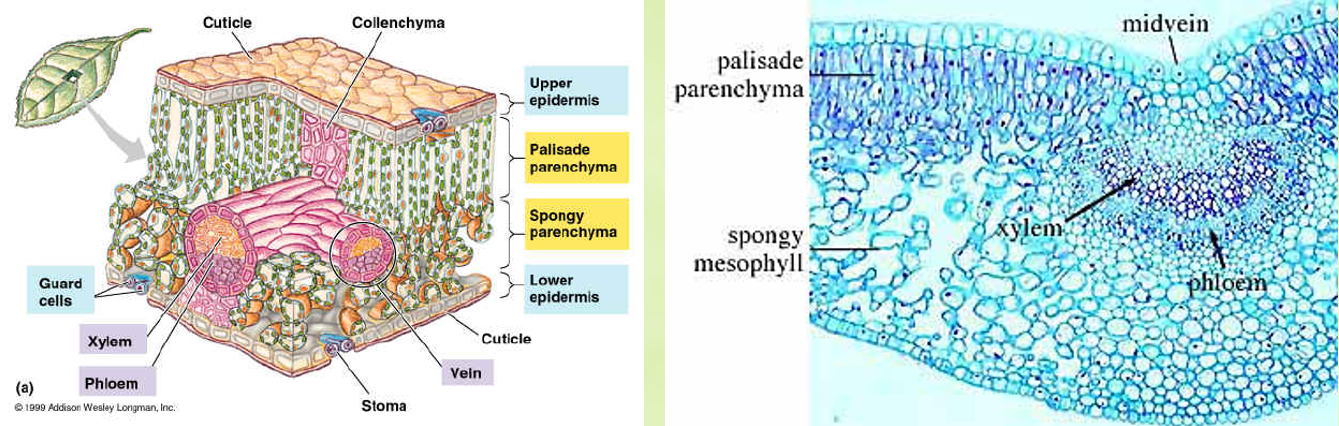
Vascular tissue in the leaf
What do all organisms require access to?
Complex organic nutrients - e.g. carbohydrates, proteins, fats, vitamins
Simple inorganic nutrients - e.g. water and mineral salts
How do plants vs animals get energy?
Plants - Through the root system and photosynthesis
Animals - Consuming and digesting food
Digestive system
Consists of specialised cells grouped into tissues and organ for digestion and absorption
Digestion
Process through which large complex organic molecules are broken down into simple substances that can cross the plasma membrane into the cells.
Mechanical digestion
Physical breaking down of food through chewing, muscular movement in the stomach and the action of bile in the small intestine.
Chemical digestion
Enzymes break down complex molecules into simpler molecules for absorption.
4 roles of the digestive system
1. Ingestion: taking in nutrients
2. Digestion: breaking down of food into simple molecules.
3. Absorption: the movement of digested molecules into the internal environment of the body.
4. Egestion: removal of waste materials.
Where does ingestion start for most animals?
The mouth (both chemical and mechanical)
Mechanical digestion in the mouth
The back molars grind food into small pieces for greater surface area for enzymatic breakdown.
The tongue moves food to increase contact with teeth and enzymes, and also moves bolus to back of mouth.
Chemical digestion in the mouth
Saliva contains enzyme amylase which accelerates the breakdown of complex carbohydrates (e.g. starch) into maltose.
Salivary glands
3 pairs in the mouth connected to the mouth through ducts (exocrine). Contain secretory cells with extensive rough endoplasmic reticulum and Golgi complexes for synthesis, packaging and transporting of amylase. Other salivary cells produce mucus.
Bolus
Ball of food after chewing has occurred
Peristalsis
Process of sequential muscle contractions that pushes food from the mouth and along the oesophagus, and also through the intestines.
Epiglottis
A small flap of tissue that closes off the trachea to prevent food from entering the larynx.
Stomach
Stretchy, muscular sac with folds called rugae, that connects the oesophagus and small intestine. Movement in and out regulated by cardiac/lower oesophageal and pyloric sphincters.
Digestion in the stomach
Mechanical: muscular walls contract and relax to physically break down large chunks of food.
Chemical: gastric juice secreted from the specialised cells in the lining of the stomach walls breaks down proteins and other substances
Mucus
Mouth - Contains protein mucin which assists in moistening and swallowing food
Stomach - Secreted to protect the stomach wall to prevent them from being digested by the enzymes in gastric juice.
Gastric juice
- Contains mucus, hydrochloric acid and protein-digesting enzymes proteases (pepsin).
- Creates an acidic environment (pH 1.5 - 3.0) inside the stomach ideal for maximum gastric enzyme action.
Breaks down long-chain polypeptides of proteins into smaller-chain polypeptides.
How are proteins digested?
1. Hydrochloric acid in the stomach breaks intact proteins into denatured proteins, unfolded to reveal their primary structure
2. Pepsin in the stomach begins breaking the proteins into small-chain polypeptides
Sphincters
Thickened sections of muscle that regulate movement in and out of the stomach, and out of the digestive tract.
Lower oesophageal sphincter
Connects the oesophagus to the stomach, preventing reflux of food during digestion.
Pyloric/pylorus sphincter
Connects the stomach to the small intestine and allows for small portions of chyme (soupy digested food, takes about 6 hours of churning to make) to move into the intestines when ready.
The small intestine
Three segments:
- Duodenum (~25 cm)
- Jejunum (~ 2.5 m)
- Ileum (3.5 m)
Pancreas
Secretes pancreatic juice. Pancreatic juice enzymes function best in the duodenum, when the pH 7.0-8.5 is the optimal environment
Pancreatic juice
Contains amylase, trypsin, lipases and bicarbonate.
Amylase
Enzyme that breaks down starch
Trypsin
Enzyme that breaks down long-chain polypeptides into smaller chains.
Erepsin
Enzyme that breaks down smaller polypeptide chains into individual amino acids (in the jejunum).
Bicarbonate
Neutralises acidic chyme in the small intestine
Liver
Produces bile during digestion, which is passed down via the bile duct into the duodenum.
How is excess bile stored?
If there is no food to digest in the small intestine when the liver secretes bile, the bile is stored in the gall bladder attached to the liver.
Bile
involved in breaking down fat. Not an enzyme, but acts to emulsify fat à breaking large globules into smaller droplets to increase surface areas.
Lipase
Enzyme that helps break down fat into fatty acids and glycerol.
Where does absorption occur?
Starts when food is digested into simple, soluble molecules. Mostly occurs at the jejunum and ileum in the small intestine.
Where is water absorbed?
90% of the water in food is absorbed in the small intestine.
Where is alcohol absorbed?
Directly through the stomach wall into the bloodstream
What is the structure of the small intestine lining?
It's long and highly folded, made up of villi to increase surface area. Rich with blood and lymph vessels
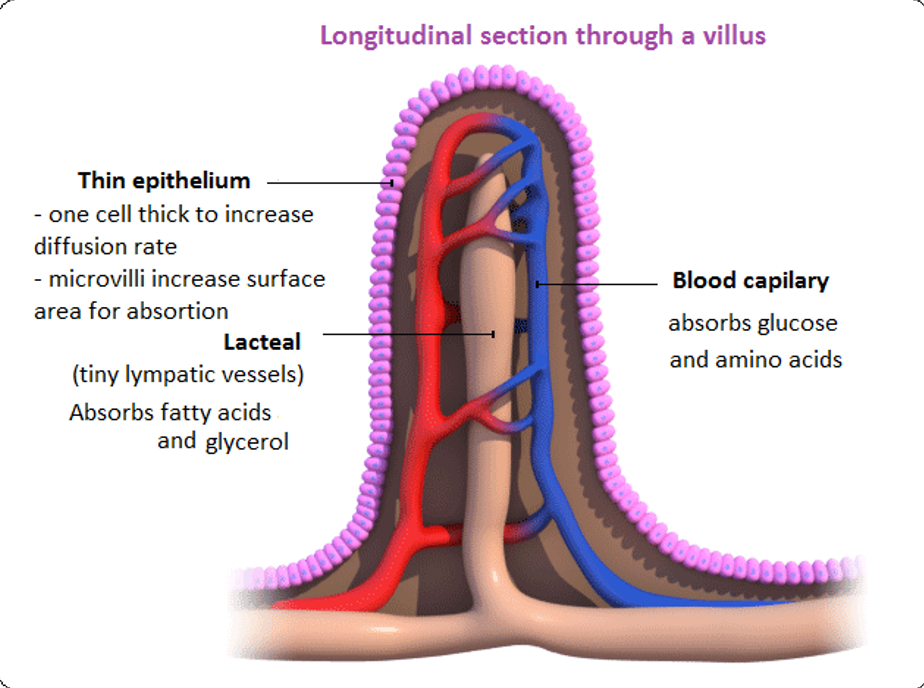
Villus
Projects from the internal surface of jejunum and ileum to, covered in microvilli to further increase the surface area. Contains capillaries and lymph vessels for material transport.
Structure of a villus image
Capillaries
Blood vessels. Where simple sugars and amino acids (broken down from proteins) are absorbed and transported into the blood stream.
Lymph vessels in the small intestine
Lacteals - absorb fatty acids and glycerol so they can enter the lymphatic system
2 parts of the final section of the digestion tract
Where egestion occurs; the colon and rectum
Colon
Absorbs water and salts back into the body and compacts undigested food materials like cellulose from plant cells.
How are vitamins A and K absorbed?
Bacteria in the colon act on undigested materials to produce vitamins A and K, which are absorbed through the colon lining.
Rectum
Faeces are pushed in using peristalsis and are temporarily stored before being defecated through the anus when the faeces build-up lead to muscles and (internal and external) sphincter at the anus relaxing.
Composition of excreted waste materials
Approx. 75% water, undigested food matter (e.g. fibre), dead and living bacteria, some protein, lipids, salts and mucus.
Endocrine systems
A communication system that relays information to coordinate body function
Endocrine glands
Ductless as they have no tubes or ducts for hormones' exit. Release directly into the bloodstream
Exocrine glands
E.g. Salivary and sweat glands, have a duct to transport their secreted molecule
Hormones
Organic compounds made in one part of the body and transported in the bloodstream to other parts. Can be lipid or protein based and can be temporary (e.g. adrenaline from adrenal gland for FFF) or long-lasting (e.g. regulatory mechanisms involving growth hormones in foetal development)
Protein-based hormones
Are water soluble, can freely travel in the bloodstream, and bind with receptors on target cells' exteriors. Includes insulin & glucagon (pancreas), thyroxine (thyroid) and anti-diuretic hormones (pituitary).
Steroid/Lipid-based hormones
Not water soluble, rely on carrier proteins to move in the bloodstream, and can pass through cell membranes (because it's fat) to bind with receptors in the cytosol. Includes cortisol, testosterone and oestrogen.