Combined deck
 Call Kai
 Learn
Learn Practice Test
 Spaced Repetition
 Match
Match Flashcards
 Knowt Play
1/139

There's no tags or description
Looks like no tags are added yet.
Name | Mastery | Learn | Test | Matching | Spaced | Call with Kai |
|---|
No analytics yet
Send a link to your students to track their progress
140 Terms
Total solids (TS) = ?
TS = TSS + TDS
total solids = Total suspended solids + total dissolved solids
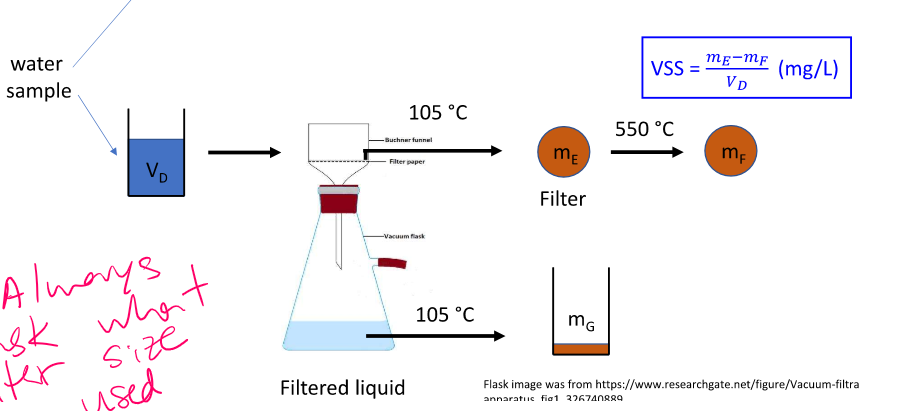
TVS
Total volatile solids

VSS
Volatile suspended solids
Nephelometric turbidity unit (NTU)
Measure of TSS based on light scan instead of filtration. Stronger the scattered light = higher turbidity value in NTU.
Is there a correlation/relationship between NTU and TSS?
No.
TOC
Total organic carbon
TIC
Total inorganic carbon
DOC
Dissolved organic carbon
NDOC
Non-dissolved organic carbon
VOC
Volatile organic carbon
NPOC
Non-volatile organic carbon
NOM
Natural organic matter
DOM
Dissolved organic matter
POM
Particulate organic matter
POC
Purgeable organic carbon
TOC = ? (3 eqns)
DOC + NDOC
TC - TIC
VOC or POC + NPOC
Natural organic matter (NOM)
Formed via chem transformations (e.g., polymerization, photolysis) of smaller macromolecules (e.g., protein, lignin, polysaccharides). Heterogeneous and doesn’t have a well-defined chem structure.
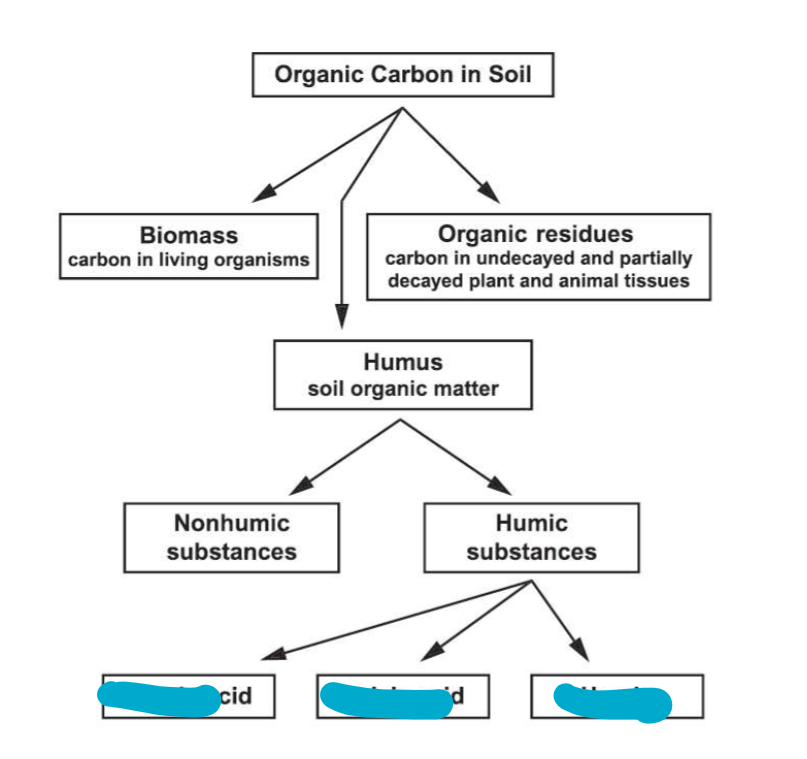
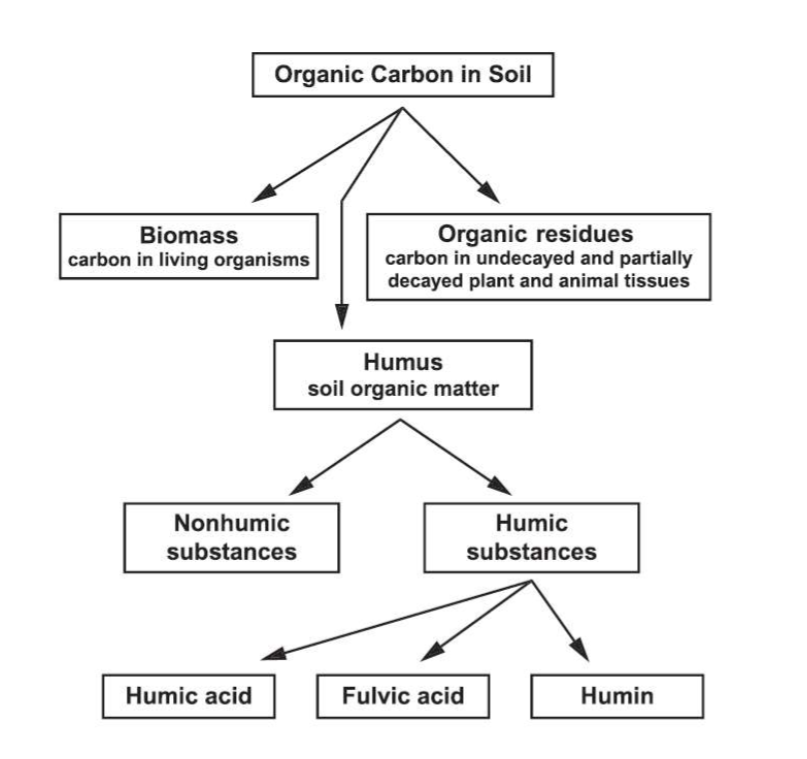
Humic substances
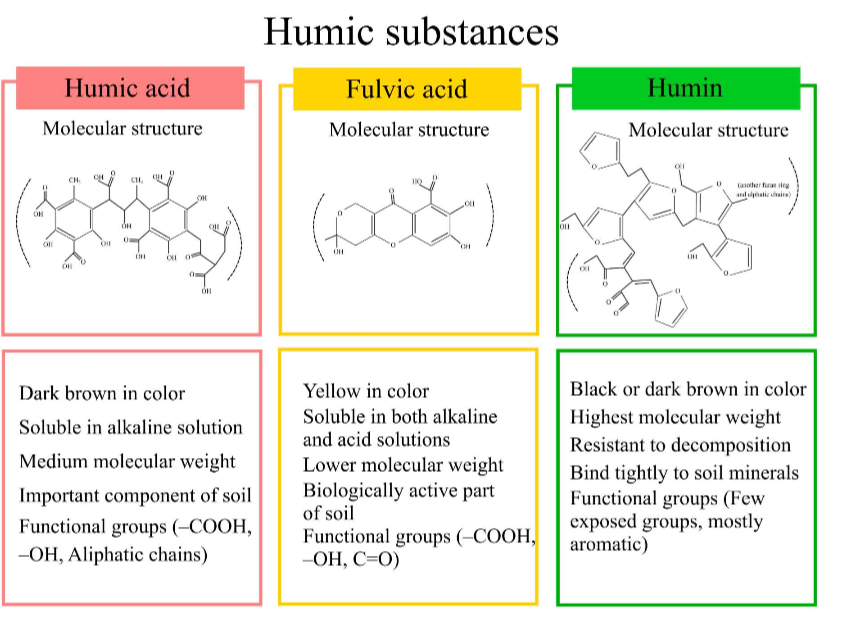
TC Measurement
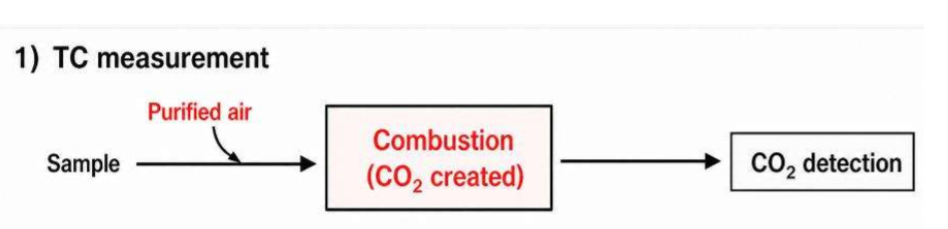
TIC Measurement
no combustion
TOC = ? (equation)
TOC = TC - TIC
Total organic carbon = total carbon - total inorganic carbon
NPOC measurement
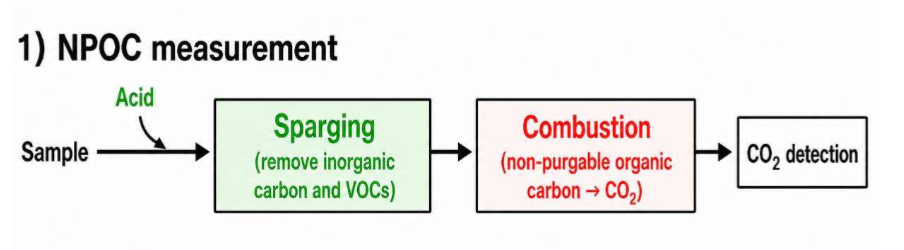
POC = ?
POC = TOC - NPOC
DOC = ?
DC - IC
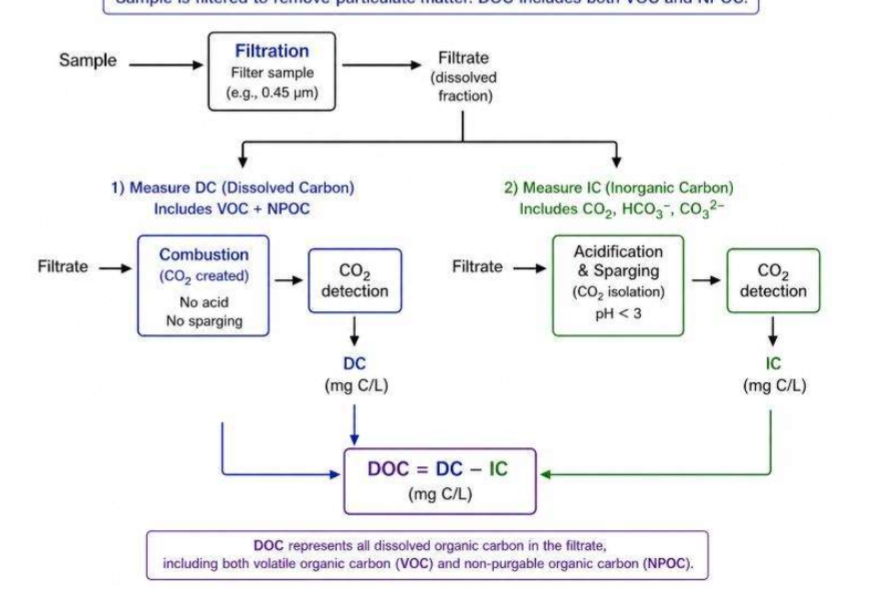
DOC includes?
VOC & NPOC.
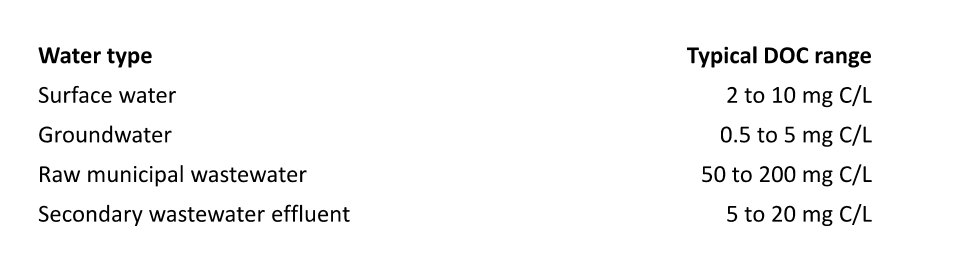
Typical DOC ranges?
Suspended solids examples
Inorganic minerals: e.g., clays (i.e., aluminosilicates), iron (hydr)oxides
sand, silt, clay
Why don’t suspended solids settle?
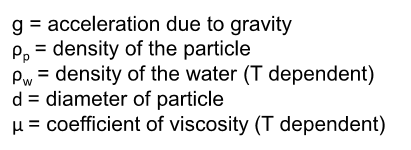
Smaller particle = slower settling rate (Stoke’s law)
Suspended particles’ surface is usually negatively charged = repel each other and won’t settle
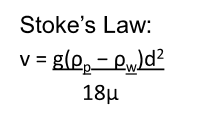
Stoke’s law
Origin of surface charge
isomorphic substitution
acid-base reactions at the surface
adsorption of Natural Organic Matter (NOM) on the surface
Isomorphic substitution
Common in clays. Oxidation state of Al = +3, Si = +4. When Al ion takes the place of Si ion, solid acquires a net charge of -1.
pHpzc or pHzpc
Point of zero charge or zero point of charge. This is the pH at which the surface charge is 0.
Why do acid-base reactions at the surface prevent suspended particles from settling?
When solution pH is < pHzpc, the surface is positively charged. The lower the pH, the more positive the surface charge is. When the solution pH > pHzpc, the surface is negatively charged. The higher the pH, the more negative the surface charge is (pKa).
Electric double layer - colloid suspensions should have no net charge (electroneutrality), but a particle’s surface is mostly negatively charged. What happens for electroneutrality to be obeyed?
Charge on the particles must be counterbalanced (counterions). E.g., negatively charged particulates, adsorbed cations form a fixed layer called Helmholtz or Stern layer. Concentration of cations decr as distance from charged particle grows until equilibrium is reached. Layer extending from outer edge of Helmholtz layer to bulk solution where charge is 0 = diffuse layer. Together, this is the electric double layer (EDL)
Zeta potential
Potential that exists at the plane of shear between the bulk liquid & an envelope of water that moves with the particle.
Calculated from the measurements of electrophoretic mobility. Determines the extent of electrostatic forces of repulsion between charged particles.
Zeta potential for particles in natural water
Typically -20 to -40 mV.
Electric double layer repulsion
Repulsion when 2 double layers (of similar sign) start to overlap
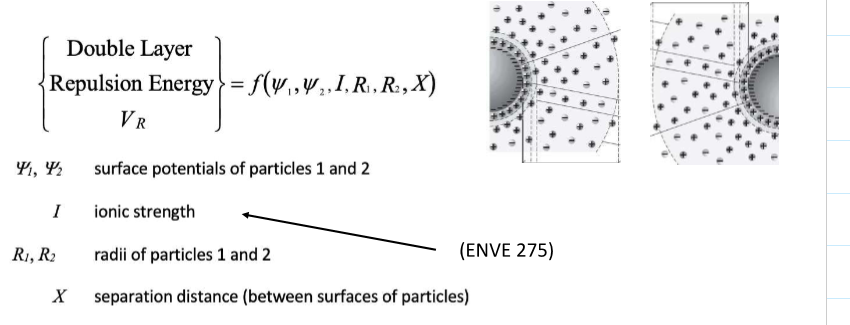
Van der Waals attraction
Attraction force arises from electron motion within molecules.
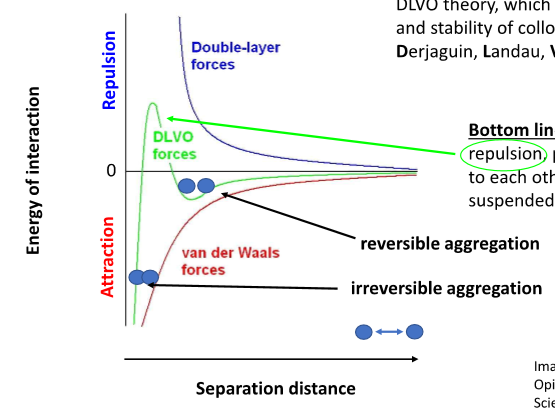
DLVO (Derjaguin, Landau, Verwey, Overbeek) Theory
Aggregation and stability of colloids. Total force = repulsion + attraction. Because of repulsion, particles won’t get closer to each to aggregate → suspended in solution.
Suspended solids are ___ and ___ particles.
inorganic (e.g., clays) and organic (e.g., bacteria, algae)
Why do suspended solids not settle in the solution? (leads to turbidity - NTU)
Small size & surface charge (usually negative)
Suspended solids can do what?
reduce clarify of water to unacceptable levels (i.e. cause turbidity) and impart colour to water (aesthetics).
be infectious agents (e.g., viruses, bacteria, protozoa), and/or;
reduce disinfection efficiency
have toxic compounds adsorbed to their external surfaces
How can suspended solids be removed?
Coagulation & flocculation
Coagulation
Process of destabilizing particles
Flocculation
Process of particle aggregation & growth which occurs due to destabilization.
Coagulant
Chemical that destabilizes particles
Flocculant
Chemical that is added to enhance flocculation process. Usually a polymer or other organic compound.
Coagulation - particle destabilization mechanisms
compression of double layer
adsorption & charge neutralization
enmeshment in precipitates
adsorption & interparticle bridging
Particle destabilization mechanisms - compression of double layer
Addition of salts increase ionic strength in the solution → double layer compression → more interaction between particles → more collision and attachment.
Repulsive interaction between similar colloidal particles decreases, decreasing the energy barrier and allowing particles to aggregate.
This is the main mechanism for alluvial deposition at river mouth.
Particle destabilization mechanisms - adsorption & charge neutralization
If right amount of chemicals (metal salts, cationic organic polymers for negatively charged particles) is added → net charge on the particles = 0 → no repulsion → more collision and attachment.
If the adsorbed species carries the opposite sign as the colloid, the particle can be destabilized.
Particle destabilization mechanisms - enmeshment in precipitates
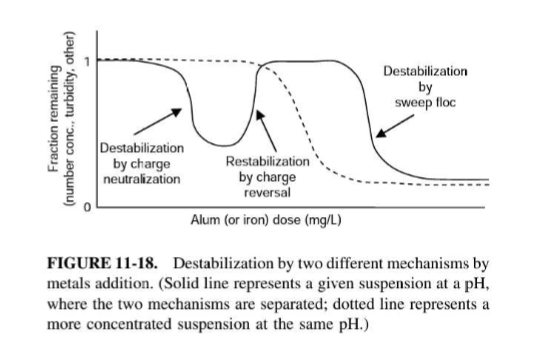
Inorganic salts (Al and Fe salts) are added to form precipitates (flocs). Precipitates are formed on the surface of the particles initially present in the solution → particles are entrapped in the flocs.
This is the dominant mechanisms in most water treatment applications where 6 < pH < 8; Al and Fe salts used at concentrations exceeding saturation.
Particle destabilization mechanisms - enmeshment in precipitates: sweep flocculation
Inorganic salts (Al and Fe salts) are added to form precipitates (flocs). Precipitates are formed on the surface of the particles initially present in the solution → particles entrapped in flocs
Particle destabilization mechanisms - adsorption & interparticle bridging
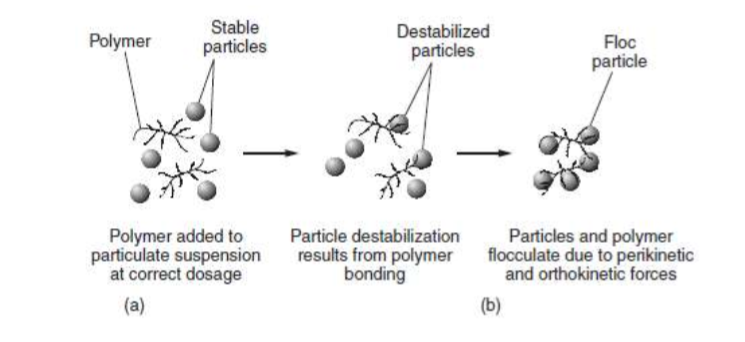
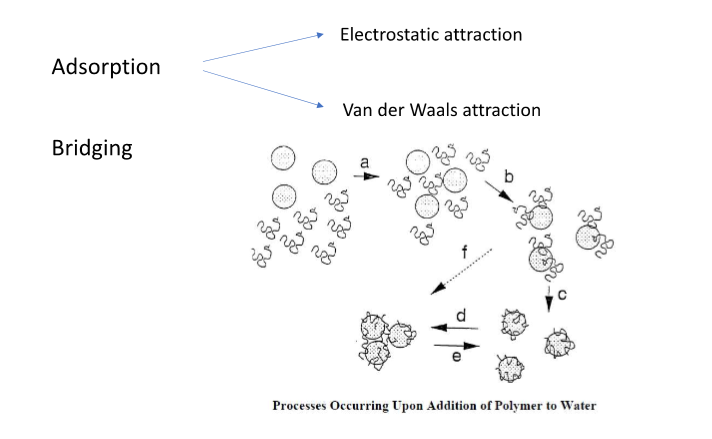
Linking of particles by polymer chain segments adsorbed to more than 1 particle. Polymers can adhere to surface of colloids & it’s possible for these to “join” together to form a “chain”. These “chains” of joined colloids/polymers can be removed from solution through gravity separation and/or filtration. Commonly non-ionic & anionic polymers (in the context of destabilizing negatively charged particles).
Coagulants used in water treatment
metal salts: alum, iron salts, polyaluminum chloride
polymers
Why are metal salts most commonly used as a type of coagulant?
High availability and cheap cost
Polymers as coagulants
Synthetic coagulating agents are widely available. Cationic, anionic, and nonionic polymers have all been found to provide excellent results in different situations. These agents are usually more costly than alum or iron salts but much smaller dosages are required. Polymers don’t produce voluminous, gelatinous flocs as their inorganic counterparts do.
Destabilization by Al(III) and Fe(III) - 3 mechanisms
compression of double layer: add salt → increase ionic strength.
Charge neutralization: cationic species adsorb on particle surface 0> charge neutralization. But if too much coagulant added = charge reversal
Enmeshment in precipitates: appropriate coagulant dosage & appropriate pH = formation of Al(OH)3(s) and Fe(OH)3(s) = enmesh suspended solids (sweep floc coagulation)
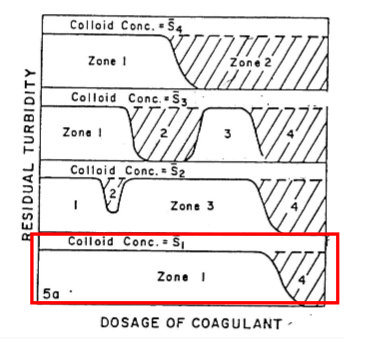
Destabilization by specific adsorption and charge neutralization occurs with a small dosage of coagulants due to low concentration of particles. However, # of particles is too small to be flocculated & settled. Sweep coagulation (large coagulant dosage) can remove particles.
Settable flocs are mainly formed at “zone 4 of high dosing conditions”
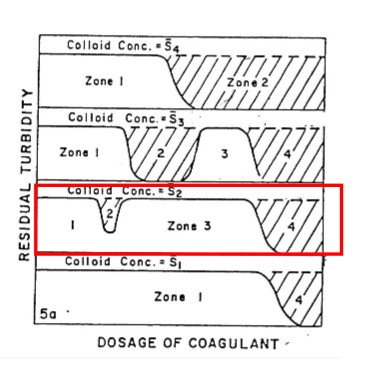
Destabilization by specific adsorption and charge neutralization occurs with a relatively small dosage of coagulants. Some particles are flocculated and settled (zone 2), but particle removal efficiency is still low due to a lack of particles in water.
When more coagulant is added, particles re-stabilize (too positive) and turbidity increases (zone 3). As coagulant addition is increased further, sweep coagulation occurs (zone 4).
Deal with this irl.
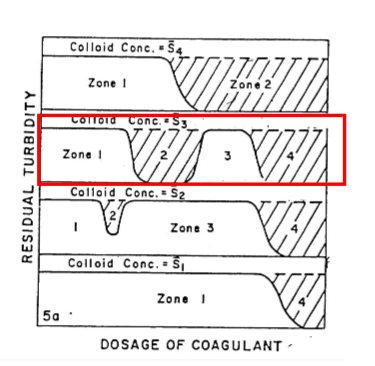
Destabilization by specific adsorption & charge neutralization occurs and most of particles are removed (zone 2). Low coagulant dose can form settable flocs.
As coagulant dosage increases further, particles are re-stabilized with a positive charge (zone 3). Sweep coagulation occurs in zone 4 with higher coagulant addition.
Deal with this irl.
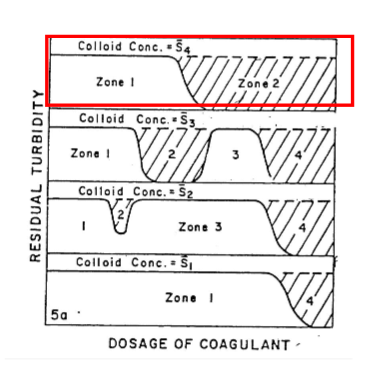
Sweep coagulation & specific adsorption/neutralization regions merge due to # of colloidal particles present in water. Coagulant dosage required to neutralize particles coincides with the onset of sweep coagulation precipitates.
Processes associated with polymeric coagulants
Factors affecting coagulant dose
Turbidity, initial pH & ALK, NOM, algae
How does initial pH and ALK affect coagulant dose?
pH can decrease significantly after coagulant addition (when ALK is low), decreasing overall coagulation efficiency → pH adjustment may be required