Open Pneumothorax Management
 Call Kai
 Learn
Learn Practice Test
 Spaced Repetition
 Match
Match Flashcards
 Knowt Play
1/19

There's no tags or description
Looks like no tags are added yet.
Name | Mastery | Learn | Test | Matching | Spaced | Call with Kai |
|---|
No analytics yet
Send a link to your students to track their progress
20 Terms
What are the three parts of the open pneunothorax management skill check?
respiration clinical findings
determinations
treatments
What is the first step of the respiration clinical findings assessment?
ask if there are at least 3 breaths every 6 seconds
OR
places NCETCO2 and compares it to the patient’s RR
What is the second step of the respiration clinical findings assessment?
ask if there is any:
SOB
tracheal tugging
intercostal or subcostal retractions
tripoding
head-bobbing
note: all findings should be present as per the rubric
note: point will be lost for every 1-2 missed
What is the third step of the respiration clinical findings assessment?
auscultation x6 points (preferably on the back)
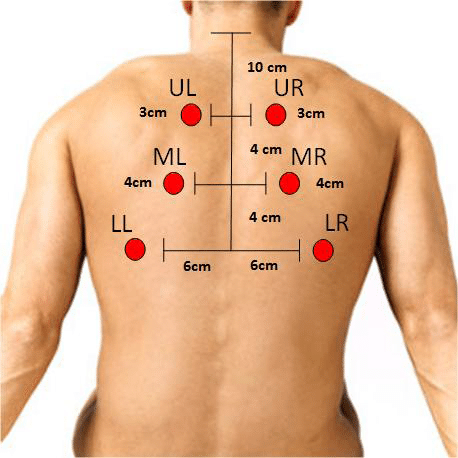
What should be asked while completing the lung auscultations?
“requesting findings (volume and quality of lung sounds) of my six-point auscultation by lung quadrants, which is being completed in this order:
upper left (UL)
upper right (UR)
middle right (MR)
middle left (ML)
lower left (LL)
lower right (LR)”
note: you will be told “absent breath sounds on left side apices to bases, clear with good volume on right side”
How can points be lost during the lung auscultation
lung sounds are not done side to side for comparision
rushes through without intention
auscultation below the ribcage
What is the fourth step of the respiration clinical findings assessment?
assess the quality of the SpO2 pleth and it’s associated reading
What should be said after assessing SpO2?
“bilateral lungs sounds (absent breath signs in right quadrants) and severe hypoxia (SpO2 of 80%) indicate likely open pneumothorax of the left lung. now I will check for sucking chest wounds”
What is the fifth step of the respiration clinical findings assessment?
observe front and back of torso for sucking chest wound and ask for findings
note: you will be told there is a sucking wound on the left anterior chest
What is the sixth step of the respiration clinical findings assessment?
rake assessment from:
360 degrees around the torso and armpit
note: you will be told “no other sucking wounds found”
What should you say after the rake assessment?
“presence of only one chest wound means that there is not an open pneumothorax on the right side - only left. will now assess for signs of closed pneumothorax via secondary assessment"
What is the seventh step of the respiration clinical findings assessment?
observe and ask for tracheal deviation
note: you will be told “trachea pulls to the right”
What is the eighth step of the respiration clinical findings assessment?
observe and ask for tracheal tugging
note: you will be told “trachea pulls to the right”
What is the ninth step of the respiration clinical findings assessment?
observe and ask for jugular vein distortion (JVD)
note: you will be told “present while supine, 45 degrees (Fowler), or upright”
What should be said after completing the assessment for tracheal deviation and JVD?
“presence of tracheal tugging and JVD suggest severe respiratory distress”
What is the tenth step of the respiration clinical findings assessment?
observe, palpate, and ask for chest wall excursion
note: you will be told “left chest overexpanded and hypomobile, right chest hypermobile”
What should be said after the chest well is palpated and findings are confirmed
“findings suggest there is not a closed pneumothorax of the right lung”
What is the final step of the respiration clinical findings assessment?
palpate clavicles and ribs for:
crepitus
instability
subcutaneous emphysema
note: you will be told “subcutaneous emphysema near the sucking chest wound”
What are the three treatments that must be given to the patient?
sit patient upright into Fowler’s positioning
place NRB (10-15 L/min)
apply 3-sided occlusive improvised dressing
How is the 3-sided occlusive improvised dressing created?
use clear, flexible plastic
3 sides (leaving the dependent side open for drainage) taped down
ensure dressing is large enough to cover the wound (plus a few cm)