HSCI 130 Week 4
 Call Kai
 Learn
Learn Practice Test
 Spaced Repetition
 Match
Match Flashcards
 Knowt Play
1/15

There's no tags or description
Looks like no tags are added yet.
Name | Mastery | Learn | Test | Matching | Spaced | Call with Kai |
|---|
No analytics yet
Send a link to your students to track their progress
16 Terms
Biomedical Model: Central Ideas
• Mind-Body Dualism
• Physical Reductionism
• Specific Etiology
• Machine Metaphor
• Individualized Regimen and Control
Mind-Body Dualism
The mind and body are treated as separate, so medicine focuses solely on the physical body while ignoring social and psychological determinants of health
Physical Reductionism
Health is understood by breaking the body into smaller biological parts examined in isolation, overlooking broader social and psychological factors
Specific Etiology
Every disease has a specific cause (e.g., pathogens), and identifying it leads to targeted treatment, but ignores how social conditions create biological vulnerability
Machine Metaphor
The body is viewed as a biological machine made of biophysical processes: a Western cultural assumption that reduces human health to mechanical function
objectives a human
Individualized Regimen and Control
Individuals responsible for maintaining their own health through diet, exercise, and self-care
victim-blaming by ignoring structural factors that constrain personal choice
Lyme Disease
Bacterial infection: borrelia burgdorferi
Discovered in the US in → Connecticut, 1970s
Symptoms include →
rash (primary symptom), headache, localized/general pain, redness, swelling, fatigue, poor appetite, arthritis, neurological symptoms, cardiac symptoms, eye swelling/redness
most common vector-borne disease in US
more prevalent than aids
co infection, ticks containing multiple diseases
Lyme Disease: Canadian Government Responses
• Federal Framework for Lyme Disease Act (2014)
• May 15-17, 2016 conference to develop a federal framework on Lyme
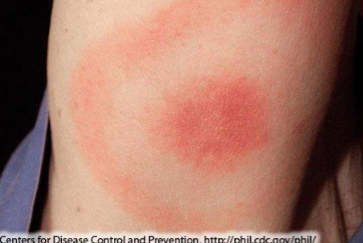
Case Study Erythema migrans (EM) rash
occurs in 70 to 80% of infected persons
Begins at the site of a tick bite after 3 to 30 days (average= 7 days)
Expands gradually up to 12 inches or more across
warm to the touch but rarely itchy or painful
Sometimes clears as it enlarges, resulting in a target or “bull’s-eye” appearance
How is LD transmitted?
through a tick bite.
infected nymphal tick can either bite human or turn into adult tick, then bite human or infect more hosts.
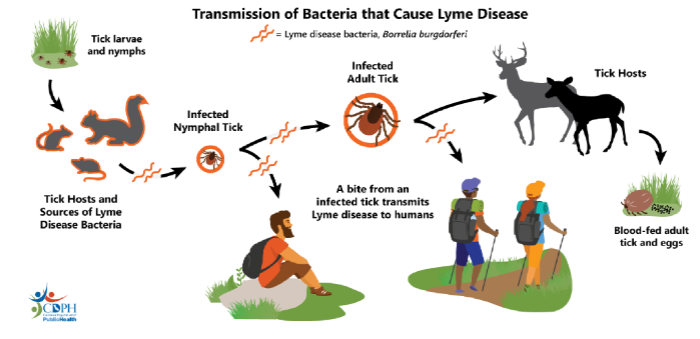
Main reservoir of Lyme Disease
inside the deer tick
What are the most influential factors for I.scapularis spread in Canada?
• Warmers temperatures
• Dispersion of ticks on animal hosts
• Climate change
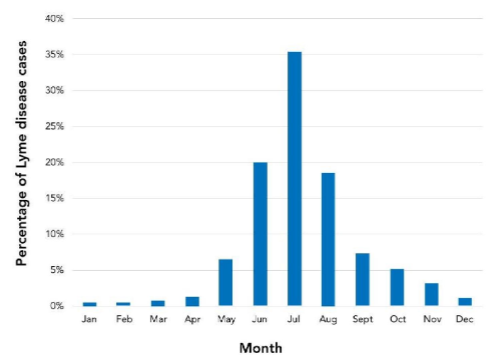
Onset of Illness
greatest during warmer season (summer)
Borrelia burgdorferi
Looks like syphilis under the microscope
spiral/corkscrew shaped (spirochetes)
Their shape aids in their motility and ability to invade host tissue
Deer ticks
sensitive to dryness
active in damp weather