EMES 442 Final
 Call Kai
 Learn
Learn Practice Test
 Spaced Repetition
 Match
Match Flashcards
 Knowt Play
1/342

There's no tags or description
Looks like no tags are added yet.
Name | Mastery | Learn | Test | Matching | Spaced | Call with Kai |
|---|
No analytics yet
Send a link to your students to track their progress
343 Terms
Neritic Zone (Continental shelf)
Includes all seafloor and open water habitats between the high water mark and the shelf ridge
Epipelagic zone
Upper 200 m of water
Benthos
Animals and plants associated with the seafloor
Infaunal
Can burrow within the soft seabed
Epifaunal
Live on the seabed surface
Ekman transport
Is the net motion of fluid as a result of the Coriolis effect and turbulent drag forces
Subtidal zone
The entire remainder of the sea from the low water tidemark to the greatest depth of the ocean
Abyssopelahic Zone
From 4000 to 6000 m
The Coriolis effect
Causes fluids and air to curve as they travel across or above Earth's surface. Due to the spinning of the earth
Mesopelagic Zone
From 200 to 1,000 m
Bathypelagic Zone
From 1000- 4000m
Nekton
Larger organism that can swim freely despite current or turbulence
Plankton
Organisms that live suspended in the water. Cannot counteract ocean current or turbulence.
Adding heat to water does what to density?
Decreases density
Adding salt to water does what to density?
Increases density
Neuston
Organisms associated with the sea surface
Hadal Zone
Environments at seabed & in the water of trenches (>6000m)
Thermocline
Rapid change in temperature over a short vertical distance
Intertidal Zone
Range of depths between highest and lowest extent of the tides
What are the three key components to Marine Biology?
Ecology, Functional Biology, Biodiversity
What important change in scientific inquiry occurred in the 19th century that allowed for the expansion of Marine Biology as a field?
The emergence of the study of “natural philosophy”
Which of the following describes how Michael Sars disproved the Azoic Theory?
Sampled the deep Norwegian fjords
SCUBA allows for exploration of what depth habitats?
Neritic zone
Pelagic zone
Intertidal zone
Piccard and Walsh descended in the Trieste into what depth habitat zone?
Hadal Zone
Three of the ocean basins are connected in the southern hemisphere in a body of water called the
southern ocean
In the Northern hemisphere, if wind moves from the West to the East over the ocean surface, in what direction is the net water movement due to Ekman transport
South
Thermohaline Circulation
What drives ocean currents in the upper 100 meters of the ocean?
Wind
What drives deep ocean currents?
Thermocline Circulation
Thermohaline Circulation
The process of deep-water circulation driven by temperature and salinity.
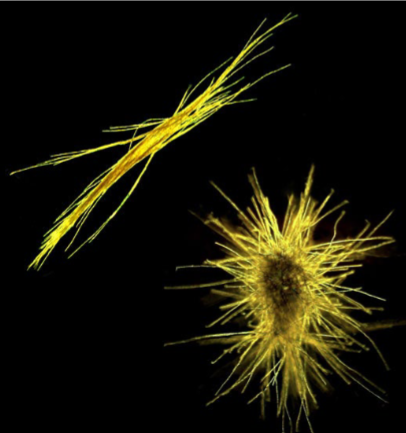
Trichodesmium
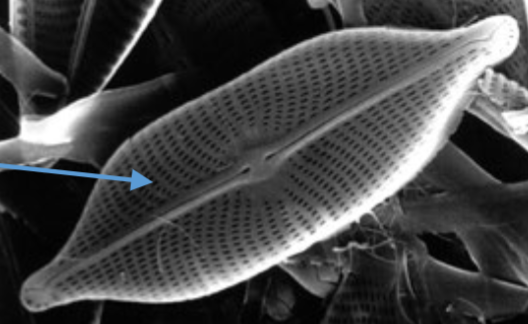
Diatom (Pennate)
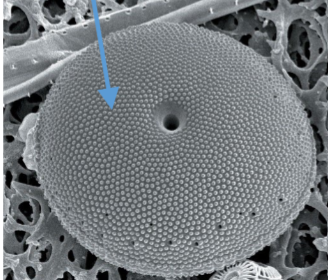
Diatom (Centric)
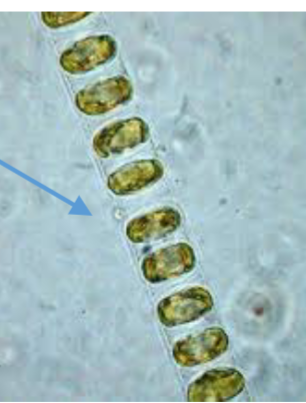
Diatom
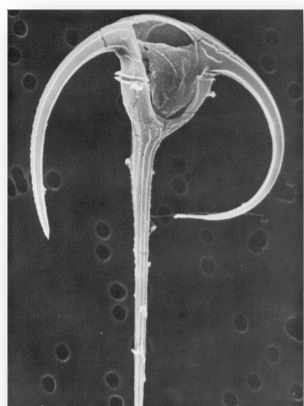
Dinoflagellate
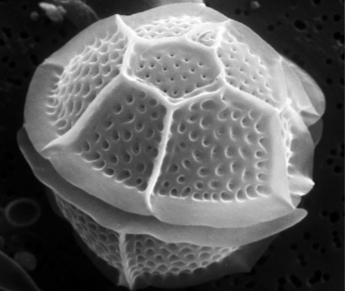
Dinoflagellate
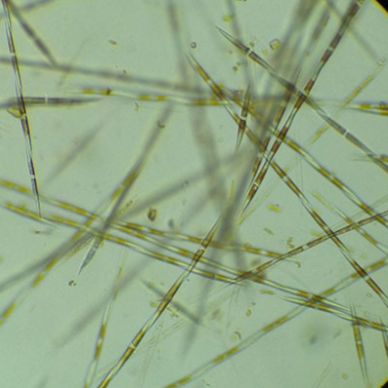
Diatom
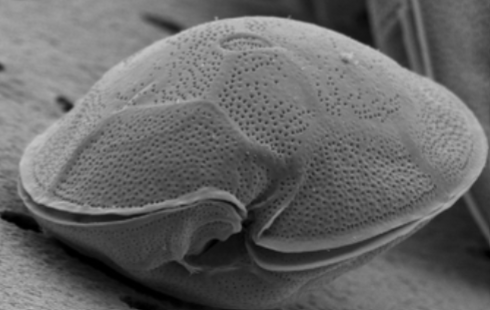
Dinoflagellate
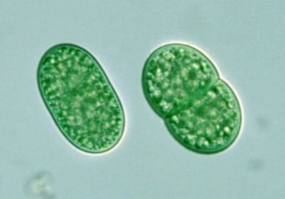
Synechococcus
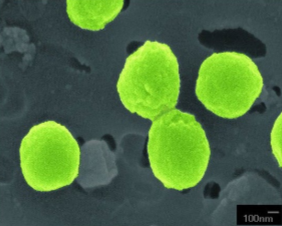
Prochlorococcus
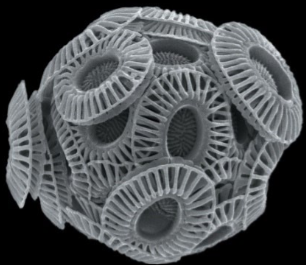
Coccolithophores
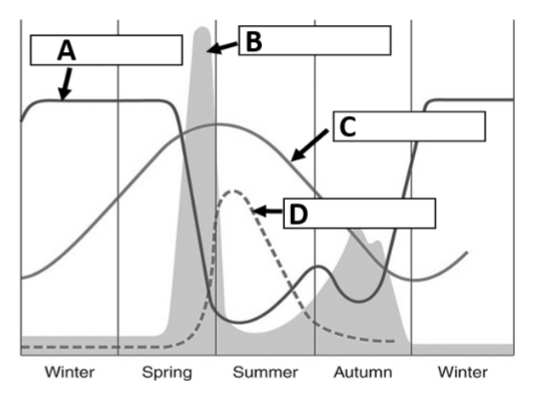
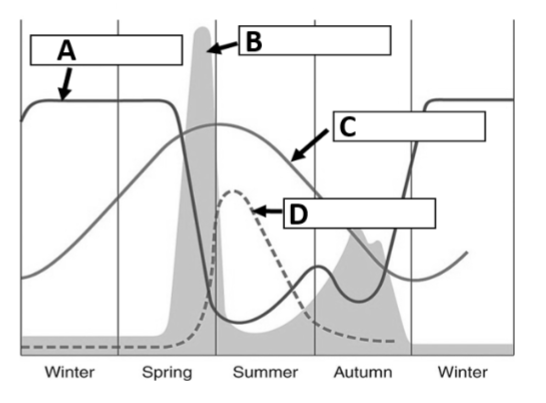
What is A?
Phosphates and Nitrates at the surface
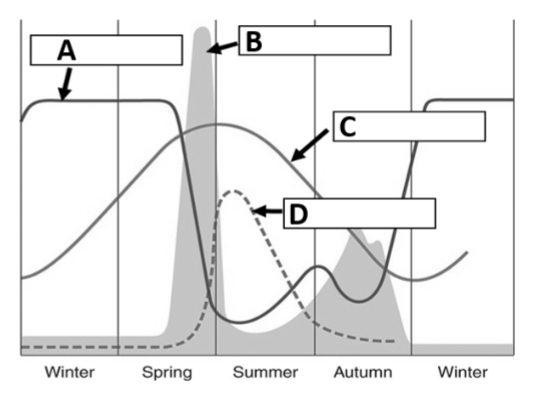
What is B?
Spring Bloom
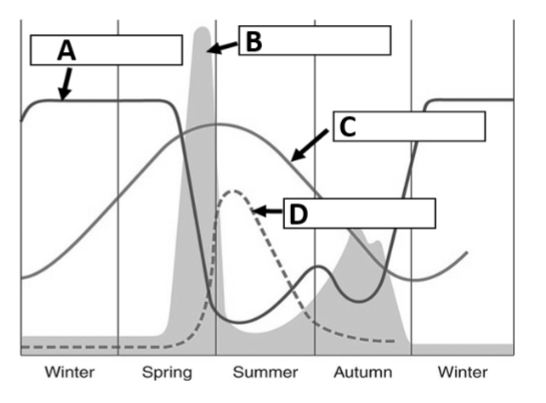
What is C?
Available sunlight
What is D?
Number of zooplankton
What percent of oxygen on Earth is generated by marine primary producers?
70%
Primary Producer
An organism capable of using the energy derived from light or a chemical substance to make an energy-rich organic compound.
Primary Consumer
An organism that consumes a primary producer
Top-Down Effect
Occurs when predators consume their prey
Bottom-Up Effect
Changes in lower trophic level exert strong effects on ecosystem
Nonconsumptive Effect
The presence of a predator causes prey species to retreat to shelter. This reaction reduces predation at the next level down in the food chain.
Primary Production
The synthesis of organic compounds from CO2 (Mainly occurs through photosynthesis)
Who carries out 90% of primary production in the ocean?
Phytoplankton
Photoinhibition
Decrease in photosynthesis due to excess light
Does primary production increase or decrease with depth?
Decrease due to less light
Gross Primary Production (GPP)
Total C fixed
Net Primary Production (NPP)
Amount of C made into new phytoplankton biomass and available to primary consumers
(GPP-respiration)
Respiration
The process by which an organism breaks down organic matter (glucose/Oxygen) to release chemical energy (ATP, NADH)
Compensation depth
The discrete depth at which the light intensity is sufficient for phytoplankton to have equal photosynthesis and respiration
Critical depth
The depth at which the integrated value of P and R are equal
What happens if mixing is below critical depth?
Phytoplankton blooms can’t form
What is NPP in the Light/dark bottle method of measuring primary production
light bottle
What is GPP in the Light/dark bottle method of measuring primary production
light bottle - dark bottle
Oligotrophic
Where there are Low nutrients so low rates of P.P.
Eutrophic
Where there are high nutrients so high rates of P.P.
What affects primary production in Tropical regions?
Nutrient Limited
What affects primary production in polar regions?
light limited
What affects primary production in temperate regions?
Affected by nutrient and light limitations due to seasonality.
Summer mixing depth
shallower due to reduced winds, thermocline from warming surface waters
Winter mixing depth
Deep due to strong winds and isothermal temps in water
What is the most abundant type of phytoplankton in the ocean?
Picoplankton
Where are Trichodesmium found
Nutrient-poor tropical and subtropical ocean water
What are the cell walls of diatoms made of?
Silicia
What are the cell walls of dinoflagellates made of?
Cellulose
What does the toxic bloom pseudo-nitzshia produce and how does it affect humans?
Domoic acid (neurotoxin). It can cause loss of short memory
Toxic diatom
pseudo-nitzshia
Toxic dinoflagellates
Gambierdiscus
What does the toxic bloom gambierdiscus produce and how does it affect humans?
Ciguatoxin. Causes ciguatera fish poisoning
Which of the following is not a bacterial primary producer?
Coccolithophore
Photic zone
layer with light intensity >1% of surface light
HNLC stands for ______and typically have ______ levels of phytoplankton abundance in these regions.
High Nutrient Low Chlorophyll; low
If a phytoplankton bloom respires 7 g glucose per square meter per day and incorporates 10 g glucose per square meter per day into biomass, what was the total amount of glucose produced during photosynthesis (GPP)?
17 g per square meter per day
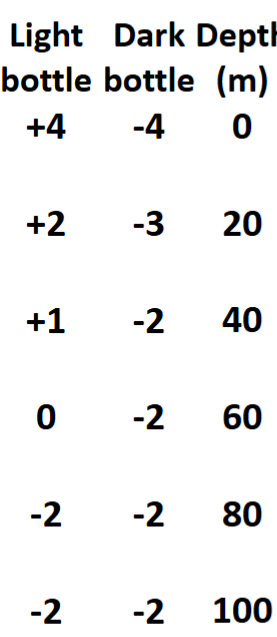
Where is critical depth?
Below 100 meters
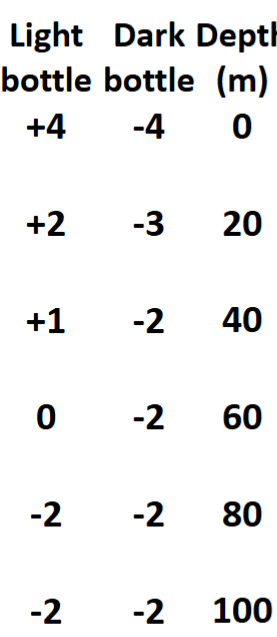
Where is compensation depth?
60 meters
What are the cell walls of coccolithophores made of?
calcium carbonate
provide buoyancy
What does sulfuric acid do for the brown algae desmarestia ligulata?
degrades the calcium carbonate teeth of sea urchins to prevent predation
Which type of algae is harvested for carrageenan and agar?
Red Algae
How is pollen from sea grasses transported?
Transported by water
Heterotroph
Obtain carbon from external sources to respire for energy
Microbial Loop
The process by which dissolved organic matter is returned to higher trophic levels through incorporation into bacterial biomass
What is DOC and what consumes it?
Bacteriophage
Viruses that infect bacteria
Which zone are bacteriophages most common in?
Epipelagic zone (Photic Zone)
Viral Shunt
The transfer of energy and nutrients from living organisms into the dissolved phase trough process of viral lysis
Viral Lysis
Process which virus induce destruction of host cells
Which types of zooplankton are protists?
Ciliates, Foraminifera(foram), Radiolaria
Which of the following can sometimes retain chloroplasts from ingested phytoplankton and use photosynthetic products?
Ciliates
Which of the following excrete an external calcium carbonate skeleton divided into chambers?
Forams
What is the Radiolaria’s skeleton of radiating spines and spheres made of?
Silicia