PSY 100 UofT Midterm #2
 Call Kai
 Learn
Learn Practice Test
 Spaced Repetition
 Match
Match Flashcards
 Knowt Play
1/45

There's no tags or description
Looks like no tags are added yet.
Name | Mastery | Learn | Test | Matching | Spaced | Call with Kai |
|---|
No analytics yet
Send a link to your students to track their progress
46 Terms
Reflex
inevitable, involuntary response to stimuli. occurs without conscious thought. Are in place for survival, automatic local responses.
ex. pulling hand away from hot surface
Instincts
Automatic behaviours you are born with that are triggered by a stimulus in your environment. A program, involves brain/hormones.
ex. Yawn (triggered by fatigue, or seeing someone else yawn)
Learning
Relatively permanent change in behaviour due to experience
Associative Learning
Occurs when we form associations between 2 stimuli
Classical conditioning
Forming associations between 2 stimuli that occur sequentially through time
ex. child sees a bee for first time, gets stung, associates bee with pain, fears bee.
Operant conditioning
Forming associations between behaviours and their consequences
ex. park illegally and get ticket, pay attention more next time when parking
Nonassociative learning
Changes in strength of your responses
Habituation
Reduces reactions to stimulus that have already been experienced and proven to be unchanging & harmless
Ex. Nursing student got used to blood and vomit no longer reacts with disgust
Sensitisation
Increases our reactions to a range of stimuli following exposure to one strong stimulus. occurs in response to stronger stimuli
Ex. After an earthquake people experience exaggerated responses to movement, light, or noise.
Observational learning
One organism learns by watching the behaviour of another organism
Implicit learning
learning that occurs in the absence of awareness.
ex. children learn grammar rules without being taught formal rules
“He goed home”
Explicit learning
the individual is consciously aware of the learning and can generally report on what has been learned
Conditioned Stimulus (CS)
environmental event whose significance is learned
ex. metronome
Unconditioned Stimulus (UCS)
has innate meaning to the organism
ex. food
Conditioned response (CR)
learned reaction
Ex. Salivating at sight of a metronome
Unconditioned response (UCR):
Appear without prior experience with a stimulus
Ex. Salivating at sight of food
Aquisition
The learning phase of developing a conditioned response
pairing a CS with an UCS to recieve a CR
requires contiguity and contingency
Contiguity
proximity in time between CS and UCS, requirement for aquisition.
Contingency
How reliably the CS predicts the UCS
Ex. Rat study with sound and electric shock
Extinction
Reduction of a learned response which happens when a CS is no longer paired with an UCS, and association between the two is broken.
Spontaneous Recovery
A reappearance of a CR during breaks between extinction training.
Ex. Day 1: dog stopped associating metronome with food. Day 2: Dog salivates to metronome a little.
Excitatory Conditioning
Classic classical conditioning, a stimulus predicts something will occur
Inhibition
A stimulus predicts something will not occur
Ex. Sound + light = no shock (sound = inhibitory signal)
Generalization
The tendency to respond to stimuli similar to the CS
Ex. fearing wasps bc bee stung you
Higher-Order Conditioning
Happens when a stimulus associated with the CS starts producing the conditioned response on its own
Ex. Dog = pain, Doghouse = dog, Doghouse = dog = pain, eventually just doghouse elicits fear
Latent Inhibition
Learning occurs slower when a CS is already familiar vs. Unfamiliar
Taste Aversion
Occurs when the sight, smell, or flavour of the food (CS) has been paired in the past with illness (UCS). Taste aversion is the resulting CR.
Operant Conditioning
The association between and action and its consequences
Thorndike’s law of effect
behaviours followed by good consequences become more likely to happen again, and behaviours followed by bad consequences become less likely to happen again.
Premack Principle
whatever behaviour an organism spends the most time and energy doing is likely to be important to that organism.
A preferred activity can be used to reinforce a less preferred activity
primary reinforcers
reinforcers with natural roles in survival
Ex. Food
conditioned/secondary reinforcers
Reinforcers whose value must be learned
Ex. Money, gold medals
Continuous reinforcement
Reinforcing a behaviour every time it occurs
Partial Reinforcement
The reinforcement of the desired behaviour on some occasions but not others
Ratio Schedules
Reinforcement depends on the number of times a behaviour occurs
Fixed Ratio Schedule
Reinforcement happens after a set number of actions
Variable Ratio Schedules
You get a reward after a number of behaviours, but the number changes each time. However, it averages out to a certain number
Interval Schedules
reinforcement happens after a certain amount of time has passed, and the behaviour occurs
Fixed Interval schedule
reward becomes available after a specific amount of time has passed, but the organism must still perform the behaviour once to get it
Variable Interval Schedules:
Reinforcement becomes available after a varying amount of time, but the average time is predictable
Shaping
Reinforcing similar behaviours to the one we want to train until it reaches the goal
Latent Learning
Learning that occurs in the absence or reinforcement, but knowledge appears later when there is motivation to use it
Ex. Tolman’s maze rats
Biological constraints:
limits on learning that come from an organism’s biologyn or evolutionary history
Ex. Birds easily learn to peck for food, but struggle to learn to peck to avoid a shock, because pecking is naturally linked to feeding
Instinctive drift
An animals natural instincts interfere with a learned behaviour
Observational learning (Social Learning Theory):
learning that happens by watching others and observing the consequences of their behaviour
Ex. Bandura’s bobo doll
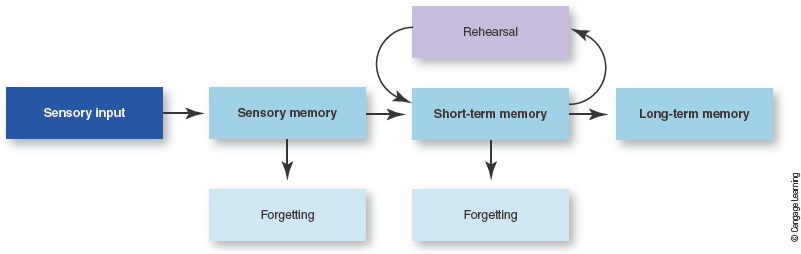
Multistore model of memory
Model of how data flows through a series of seperate stages of memory