Production and cost
 Call Kai
 Learn
Learn Practice Test
 Spaced Repetition
 Match
Match Flashcards
 Knowt Play
1/67

Earn XP
Name | Mastery | Learn | Test | Matching | Spaced | Call with Kai | Chat |
|---|
No analytics yet
Send a link to your students to track their progress
68 Terms
long run of production
The time period in which the production is changed by changing all types of inputs
what type of inputs are identified in long run production?
variable inputs only
long run production function
the function which shows the technological relationship between the inputs and outputs in the long run of production is identified as long run production function
Economic theory that explains the long production process
laws of returns to scale
law of returns to scale
the law of returns to scale explains the relationship between the percentage change in the inputs and the percentage change in the output when the production is changed by changing all types of inputs in the long run production process.
three types of returns to scale
increasing returns to scale
constant returns to scale
decreasing returns to scale
increasing returns to scale
increasing returns to scale refers to a situation where output increases at a higher percentage than the percentage increase in the inputs when the production is increased by increasing all types of inputs.
constant returns to scale
constant returns to scale refers to a situation where output increases at same percentage of increase in inputs when production is increased by increasing all types of inputs.
decreasing returns to scale
decreasing returns to scale refers to a situation where output increases at lower percentage of increase in inputs when production is increased by increasing all types of inputs.
reasons for increasing returns to scale
Indivisibility of some production factors
specialization through division of labor
possibility of using machineries
there are onetime costs
reasons for decreasing returns to scale
scarcity of resources/ constraints regarding the resources
stress
problems related to the management and co-ordination
production
the process of converting the factors of production into goods and services
business firms
they are the entities which organize the factors of production process by mixing the productive economic resources in order to produce and supply the goods and services demanded by different parties in an economy
5 major types of business organizations found in a market economic system according the their organization structure
sole proprietorships
partnerships
incorporated companies
cooperative societies
state entrepreneurships
output
the final outcome of a certain production process is identified as the output
inputs
anything which is used within the production process
two types of inputs used in the production process
fixed inputs
variable inputs
fixed inputs
Fixed inputs are inputs that do not depend on the number of units produced. They are incurred even when output is zero and remain constant as the level of output increases.
examples for fixed inputs
buildings
machineries
equipment
variable inputs
Variable inputs are inputs that depend on the number of units produced. Their requirement is zero when output is zero and increases gradually as the level of output rises.
examples for variable inputs
labor
raw materials
production function
A production function shows the functional relationship between inputs and outputs in relation to a particular production activity.
two production times based on types of inputs which can be observed within the production process
short run
long run
short run
The short run is the time period in which at least one input remains fixed.
In the short run, output can be increased only by increasing the variable inputs while keeping the fixed inputs constant.
Therefore, both fixed and variable inputs are present in the short-run production process.
Long Run
long run is the time period in which the output is increased by increasing all types of inputs.
all inputs become variable in the long run
no fixed inputs are identified in the long run production process
the two types of production processes are categorized based on?
based on types of inputs used
short run production process
short run is the time period in which at least on input remains fixed
in the short run the output is increased by only increasing variable inputs while fixed inputs held constant.
therefore in short run both variable inputs and fixed inputs can be seen
the three assumptions the short run production process is based on
Atleast one input remains fixed
Variable inputs are homogenous
Technology held constant
short run production function
the technical relationship between the variable inputs and the total output while the fixed inputs remain constant is shown through the short run production function
Q= f {L1,L2,L,3…,K}
L = variable inputs
K = fixed inputs
Concepts related to short run production process
Total product
Average product
Marginal product
Total product
the total output obtained by using a certain amount of variable inputs mixing with a given amount of fixed inputs is identified as the total product.
Average product
Average product refers to the average amount of output received for one unit of variable input
AP = TP/ L (units)
Marginal product
Marginal product refers to the addition to the total product when the number of units of variable are increased by one additional unit
MP = change in TP / change in L
law of diminishing returns
Law of diminishing returns state that in the short run when the variable inputs are increased while the fixed inputs are held constant the marginal product and the average product starts to decrease after a certain point
Another name for law of diminishing marginal returns
Law of variable factor proportions
Which theory decides the shape of the short run product curves as well as the short run cost curves?
Law of diminishing marginal returns
Which economic theory decides the behavior of short run production process
Law of diminishing marginal returns
Reason for the law of diminishing marginal returns
Existence of constraints (fixed inputs) within the production process
When only the variable inputs are increased while the fixed inputs remain constant, the efficiency of the variable inputs starts to decrease after a certain point.
understand the behavior
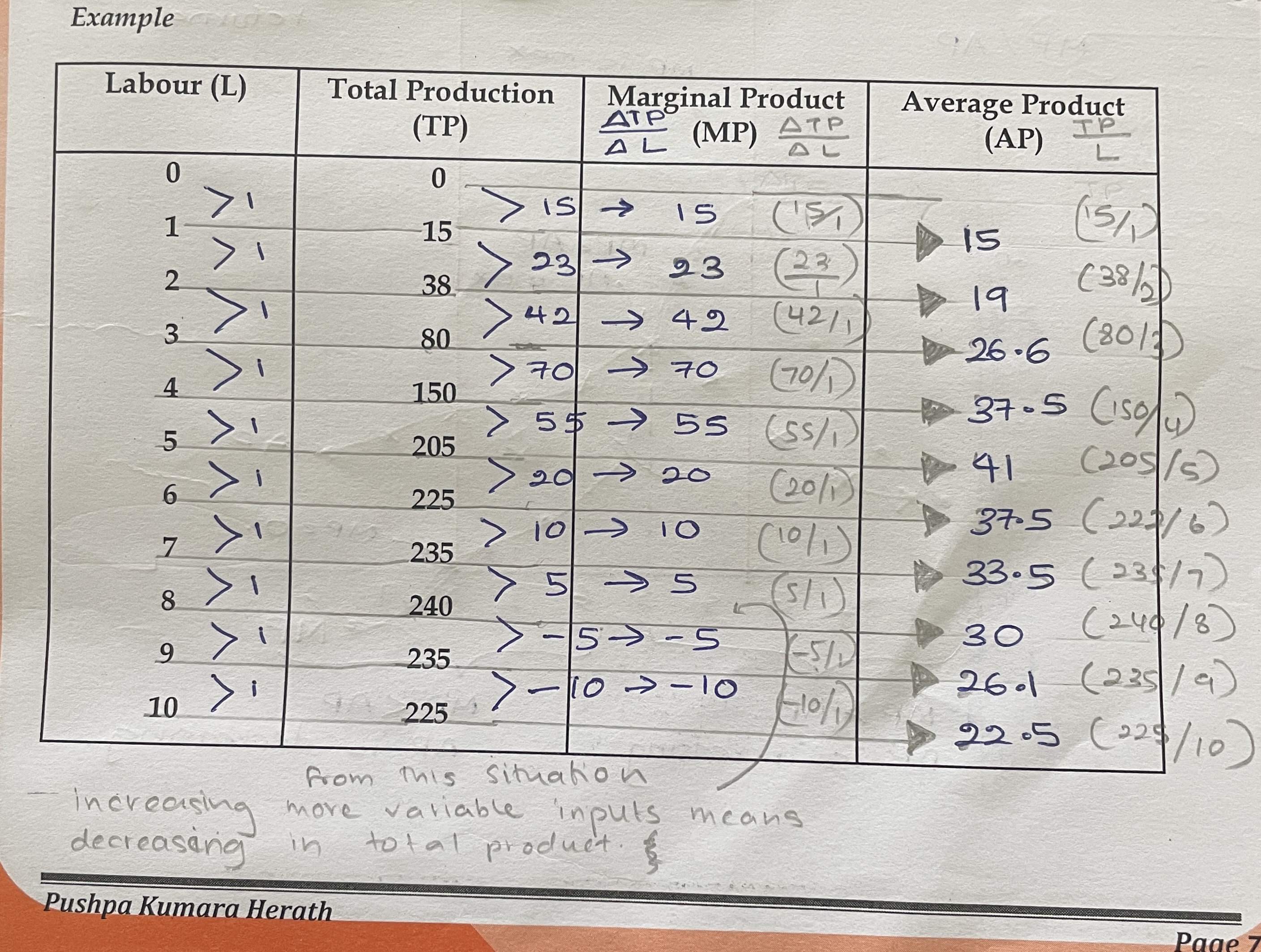
Study the behavior of TP, AP,MP
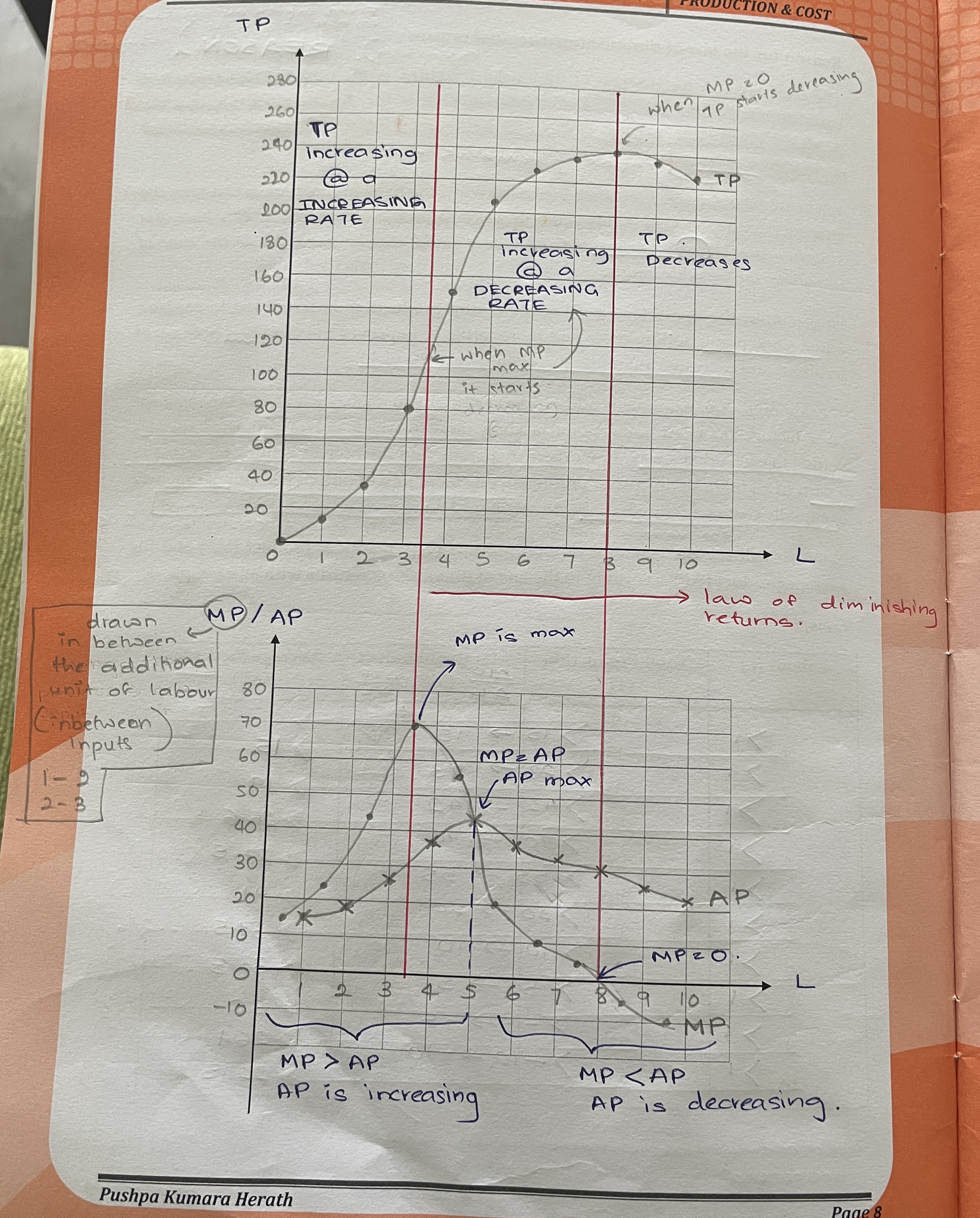
When MP is maximum
Total product starts to increase at a decreasing rate
MP > AP
AP is increasing
MP = AP
AP is maximum
MP = 0
total product starts decreasing
MP < AP
AP is dec
Three stages of TP
Increasing at a increasing rate until MP Is maximum
Increasing at a decreasing rate
Decreasing
Cost of production
In economics, cost of production refers to the opportunity cost of all resources used in the production process of a certain good or service
Two components of economic cost
Explicit cost
Implicit cost
Another names for explicit cost
Direct cost
Financial cost
Another names for implicit cost
indirect cost
Explicit cost
Refers to the cost incurred on purchasing resources from outside of the organization in order to produce goods and services
There is a money outflow from the organization due to the explicit cost
Eg for explicit cost
Salaries paid
Purchase Of RM
interest paid on loans
Electricity bill
Implicit cost
Refers to the opportunity cost of resources owned by the organization itself which are used into the production activity being considered
There is NO money outflow from the organization due to the implicit cost
Types of costs included in the indirect/ implicit cost
OPC of own financial capital (forgone interest income)
OPC of own labor (forgone salary income)
Normal profits (forgone entrepreneurship income)
Economic depreciation (reduction in FA market value)
Forgone interest income
Forgone income from the next best investment opportunity
Another name for forgone interest Income
OPC of own financial capital
Forgone salary income
Forgone income from the next best employment opportunity
AKA for forgone salary income
OPC of own labor
Normal profits
Minimum payment expected by an entrepreneur to retain his resources and perform his functions
AKA for normal profits
OPC of entrepreneurship
Economic depreciation
Reduction in market value of fixed assets used in production activity
Economic depreciation = market value of FA in the beginning of the year (-) market value of the fixed asset at the end of the year
Difference between accounting cost and economic cost
accounting cost refers to explicit cost incurred in production process.
That is the cost incurred to acquire resources from outsiders to carry out a certain production activity.
This in other words is known as the direct or financial cost
Economic cost refers to the opportunity cost of all the economic resources used in production process
That is the total of direct and indirect costs incurred in the production process
Economic costs includes both opportunity cost of resources acquired from outside as well as the opportunity cost of the resources owned by the organization
Economic costs = opportunity cost
Economic cost = explicit cost + implicit cost
Difference between accounting profit and economic profit
accounting profit is obtained by deducting explicit cost from the total revenue
Accounting profit = total revenue - explicit cost
economic profit is obtained by deducting economic cost from total revenue.
Economic cost includes both explicit and implicit costs
Economic profit = total revenue - economic cost
Accordingly the difference between accounting profit and economic profit is implicit cost
Economic profit can be obtained by deducting implicit cost from account profit
Economic profit = accounting profit - implicit cost
Sunk cost
A cost incurred in the past and cannot be recovered at present, such costs are identified as sunk costs
Does sunk cost incur an OPC?
NO.
Ex for sunk cost
cost incurred in installing a machine
Cost incurred on performing market survey
Is capital OPC for economic costs?
NO. but the forgone interest from capital is an OPC.
Eg- FD interest income using the capital is forgone