461 Conceptual Questions
 Call Kai
 Learn
Learn Practice Test
 Spaced Repetition
 Match
Match Flashcards
 Knowt Play
1/53

There's no tags or description
Looks like no tags are added yet.
Name | Mastery | Learn | Test | Matching | Spaced | Call with Kai |
|---|
No analytics yet
Send a link to your students to track their progress
54 Terms
What is the driving force for heat transfer?
temperature difference
Which of the following is not a mode of heat transfer
induction
T/F - The thermal conductivity is a material property that quantifies its ability to conduct heat.
True
Which of the following has the highest thermal conductivity?
copper
What is the thermal conductivity of a perfect vacuum in W/mK?
0
Which of the following objects emit thermal radiation (can choose multiple)
Human Body
Laptop
Fire
The Sun
All of the Above
T/F - Conduction can occur in solids, liquids, or gases.
True
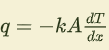
T/F - Fourier’s law of heat conduction is expressed by the picture seen below. The negative sign in the expression is needed for q to be positive along x since k and A are always positive, and the temperature gradient is negative
True
T/F - Thermal conductivity of a medium is a constant. It is not dependent on other properties such as temperature and pressure.
False
Which of the following is not a correct statement about Blackbody radiation?
The emissivity of a blackbody is 0
T/F - Conduction heat transfer can take place in stagnant liquids and gases as well as solids.
True
T/F - Heat transfer has direction as well as magnitude, and thus it is a vector quantity.
True
T/F - The thermal conductivity of a solid material is constant. It does not vary with temperature.
False
Which of the following is not an example of heat generation?
Endothermic Chemical Reactions in a solid
How is the boundary condition on an insulated surface expressed mathematically?
dT/dx = 0
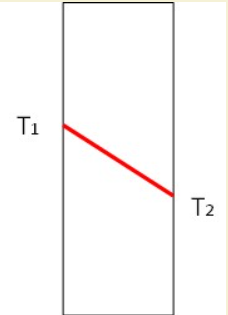
Heat is conducted through a large plane wall. T1 is greater than T2. What would the temperature profile across the wall look like, assuming steady-state heat transfer, 1-D heat conduction, constant k, and no heat generation?
A cylindrical wire generates heat uniformly, suspended vertically in air. What would the temperature profile across the wall look like, assuming steady-state heat transfer, 1-D heat conduction (radial direction), constant k, and no heat generation?

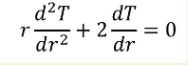
Which of the following is not a correct assumption based on the simplified equation of the heat conduction equation?
2-Dimensional Heat conduction
Heat is conducted through 3 layers of wall. Assume steady state heat conduction, no heat generation, and 1-dimensional heat transfer. Compare the heat transfer rate, q1, q2, and q3 when k1=k2=k3.
q1=q2=q3
Which of the following statements about fins is FALSE?
Fins are more effective when the surrounding fluid is subjected to natural convection.
Heat is conducted through 3 layers of wall. Assume steady state heat conduction, no heat generation, and 1-dimensional heat transfer. Compare the heat transfer rate, q1, q2, and q3 when k1>k2>k3.
q1=q2=q3
In a given fin configuration, the increase in thermal conductivity will (Assume the fin base temperatures remain the same.)
Increase the heat transfer rate between the fin and the surroundings
Which of the following is least likely to decrease the thermal contact resistance between two media in contact?
Make a vacuum gap at the interface
T/F - When designing a fin, carbon steel is typically a better choice than aluminum.
False
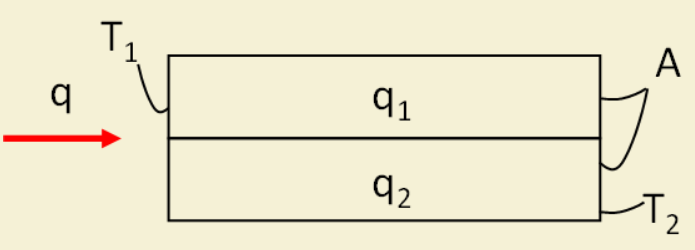
Heat is transferred through two layers of identical plates that are stacked on top of each other. Assume steady state heat conduction, no heat generation, and 1-dimensional heat transfer. Compare the heat transfer rate, q1 and q2.
q1=q2
T/F - Lumped capacitance analysis is used to study 1-D steady conduction heat transfer.
False
T/F - A slender body is more likely to be applicable for the lumped capacitance system than a round one of the same volume and material.
True
If the diameter of the steel ball in the above question is twice as large, how would the time constant change? Assume other conditions remain the same.
Time constant becomes larger
T/F - Any objects made of copper with any shapes and sizes subjected to sudden heating or cooling may be assumed to be a lumped capacitance system.
False
T/F - Consider two identical objects: one is dropped in water and the other is cooled naturally in air. The object in water is more likely to be applicable for the lumped capacitance system than the one cooled naturally in air.
False
Which of the following is not a correct statement about the fin analysis?
Heat transfer is one-dimensional.
T/F - Consider steady, laminar, two-dimensional, incompressible flow with constant properties on a flat plate. The velocity boundary layer and thermal boundary layer increases with distance from the leading edge.
True
T/F - Consider steady, laminar, two-dimensional, incompressible flow with constant properties. For a given geometry, heat transfer coefficient depends on the Reynolds number and the Prandtl number only.
True
T/F - Consider a steady, laminar, two-dimensional, incompressible fluid with constant properties flow along a flat plate. The convection coefficient is uniform anywhere on the plate.
False
T/F - Convection heat transfer coefficient is usually higher for natural convection than forced convection.
False
T/F - Nusselt number can be used to determine the types of fluid flow, laminar or turbulent flow in a forced convection heat transfer.
False
T/F - Prandtl number depends on the type of flow or the flow geometry.
False
T/F - The thermal boundary layer develops in flow over a surface if the fluid and the surface of a solid body are at the same temperature.
False
T/F - The velocity boundary layer and the thermal boundary layer coincide when Prandtl number is equal to 1.
True
T/F - The convective heat transfer coefficient in laminar flow over a flat plate increases with distance
False
In the hydrodynamic boundary layer over a flat plate in laminar flow the velocity is
Increases from the solid surface to the free stream
As the viscosity of fluids increases the boundary layer thickness
increases
T/F - Heat transfer rate is higher in turbulent flow in general compared to the laminar flow
True
Prandtl number is
The ratio of momentum diffusivity to thermal diffusivity
In laminar flow over a flat plate,
The thermal boundary layer is thicker than hydrodynamic boundary layer if the Prandtl number is smaller than one
T/F - Nusselt number is a dimensionless heat transfer coefficient that can be negative.
False
T/F - Prandtl number depends on the type of flow or the flow geometry.
False
What fluid property is responsible for the development of the velocity boundary layer?
viscosity
T/F - In the thermally fully developed region in a circular pipe with a constant surface heat flux, the temperature profile may change in the flow direction.
True
Consider a forced convection in a circular pipe in a laminar flow. The heat transfer coefficient is highest ____________
at the inlet of the tube
T/F - Consider a forced convection in a circular pipe with a constant surface heat flux. The mean fluid temperature increases linearly in the flow direction in the fully developed region.
True
T/F - For internal convection under uniform heat flux thermal boundary condition, laminar flow, and fully developed flow, the Nusselt number is constant at 4.36 for flow in a square duct.
False
T/F - For internal convection under steady-state conditions, the flow remains either laminar or turbulent throughout the entire channel, without transitioning between the two regimes.
True
In internal convection problems, a constant surface temperature boundary condition can be assumed under which of the following conditions? Select all that apply.
1. The channel is perfectly insulated.
2. The channel is submerged in a large reservoir with a constant temperature.
3. There is phase change at the surface, such as boiling or condensation.
4. The wall is subjected to a uniform heat flux along the flow direction.
2 & 3