Cell Biology Test Bank #3
 Call Kai
 Learn
Learn Practice Test
 Spaced Repetition
 Match
Match Flashcards
 Knowt Play
1/49

There's no tags or description
Looks like no tags are added yet.
Name | Mastery | Learn | Test | Matching | Spaced | Call with Kai |
|---|
No analytics yet
Send a link to your students to track their progress
50 Terms
A. Transporters and channels
B. Receptors
C. Enzymes
D. Selective barrier
Plasma membrane proteins provide the following function to the cells. Choose one or more
A. Transporters and channels
B. Receptors
C. Enzymes
D. Selective barrier
E. Energy Generation
C. Because of the hydrophobic tails of the phospholipids
Why are water-soluble substances unable to freely cross the lipid bilayer of the plasma membrane to enter the cytosol?
A. Because of the hydrophobic outside head group of the membrane
B. Because of the hydrophilic tail of the phospholipids
C. Because of the hydrophobic tails of the phospholipids
D. Because of the hydrophilic inside head group of the membrane
A. Composition of the hydrophilic head group
The fluidity of a lipid bilayer in cells is determined by the following ways, EXCEPT
A. Composition of the hydrophilic head group
B. Number of carbons in fatty acid tails
C. Fatty acid saturation
D. Amount of cholesterol
B. phosphoglycerides
C. sphingolipids
D. steroids
Which of the following is/are components of eukaryotic cell membranes. Choose one or more
A. lipopolysaccharides
B. phosphoglycerides
C. sphingolipids
D. steroids
B. increase the proportion of phospholipids with unsaturated fatty acids
How could you increase membrane fluidity?
A. increase the amount of cholesterol present in the membrane
B. increase the proportion of phospholipids with unsaturated fatty acids
C. increase the length of the fatty acid tails in phospholipids
D. increase the proportion of phospholipids with saturated fatty acids
D. B
Shown here are FRAP results for the same membrane proteins after three treatments. The first curve represents untreated protein. The rest of the curves are taken after treating the membrane proteins to increase their membrane mobility. Which frame shows an increase in membrane motility?
A. Both B and C
B. C
C. Both A and B
D. B
E. A
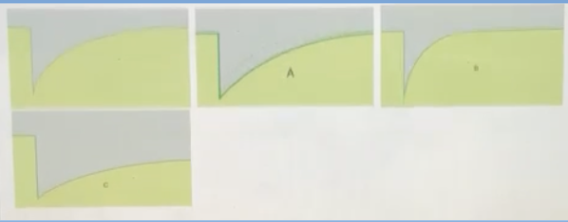
D. A
Shown is a schematic diagram of a membrane phospholipid. Which of the marked segments is different between phosphatidylcholine and phosphatidylethanolamine?
A. B
B. D and E
C. C
D. A
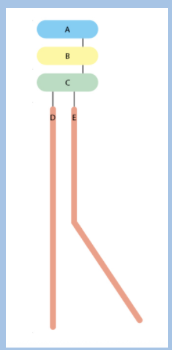
A. decreased amount of cholesterol
D. Polyunsaturated fatty acids
You will expect to find the following in a membrane of a cell that is adapted to function in a very cold temperature. Choose one or more
A. decreased amount of cholesterol
B. saturated fatty acids
C. increased amount of cholesterol
D. Polyunsaturated fatty acids
D. It will only interact with the hydrophilic head group of cell membranes
All of the following are true about the molecule below, EXCEPT
A. It is part of a cell membrane in eukaryotes
B. Contains both hydrophilic and hydrophobic regions
C. It is responsible for the membrane fluidity cells
D. It will only interact with the hydrophilic head group of cell membranes
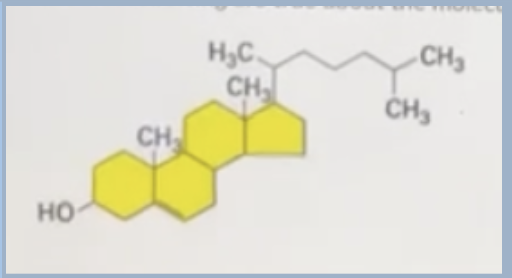
A. Blue side
The following vesicle originated from Golgi apparatus and fuses with the plasma membrane. Which monolayer will face outside (non-cytosolic side)?
A. Blue side
B. Sometimes blue and other times orange
C. It will be a hybrid of the two colors
D. orange side
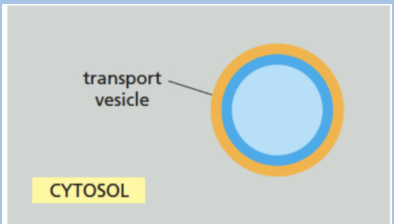
C. expels Na+ from the cell and bring in K+ into the cell
Which of the following is TRUE to all Na+/K+ pump located in the membrane.
A. expels K+ from the cell and brings in Na+ into the cell
B. both Na+ and K+ travel the same direction
C. expels Na+ from the cell and bring in K+ into the cell
D. the movement of Na+ and K+ are driven by their concentration gradient
D. H2O would diffuse out
In one experiment, you create a liposome – a vesicle made of phospholipids – that is filled with distilled water. You placed the liposome in a solution that contains 1mM glucose and 1 mM sodium chloride. What would happen the fastest?
A. NaCl would diffuse in
B. Na+ would diffuse in
C. Glucose would diffuse in
D. H2O would diffuse out
E. Nothing will happen
A. movement of glucose and sodium from the gut lumen to the cell
Absorption of glucose molecules from the gut lumen into the surrounding epithelial cells involves
A. movement of glucose and sodium from the gut lumen to the cell
B. glucose moves from gut lumen to cells at the expense of Na+ moving to opposite direction
C. It involves movement of Na+ against the concentration gradient
D. It involves ATP hydrolysis
B. mainly transport soldiers
Cells contain two classes of membrane transport proteins, transporters, and channels. Which of the following is TRUE to only transporters.
A. only used to transport solutes down their concentration gradient
B. mainly transport soldiers
C. only used to transport solutes actively against their concentration gradient
D. mainly transport ions
C. carbon dioxide, water, glucose
Different molecules pass directly through lipid bilayers at different rates. Which of the following choices presents the correct order, from fastest to slowest?
A. oxygen, sodium ions, glucose
B. water, oxygen, glucose
C. carbon dioxide, water, glucose
D. sodium ions, oxygen, glucose
A. ATP hydrolysis
B. ion gradient
C. light energy
D. concentration gradient of other solutes
Cells use which of the following sources of energy to actively move solutes against their concentration gradient. Choose one or more
A. ATP hydrolysis
B. ion gradient
C. light energy
D. concentration gradient of other solutes
D. the pump moves Ca2+ from extracellular space into the cytosol
Which of the following is FALSE about Ca2+ pump
A. It consumes ATP
B. They are found in plasma membrane of all eukaryotic cells
C. the pump moves Ca2+ from cytosol into the extracellular space
D. the pump moves Ca2+ from extracellular space into the cytosol
True
True or false? Electrochemical H+ gradients drive the transport of solutes in plants, fungi, and bacteria
C. they couple the flow of ions to an energy source to carry out active transport
All of the following are true about ion channels EXCEPT
A. Move ions down their concentration gradient
B. unlike a transporter an ion channel does not need to undergo conformational changes
C. they couple the flow of ions to an energy source to carry out active transport
D. ion channels are gated
Na+ pump - Active import of K+ ions
Ca2+ pump - Active transport of ions into
H+ pump - Transport of solutes in plants,
Bacteriorhodopsin - Light driven export of H+
Match the membrane pumps with their function
Active import of K+ ions
Active transport of ions into
Transport of solutes in plants,
Light driven export of H+
Active export of K+ from cells
Na+ pump -
Ca2+ pump -
H+ pump -
Bacteriorhodopsin -
A. both concentration gradient and membrane potential
The movement of ions across the cell membrane in figure (A) below is driven by
A. both concentration gradient and membrane potential
B. membrane potential
C. ATP hydrolysis
D. concentration gradient
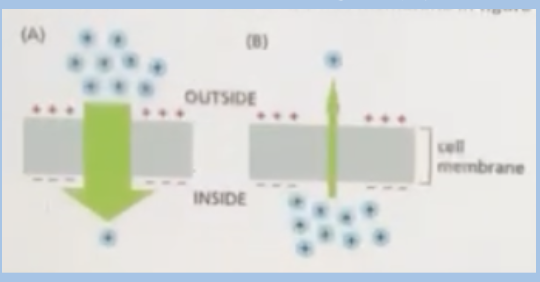
True
True or false? H+ pumps in animal cells are responsible for the acidification of the lysosome lumen
False
True or false? The concentration of Na+ ions is higher outside the cell compared to extracellular spaces
D. -40
Calculate equilibrium membrane potential for potassium in mV if the concentration of potassium (K+) inside is 180 mM and (K+) outside is 40 mM. Hint: round to whole #
A. 97
B. -97
C. 40
D. -40
A. 350 mV
Calculate the change in reduction potential (∆Eº) for the transfer of electrons from NADH (-320 mV) to ubiquinone (30 mV).
A. 350 mV
B. 1180 mV
C. -350 mV
D. -290 mV
E. 290 mV
C. generation of ATP by TCA
All of the following processes require a membrane to produce energy, EXCEPT?
A. generation of ATP by photosynthesis in plants
B. generation of ATP by oxidative phosphorylation
C. generation of ATP by TCA
D. generation of energy in mitochondria
B. gel electrophoresis
You used restriction endonuclease to digest a plasmid. What will you do next to determine the size of the fragments produced?
A. polymerase chain reaction
B. gel electrophoresis
C. hybridization
D. RNA interference
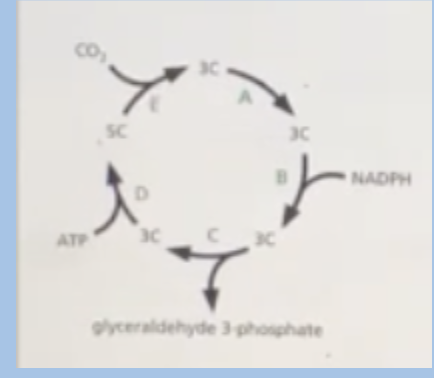
A. A
D. D
In this simplified diagram of the reactions of the carbon-fixation cycle, which step consumes ATP?
A. A
B. B
C. C
D. D
D. Dissociation of Ran-GDP from the nuclear import receptor decreases its affinity to proteins in the cytosol
Proteins enter the nucleus through nuclear pores. Which of the following statements is NOT TRUE about transport of proteins into the nucleus.
A. the proteins must contain a nuclear ionization signal
B. GTP hydrolysis drives nuclear transport
C. binding of Ran-GTP to nuclear import receptor decreases its affinity to proteins in the nucleus
D. Dissociation of Ran-GDP from the nuclear import receptor decreases its affinity to proteins in the cytosol
True
True or false? All proteins destined to be transported to the nucleus must have a nuclear localization signal
False
True or false? Proteins made in the cytosol without signal sequence are delivered to the lumen of the ER
Endoplasmic reticulum (ER) - synthesis of most lipids and proteins
Endosomes - sorting of endocytosed material
Golgi apparatus - sorting and packing of proteins for transport
Match the organelles with their function
Intracellular degradation
sorting and packing of proteins for transport
Glycolysis
sorting of endocytosed material
synthesis of most lipids and proteins
Oxidative breakdown of toxic molecules
Endoplasmic reticulum (ER) -
Endosomes -
Golgi apparatus -
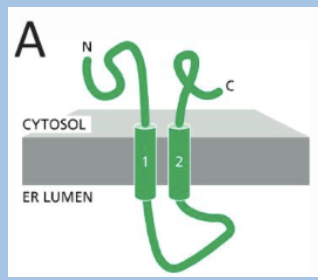
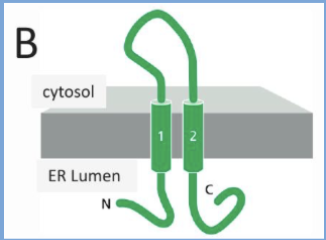
B
A transmembrane protein normally form a structure shown below. If an ER signal sequence were added to its N-terminus, which structure would the engineered protein adopt?
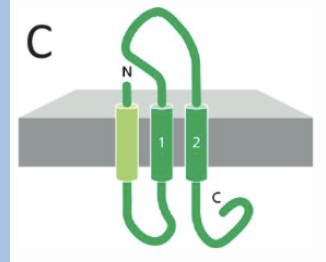
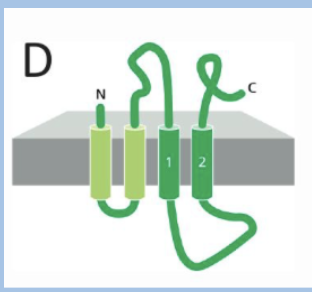
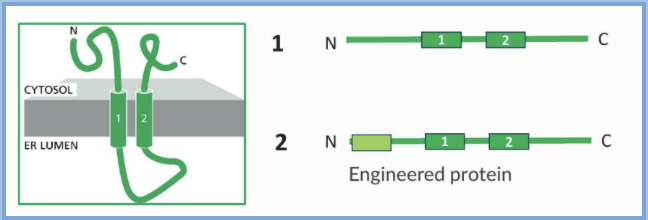
A. endosomes
Which cellular compartment acts as the main sorting station for extracellular cargo molecules taken up by endocytosis?
A. endosomes
B. golgi apparatus
C. lysosomes
D. ER
B. SNAREs
These proteins play a central role in the fusion of a vesicle with a target membrane?
A. clathrins
B. SNAREs
C. Rab proteins
D. adaptins
D. process of ingesting and destruction of infection agent
Phagocytosis
A. it is a process of expelling cholesterol using receptor-mediated exocytosis
B. is a process of cell feeding from intracellular space by the process of endocytosis
C. It is a process of collecting cholesterol using receptor-mediated endocytosis
D. process of ingesting and destruction of infection agent
Cargo – Molecules packaged into vesicles
Receptor – captures the correct cargo
Adaptin – mediates contact between the cargo receptors and clathrin
Clathrin – shapes the forming vesicle
Match the following structures used in receptor mediated endocytosis with their functions
shapes the forming vesicle
captures the correct cargo
Molecules packaged into vesicles
mediates contact between the cargo receptors and clathrin
Cargo –
Receptor –
Adaptin –
Clathrin –
C. 27
Calculate equilibrium membrane potential for calcium in mV if the concentration of calcium (Ca2+) inside is 20mM and (Ca2+) outside is 145 mM. Hint: approximate to whole number
A. -53
B. 53
C. 27
D. -27
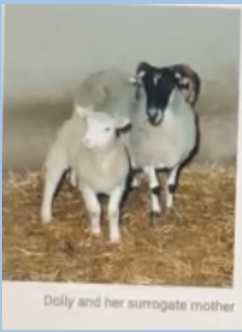
B. Differentiated cells, like skin cells, contain all the genetic instructions needed to direct the formation of a complete organism
C. Dolly is not genetically related to her mother
Based on what we discussed in class and looking at the picture of Dolly and her surrogate mother, what can be concluded? Hint: select more than one answer
A. Differentiated cells, given the required nutrition, can divide until they form a whole organism
B. Differentiated cells, like skin cells, contain all the genetic instructions needed to direct the formation of a complete organism
C. Dolly is not genetically related to her mother
D. Differentiated cells lack some genetic information normally found in an egg or sperm cells
D. CRISPR can change the genetic make of the cell or organism
CRISPR is different from RNAi technique in that
A. CRISPR can silence the expression of mRNA
B. CRISPR depends on RNA to recognize the target site
C. CRISPR and RNAi are similar in all aspects
D. CRISPR can change the genetic make of the cell or organism
B. green fluorescent protein (GFP)
Which of the following techniques is NOT normally used to change the expression of genes or protein produced in the cell or the organism
A. CRISPR Cas9
B. green fluorescent protein (GFP)
C. RNA interference (RNAi)
D. homologous recombination
B. Guide RNA
For RNAi to successfully inhibit the activity of specific gene, it requires the following EXCEPT
A. mRNA
B. Guide RNA
C. RNA-induced silencing complex
D. dsRNA
A. to import extracellular materials
Eukaryotic cells engage in continual endocytosis and exocytosis across their plasma membrane. Why do cells engage in endocytosis?
A. to import extracellular materials
B. They use it to communicate with other cells
C. secrete extracellular materials
D. they use it for mating with other similar cells
B. Two-dimensional PAGE
Which of the following techniques would you use to separate two proteins with the same size but different isoelectric points?
A. Ion-exchange chromatography
B. Two-dimensional PAGE
C. Antibody affinity chromatography
D. SDS – PAGE
A. Mercaptoethanol
You purified a protein complex with multiple subunits bound together by disulfide bond. Which of the following chemicals would you use to separate the subunits before loading it to polyacrylamide gel electrophoresis.
A. Mercaptoethanol
B. Sodium dodecyl sulfate (SDS)
C. weak base
D. weak acid
B. liquid chromatography
D. SDS-PAGE
Which of the following can be used for separating different proteins within a sample. Hint: multiple answer question.
A. mass spectrometry
B. liquid chromatography
C. x-ray crystallography
D. SDS-PAGE
A>B>D>C
Rank the following based on their rate of movement across a protein-less lipid bilayer membrane down their concentration gradient.
A. Small nonpolar molecules, such as O2 and CO2
B. Small uncharged polar molecules, such as water or urea
C. Charged molecules (ions)
D. Large uncharged polar molecules (amino acids and glucose)
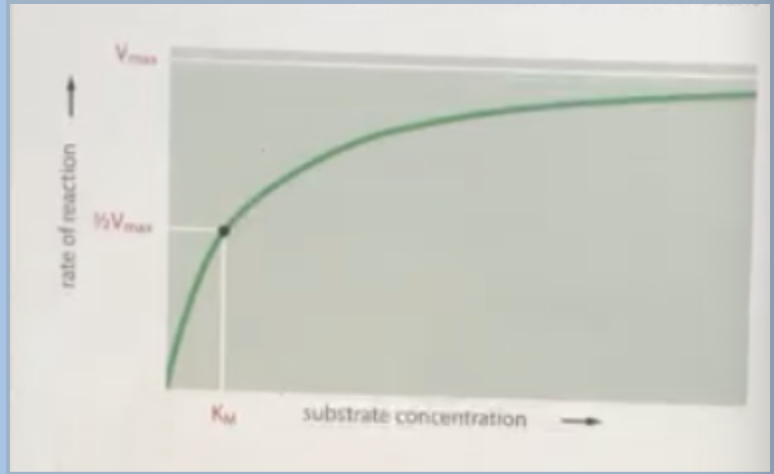
D. The KM would move to the left (decrease)
You are running an experiment to mutate an enzyme in order to increase the enzyme’s ability to bind its substrate. Using the graph as a comparison, what effect would the mutant version of the enzyme likely have on the Km?
A. The KM would move to the right (increases)
B. The KM would not change at all (no effect)
C. The KM would move to the right initially but eventually move to the left
D. The KM would move to the left (decrease)
1. Regulatory GTP-binding proteins act as on/off switches that control important cell signaling pathways involved in growth and division
2. These proteins are active when bound to GTP and become inactive when GTP is hydrolyzed to GDP
3. If a mutation prevents GTP hydrolysis, the protein stays active and continuously sends growth signals
4. An example is Ras, a small GTPase that regulates pathways controlling cell proliferation
Explain, in at least 3 sentences but not more than 6 sentences, how regulatory GTP-binding proteins can be responsible for human cancer
List your explanation by number or bullet points
Mention at least one example of a protein regulated by GTP-binding
1. Phospholipids are synthesized on the cytosolic side of the endoplasmic reticulum
2. Different Phospholipids are asymmetrically distributed with phosphatidylcholine (PC) being restricted to the outer (exoplasmic) leaflet and phosphatidylethanolamine (PE) and phosphatidylserine (PS) both being restricted to the inner (cytosolic) leaflet
4. Flippases selectively transport specific phospholipids like PE and PS from the outer exoplasmic face to the inner cytosolic helping maintain this asymmetry
4. Scramblase randomly selects phospholipids between both leaflets disrupting asymmetry when activated
5. This randomization is especially important during processes like apoptosis, where PS is exposed on the outer leaflet as a signal
6. Together, flippases maintain lipid asymmetry under normal conditions, while scramblases allow controlled loss of asymmetry when needed.
Describe how flippases and scramblases are used by cells to maintain asymmetric distribution of phospholipids on animal cell membranes
List your answer by number to receive credit. Limit your answer to 4-6 sentences