Systems
 Call Kai
 Learn
Learn Practice Test
 Spaced Repetition
 Match
Match Flashcards
 Knowt Play
1/130

There's no tags or description
Looks like no tags are added yet.
Name | Mastery | Learn | Test | Matching | Spaced | Call with Kai |
|---|
No analytics yet
Send a link to your students to track their progress
131 Terms
What are the levels of biological make-up?
Cell = smallest unit of life
Tissues = collection of cells (same type/function)
Organs = collection of tissues (different type/function but work together)
Systems = collection of organs working together
What are examples of tissues?
Muscle
Bone
What are examples of organs?
Stomach
Heart
What are examples of systems?
Reproductive
Digestive
What is the largest system in the body?
Integument system (skin)
What does the skin do?
Acts as a protective barrier between the internal environment and the external environment
Involved in sensory reception, secretion, excretion, respiration, heat regulation, locomotion, coloration, digestion, nutrition, mineral deposition, osmoregulation
What is the function of the integument system?
Help maintain body form
Provide protection from abrasions
Support accessory structures
Allow for movement of ions and solutes
Minimize hydrodynamic friction
Prey capture/manipulation
What are the 2 layers of skin?
Epidermis
Dermis
What is the epidermis?
Outer, protective, nonvascular layer
What is the epidermis’s purpose?
Contains mucous glands, venom glands, photophores, sense organs, lateral line organs
Dermal denticles pass through this
What is the dermis?
The underlying connective tissue layer
What is the dermis’s purpose?
Contains nerve endings, blood vessels, and lymph vessels
Dermal denticles originate here
What are the cellular glands?
Primarily mucus and venom glands
What is the function of the neural crest cell?
Create mesenchyme for development of photophores, chromatophores and scales/dermal denticles
What is the function of the hard structure (dermal denticles) in the soft tissue?
Creatures structure for the body
Soft tissue = mobility
Dermal denticle = more protection
Where are the photophores located?
In the epidermis
What are the light from photophores used for?
Countershading
Schooling (species recognition)
Prey attraction
Obscure position of mouth
What families are photophores present in?
Etmopteridae
Dalatiidae
How do dermal denticles help with hydrodynamics?
They have ridges and cusps
How do dermal denticles change throughout life?
Skates, rays, chimaeras rely on mucus secretion (have reduced denticles)
Embryos use mucus for protection (scales displace mucoid cells during growth)
Adults still secrete mucus but on a smaller scale
Scales are shed and formed continuously and get larger as the animal grows larger
What type of dermal denticles do fast swimmers (Mako, Hammerheads, Dusky)?
Smaller, lighter denticles (300 microns wide, 7 ug)
More dermal denticles per square centimeter (11.5)
Why do faster swimmers have smaller dermal denticles?
For good hydrodynamics (makes them light in the water column)
Water flowing over something small and smooth = less friction
What type of dermal denticles do moderate swimmers have (Sandbar, Blue)?
Moderate length and weight (300 microns wide, 40 ug)
Moderate denticles per square meter (8.6)
What type of dermal denticles do sluggish/benthic swimmers have (Nurse, Sandtiger)?
Large, heavy denticles (600 microns, 40 ug)
Less denticles per square meter (2.4)
Why do benthic swimmers have larger dermal denticles?
No need to maintain positions in the water column (not streamlined/light, largest/heaviest dermal denticles)
What are some modifications of scales?
Fin spines
Stingray spines
Rostral teeth
Teeth
How do stingray spines work?
Stop growing after reaching full size (can be replaced!)
Covered in a heath of skin/mucus
2 ventrolateral grooves house venom glands
Ending point has barbs that face backward along the spine
What are the 3 main properties of water?
Very dense
High viscosity (resistance to deformation)
Energetically costly to move
What are the types of drag?
Frictional drag
Form/Pressure drag
What is frictional drag?
Interaction between the surface of the organism and the water (nothing to do with speed of the animal)
What is form drag?
Difference in pressure in front of the organism verses behind the organism
How does frictional drag work?
When water molecules hit a structure, they lose momentum
The water closest to the body is slowed the greatest, while the effect lessens further from the body surface
What is a boundary layer?
Non-moving water layer that creates friction with surrounding water
How do elasmobranchs reduce frictional drag?
Reduce surface area
How do elasmobranchs reduce surface area?
Fold in fins (EX: Chimaera)
Cover body surface with mucus
Reduce scale sizes
Schooling
Move out of high current water
How does form drag work?
When water flow separates away from the body (causes backflow)
More pronounced at higher speeds
Greater than frictional drag
What is backflow?
Chaotic water movement to fill in the low pressure area
How do elasmobranchs reduce form drag?
Increase surface roughness
Streamline shape (fusiform, tapering)
Life history traits
How do elasmobranchs increase surface roughness?
Increase the dermal denticles —> this will increase frictional drag
Each divot from the dermal denticle creates miniature backflow
By the time the flow reaches the end of the animal there is already a natural backflow
How do fin sizes differ in sharks?
Pelagic need more lift so they have bigger fins (more form drag)
Benthic need less lift so they have smaller fins (less form drag)
What is the general tooth structure?
Made of apatite crystals (calcium phosphate)
Acellular bone
Not anchored in the jaw (on a fibrous tooth bed)
Dermal denticles and teeth are basically identical
Why do sharks replace teeth?
They need different size teeth at different life stages (juveniles replace more because they are growing quicker)
Replacement times vary (some can even replace entire rows at a singular time)
What is sexual heterodonty?
The differences in teeth depending on sex
Atlantic stingray (males = pointy teeth, females = flat teeth)
What are ontogenic differences in teeth?
Differences in teeth depending on life stage
Great White (juveniles = pointy teeth because smaller prey items, adults = large, serrated teeth)
Give some examples on how teeth dictate diet.
Large central cusp with lateral cusps (clutching/holding fish/invertebrates)
Long, thin and pointed, angled inward (catch slippery fish/squid, tearing flesh)
Serrated and triangular, angles (Tear, cutting/sawing chucks of flesh)
Flat millstone of pavement-like (grinding shellfish/crabs)
Low molar-like (crush crustaceans)
Hundreds of tiny teeth (filtering plankton/small fish)
What trophic level are most sharks?
Tertiary consumers
What do apex predator sharks eat?
Dolphins, seals
What do tertiary consumer sharks eat?
Squid, small fish, invertebrates
What do primary consumer sharks eat?
Plankton
What is the purpose of the digestive system?
Process by which food is broken down into usable products and waste
Why do sharks need a strong, effective digestive system?
They cannot chew food into smaller pieces
What is a unique thing sharks can do with their stomachs?
Evert their stomachs/regurgitate to rid their body of items that are indigestible/harmful
What are the main organs of the digestive system?
Mouth
Oral cavity
Esophagus
Stomach
Intestine
Rectum
Cloacal
What are the accessory organs of the digestive system?
Pancreas
Liver
Gall bladder
What are the types of spiral valves?
Scroll
Posterior funnel
Spiral
What elasmobranchs have scroll spiral valves?
Sphyrnidae
What elasmobranchs have a posterior funnel spiral valve?
Rays, skates
What elasmobranchs have a spiral spiral valve?
Holocephalans
Most sharks
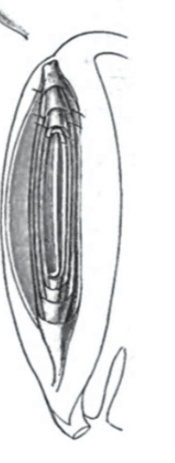
What is this?
Scroll Spiral Valve
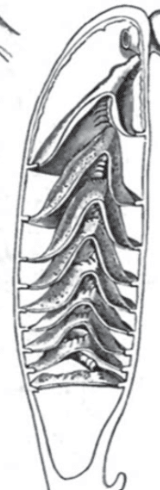
What is this?
Funnel Spiral Valve
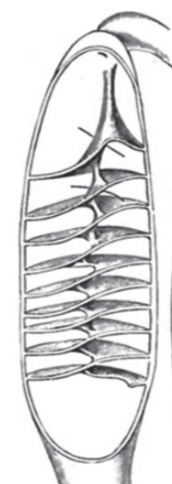
What is this?
Spiral spiral valve
What do the folds in the valve reflect?
The diet
More folds = more plant-based diet
Chimaera = 2-3 folds
Basking Shark = 50 folds
What is the largest internal organ?
Liver
What does the liver do?
Produce bile
Holds squalene and other lipids for energy and buoyancy
Detoxified the blood and regulates blood products
How do livers change between a sharks mode of life?
Large, slow swimming sharks = large buoyant livers to make them neutral
Faster sharks = smallest livers, swimming aids in buoyancy
Benthic sharks = small livers because they swim at intervals + not benefit from density reduction
What type of diet do juvenile sharks normally have?
Invertebrates
What type of diet do adult sharks normally have?
Teleosts, smaller sharks, marine mammals, reptiles, birds
More diverse
What are often highly specialized diets?
Zooplankton, crustacenas, cephalopods
What trophic level typically has a more generalized diet?
Top predators
Why are digestion rates variable?
Based on type of food and species of shark
What is the typical length of eating and length of digestion?
Short feeding bouts followed by long periods of digestion
What are digestion rates affected by?
Temperature
Amout of food
How does temperature affect digestion rates?
Higher temperature accelerates digestion
Higher temperatures increase secretion of digestive enzymes
How does the amount of food affect digestion rates?
A large meal is digested more rapidly
Why do elasmobranchs have a slow digestion rate?
The spiral valve design dictates slower rates of gastrointestinal emptying, lower food consumption rates, and slower food dynamics compared to teleosts
What are the parts of the gill structure?
Gill arch
Gill raker
Primary lamellae
Secondary lamellae
Demibranch
Holobranch
What are gill arches?
Where everything projects off of
5 gill slits = 5 gill arches
What are gill rakers?
Cartilaginous projections off the gill arch
Project into the pharynx area
What are primary lamellae?
Highly vascularized structure
Comes off the other side (compared to the gill rakers) of the gill arch
What are secondary lamellae?
Site of gas exchange
Branches perpendicular off of the primary lamellae
What is a demibranch?
One set of primary lamellae + secondary lamellae on the gill arch
Happens on only 1 gill arch
What is a holobranch?
Two sets of primary lamellae + secondary lamellae
Happens on all the other arches
How does gas exchange in the gills work?
Water passes between the primary lamellae and secondary lamellae
Blood flows in the opposite direction of the water (Counter current exchange)
What is counter current exchange?
Dissolved gases diffuse faster between fluids with a high concentration gradient (flow in opposite directions to keep up the concentration gradient through the whole gills)
Low oxygen blood is continually meeting fresh water with a high oxygen concentration
This maintains the concentration gradient and oxygen continues to diffuse into the blood
What is ventilation?
Means by which water is passed over the gills
What are the types of ventilation chondrichthyans use?
RAM ventilation
Buccal ventilation
What are the 2 types of RAM ventilation?
Obligate
Facultative
What is RAM ventilation?
Forward movement is used to pass water over gills
What types of elasmobranchs use RAM ventilation?
Most highly active fish
What is obligate RAM ventilation?
Must have forward motion at all times
What is facultative RAM ventilation?
Use RAM ventilation when moving but can actively ventilate when at low speeds/when stopped
How do RAM ventilating elasmobranchs maintain oxygen uptake when oxygen levels decline?
Swim faster
Open mouth wider
Change respiratory efficiency (increasing blood flow [perfusion] + recruit lamellae [secondary])
What is buccal ventilation?
The use of the buccal and pharyngeal/gill movements to pass water over gills
Some have specialized muscles to contract gills and pump water
What are the steps to buccal ventilation?
Open mouth and close gills
Depress the tongue to expand the buccal cavity and create negative pressure
Pressure change forces water in the mouth
Mouth closes
Gills open
Floor of the buccal cavity raises and forces the water out over the gills
How do spiracles help in buccal ventilation?
Keep mouth closed and drop their tongue to draw water in from the spiracles
What does the excretory system do?
Maintains proper concentration of internal ions, proper body volume (water column), osmotic balance, metabolic end products, foreign substances
Where is the kidney?
Embedded in dorsal cavity wall
Runs entire length of the body
What is the function of the kidney?
Arteries branch off the dorsal aorta and enter the kidney where the blood is filtered
Some molecules are reabsorbed for aid in osmoregulation
Nitrogenous waste is collected and supplied to the ureter for excretion as urea
What type of circulatory system do sharks have?
Closed
What does it mean to be a closed circulatory system?
Blood is contained in arteries and veins and a muscles continually contracts to circulate it