Bio 161 - Meiosis
 Call Kai
 Learn
Learn Practice Test
 Spaced Repetition
 Match
Match Flashcards
 Knowt Play
1/86

There's no tags or description
Looks like no tags are added yet.
Name | Mastery | Learn | Test | Matching | Spaced | Call with Kai |
|---|
No analytics yet
Send a link to your students to track their progress
87 Terms
Meiosis is essentially
cell division that allows for sexual reproduction
Binary fission is
reproduction for prokaryotes
Mitosis is..
asexual reproduction
great for maintaining pop. or repairing tissue
the whole point of mitosis is
to keep variability very low
Parent cell’s genetic info coped, EXACT COPY → high fidelity, daughter cells are clones
Why is Meiosis necessary?
allow for sexual reproduction (increases genetic variation)
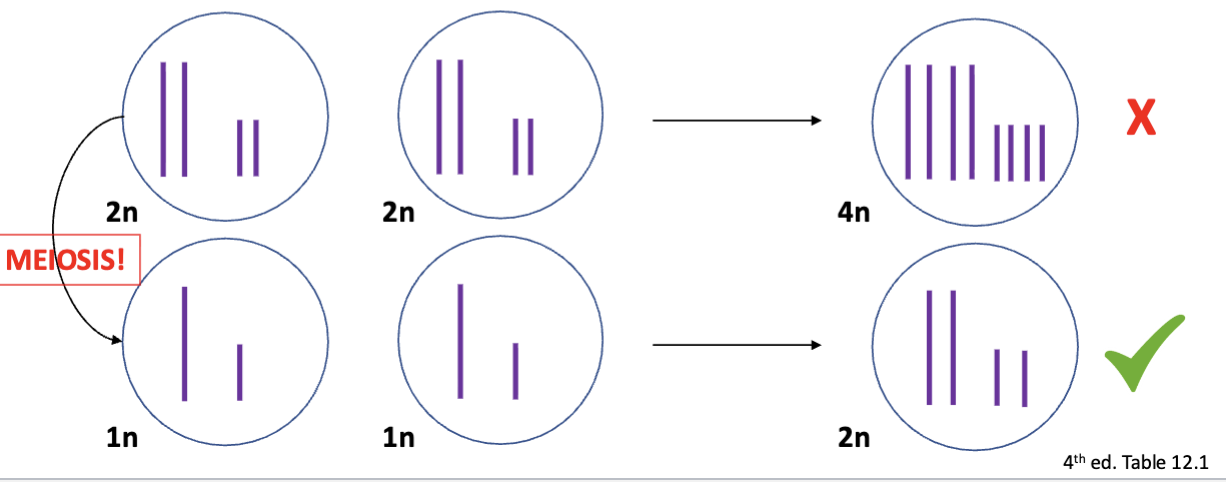
maintain chromosome number
Unlike Mitosis, Meiosis…
takes 2 different parent cells, mixes & introduces whole new daughter cell w/aspects of each genotype from each parent cell
What does “ploidy” refer to?
The number of complete sets of chromosomes in a cell.
What is a “set” of chromosomes
the complete collection of distinct chromosomes an organism needs to define its entire genetic blueprint (one genome copy).
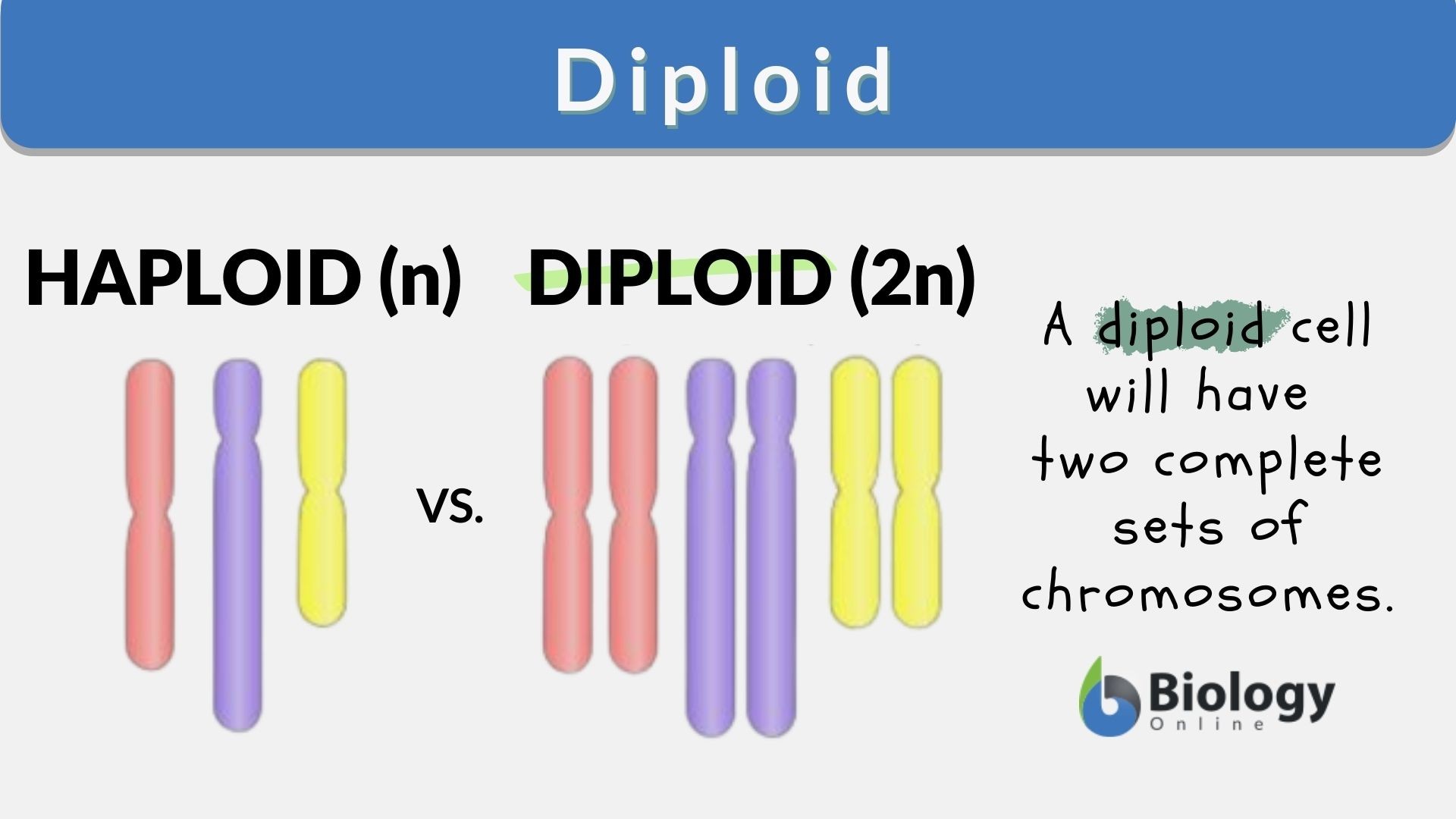
What does 2n mean?
Diploid — two sets of chromosomes
cell contains two complete sets of chromosomes—one set inherited from the mother and one set from the father (homologous chromosomes)
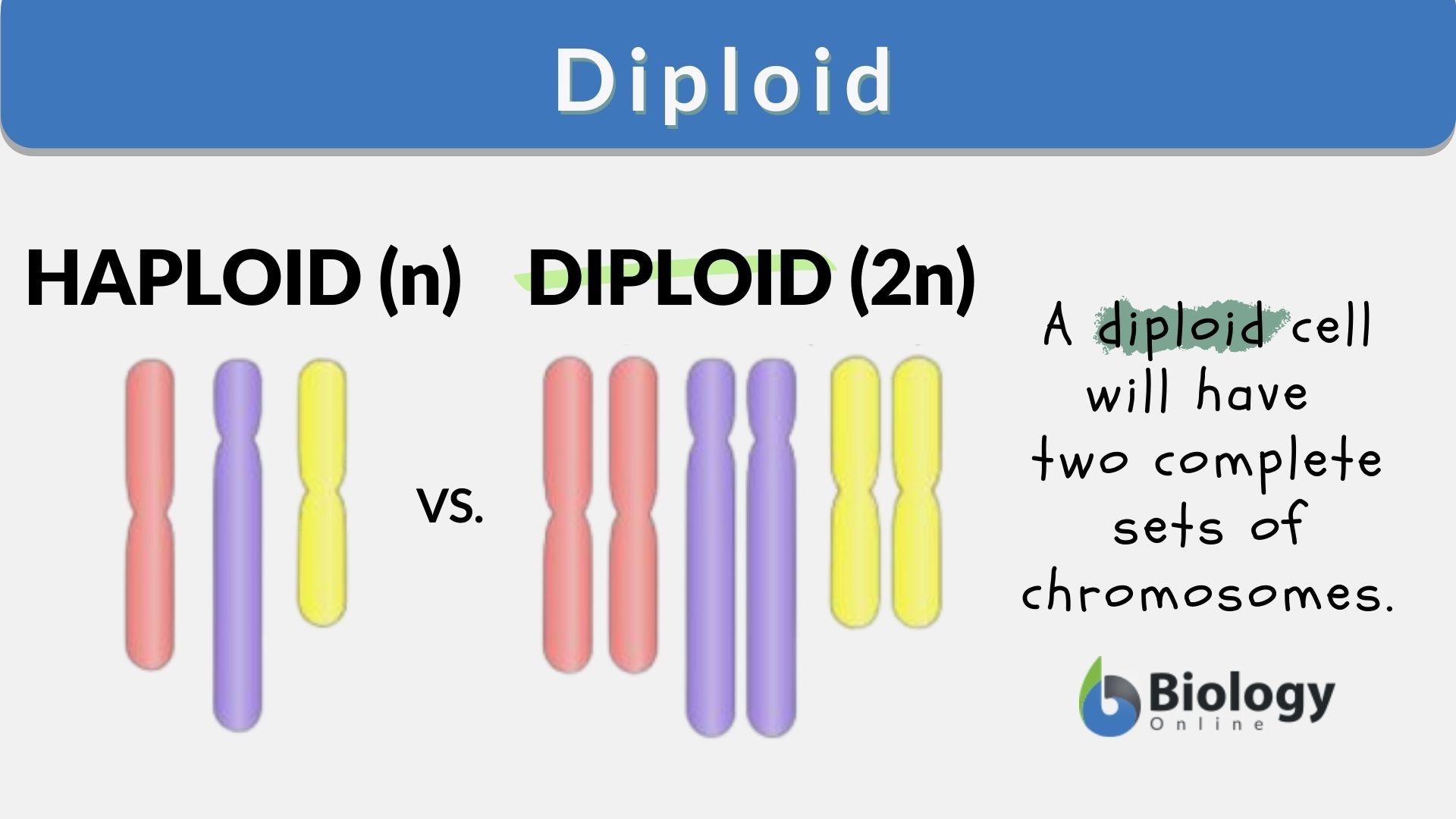
What does n mean?
Haploid - one set of chromosomes
Contains only a single set of unpaired chromosomes
Are gametes haploid or diploid?
Haploid!!!
In humans almost all cells/somatic cells (except gametes) are
diploid = contain 2 copies of each chromosomes
1 copy from mom, 1 from dad
In haploid, the chromosome number n are
from both mom and dad mixed up
Human Diploid Chromosome Number (2n)
2n = 46
Human Haploid Chromosome number (n)
n=23
in humans, this applies only to gametes (sperm and egg cells)
In Meiosis you take haploid (gamete) cells from 1 parent and…
fuse + mix with haploid (gamete) cells from another parent to achieve diploid organisms!!
What are homologous chromosomes?
A maternal and paternal pair with the same genes but possibly different alleles.
Are homologous chromosomes identical?
No, they have the same genes but different alleles.
What are sister chromatids?
Identical copies of a single chromosome produced during DNA replication.
Are sister chromatids identical?
yes!
What connects sister chromatids?
centromere (concentrated cohesin proteins)
Does DNA replication change chromosome number
no!
Why doesn’t replication change chromosome number?
chromosome number is based on centromeres, not DNA amount
What changes after DNA replication?
amount of DNA doubles, not chromosome number
What is mitosis used for?
growth, repair, & asexual reproduction
What is meiosis used for?
production of gametes (sex cells)
How many cells does mitosis produce?
2 identical diploid cells
How many cells does meiosis produce?
4 genetically unique haploid cells
What happens to ploidy in meiosis I?
2n → n
What happens to ploidy in meiosis II?
no change in ploidy
n → n !
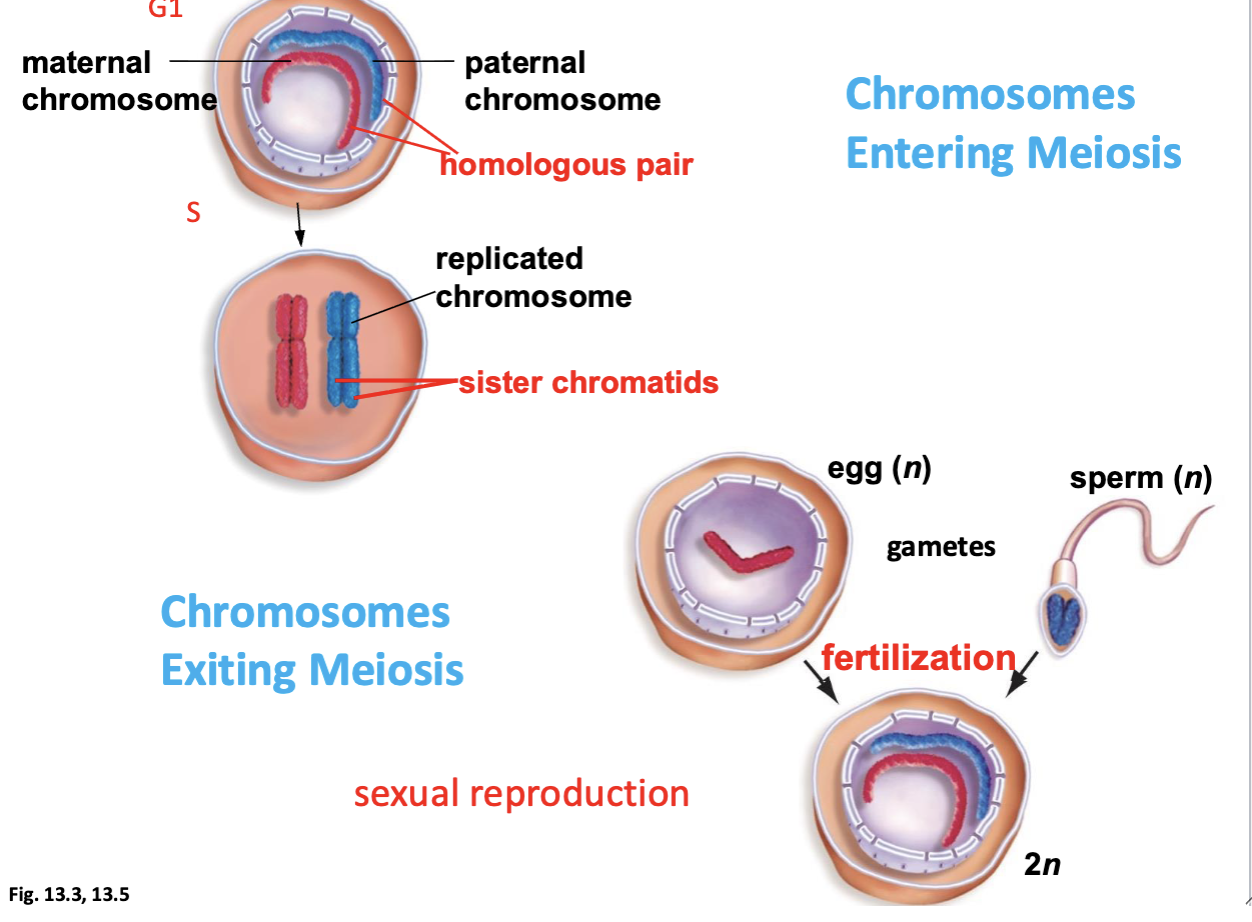
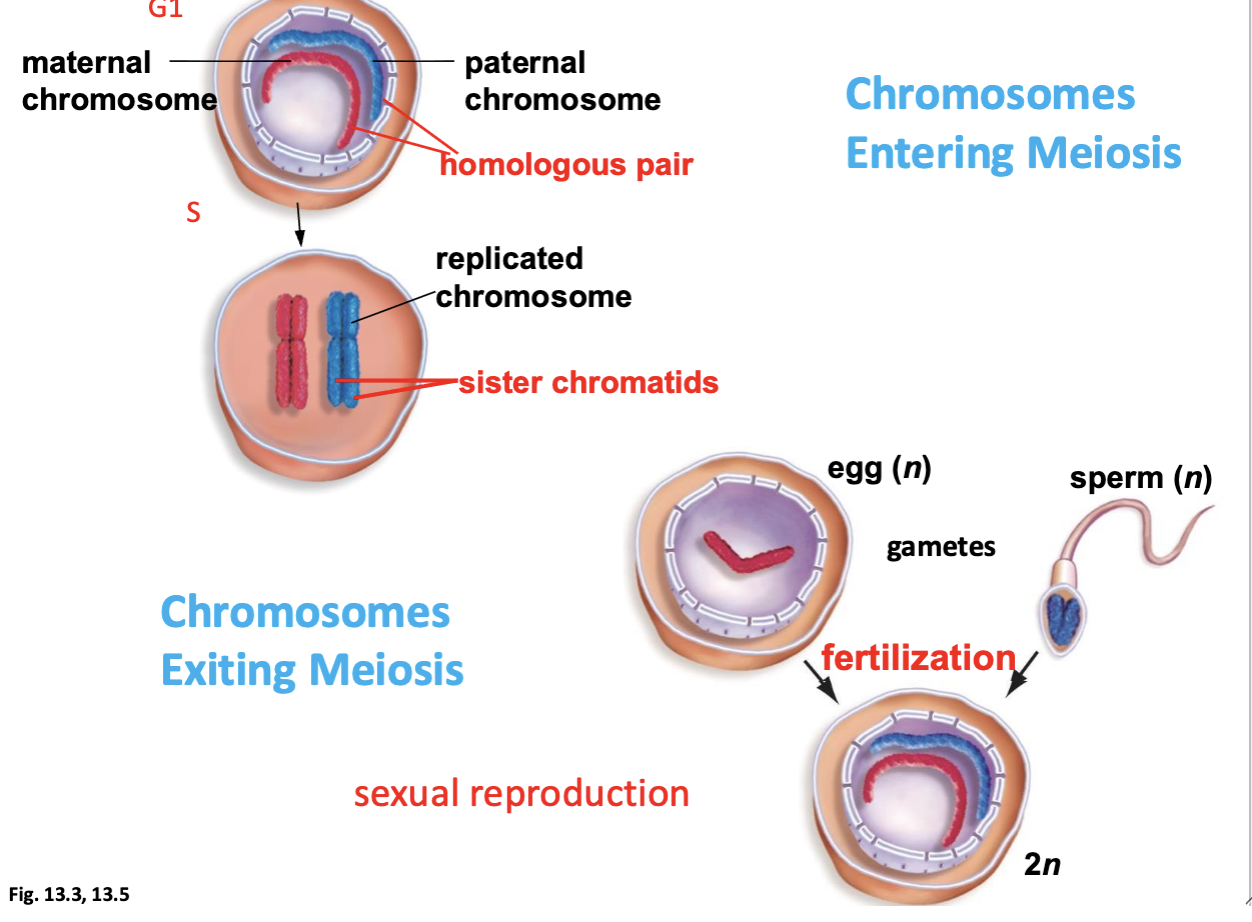
BIG PICTURE: 1) Chromosomes prior to entering Meiosis
2n diploid cell in G1 → has maternal chromosome & paternal chromosome (homologous pair)
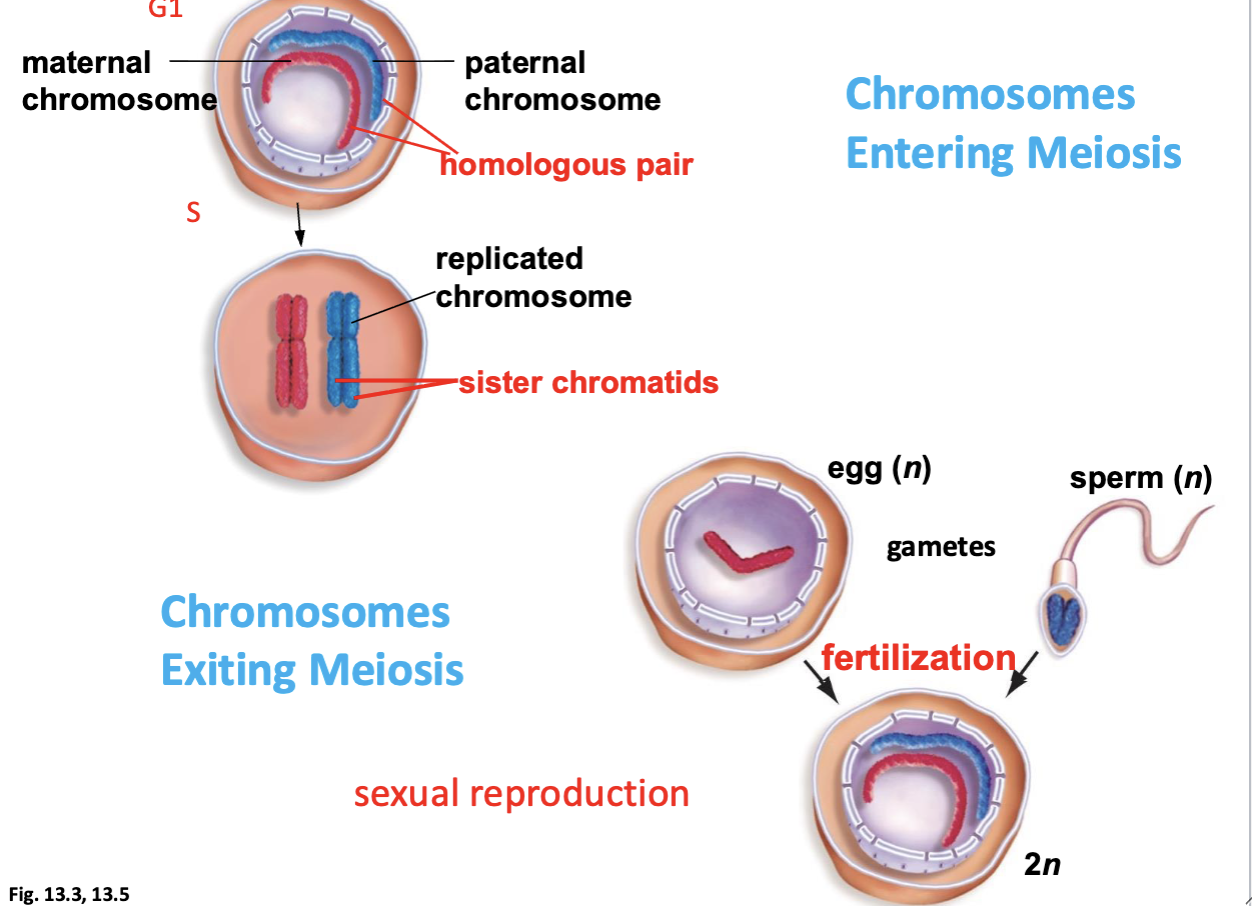
BIG PICTURE 2) Chromosomes after S Phase prior to entering meiosis
replication achieves high fidelity of chromosomes in parent cell
replicated chromosomes as sister chromatids
STILL 2n !!!! → Doubled DNA but did not increase # of chromosomes
enter meiosis this way
BIG PICTURE 3) Chromosomes Exiting Meiosis
end up w/single chromosomes /haploid cells
1n females haploid = egg
1n in male cells = sperm
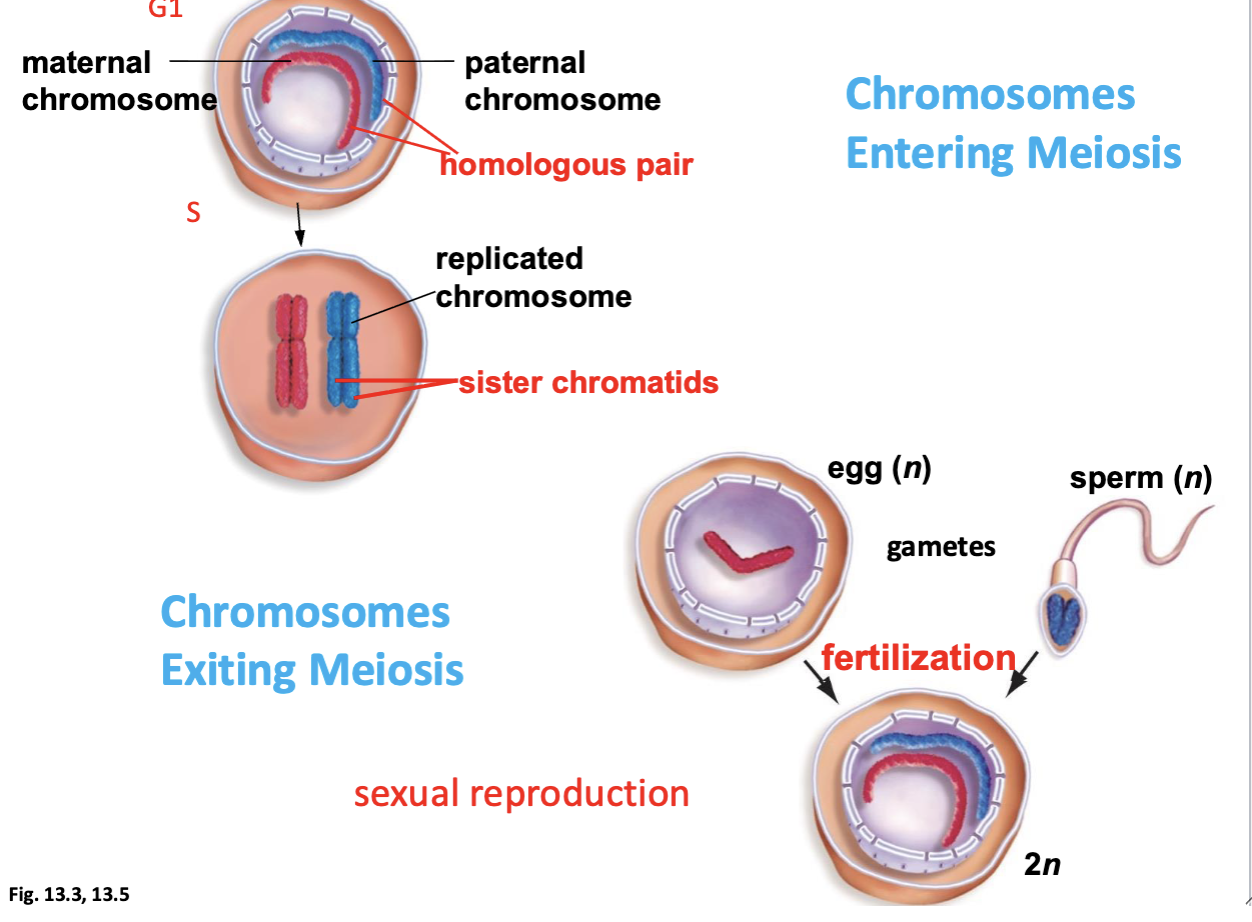
BIG PICTURE: Gametes from Meiosis have…
egg (n) have one sister chromatid from mom
sperm (n) have one sister chromatid from dad
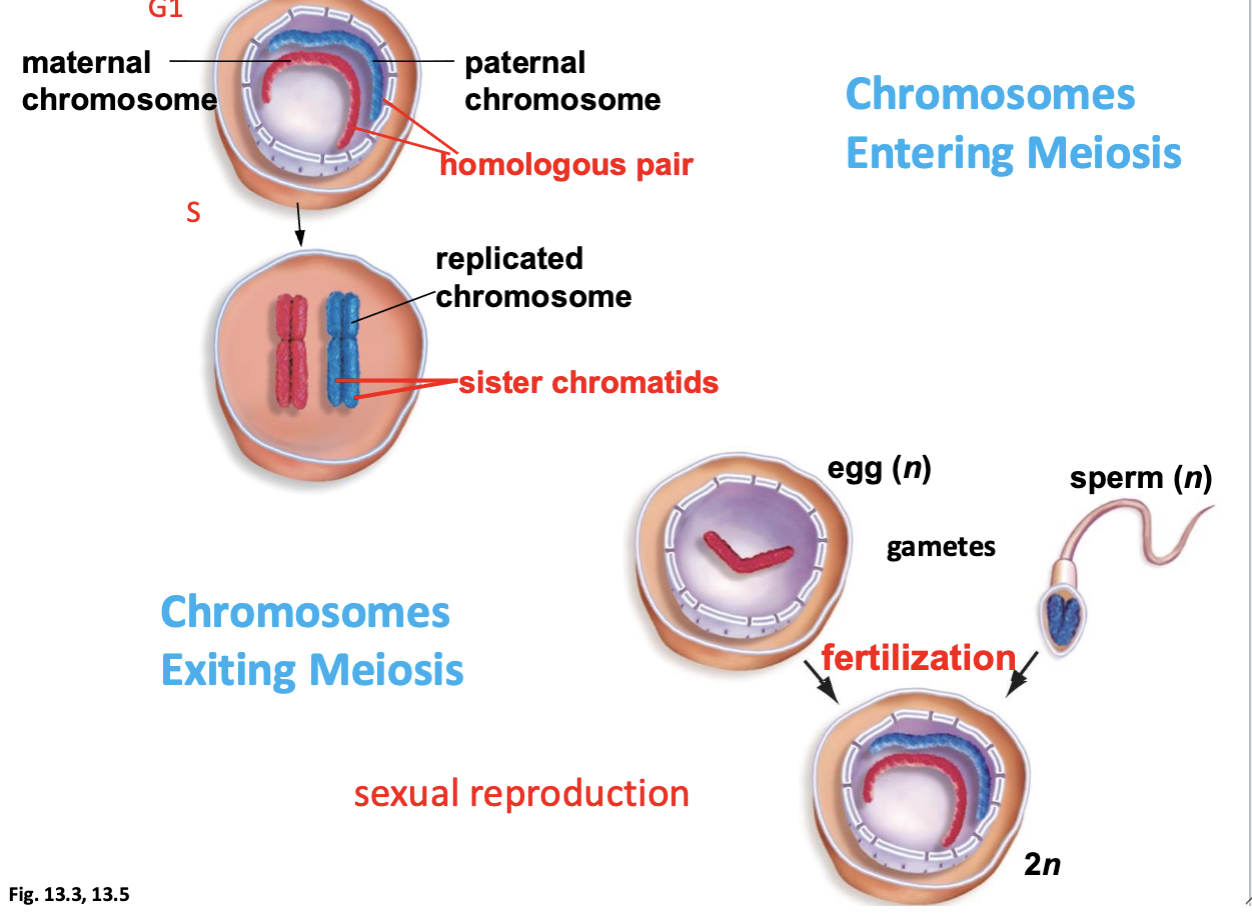
BIG PICTURE 4) Fertilization
gametes fuse together & achieve 2n diploid cell that can undergo mitotic division
& maintain diploid state!
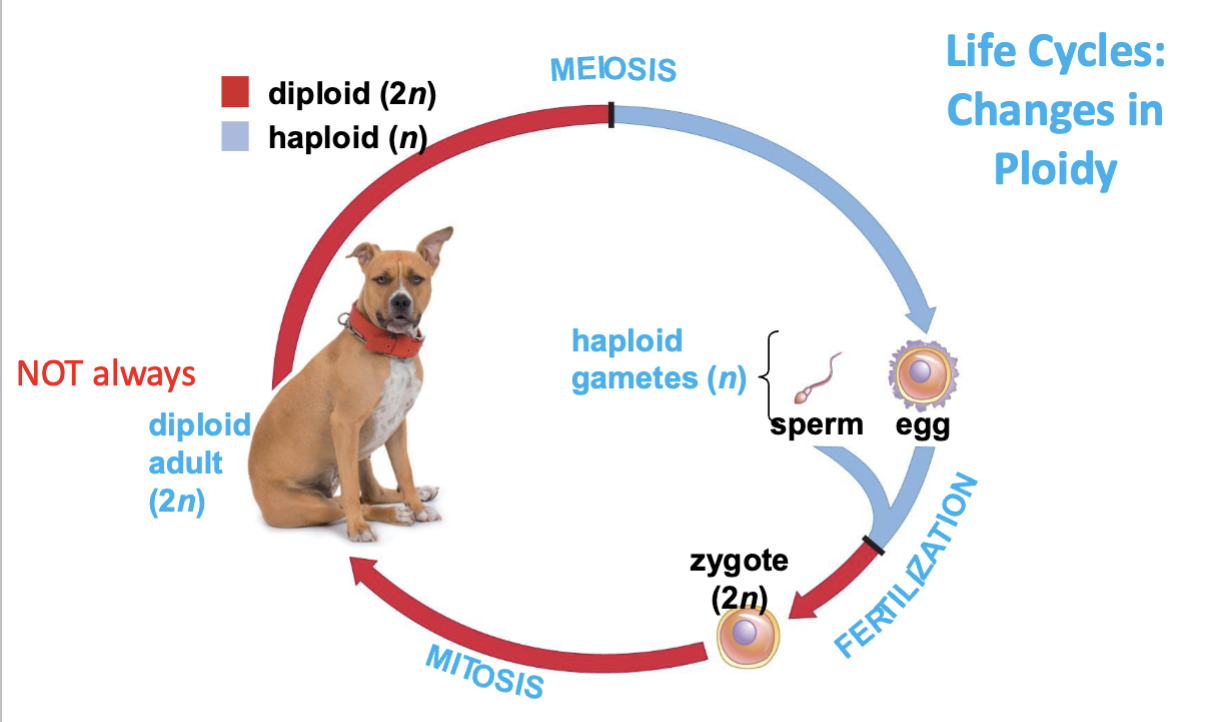
Life Cycles: Changes in Ploidy - Start off with…
start with haploid gametes (n)
start out as potential future organisms in context of sperm from father & egg from mother
undergo fertilization (fuse)
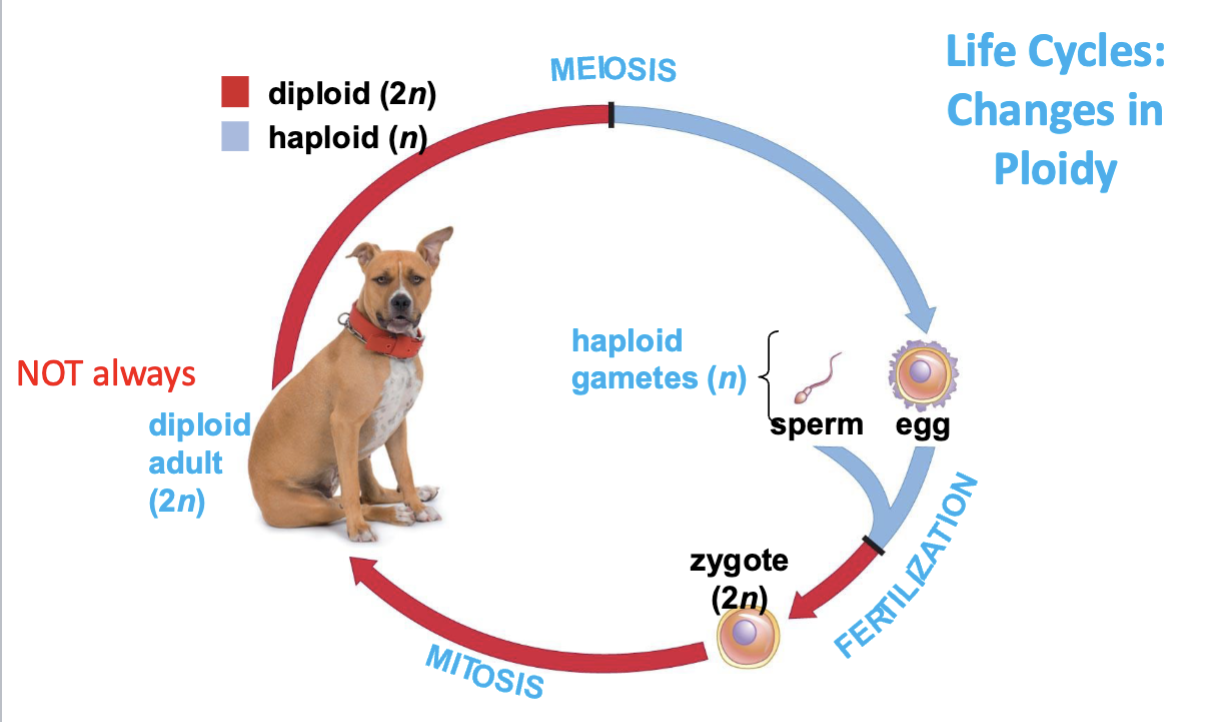
Life Cycle: Changes in Ploidy - After fertilization…
zygote (2n) diploid cells produced
goes through millions of mitotic divisions → diploid adult (2n) reached
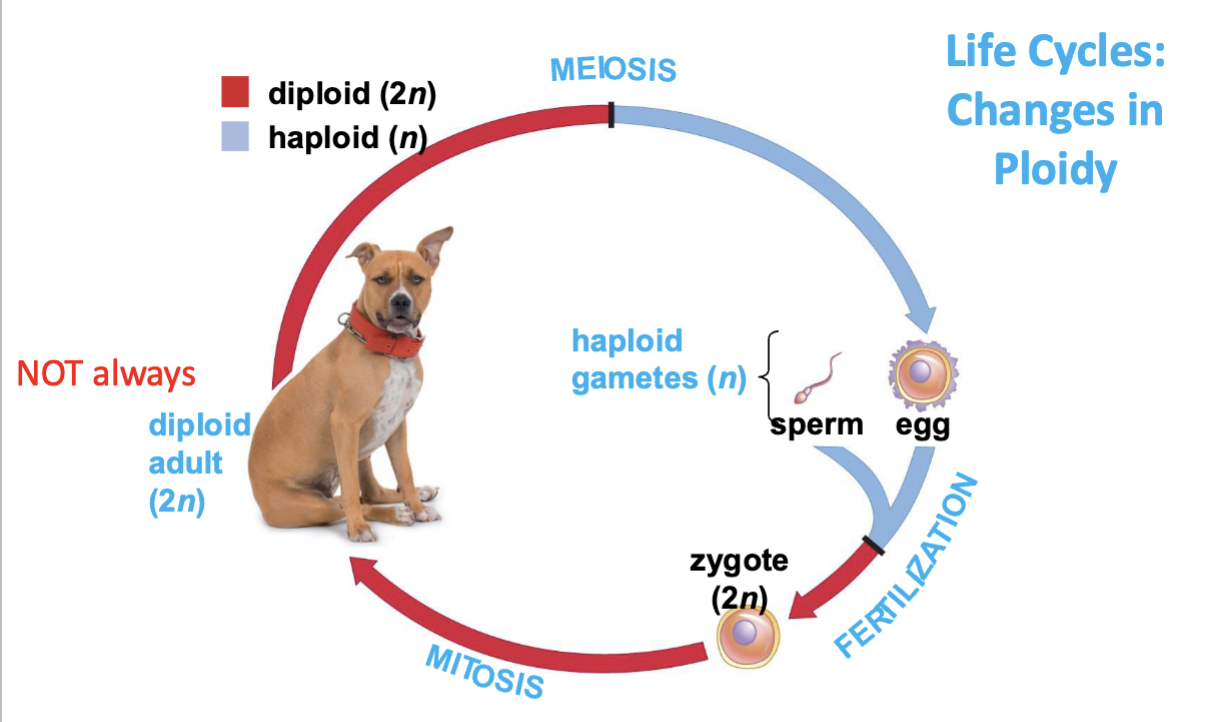
Life Cycle: Changes in Ploidy - Once Diploid adult is reached
undergoes mitosis
sexual maturity occurs to where reproductive cells/organs go through meiosis!
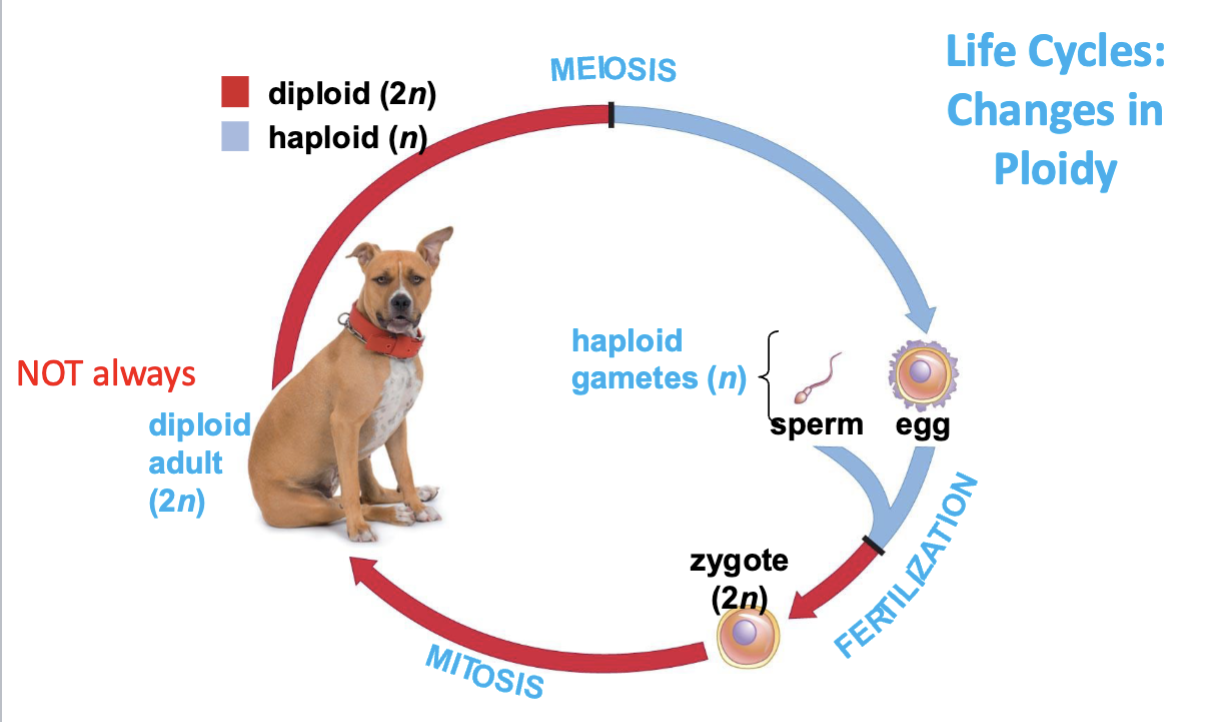
Life Cycle: Changes in Ploidy - After sexual maturity
meiosis occurs to achieve haploid gametes (n)!
cycle begins again
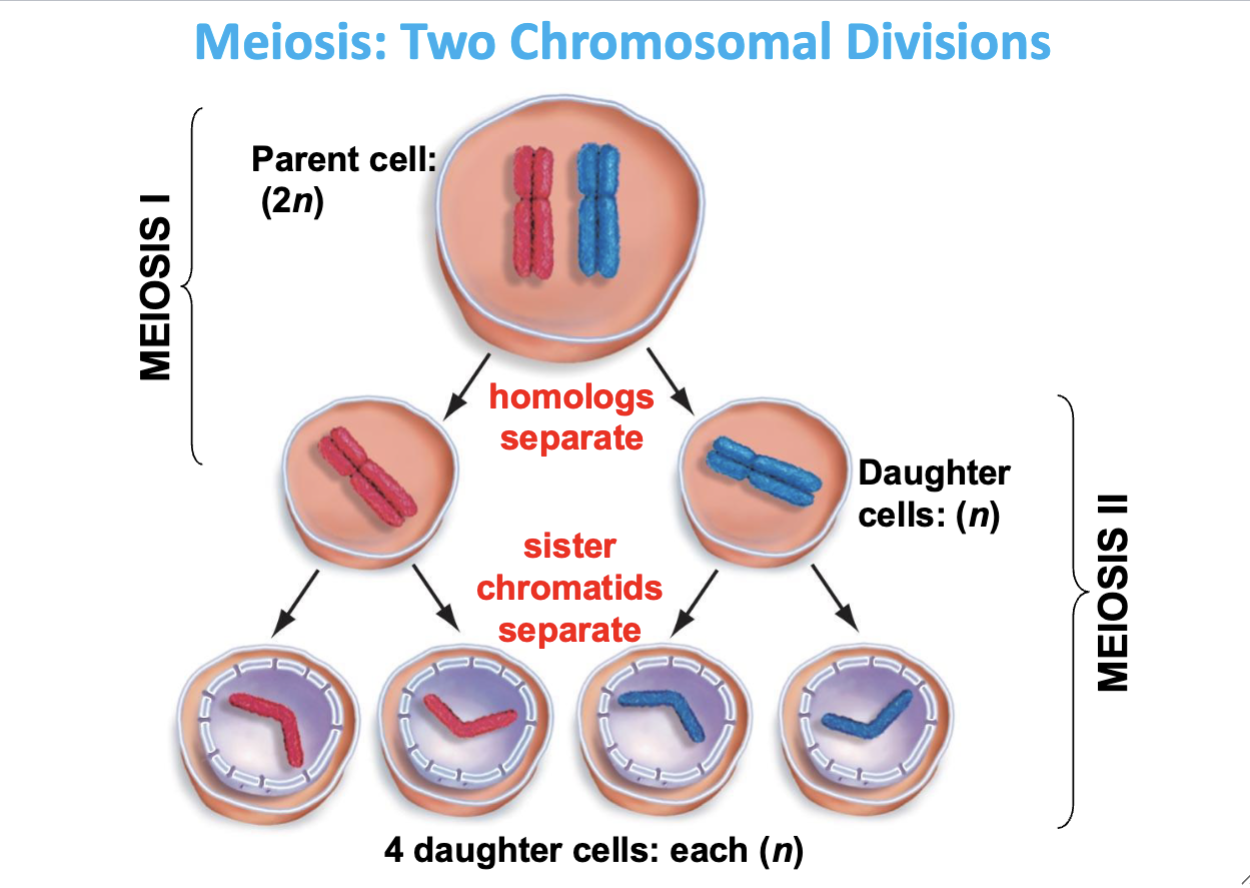
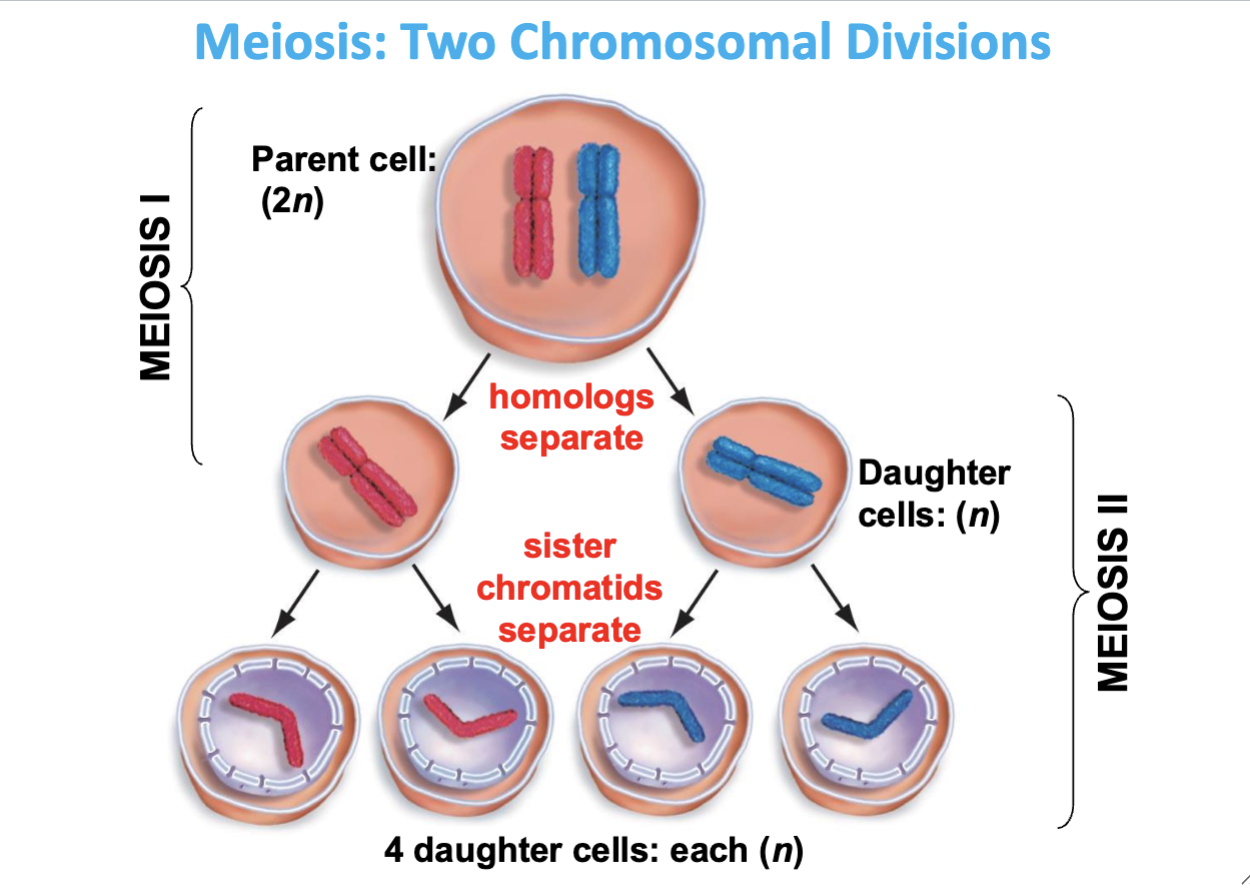
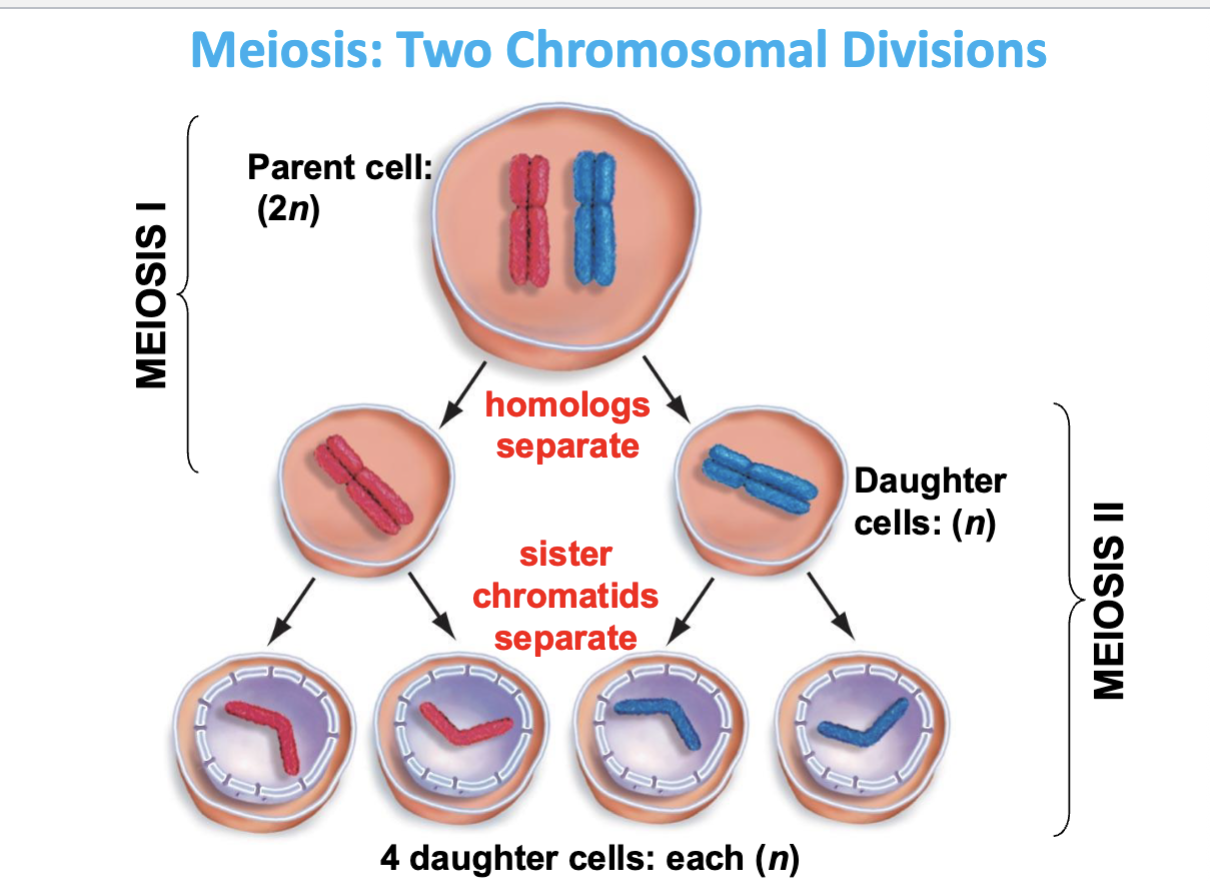
Meiosis: Two Chromosomal Divisions - Meiosis I
Parent cell (2n) has sister chromatids from mom, sister chromatids from dad, has undergone replication of chromosomes
In meiosis 1 homologous pairs separate!
→ still 1 chromosome in each daughter cell
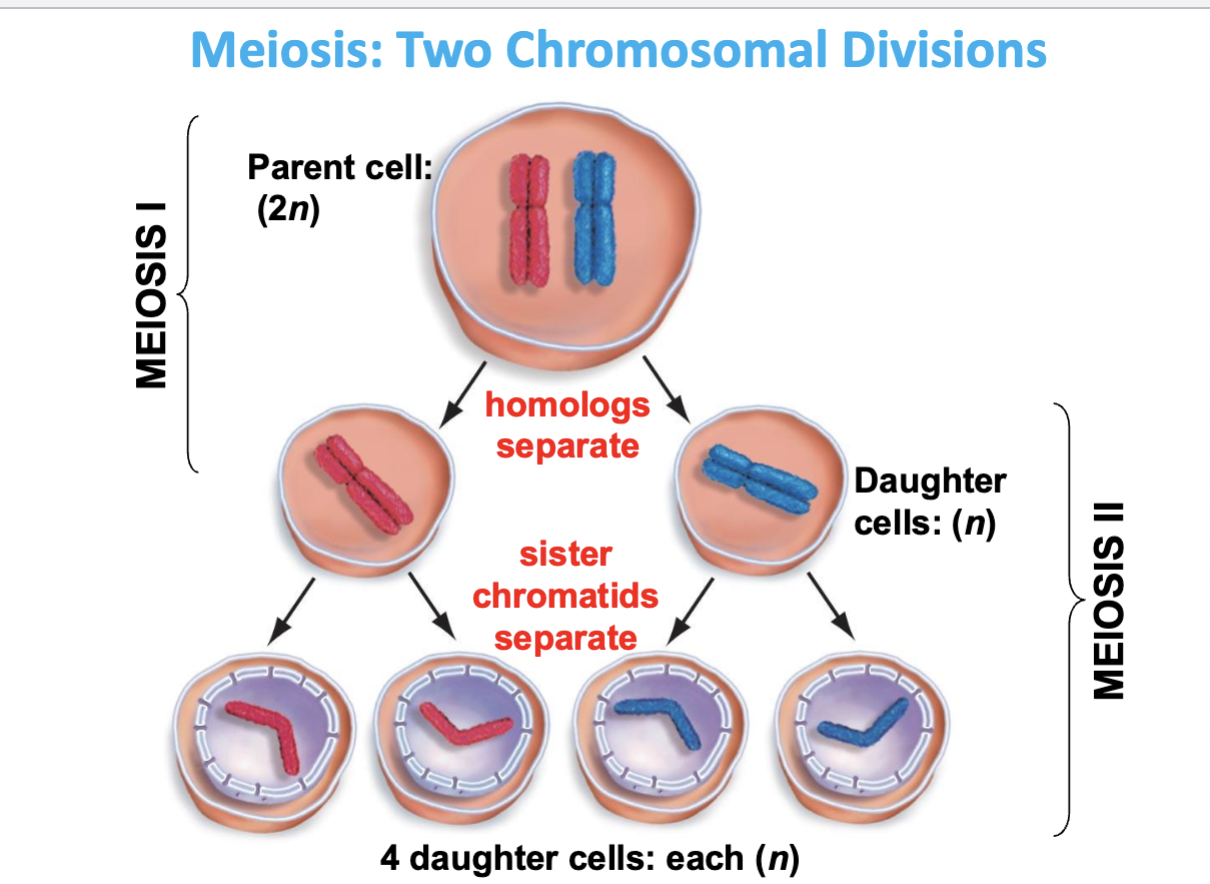
Meiosis: Two Chromosomal Divisions - Mitosis II
In meiosis II sister chromatids separate !
4 daughter cells result (each n)
still haploid but have HALF DNA of parent cell
each haploid cells end up w/SINGLE copy of DNA → gametes !
Summary of sexual reproduction (human wise)
Sexual reproduction uses meiosis to make haploid gametes (23 chromosomes), fertilization restores diploid number (46), and mitosis grows the organism from the zygote while meiosis in adults creates genetically unique gametes for the next generation.
Before replication
Chromosomes: 2n
DNA: normal
After replication (before Meiosis I)
Chromosomes: 2n (still the same number — just duplicated)
DNA: double
After Meiosis I
Chromosomes: n
DNA: original amount
After Meiosis II
Chromosomes: n
DNA: half of original amount
Meiosis I: What is produced by interphase prior to entering Meiosis?
have germinal cells of individual species → give rise to gametes
have undergone replication
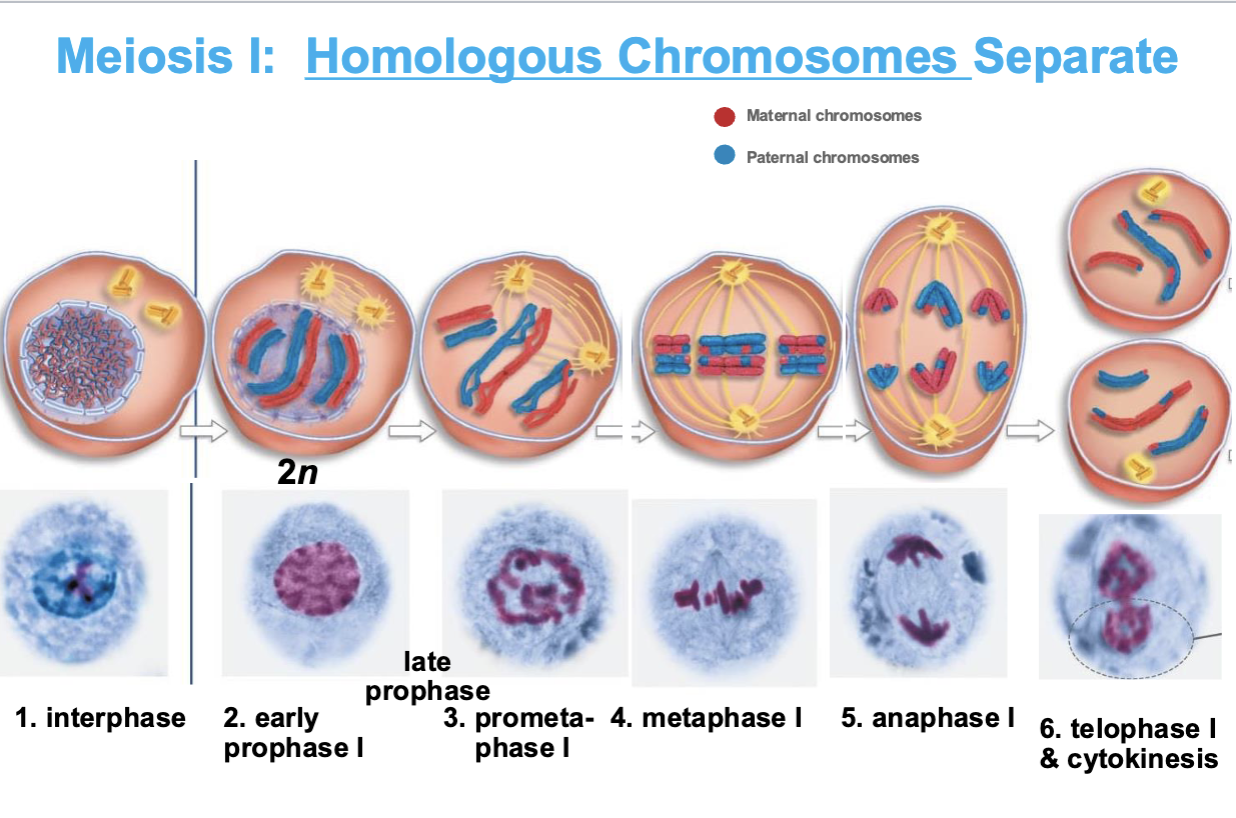
Meiosis I: What is in early prophase I?
have double amount of DNA
2n = 6 chromosomes (in this case)
3 pairs of homologous chromosomes
chromosomes condense & spindle apparatus forms, nuclear envelope beings to break down & synapsis (paring) of homologous chromosomes
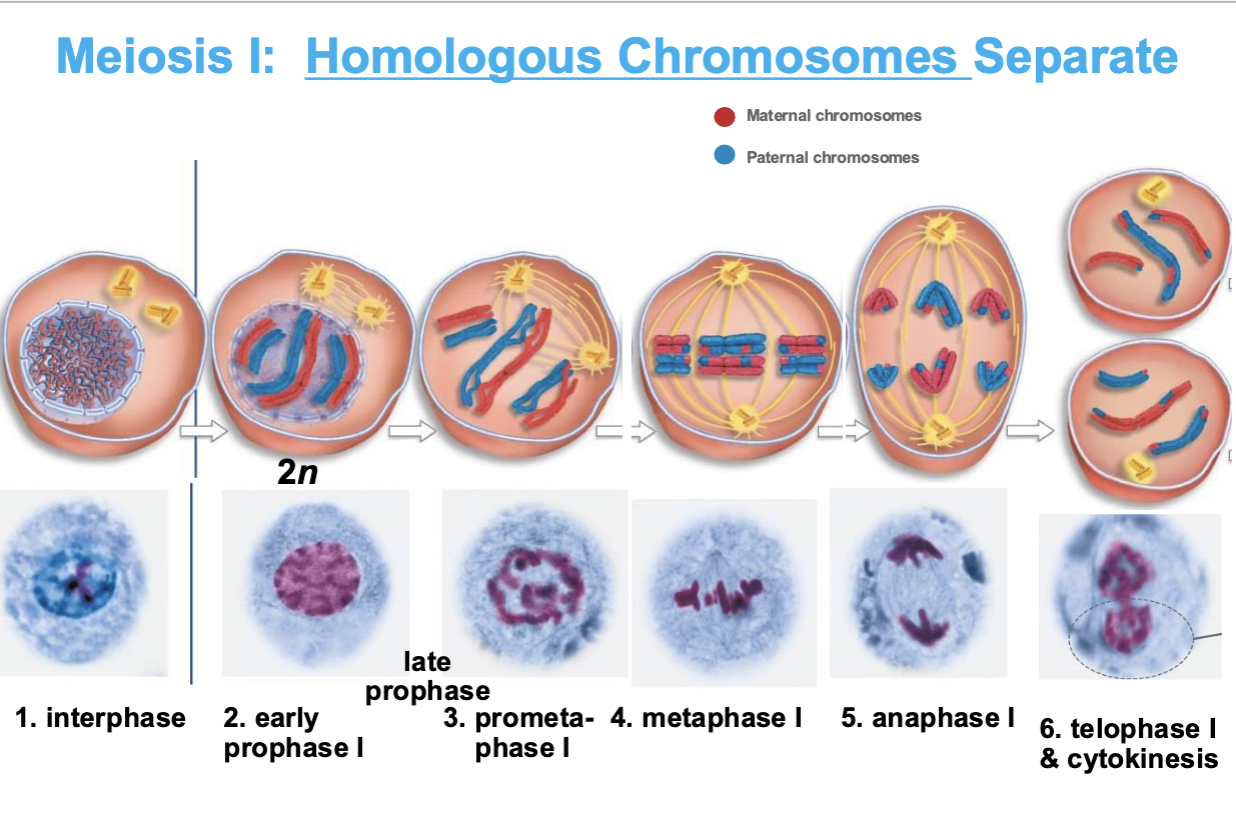
Meiosis I: What happens in late prophase I/prometaphase I?
Chiasmata (cross over points) visible → formed by nonsister chromatids
nuclear envelope broken down
spindles associate with PAIRS of homologous chromosomes
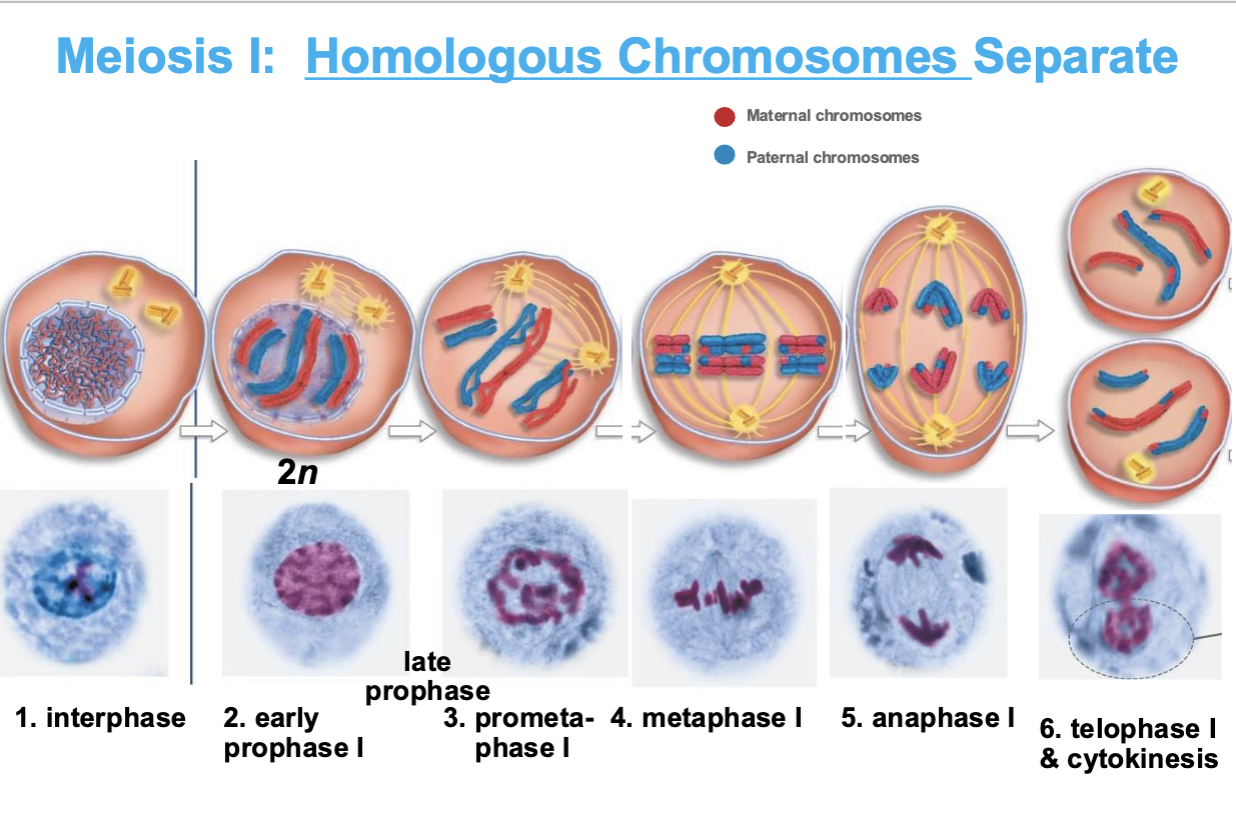
Meiosis I: What happens in metaphase I?
pairs of homologous chromosomes aligned @ plate (not sister chromatids like in meiosis)
cross over has occurred! → pieces of homologous pairs of chromosomes from maternal & paternal, mixing, increases variability
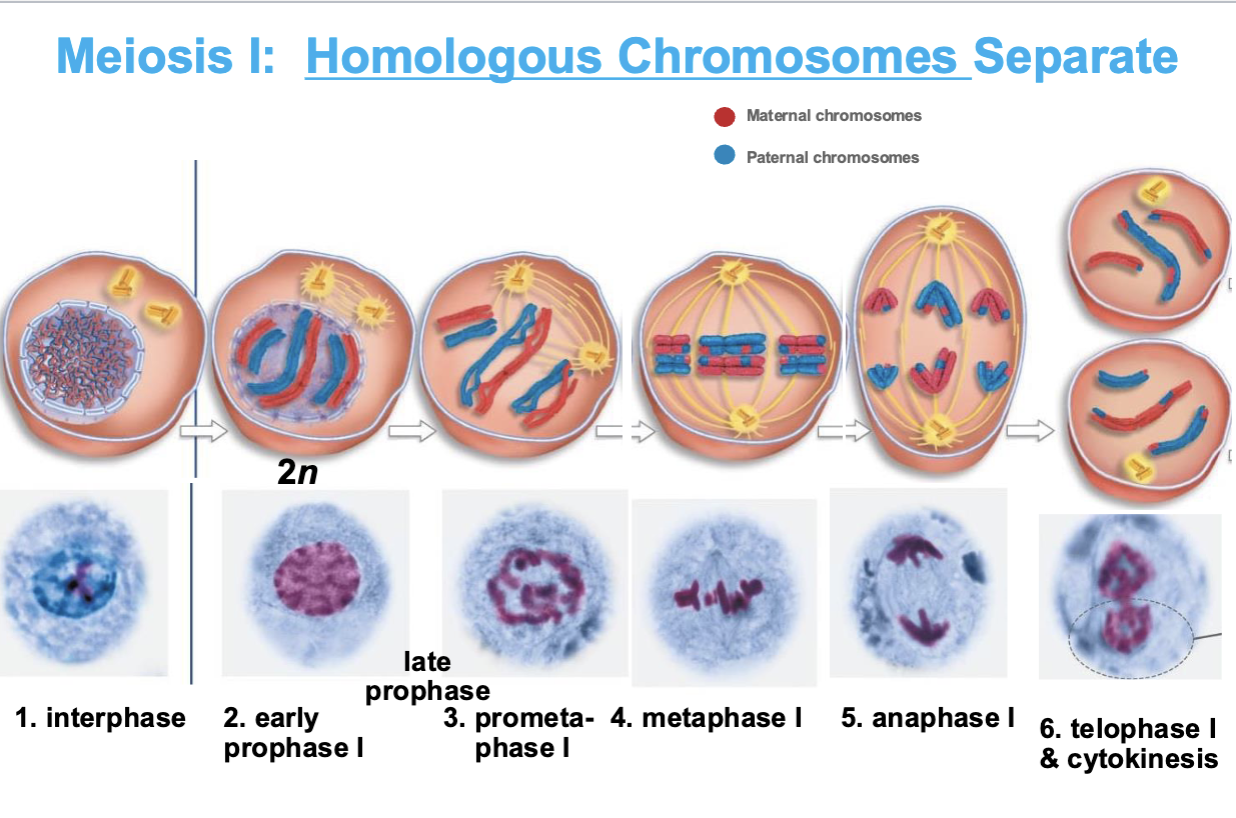
Meiosis I: What happens in anaphase I?
pairs of homologous chromosomes oulled apart & move to opposite poles of spindle apparatus
Chiasma broken, centromere cohesins intact
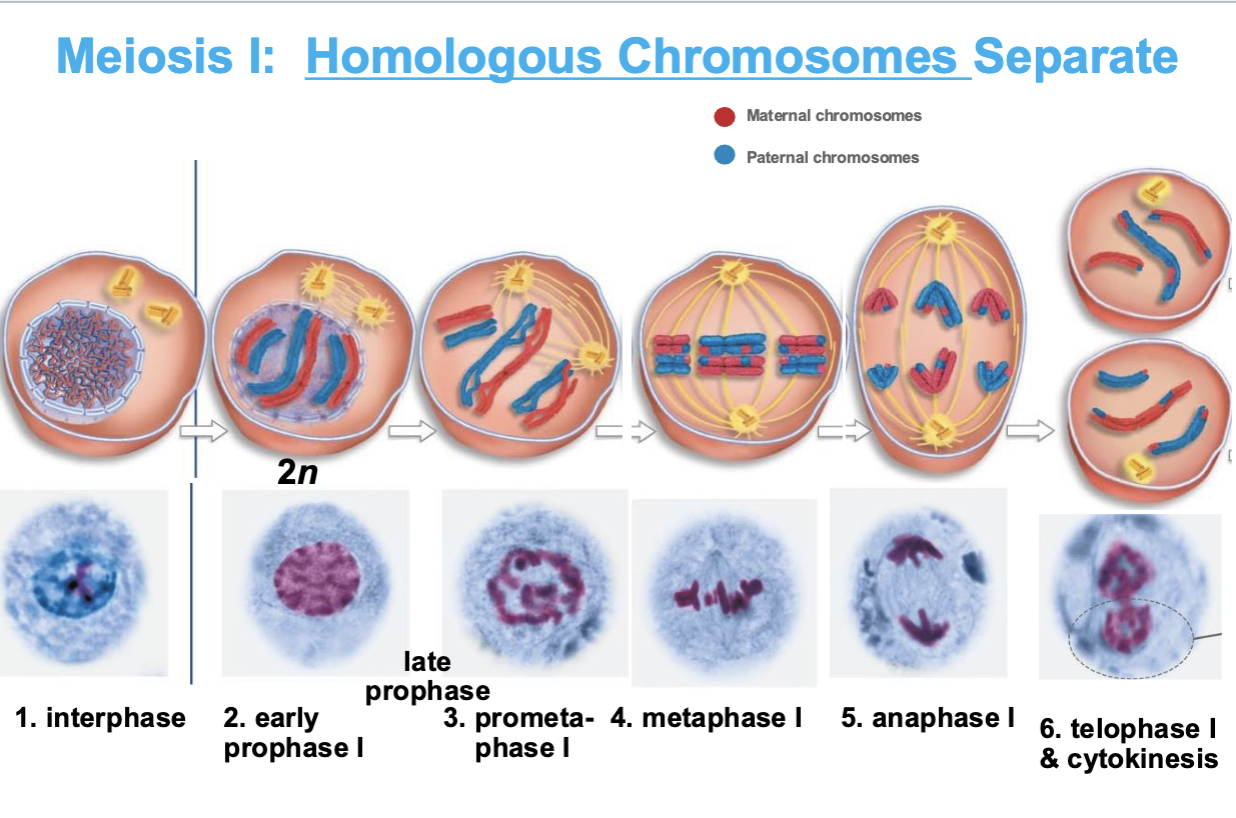
Meiosis I: What happens in telophase I & cytokinesis?
Homologs are at opposite poles, spindle apparatus disassembles
Cell divides, chromosomes # reduced
each daughter cell has double # of nucleic acid than it will as a gamete (still as sister chromatids) → unique chromosome as pair of sister chromatids (HAPLOID CELLS)
“normal” amount of DNA
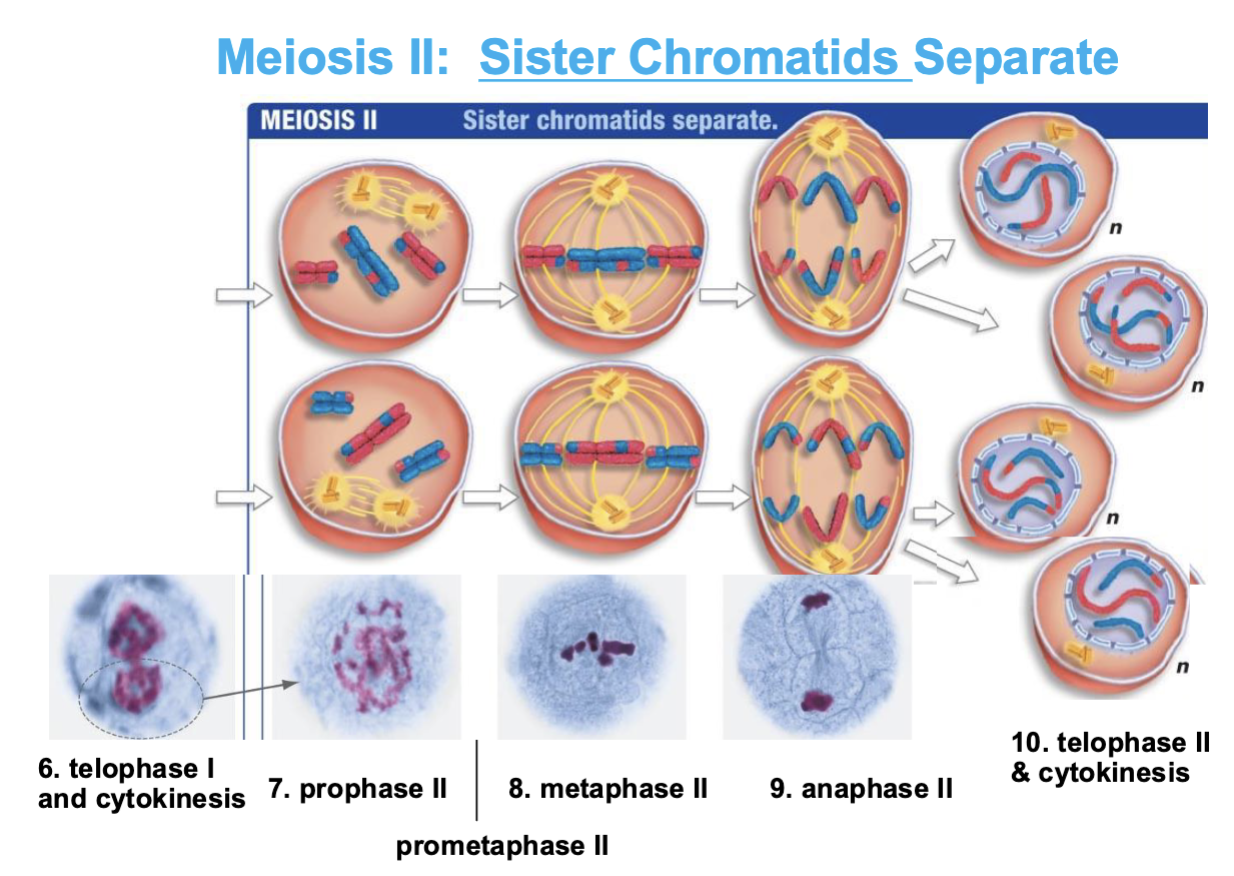
Meiosis II: What happens in Prophase II?
cells enter as HAPLOID cells → chromosomes have sister chromatids
spindle aparatus reforms
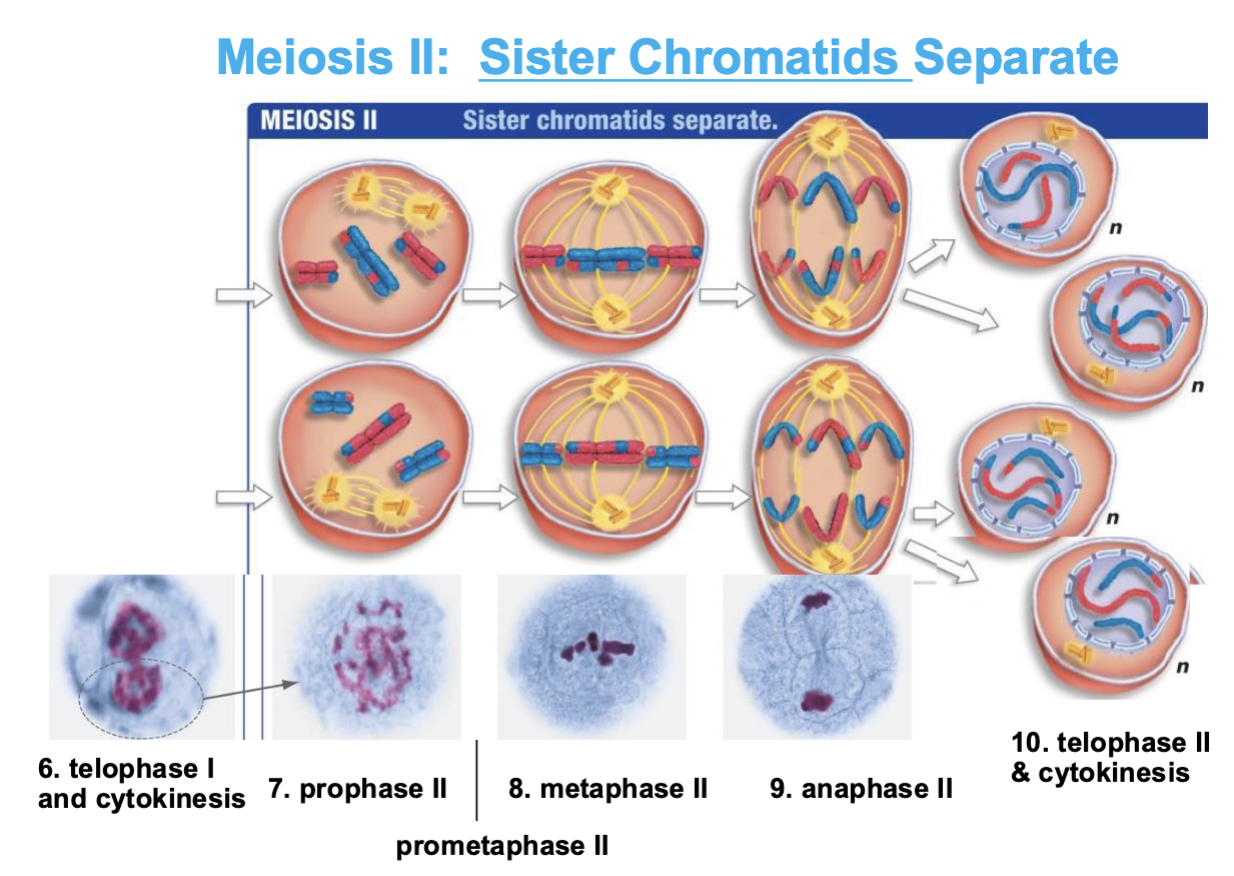
Meiosis II: What happens in prometphase II/ metaphase II?
microtubules bind to sister chromatids
sister chromatids align @ metaphase plate
Meiosis II: What happens in anaphase II?
sister chromatids pulled apart!! move to opposite poles of spindle apparatus
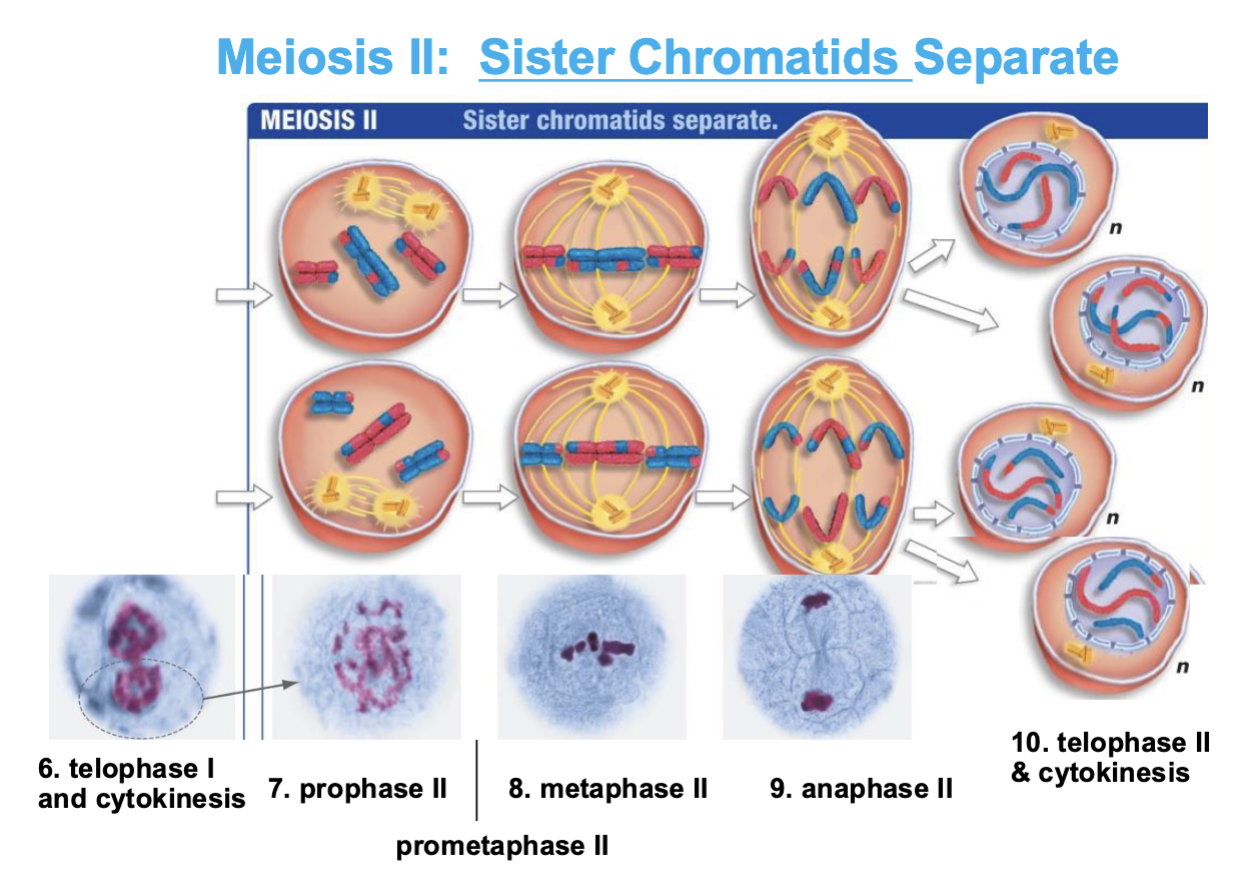
Meiosis II: What happens in telophase II & cytokinesis?
Daughter chromosomes are at opposite poles, spindle apparatus disassembles
Cell divides, chromosome # unchanged
end up w/4 gametes → each has single chromatid of single chromosomes → all 1n
Meiosis leads to genetic variation through…
Crossing Over
Random Alignment of homologs
Genetic variation 1st: Crossing Over - Condensation
2 chromosomes as homologous pair of chromosomes condense
→ sister chromatids present held together by cohesin proteins
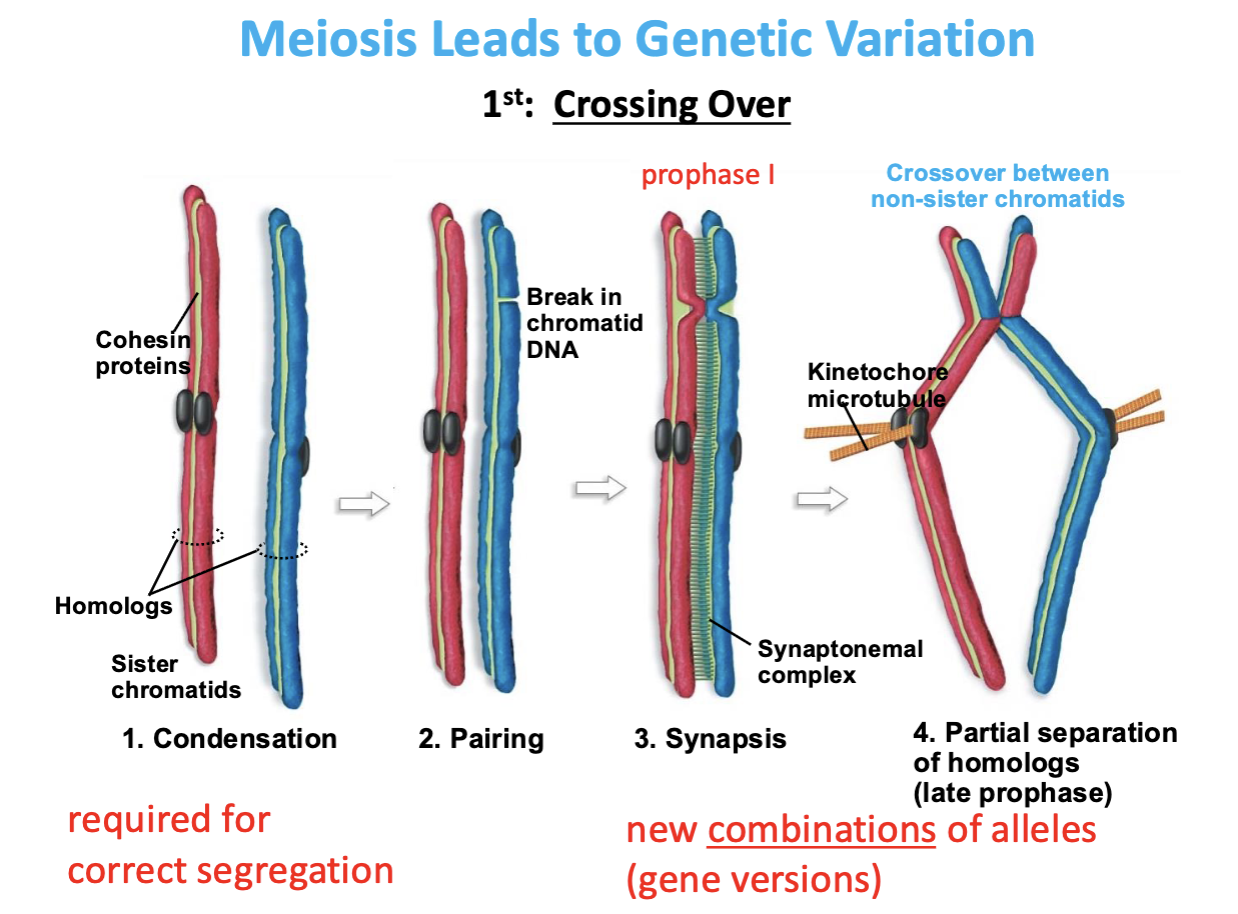
Genetic variation 1st: Crossing Over - Pairing
break in chromatid DNA
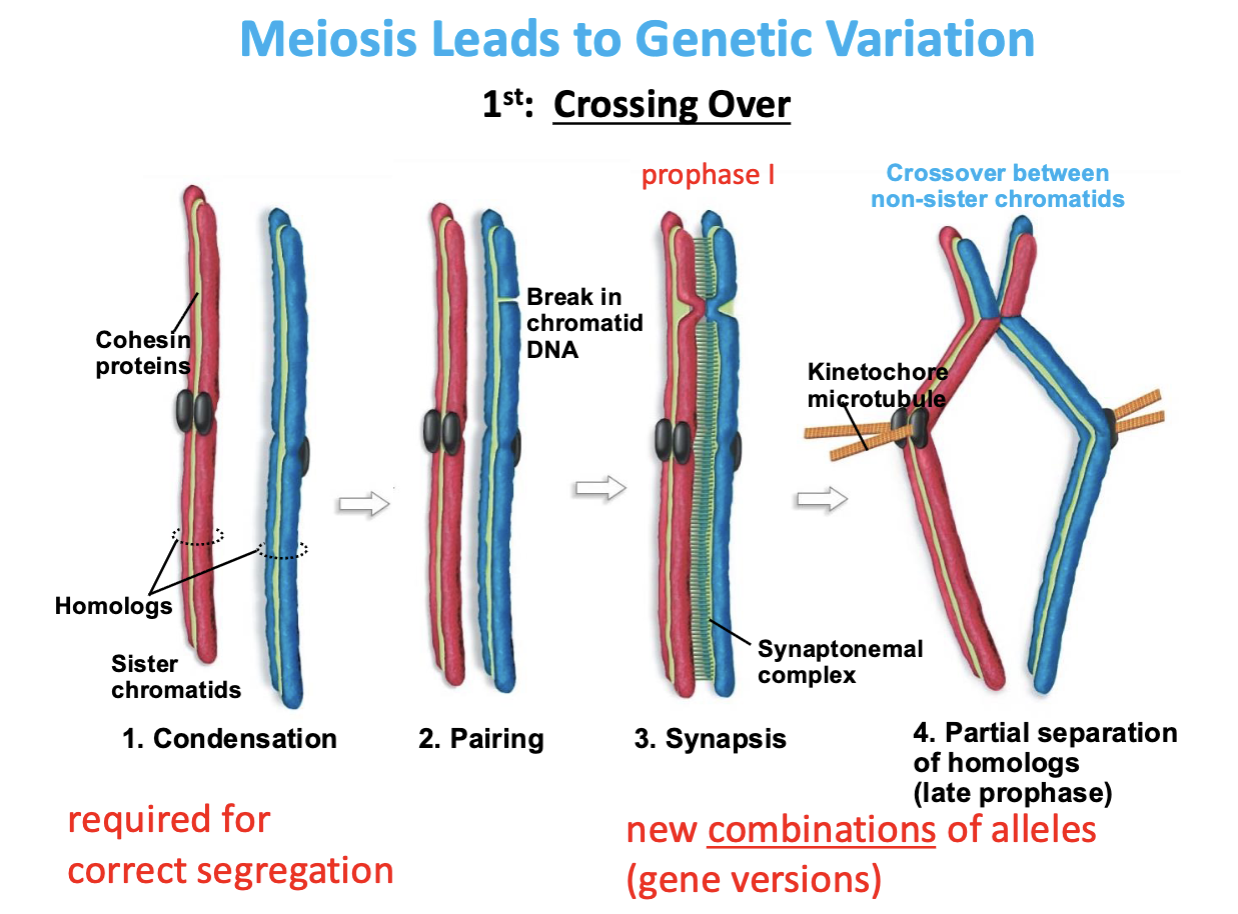
Genetic variation 1st: Crossing Over - Synapsis
pairing of nonsister chromatids → synaptonemal complex
prophase I
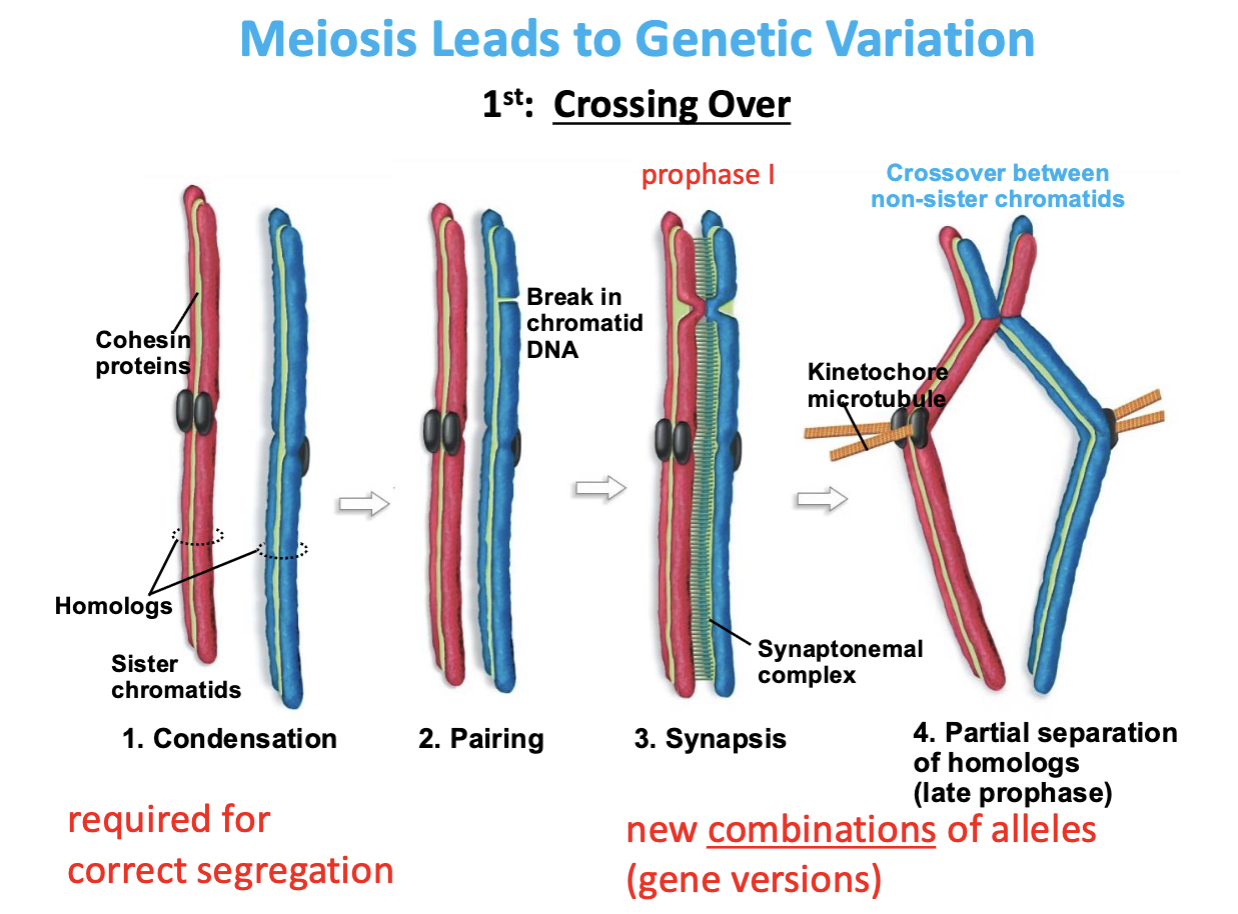
Genetic variation 1st: Crossing Over - Partial Separation of homologs
late prophase
crossover between non-sister chromatids → swap pieces of DNA
Meiosis: Crossing over is…
required for correct segregation
important for new combinations of alleles (gene versions)
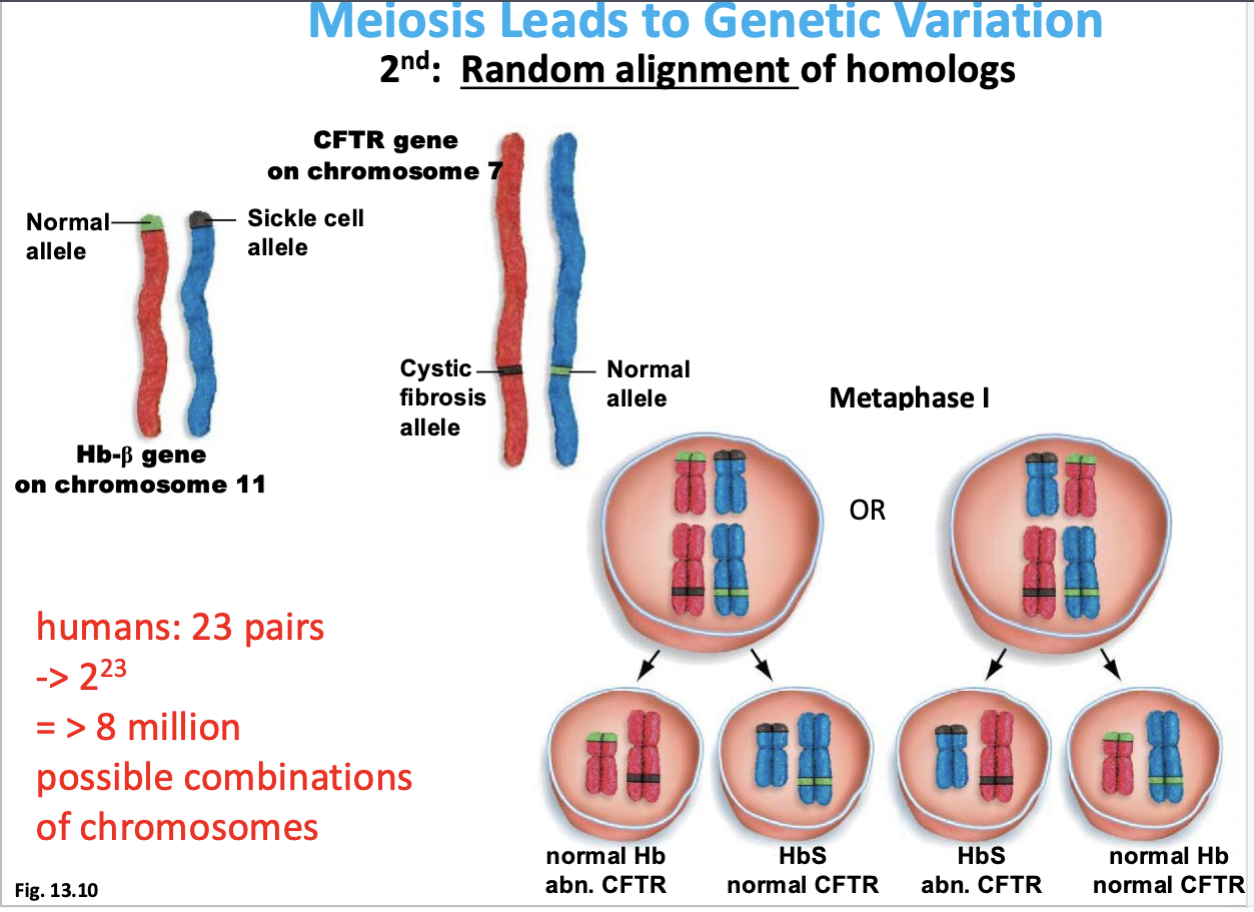
Genetic Variation: 2nd) Random Alignment of homologs
based on how homologous chromosomes align along metaphase plate
either only maternal or only paternal (in this case) or swapped → different combinations of chromosomes
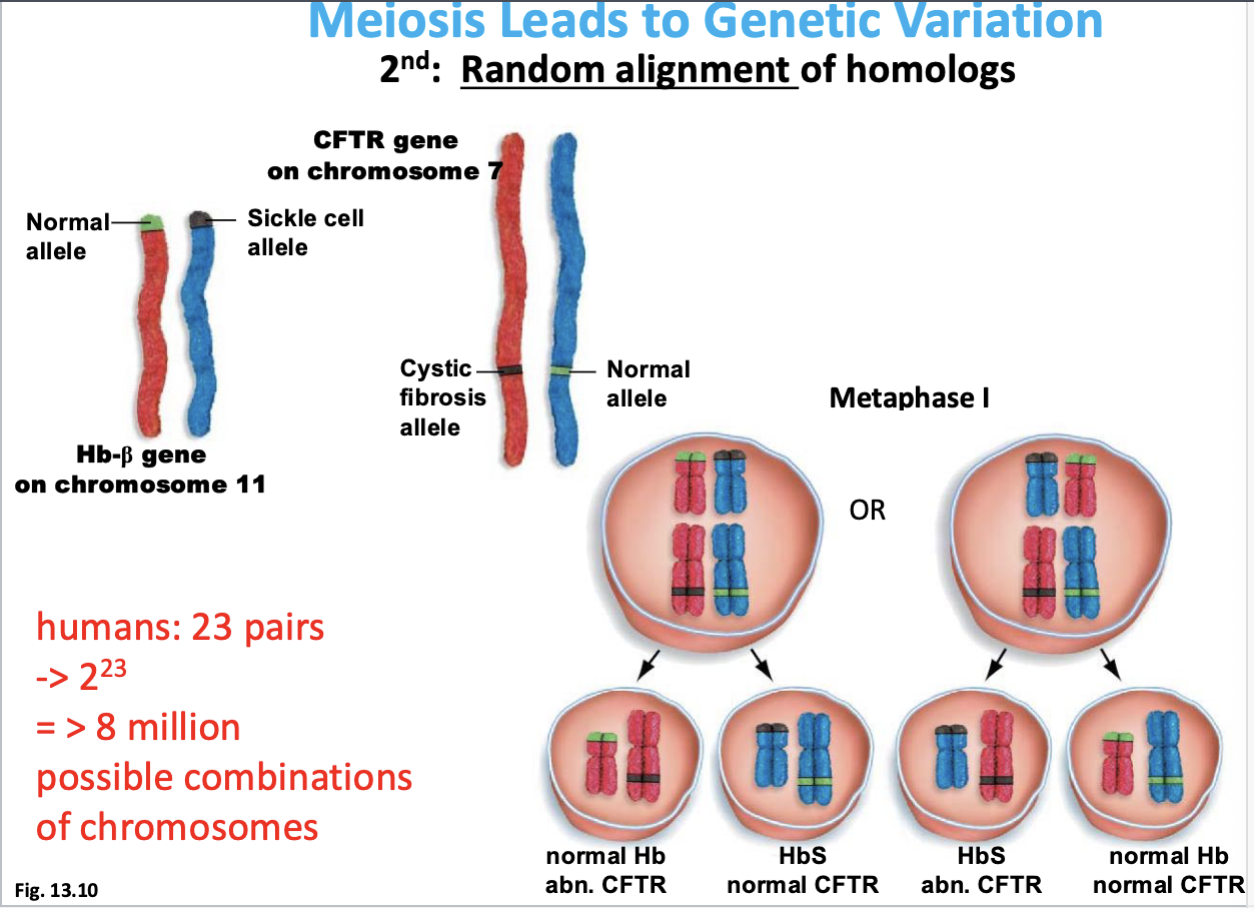
Random Alignment of homologs - Humans have 23 pairs
223
→ 8 million possible combinations of chromosomes
What is independent assortment?
Random alignment of homologous chromosomes in metaphase I.
What does independent assortment create variation in?
Different combinations of chromosomes.
What is crossing over?
Exchange of DNA between homologous chromosomes in Prophase I.
What does crossing over create variation in?
Genetic variation within chromosomes. (different alleles)
Formula for chromosome combinations from independent assortment?
2n
How are chromosomes arranged in mitosis metaphase?
Single chromosomes line up individually.
How are chromosomes arranged in meiosis I metaphase?
Homologous pairs line up together.
Key difference between meiosis I and mitosis?
Meiosis I separates homologs; mitosis separates sister chromatids.
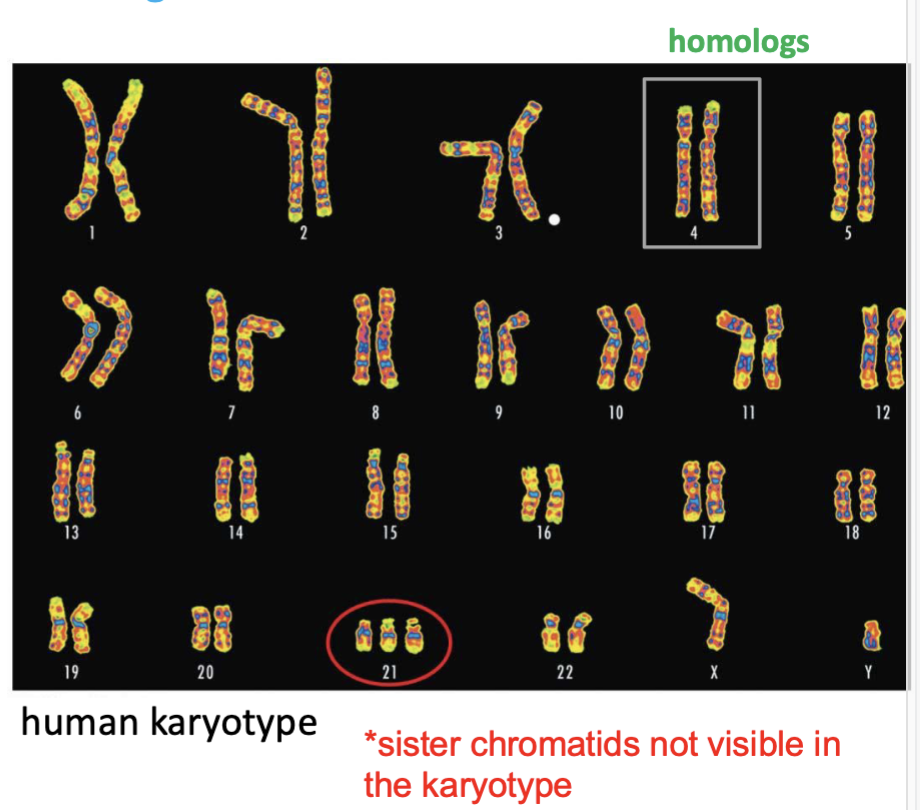
What does a karyotype show?
Number, size, shape, and arrangement of chromosomes.
sister chromatids not visible in karyotype
What is aneuploidy?
Abnormal number of individual chromosomes
Mistakes in Meiosis: Change in Chromosomes Number - Trisomy
example of aneuploidy
Trisomy 21 = down syndrome (in humans)
If cell went through interphase, the # of total individual chromatids present in the cell this karyotype was taken from is equal to?
94! (or # total DNA pieces present)
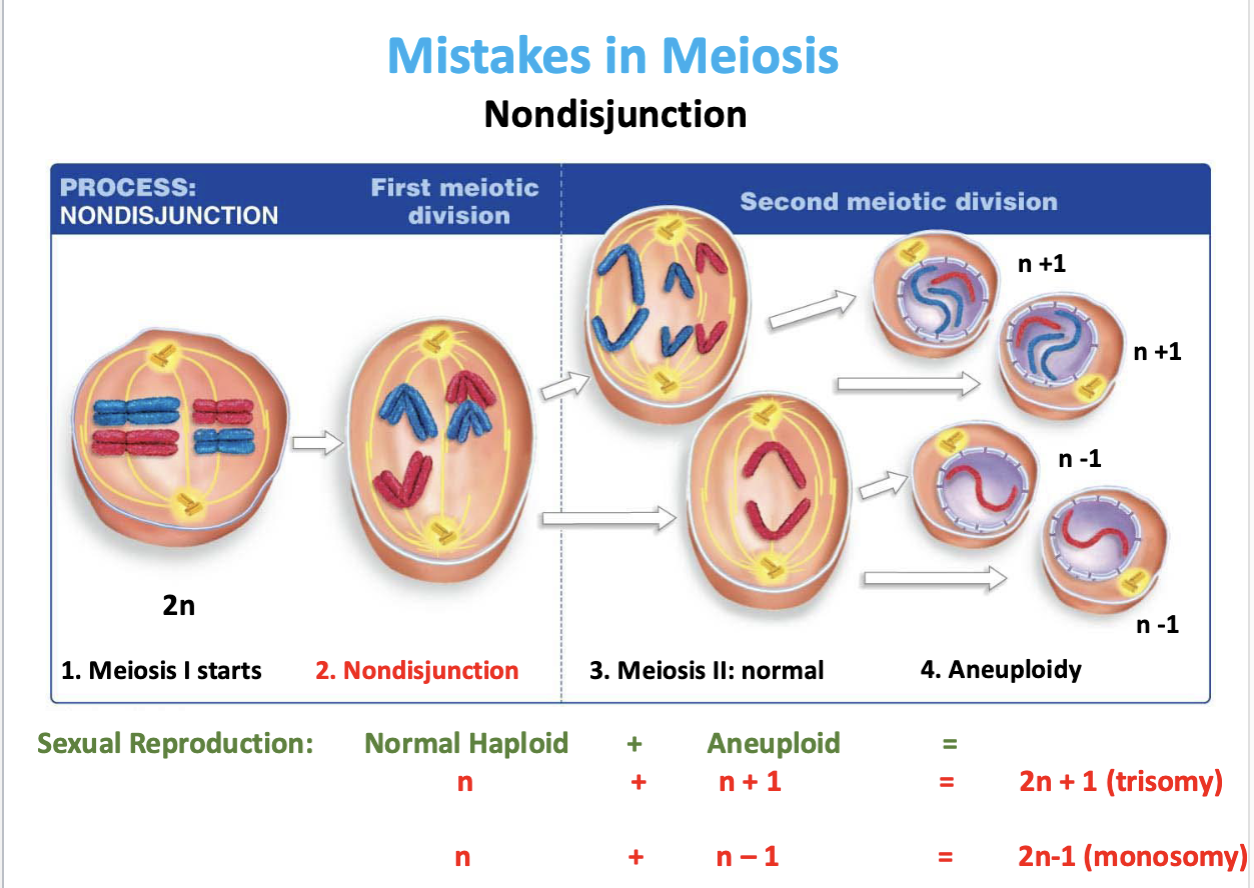
Mistakes in Meiosis: Nondisjunction
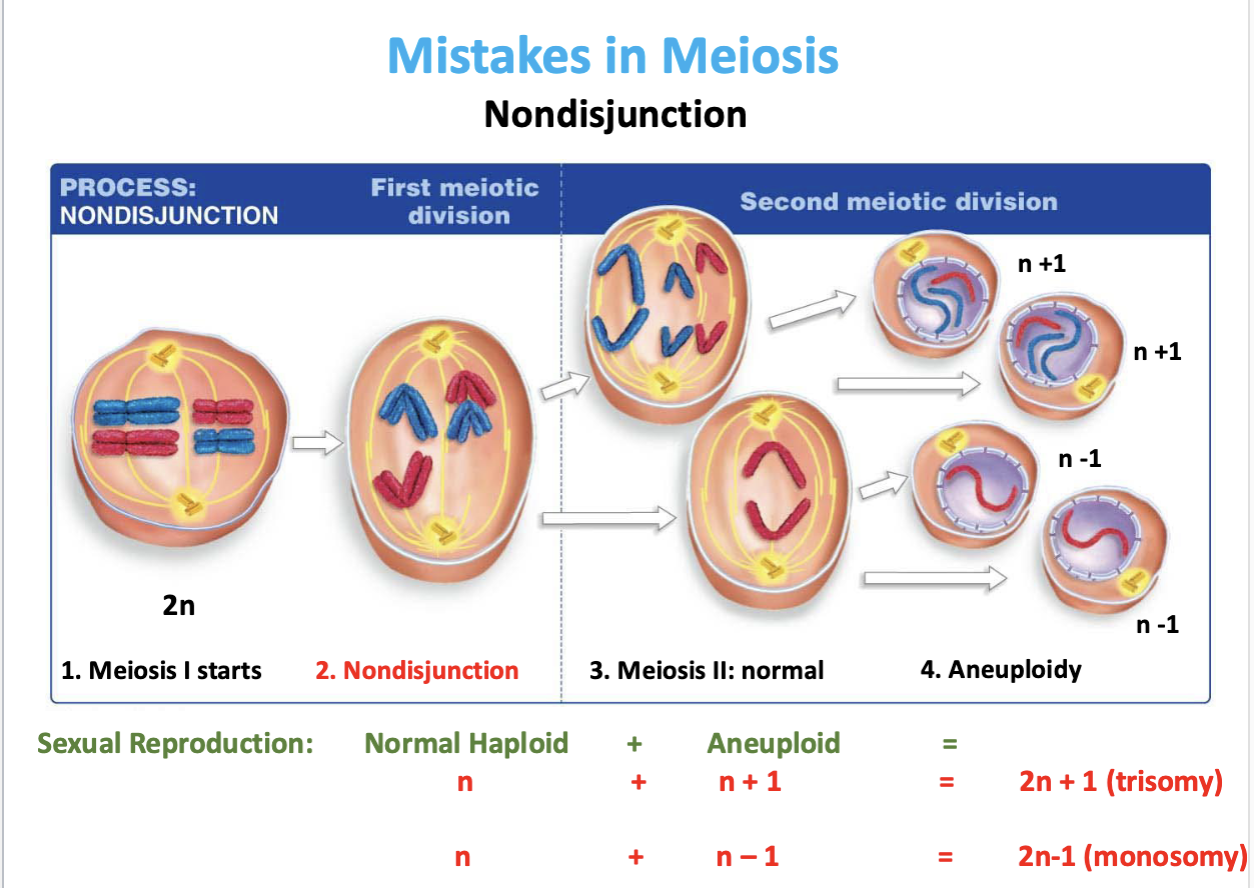
Failure of homologous chromosomes to separate properly.
microtubules pull innappropiate # oh homologs
results in aneuploidy
When can nondisjunction occur?
Meiosis I or Meiosis II
Nondisjunction in Meiosis I results in what gametes?
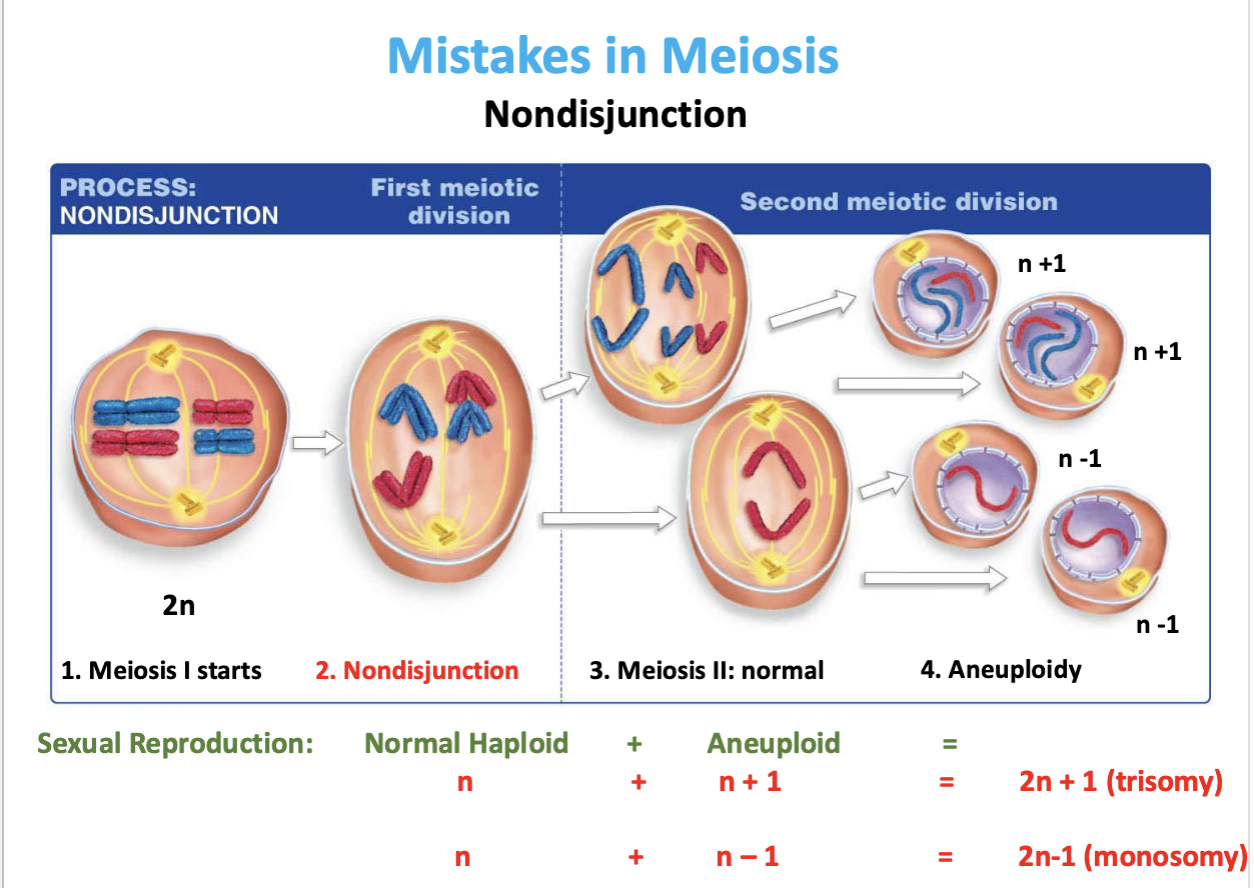
All abnormal (n+1 or n-1)
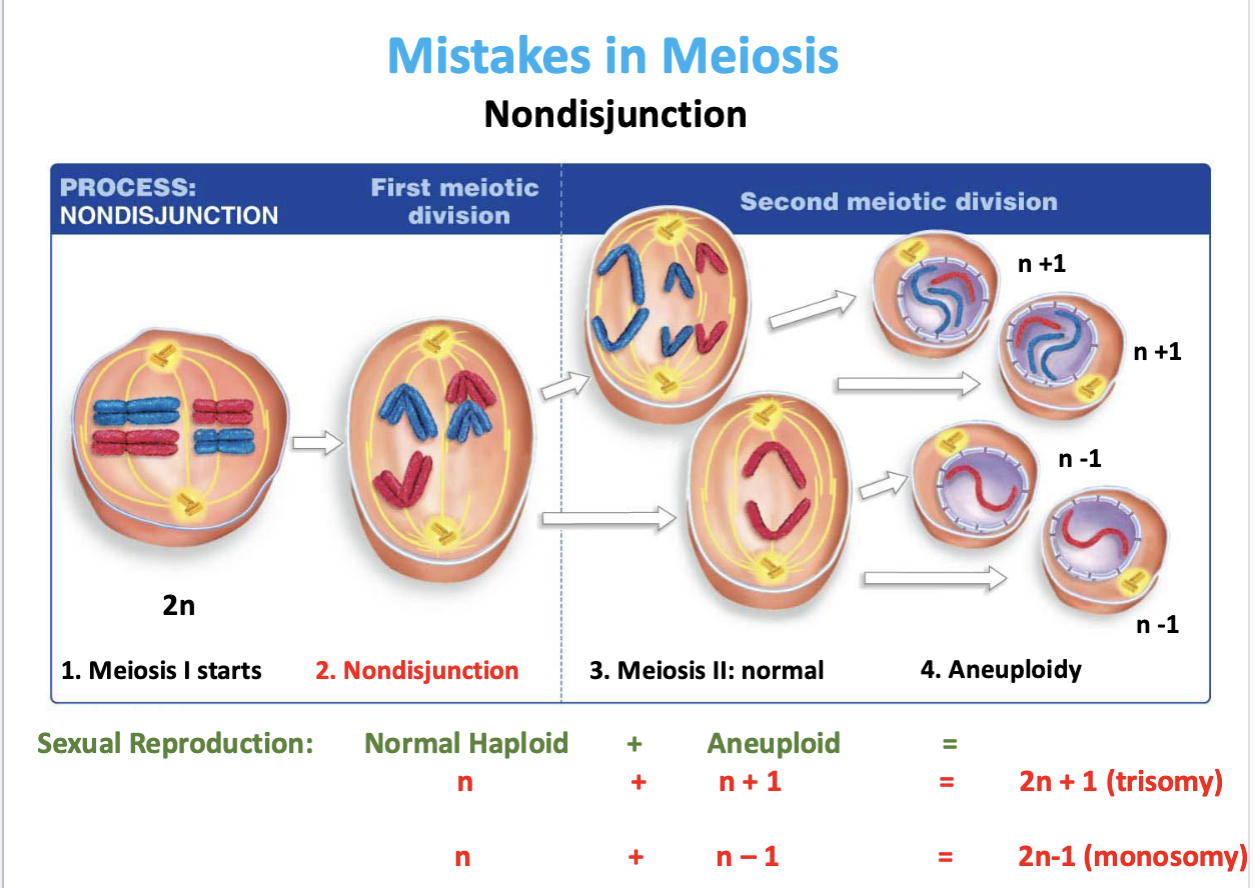
Aneuploid n+1
2n + 1 (trisomy)
many nonproductive
trisomy 21 is rare case of productive
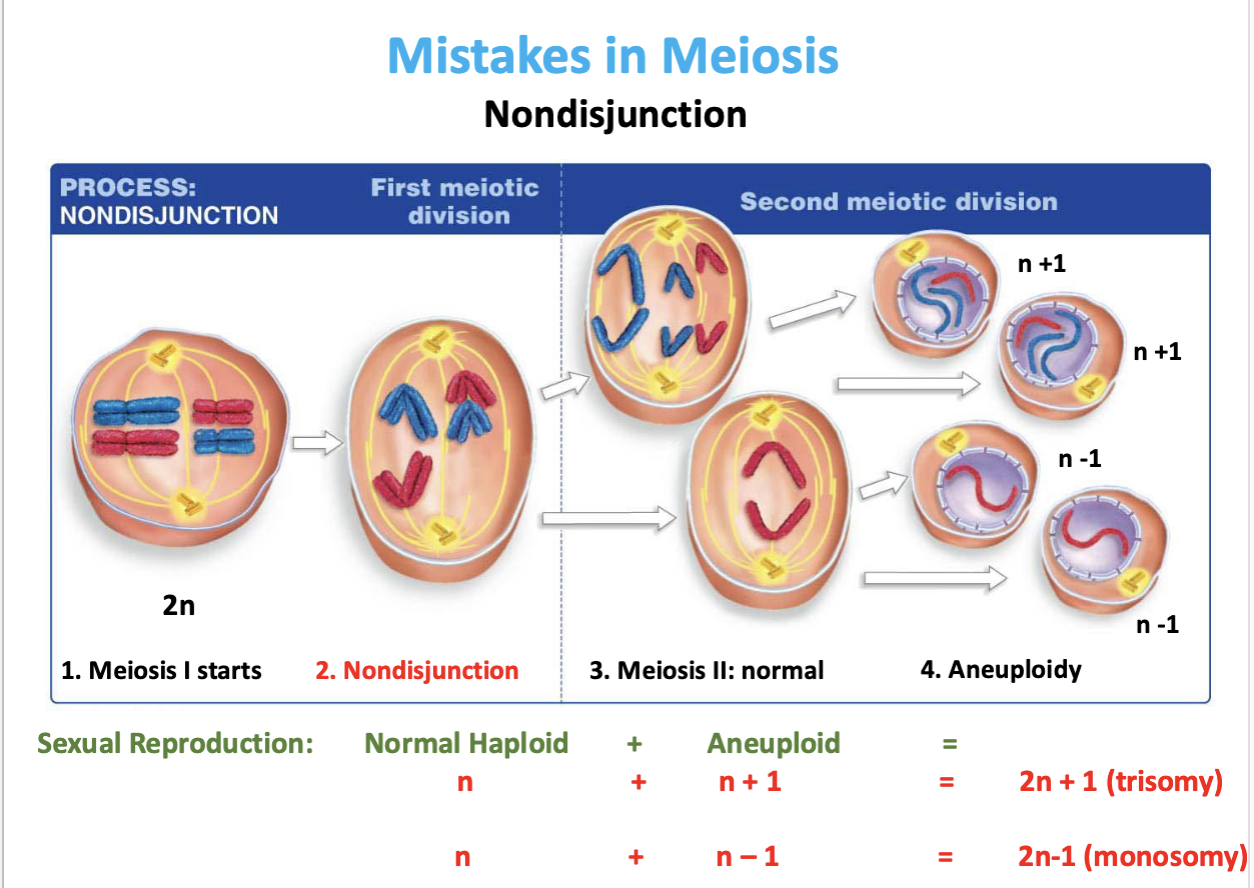
Aneuploid n -1
2n-1
extremely rare
usually nonproductive for non sex chromosomes (only sex chromosomes ok w/1 copy)
What does an unreplicated chromosome look like?
single rod
What does a replicated chromosome look like?
X shaped structure w/two sister chromatids
What does a homologous pair look like?
Two X-shaped chromosomes together. (after replication)
Why is meiosis important for evolution?
It creates genetic diversity in offspring.
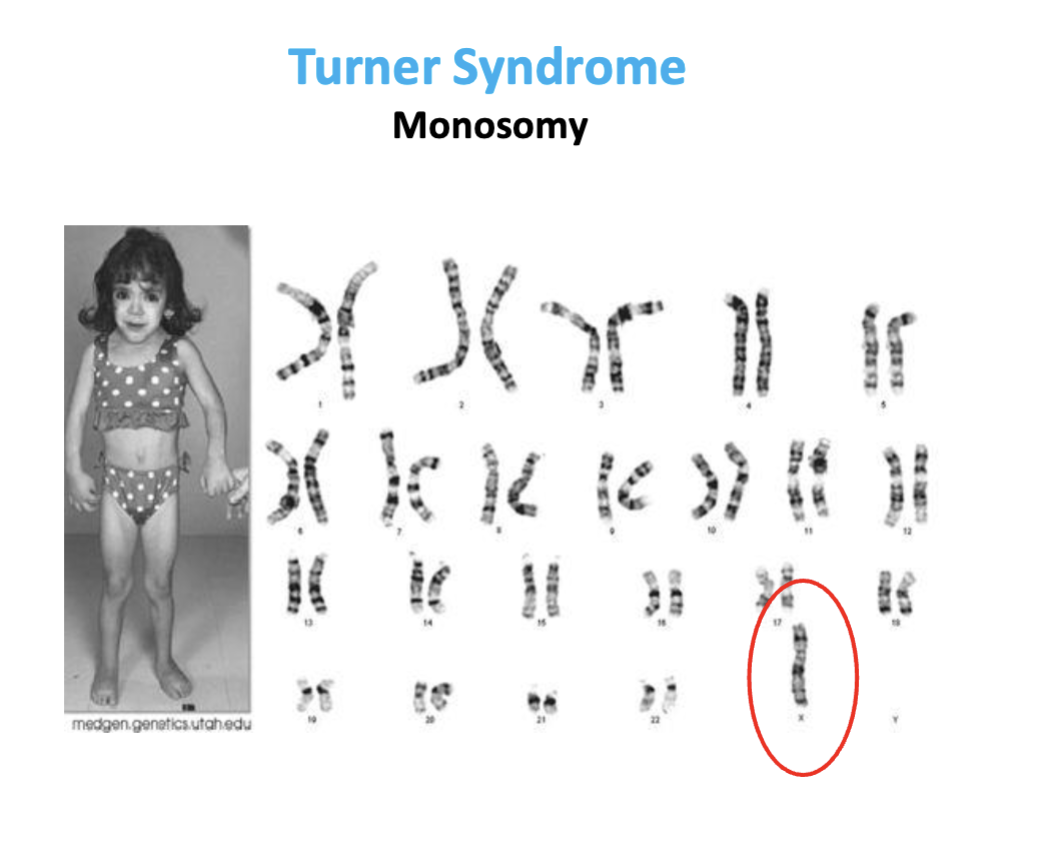
Turner syndrome is an example of
X chromosome monosomy
a genetic condition affecting only females. It occurs when one of the X chromosomes is completely or partially missing
Because embryos with a 45,Y chromosomal makeup are not viable early in development, Turner syndrome only occurs in individuals with a female chromosomal background.
Autosomal chromosomes =
non-sex chromosomes
need 2 copies of autosomal chromosomes