Digestive System
 Call Kai
 Learn
Learn Practice Test
 Spaced Repetition
 Match
Match Flashcards
 Knowt Play
1/122

There's no tags or description
Looks like no tags are added yet.
Name | Mastery | Learn | Test | Matching | Spaced | Call with Kai |
|---|
No analytics yet
Send a link to your students to track their progress
123 Terms
or/o
mouth
orofacial - relating to the mouth and face
bucc/o
cheek
buccogingival - pertaining to the cheek and the gums
cheil/o
lip
cheilitis - inflammation of the lip
labi/o
lip (of the mouth or genitals)
labiodental - relating to the lips and teeth
palat/o
palate (roof of the mouth)
palatoplasty - surgical repair or reconstruction of the palate
uvul/o
uvula
uvulitis - inflammation of the uvula
lingu/o
tongue
sublingual - pertaining to the area or structures under the tongue
gingiv/o
gums
gingiva - gums
gingivitis - inflammation of the gums
dent/i
teeth
dentist - a medical professional specializing in teeth
odont/o
teeth
odontology - the study of anatomy, growth and disease of the teeth
rugae
the series of anatomical folds in the mucous membrane in hollow organs, primarily the stomach, vagina, bladder and hard palate
papillae
small, nipple like anatomical structure, elevation or projection from the body, most notable on the tongue, skin and kidneys.
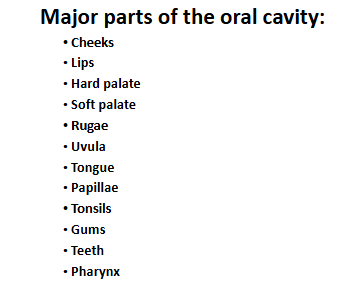
Major parts of the oral cavity
faci/o
face
facial surface - the outside surface of the teeth. Opposing the lingual surface
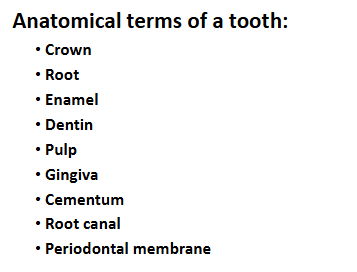
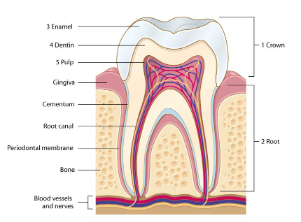
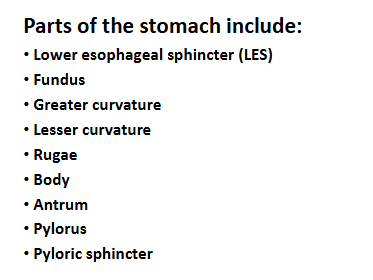
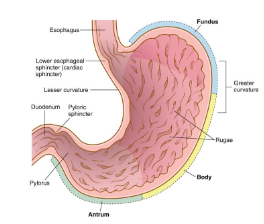
The stomachs parts
lower esophageal sphincter (esophagus delivers food to the stomach)
fundus (upper portion)
body (middle section)
antrum (lower section)
pyloric sphincter (stomach releases food to the small intestine)
Small intestine parts
duodenum (1 ft, receives food from the stomach and bile from the liver and the gallbladder and pancreatic juices) [digestion via bile and pancreatic juices]
jejunum (8 ft, connects to the next section)
ileum (11 ft, attaches to the large intestine)
villi (peaks to increase the surface area of the small intestine)
Large intestine parts
ileocecal valve (sphincter connecting the ileum to the cecum)
cecum (pouch-like first section, receives undigested food, absorbs salts and fluid, connects to the appendix)
colon (5 ft, 4 segments)
ascending colon (extends from the cecum to the underside of the liver, turns left (hepatic flexure) and transitions into the transverse colon)
transverse colon (passes horizontally left towards the spleen (splenic flexure) then down into the descending colon)
descending colon (connects the transverse to the sigmoid colon)
sigmoid colon (S shaped, connects the descending colon to the rectum)
rectum (the muscle that holds stool before defecation)
anus (the termination of the gastrointestinal tract)
Liver (bile)
produces bile containing cholesterol, bile acids and bile pigments. Bilrubin is a bile pigment that gives feces their brownish colour. It continuously produces bile, which passes through the hepatic duct to meet the cystic duct and enter the gallbladder
Jaundice
aka hyperbilirubinemia
blocked bile duct accumulates bilirubin in the bloodstream instead of excreting it in the bile
Gallbladder
connects to the cystic duct. A pear-shaped sac under the liver that stores and concentrates bile for later use. Releases bile in response to food in the stomach and duodenum via the common bile duct.
Pancreas (exocrine)
secretes pancreatic juices (enzymes) that are released into the pancreatic duct, which meets the common bile duct before the duodenum. It produces amylase, lipase and protease
Liver (general)
helps maintain glucose levels, manufactures blood proteins required for clotting, releases bilirubin and removes toxins and poisons from the blood.
Bile
acts as a detergent to break down fat in foods and increase surface area for digestion
Portal vein
brings blood from the liver to the intestines, and nutrients are absorbed by the small intestine and pass into the portal vein, giving the liver the first chance to use them.
Pancreas (endocrine)
secretes insulin into the bloodstream, which acts as a carrier to bring glucose into the cells and out of the bloodstream
an/o
anus
anoscope - an instrument to examine the anus and lower rectum
append/o
appendix
appendectomy - removal of the appendix
appendic/o
appendicitis - inflammation of the appendix
cec/o
cecum
cecal - referring to the cecum
celi/o
belly, abdomen
celiac disease - damage to the lining of the small intestine caused by gluten
cholecyst/o
gallbladder
cholecystectomy - surgical gallbladder removal
chol/e
gall, bile
choledoch/o
common bile duct
choledochtomy - a surgical incision into the common bile duct
col/o
colon
colostomy - a surgical procedure that creates an opening called a stoma in the abdominal wall
colon/o
colon
colonic - a flush of the large intestine
duoden/o
duodenum (1st section SI)
duodenal - pertaining to the duodenum
ile/o
ileum (3rd section SI)
ileitis - inflammation of the ileum
jejun/o
jejunum (2nd part SI)
jejunolileitis - inflammation of the jejunum and ileum
mandibul/o
lower jaw, mandible
mandibulectomy - surgical removal of all or part of the lower jaw
odont/o
tooth
orthodontist, periodontist, endodontist - straightening specialist, disease specialist, internal tooth specialist
peritone/o
peritoneum (membrane lining the abdominopelvic cavity)
peritoneocentesis - a surgical puncture to remove fluid from the peritoneal cavity
proct/o
anus and rectum
proctologist - anus and rectum specialist
pylor/o
pyloric sphincter
pyloroplasty - a surgical procedure that destroys the pyloric sphincter so the stomach empties quicker and easier
sialaden/o
salivary glands
sialadenitis - inflammation of the salivary glands
sigmoid/o
sigmoid colon (lower third)
sigmoidoscopy - examination of the sigmoid colon with a small camera
uvul/o
uvulectomy - surgical removal of all or part of the uvula
amyl/o
starch
amylase - enzyme responsible for the digestion of starch
bil/i
gall, bile
biliary - anything to do with bile, the liver, gallbladder or bile ducts
chlorhydr/o
hydrochloric acid
achlorhydria - absence of hydrochloric acid related to gastric carcinoma
glycogen/o
glycogen, animal starch
glycogenesis - liver breaking down animal starches when blood sugar is low
lith/o
stone
lithogenesis - the formation of calculi or stones
py/o
pus
pyorrhea - “discharge of pus” used to describe periodontitis aka gum disease
prote/o
protien
protease - enzyme for the digestion of protein
sial/o
saliva, salivary
sialolith - salivary stone
steat/o
fat
steatorrhea - the improper excretion of fat in the feces
-ase
enzyme
lipase - enzyme to break down fats
-chezia
defecation, elimination of waste
hematochezia - excretion of bright red blood from the anus, usually with stool
-prandial
meal
postprandial - after a meal
-emesis
vomiting
hematemesis - vomiting up blood
-pepsia
digestion
dyspepsia - indigestion
-ptysis
spitting
hemoptysis - coughing up or spitting up blood
-rrhage, -rrhagia
bursting forth (blood)
hemorrhage - loss of a large amount of blood over a short interval
gastrorrhagia - hemorrhage or bleeding from the stomache
-rrhaphy
suture
herniorrhaphy - suture to repair a hernia
-stasis
stopping, controlling
cholestasis - the flow of bile from the liver is interrupted
-stenosis
narrowing, tightening, stricture
pyloric stenosis - a congenital narrowing that causes blockages in the flow of food in newborns
-tresia
opening
atresia - absence of an opening
esophageal atresia - congenital anomoly where the esophagus does not connect to the stomach
colangi/o
bile ducts
cholangitis - inflammation of the bile ducts usually from a bacterial infection
AFP
alpha-fetoprotein - tumour marker for liver cancer
alk phos
alkaline phosphate
ALT, AST
alanine transaminase, aspartate transaminase - enzymes measured in blood to evaluate liver function
BE
barium enema
BM
bowel movement
BRBPR
bright red blood per rectum - hematochezia
CD
celiac disease
CIC
chronic idiopathic constipation
CT
computed tomography
EGD
esophagogastoduodenoscopy
EPI
exocrine pancreatic insufficiency
ERCP
endoscopic retrograde cholangiopancreatography
ESLD
end-stage liver diease
EUS
endoscopic ultrasonography
FOBT
fecal occult blood test
G tube
gastrostomy tube - feeding tube
GB
gallbladder
GERD
gastro
GI
gastrointestinal
HBV
hepatitus B virus
HCC
hapatocellular carnioma
IBD
inflammatory bowel disease
IBS
irritable bowel syndrome
J-tube
jejunostomy tube - feeding tube
LAC
laparoscopic-assisted colectomy
LAP
laprascopic
LFT's
liver function tests - alk phos, bilirubin, AST, ALT
MRCP
Magnetic resonance cholangiopancreatography
MRI
magnetic resonance imaging
NASH
nonalcoholic steatohepatitis (fatty liver)