2.) 1.3 The Neuron and Neural Firing (#8-18)
 Call Kai
 Learn
Learn Practice Test
 Spaced Repetition
 Match
Match Flashcards
 Knowt Play
1/34

Earn XP
Description and Tags
#8-18
Name | Mastery | Learn | Test | Matching | Spaced | Call with Kai |
|---|
No analytics yet
Send a link to your students to track their progress
35 Terms
neuron
a nerve cell and the basic building block of the nervous system
carries messages throughout the nervous system
draw a neuron and label each part
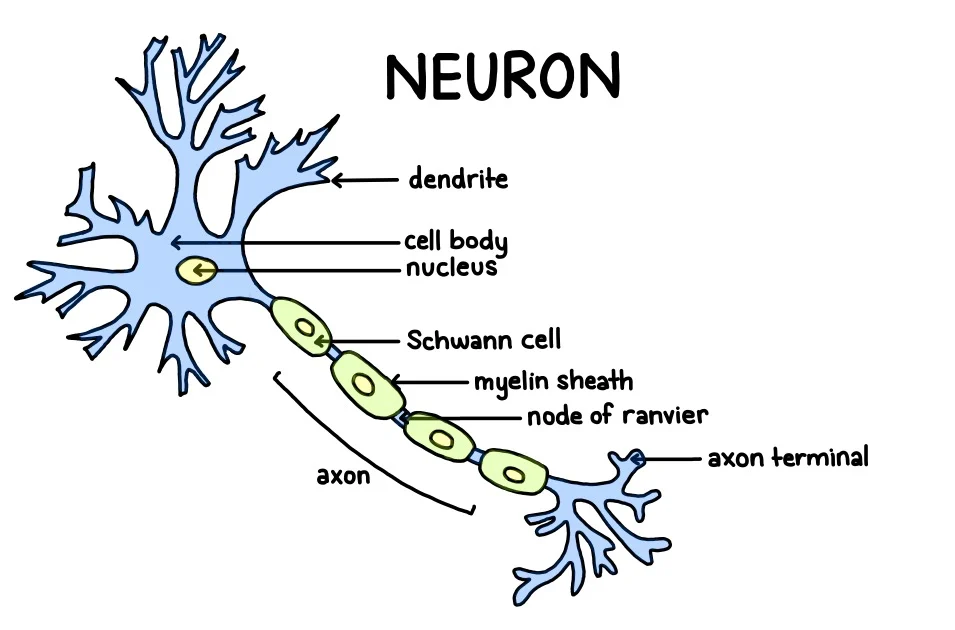
dendrite
receives signals from other neurons
a neuron’s often bushy, branching extensions that receive and integrate messages, conducting impulses toward the cell body
soma (cell body)
the part of a neuron that contains the nucleus and DNA
the cell’s life-support center
axon
covered in the myelin sheath
carries signals from one end to the other
the segmented neuron extension that passes messages through its branches to other neurons, muscles, or glands
axon terminals / terminal buttons
the special endings of a neuron’s amazon that sends signals to the next neuron
myelin sheath
a layer of fatty tissue that insulates and protects the axon of some neurons, which enables greater transmission speed as neural impulses hop from one node to another
degeneration/deterioration: diminished control and slower reaction time; worse case is the disease multiple sclerosis where communication to muscles and brain regions slow, resulting in diminished muscle control and sometimes impaired cognition
Nodes of Ranvier
the spaces between schwann cells
schwann cells
produce myelin for the myelin sheath
glial cells (“glue cells”)
support cells for the nervous system, providing extra protection and nourishment to neurons
explain the process of neural transmission
Neurons transmit messages when stimulated by our senses or by neighboring neurons with a process quicker than a second. When not firing, or at rest, a neuron has a slight negative charge called resting potential.
If stimulation reaches the threshold, or the minimum stimulation needed to trigger a neural impulse, a neuron will fire. A neuron sends a message by firing an impulse, called the action potential—a brief charge that travels down its axon.
A neuron’s reaction of firing or not firing is not determined by the strength of a stimulation as long as the threshold is met. It will either send a firing or not at all (the all-or-nothing response)
Before a neuron can fire again, the ions need to return to their original position or be repolarized. This brief pause between firings is called the refractory period. Once polarized, the neuron is back to its resting potential.
threshold
the minimum stimulation needed to trigger a neural impulse
action potential
a brief electrical charge, or a neural impulse, that travels down an axon to send a message
resting potential
when a neuron is not firing, or is at rest, and has a slightly negative charge
refractory period
the brief resting pause in neural processing that occurs after a neuron has fired.
(happens after the action potential and before the resting potential)
a brief period of time before an action potential happens again until the ions in the axon return to their original position, or gets repolarized
a brief period of time before an action potential happens again until the axon returns back to its resting state, or gets repolarized
all-or-nothing principle
a neuron’s reaction of either firing with a full-strength response, or not firing at all
synapse / synaptic left
the meeting point between neurons
a small space between the neurons
reuptake
a neurotransmitter’s reabsorption by sending the neuron
when neurotransmitters finally drift away, to be either broken down by enzymes or reabsorbed by the sending neuron
excitatory neurotransmitters
increases (excites) the likelihood that the next neuron will fire a neural impulse
inhibitory neurotransmitters
decreases (calms) the likelihood that the next neuron will fire a neural impulse, helping to regulate brain activity
acetylcholine (ACh)
function: a neurotransmitter that enables muscle action, learning, and memory
malfunctions —> with Alzheimer’s disease, ACh-producing neurons deteriorate
dopamine
function: a neurotransmitter that influences movement, learning, attention, and emotion
malfunctions —> oversupply is linked to schizophrenia; undersupply is linked to tremors and decreased mobility in Parkinson’s disease
serotonin
function: neurotransmitters that affects mood, hunger, sleep, and arousal
malfunctions —> undersupply is linked to depression. Some drugs that raise serotonin levels are used to treat depression.
norepinephrine
function: neurotransmitter that helps control alertness and arousal
malfunction —> undersupply can depress mood
GABA (gamma-aminobutyric acid)
function: a major inhibitory neurotransmitter
malfunction —> undersupply is linked to seizures, tremors, and insomnia
glutamate
function: a major excitatory neurotransmitter (involved in memory)
malfunction —> oversupply can overstimulate the brain, producing migraines or seizures
endorphins
function: neurotransmitters that reduce pain or blocks pain signals to the brain
the body’s natural pain killers
oversupply with opioid drugs can suppress the body’s natural endorphin supply
Substance P
function: a neurotransmitter involved in pain response and transmitting pain signals to the CNS
malfunction —> oversupply can lead to chronic pain
how does the endocrine system transmit information and interact with the nervous system?
The endocrine system uses hormones that are transmitted through the bloodstream to affect targeted cells at a slower pace, but long-lasting effects. It interacts with the nervous system through the hypothalamus, which controls the pituitary gland. Together, they help regulate things like stress, growth, and mood.
hormones vs neurotransmitters
Neurotransmitters are the chemical messengers of the nervous system and hormones are the chemical messengers of the endocrine system. Hormones are transmitted through the bloodstream slowly, but have long-lasting responses. Neurotransmitters are transmitted across the synaptic gaps between neurons at a rapid pace, but only produce short-lasting results.
adrenaline
release points: adrenal glands
function: hormones that prepares the body for emergencies (fight or flight responses)
ghrelin
release points: cells of especially in the stomach
function: a hormone that stimulates hunger and signals the brain when it is time to eat
leptin
release points: adipose tissue
function: a hormone that regulates body weight, metabolism, and can suppress hunger
melatonin
release points: pineal gland located in the center of the brain
function: a hormone that regulates body’s sleep-wake cycle, induces sleep
oxytocin
release points: pituitary gland
function: a hormone that facilitates lactation and improves relationships (the bonding hormone)