BESC 204 - Exam 3
 Call Kai
 Learn
Learn Practice Test
 Spaced Repetition
 Match
Match Flashcards
 Knowt Play
1/93

There's no tags or description
Looks like no tags are added yet.
Name | Mastery | Learn | Test | Matching | Spaced | Call with Kai |
|---|
No analytics yet
Send a link to your students to track their progress
94 Terms
Explain the primary ecological role of fungi
recyclers/degraders, break down complex organic compounds into simple molecules, minerals, and energy, elements are then reused by other organisms
List the structural components of plants that fungi can degrade
Cellulose
Lignin
Pectin
Cutin
Nutritional succession
zygomycetes > simple sugars
ascomycetes > cellulose
basidiomycetes > cellulose and lignin
R-selected
Species that reproduce early in their life span and produce large numbers of usually small and short-lived offspring in a short period.
K-selected
organisms that reproduce later in life, produce fewer offspring, and devote significant time and energy to the nurturing of their offspring.
Spore dispersal mechanisms utilized by fungi
Wind
Water
Vector
Self-propelled
Spore dispersal mechanism of Pilobolus sp.
-Aerial growth directed towards a light source
-black spore mass at head of sporangium is ejected 3 meters after rupture of subsporangial vesicle
-Parasitic nematode larvae crawl up the sporangium and are launched with the spores
Spore discharge utilized by Basidiomycetes.
-thin layer of water coats the spore
-droplet of water begins to swell at the base of the conidium due to excretion of sugar molecules
-once swollen, droplet grows large enough to contact the spore
-droplet rapidly redistributes, flowing into the thin coat of water
-redistribution shifts the center of gravity causing it to catapult away
Buller's Drop
The droplet of water that accumulates at the tip of the basidiospore
fermentation reaction
glucose----> 1- ATP
----> VFA's + CO2 + CH4
Why can't a beverage be produced from fermentation alone?
To get anything above 18%, the beverage must be distilled
Ingredients found in true beer
Yeast
Hops
Malt
Water
Difference between an ale and a lager
Ale - complex flavor; brewed at a warmer temperature (55); quicker
Lager - cleaner taste; brewed at a cooler temperature (45); takes more time
Saccharification
Application of heat to a starch to trigger the enzymatic processes of converting the starch to fermentable sugar.
Differences between wine making and beer making
1) Ingredients for beer are sterilized; those for wine are not
2) Different species or strains of yeast used
3) Sugar for beer comes from malt and must be converted; that for wine comes from grape juice
4)Additives - hops added to beer; none to wine
5) Water added to beer; none to wine
Effect of prohibition on US brewing industry
Caused a sharp decline
Pasteur's role in zymurgy
-Discovered that yeast was responsible for the fermentation process
-Showed that hops acted to inhibit bacterial growth
-Discovered bacteria in fermenting beer > Pasteurization
noble rot
Botrytis - causes healthy grapes to shrivel and adds its own character to the wines. This requires a period of damp misty mornings and warm afternoons.
Ice Wine
Grapes are harvested and pressed while frozen solid (-10°C) so water can be driven out as shards of ice - leaving a higher concentration of sugars - and after
fermentation - higher concentration
of alcohol.
Sake
Rice + Aspergillus oryzae turns starch to sugar
Sugar + yeast makes the brew
Camembert
a soft surface-ripened cheese with a thin grayish-white rind and a yellow interior
p. camemberti
blue cheese
Made from sheep's milk; aereated and left out
P. roqueforti
Quorn
Meat substitute made from fungal protein that is fermented and mixed with egg whites and vegetable oils.
Soy Sauce
soybeans crushed
formed into cakes and placed in cool, dark environment for 3 months
fungi grow on cakes
cakes soaked in salt water for 1-3 years
flavored salt water = soy sauce!
soybeans + wheat + Aspergillus oryzae
Tempeh/Oncom
cooked soybeans + Rhizopus oligosporus
-made from legumes
soybeans + neurospora
-only human food made with Neurospora
Ecovative design
Pleurotos ostreatus
packing material and house insulation
Mycoworks
Make handbags out of leather like (mycellium/reishi) products
Innomy
Make meat alternative using field mushrooms
Meati
Make meat alternatives out of mycellium
Common measures to avoid mushroom poisonings
1) Dig, don't pick
2) Look for or do a spore print
3) Keep different specimens separate
4) Don't eat wild mushrooms raw
5) Don't consume with alcohol until you know the mushroom
6) Learn Latin names
7) Get a good identification manual
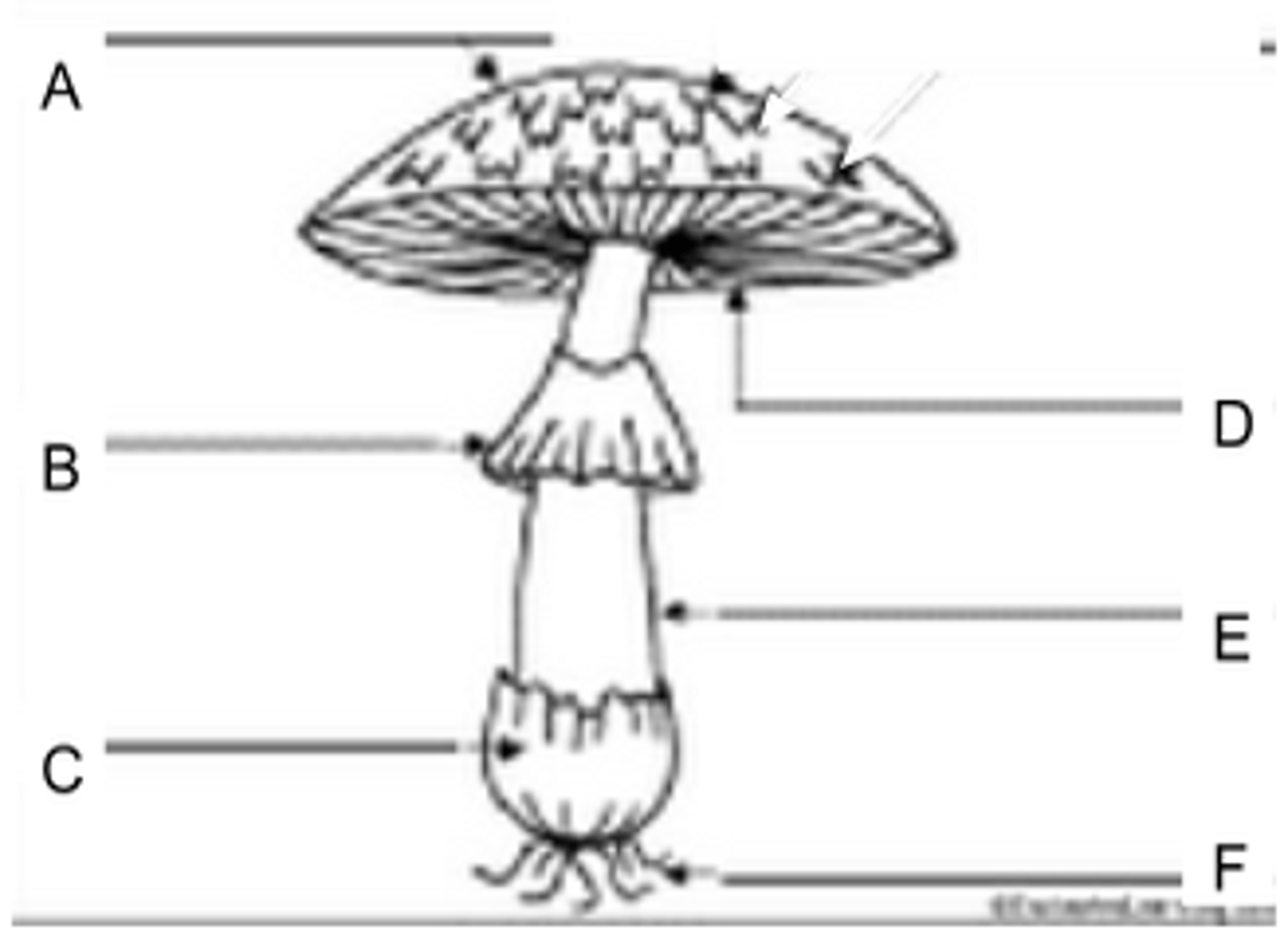
Pileus
A
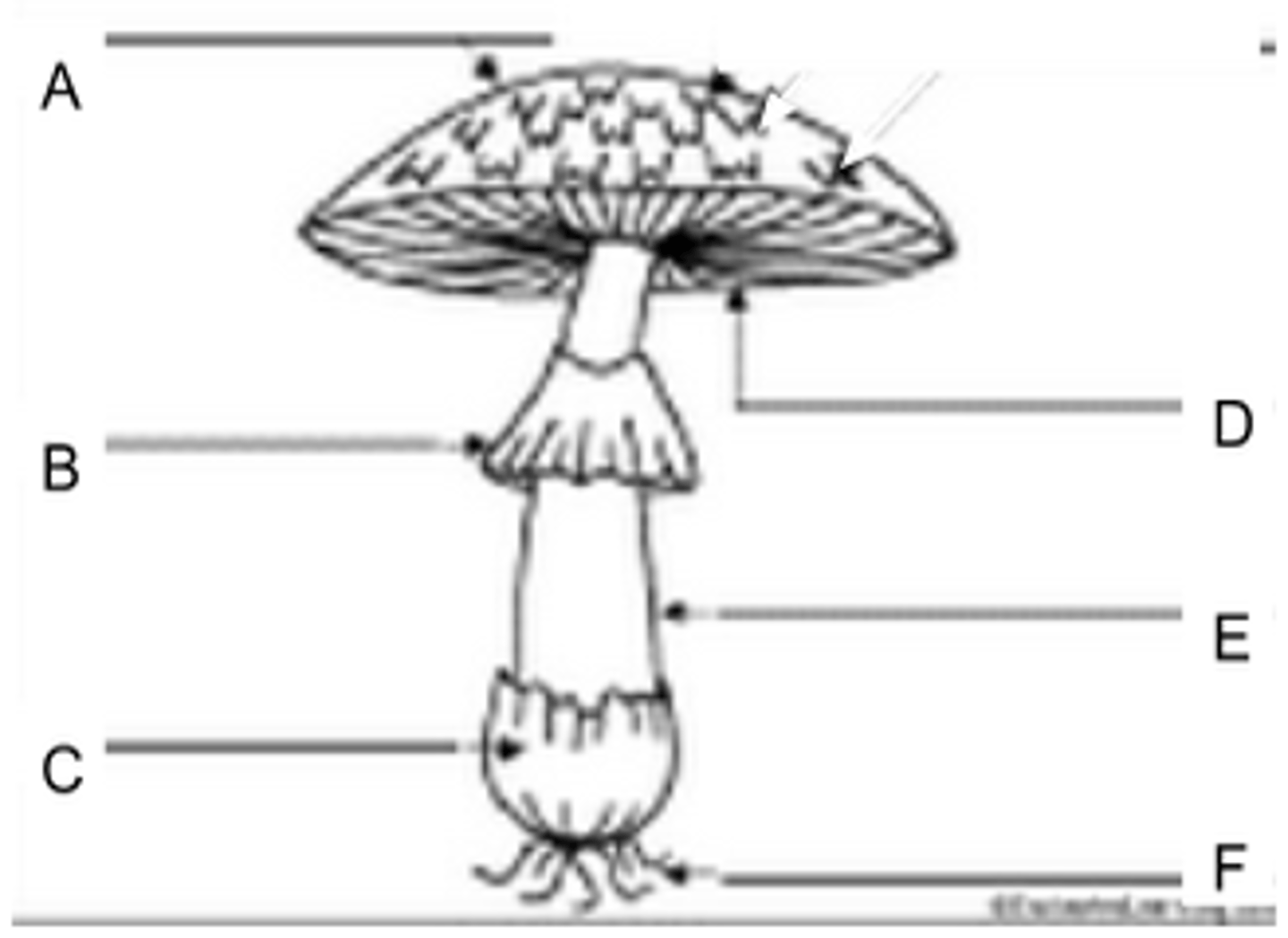
Gills
D
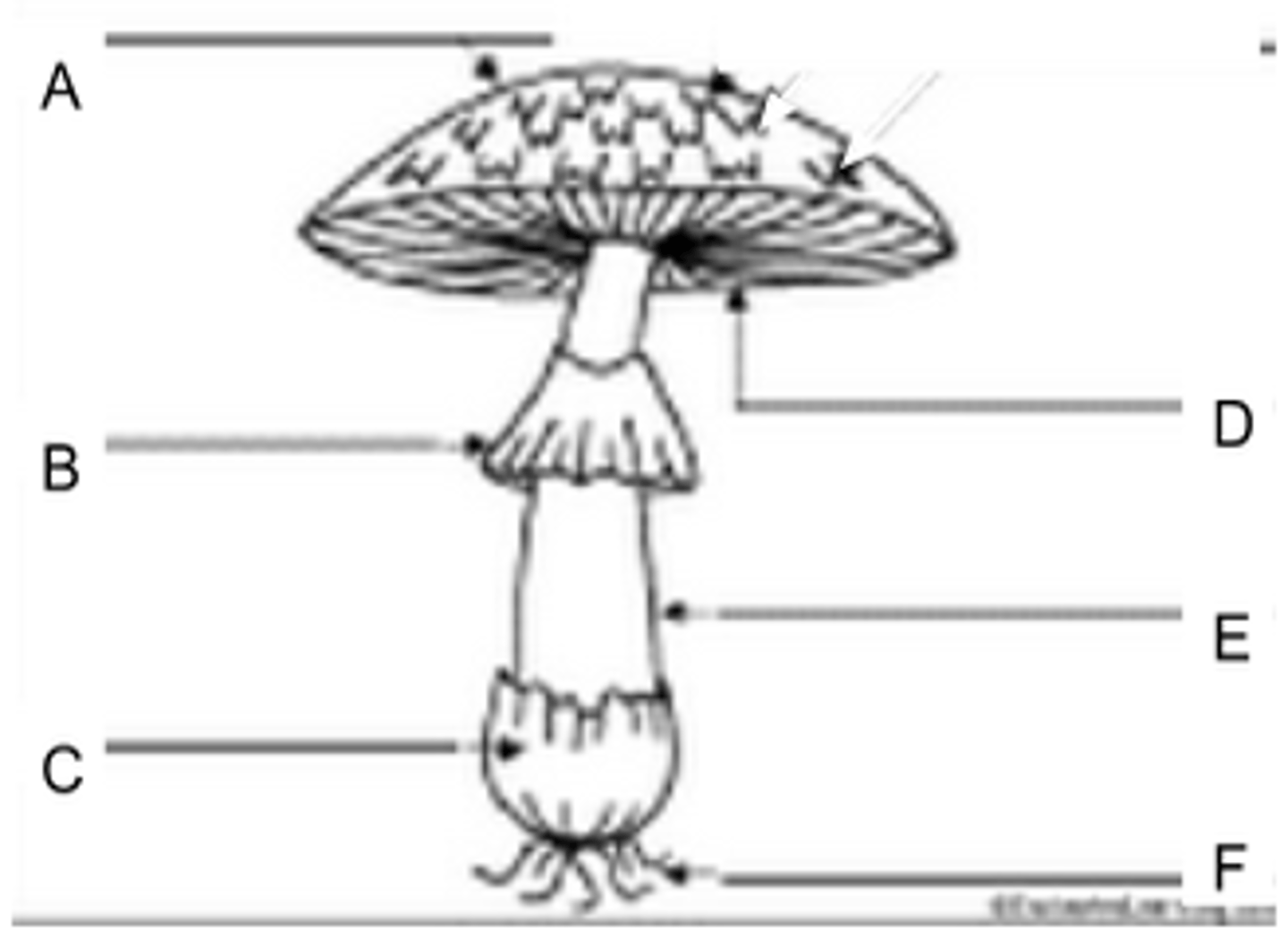
Annulus
B
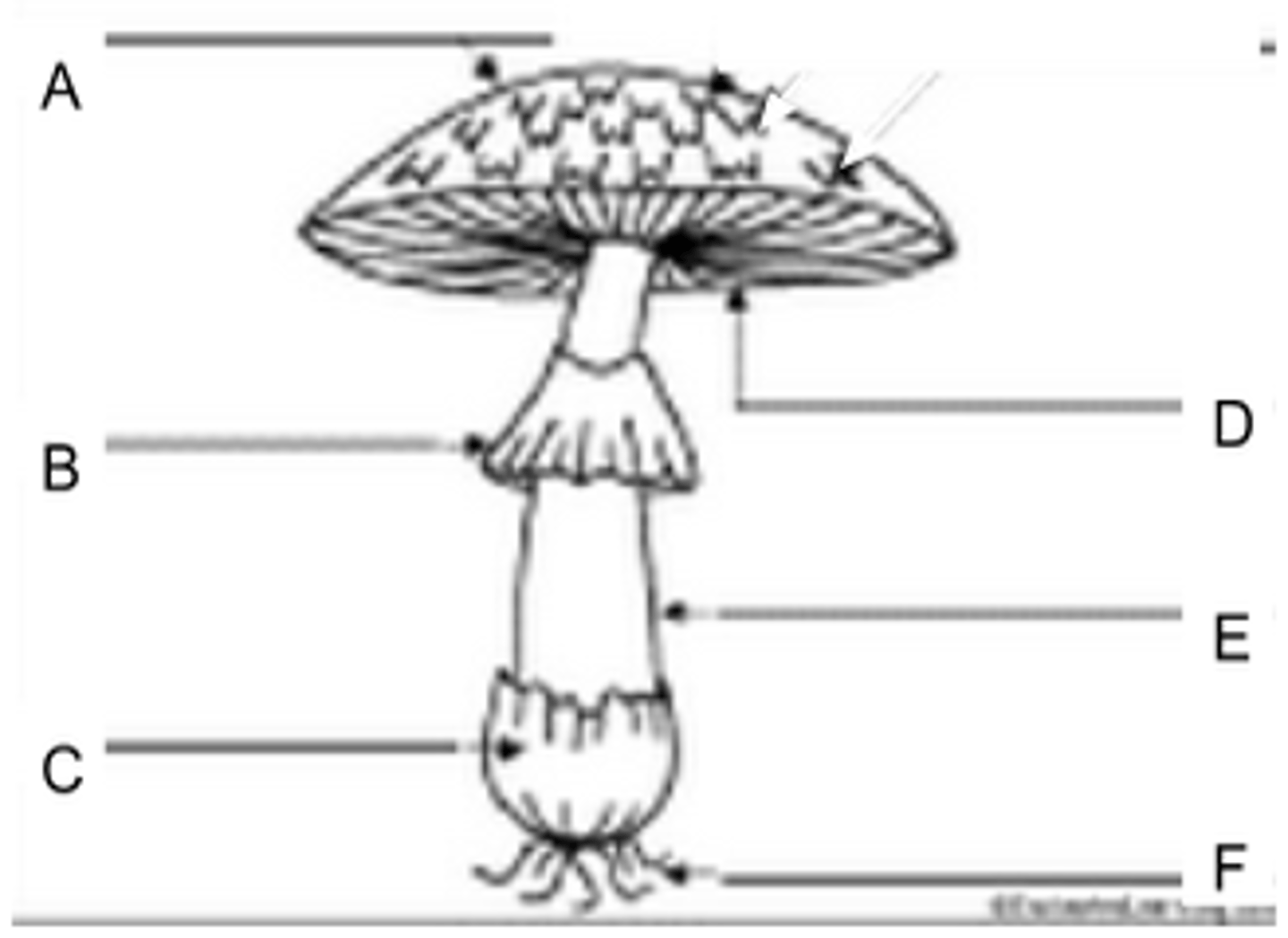
Scales
Arrows
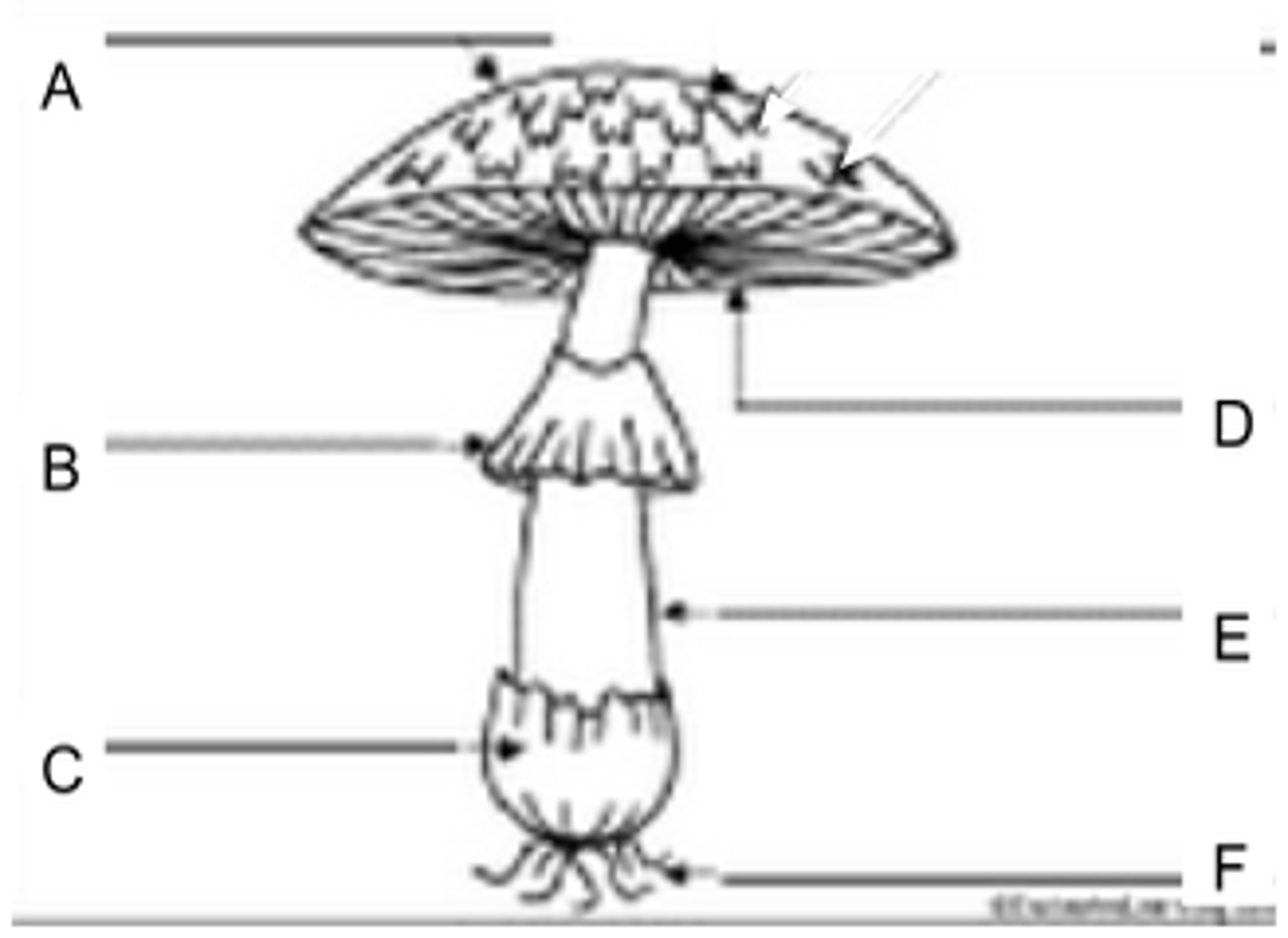
Stipe
E
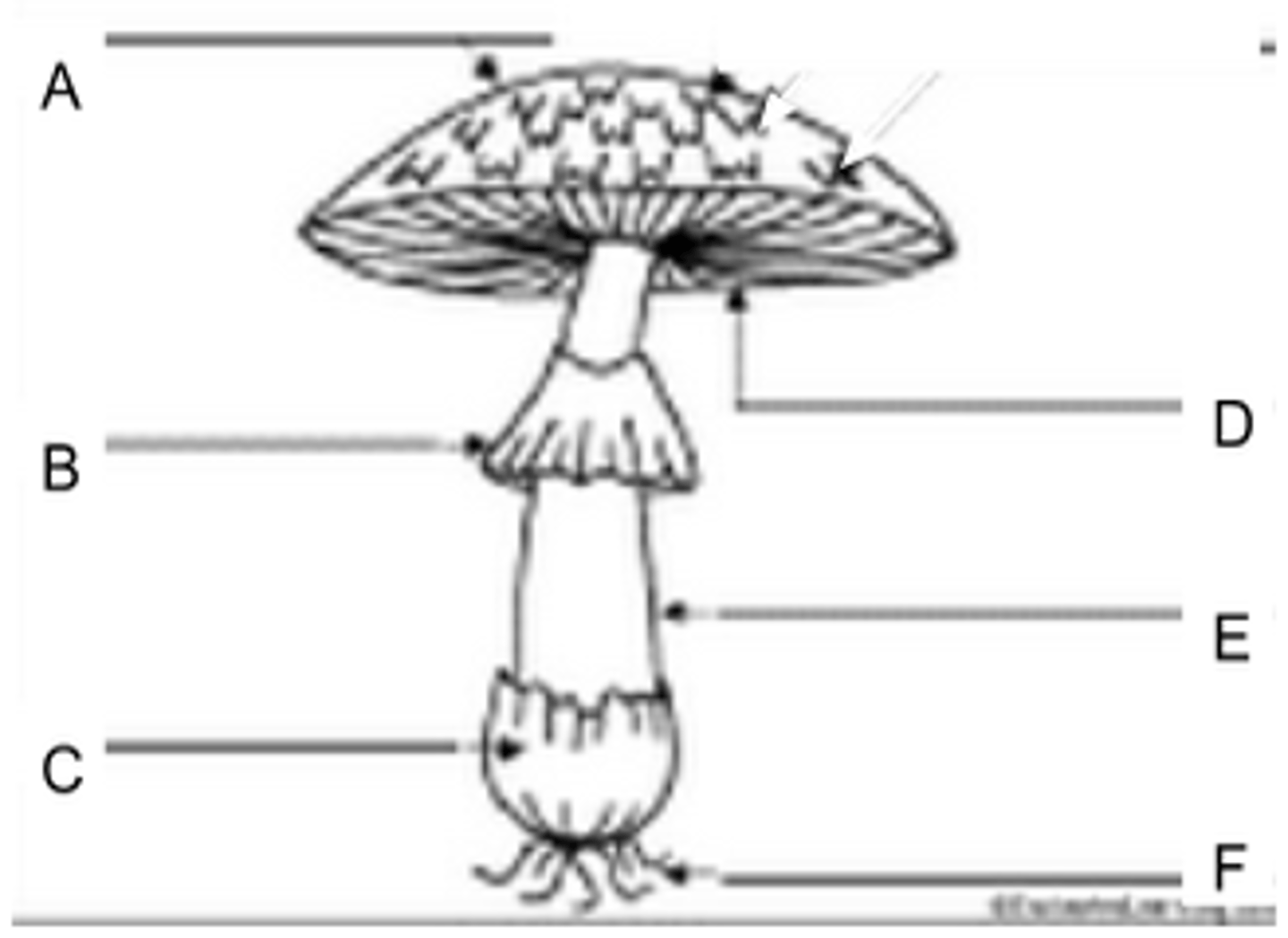
Volva
C
steps for commercial mushroom production
1) Growing the spawn
2) Compost
3) Spawning - adding grain infested with mycelium to compost
4) Casing - cover compost with low nutrient medium
5) Growth - 2 to 3 weeks
6) Harvesting
Fool Proof Four
Morels
Shaggymane
Giant puffballs
Sulfur shelf
pink button meadow mushroom
Agaricus campestris
white button mushroom
Agaricus bisporus
morel
Morchella species
Giant puffball
Calvatia gigantea
Common bolete
Boletus edulis
Shiitake
Lentinula edodes
Huitlacoche
Ustilago maydis
Why are dogs and pigs used to hunt wild truffles?
They can smell the scent of the truffles which are similar to animal pheromones
Death Cap
Amanita phalloides
Looks like Amanita caesarea
False Morel
Gyromitra esculenta
Looks like
Inky cap
Coprinus atramentarius
Coprine
-causes hot flushes, metallic taste, tingling, numbness, headache, nausea, vomiting
-occurs when consumed with alcohol
-Species of Coprinus atramentarius (Inky caps)
Gyromitrin
-cause bloating, nausea, vomiting, diarrhea, dizziness
-liver toxicity after 36-48 hours
-Species of Gyromitra
Miscellaneous Gastrointestinal irritants
-causes vomiting and diarrhea, with abdominal cramps
-full recovery after about a day
-common to multiple fungi
Orellanine
-causes nausea, vomiting, and loss of appetite 12 hours - 3 days after consumption
-causes renal damage occurs after 3-15 days
-species of cortinarius
Amatoxins
-attack liver, intestines, and kidneys
-experience diarrhea, vomiting, and abdominal pain
-false remission
-collapse of kidney and liver function followed often by death
Phallotoxins
lethal if injected
no effect if taken orally
Psilocybin
-natural hallucinogen found in certain mushrooms
-causes uncontrollable laughter, hallucinations, euphoria, and disembodied experience
-begin 10-30 minutes after consumption
-can cause bad trips
-species of Psilocybe, Panaeolus, Conocybe, and Gymnopilus
-in the LSD family
Why do poisonous mushrooms look like edible mushrooms?
Mimicry to protect them from predators; could just be happenstance
What kind of organisms can biocontrol fungi be used on?
-Insects
-Nematodes
-Other fungi
etc.
Advantages and Disadvantages of Fungal Biocontrols
Pro:
-Reduced use of chemical pesticides
-High reproductive capacity
-Short generation time
-Specific to a particular host
-Resting/resistant stages
Con:
-Only cause damage not death
-Only reduce a population, not eliminate
-Acts slowly
-Cause damage to other beneficial organism
-Limited to where and when it can be effective
Two modes of nematode trapping
Arthrobotrys dactyloides: hyphal cells swell around nematode
Hirsutella rhossilliensis: feeds off the nematode
Modes of action of Trichoderma
-Mycoparasitism: acts like a parasite to the parasite
-Antibiosis: secondary metabolites act like antibiotics
-Competition: compete with parasites
Uses of beneficial fungi for improving plant health
Endophytic:
-Promote plant growth, reduce salt, heat, or drought stress
-Improve resistance to insects
-Produce bioactive compounds
Mycorrhizal:
-Improve nutrient availability
-Improve systemic resistance
-Influence plant bioactive compound production
Pros and Cons of Genetic Modification
Pro:
-Increased yield, drought resistance, nutritional value
-Reduction of pesticide use
-Fungal degrading enzymes can reduce fungal infections
-Could be more environmentally friendly
-Reduced browning and longer shelf life
-Potential for pesticide, drug production
Con:
-Might not be effective against new pathogens or environments
-Traits can drift to non-GMO crops
-Resistance genes are only against one pathogen
-Pathogens can overcome resistance by mutation
Examples of genetically modified fungi
-Breeding new strains of mushroom using basidiospore chemical mutagenesis
-Genetic engineering by Agrobacterium
-Bt corn (Bacillus thuringiensis)
Why does CRISPR/Cas9 not require USDA approval and regulation?
In the non-browning mushrroms, no genes were removed nor was foreign DNA added
Genetically modified non-browning mushrooms
-CRISPR puts cuts in an enzyme family to stop production of that enzyme
-deletes some pairs in PPO which slows aging and browning of mushrooms
-USDA says it doesn't need approval
What changes does CRISPR/Cas9 make to DNA?
-CRISPR causes mutations; can edit DNA by taking out or inputting sections of genomic material
-Cas9: enzyme carries the guide RNA to the target nucleus
Methods of Genetic Modification
Agrobacterium
Mutagenesis
Gene gun
CRISPR
Brief history of Genetic Modification
-Breeding has been around for millenium
-Mendel experiments
-X-ray mutagenesis during the 20s
-Hybrid vigor during Green Revolution
-CRISPR in the 80s
Symbiosis
A close relationship between two species that benefits at least one of the species.
Mutualism
A relationship between two species in which both species benefit
Commensalism
A relationship between two organisms in which one organism benefits and the other is unaffected
Parasitism
A relationship between two organisms of different species where one benefits and the other is harmed
Ectomycorrhizae
-A type of mycorrhizae in which the mycelium forms a dense sheath, or mantle, over the surface of the root. Hyphae extend from the mantle into the soil, greatly increasing the surface area for water and mineral absorption.
-Only affect trees
-Truffles, false morrels, amanita muscaria, chanterelles
VAM Endomycorhizzae
-Gain entry into host
-Zygomycota (Glomeromycota)
-Have broad host range (orchids)
What is the benefit to the plant and to the fungus having this relationship?
Plants:
-Increased surface area for nutrient and water uptake
-Selective acquisition of some nutrients
-Increased tolerance of poor soil conditions
-Protection from soil borne pathogens
Fungus:
-Food
Hartig Net
hyphal network, that extends into the root, penetrating between the epidermal and cortical cells of ectomycorrhizal plants. This network is a site of nutrient exchange between the fungus and the host plant.
Mantle
External sheath of mycelium around tree roots
arbuscle
Nutrient transport tissue associated with mycorrhizal fungi
Vesicle
A membrane bound sac that contains materials involved in transport of the cell.
Lichen morphological types
Foliose (leaf like)
Crustose (crust like)
Fructicose (shrub like)
Lichens
small plants that consist of algae (phycobiont) and fungi (mycobiont)
Lichen's role in the environment
-Break down rocky substrate to make it possible for plant habitation
-Indicators of air pollution
Lichen reproduction
asexually, sexually, or both
asexual - stress resistant packets of fungal and algal cells
sexual - fungus reproduces by producing an ascocarp (alga does not sexually reproduce in the lichen)
Benefit the algae gets from mycobiont
-Protect them from environment
-Act as an anchor
endophytic fungi
fungi that live within aboveground parts of plants without causing obvious deleterious symptoms
Advantages of endophytic relationship
Improve ability to tolerate abiotic stresses (drought) and improve resistance to insects and herbivores
Laboulbeniomycetes
-parasite found on ladybugs and other insects, passed by contact, spore producing structure
-Mild parasites, but the insects don't show any disease symptoms
-Bug STD
Septobasidium
-grows on woody plants
-looks like a velvety patch
- scale insect lives underneath it- beneficial
- symbiotic relationship (insect gets nutrients from tree, fungi gets nutrients from insect)
-Fungi protects insect, insect gets food from plant beneath
Neocallimastix
in intestines of herbivores and symbiotic since organisms can't make cellulase to break down cellulose it does so for nutrients. (cow example)
Leaf cutter ants and fungi
-Take leaf cuttings and feed them to fungus gardens, feed off hyphae (bromatia)
-Ants tend fungus
-Can be attacked by escovopsis, if left untended; inhibited by streptomyces on ants
Termitomyces
cultivated by termites
Leaf Cutter Ants vs. Termites
-Ants in New World; termites in Old World
-Termites have larger gardens
-Termites eat the plant material; ants give it to fungus
-Ant fungi is a ball; termite fungi are balls with conida and conidiphore clusters
-Termite mounds have fruiting structures, ant mounds do not
Cordyceps and Ophiocordyceps
-Fungi that are parasitic to insects and arachnids
-Infect them and cause them to act strange
-Insects die from fungal infection
-Used in China for medicinal purposes
-Vegetable Insects/Catepillars