WPS 224 Softwood structure
 Call Kai
 Learn
Learn Practice Test
 Spaced Repetition
 Match
Match Flashcards
 Knowt Play
1/9

There's no tags or description
Looks like no tags are added yet.
Name | Mastery | Learn | Test | Matching | Spaced | Call with Kai |
|---|
No analytics yet
Send a link to your students to track their progress
10 Terms
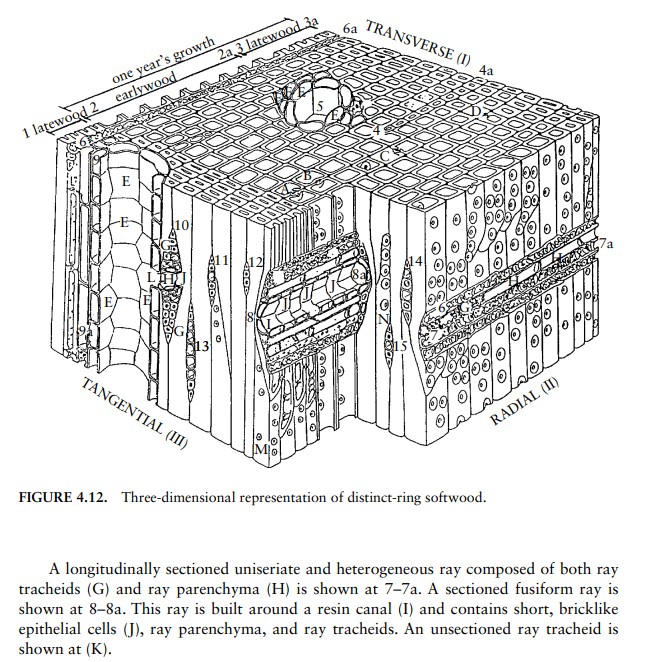
Longitudinal tracheids
90-95% of total tree volume.
Hollow centre (lumen), closed ends, pits are normally bordered.
~100 times longer than wide.
Pitting
Pits on longitudinal tracheids. Bordered.
They typify tracheid-to-tracheid linkages, therefore pit location matches adjacent tracheids.
Aspired pits
Pit whose membrane is flexible, making it shift to one side, blocking the aperture by the impenetrable torus.
Drying can be a cause because of liquid pressure differences.
Occurs more frequently in earlywood.
Wood with apsired pits are resistant to the penetration of chemicals and preservatives, and dry slowly.
Longitudinal parenchyma
Rare amongst species.
Same general shape of tracheids. Occurs as longitudinal strands of short cells butted end-to-end.
1-2% of total tree volume.
Epithelium
Horizontal and longitudinal resin canals always accompany each other.
Horizontal canals found in some rays.
Intercellular space surrounded by specialized parenchyma cells that secrete resin into the canal. Can be created via trauma.
Aids in healing, repels insects & other outsiders.
Rays
Uniformly narrow rays characterize softwoods, except where horizontal resin canals are present.
In tangential view rays are usually one to a few cells wide. Uniseriate and biseriate.
Composed of either ray parenchyma (thick or thin walled, pits or no pits) or ray tracheids (thick walled, bordered pits), or both. Homogeneous or heterogeneous rays.
Dentate ray tracheids
Ray tracheids that form secondary walls that are locally thickened in the vicinity of pits. Look like teeth.
Fusiform ray
Ray that contains resin canal.
Crossfield pitting
Crossfield pitting occurs at the intersections of longitudinal tracheids and ray parenchyma, and the half‐bordered pits are of unique form.
Occurs in all softwoods.
Useful in identification of species, because of variation of shapes in radial view.
Identification