last test oh my god
 Call Kai
 Learn
Learn Practice Test
 Spaced Repetition
 Match
Match Flashcards
 Knowt Play
1/42

There's no tags or description
Looks like no tags are added yet.
Name | Mastery | Learn | Test | Matching | Spaced | Call with Kai |
|---|
No analytics yet
Send a link to your students to track their progress
43 Terms
Differentiate between prokaryotic and eukaryotic cells
Prokaryotic cells do not have a nucleus, they are single celled, and its DNA is stored in a plasmid. Eukaryotic cells have a nucleus and store their DNA in the nucleus.
Differentiate between plant and animal cells
Plant cells have larger vacuoles chloroplasts, cell walls, and are more rigid/square. Animal cells have smaller vacuoles, cell membranes, and are more round in shape.
Cell size - why are cells small?
They need to be small to function. If they’re too big, the organelles cannot function and it will die.
Endosymbiosis?
The evidence that, a long time ago, a cell absorbed another, and instead of it dying, it lived inside the cell and provided a function to the larger cell, creating a symbiotic relationship. (Mitochondria)
Active and passive transport
Active transport - the movement of cells across a semi permeable membrane against a concentration gradient. Requires ATP
Passive transport - moves molecules from areas of high → low concentration until equilibrium
Diffusion
Diffusion - movement of molecules from areas of high → low concentration
Osmosis
Osmosis - movement of water molecules from areas of high → low concentration
Facilitated Diffusion
Facilitated Diffusion - high →low w/ help of transmembrane proteins
Ion Pumps
Ion Pumps - ions against a concentration gradient and charge gradient
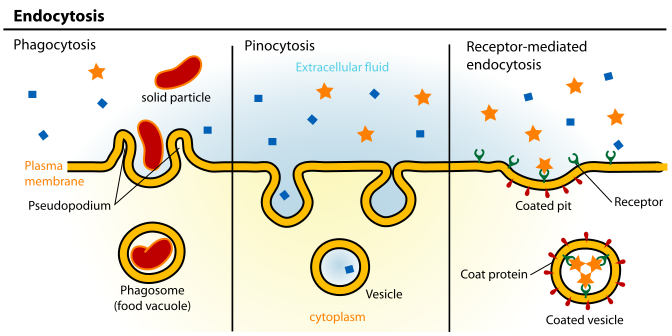
Endocytosis Types
Phagocytosis - cell eats cell, sends out pseudopods, and engulfs particle, forming a membrane bound vesicle
Pinocytosis - cell drinking, cell membrane folds inward taking fluid + solute w/ it
Receptor mediated endocytosis - molecules in environments that cell takes in based on receptors
Osmosis - Hypotonic, Hypertonic, Isotonic Solutions
Hypertonic : a high concentration of solute relative to another solution
Hypotonic: a low concentration of solute relative to another solution
Isotonic : When the solute of both solutions is equal
Vacuole function in plant cell - turgor pressure
Vacuole - a cells storage / disposal area. In plants, it provides structure and regulates water balance.
Turgor pressure - the internal force of water pushing the membrane against a plant cell wall, providing necessary structure
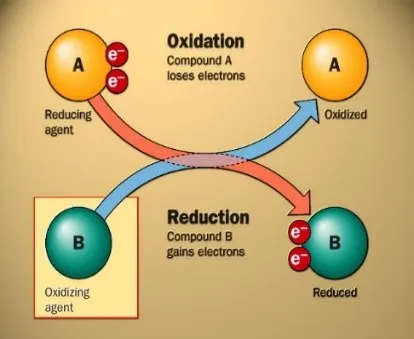
Oxidation / reduction and energy transfer
a cells loses an electrion, which then oxidizes, becoming reduced, but it gains energy and a new electron when reduced. Loss of Electron is Oxidization, Gain of Electron is Reduction
ATP / ADP
ATP is a primary energy carrier in all living cells. ADP is the “empty battery”, its formed when a cells ATP releases energy. The cell “recharges” (regains a phosphate) and becomes ATP again.
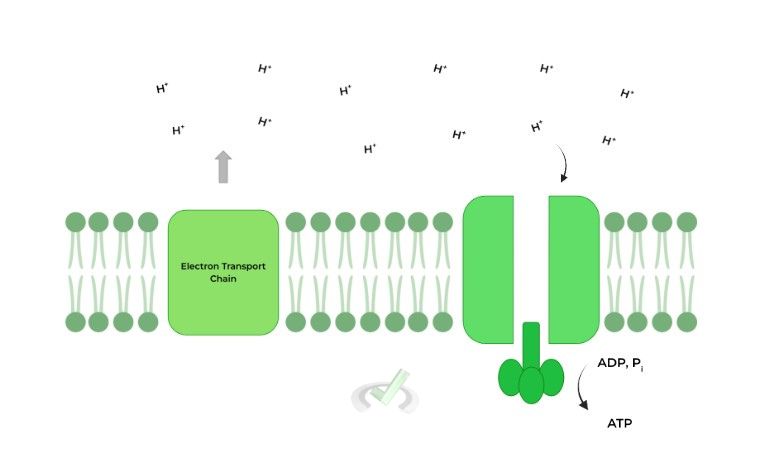
Transport and ATP synthase
Transport - the movement of substances within an organism
ATP synthase - high energy reduced molecules donate electrons to complexes in membrane. Electron is transferred thru membrane and brings H+ w/ it. H+ is turned into potential energy, which can be used to do work. Energy from the moving H+ is used to catalyze the reaction between ADP and inorganic phosphate to make ATP. This is phosphorylation
Chemosynthesis
the process where chemosynthetic organisms use chemicals like hydrogen sulfide + O2 + CO2 to make other chemicals like sugar and water
Photosynthesis
Photosynthetic organisms use solar energy to turn CO2 and water into sugar and oxygen
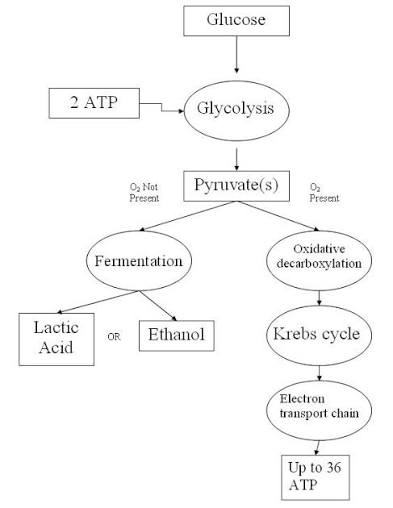
Cellular Respiration
The process where, by demand of chemical energy of “food” molecules, is released and partially captures in the form of ATP
Photosynthesis vs Cellular Respiration
Photosynthesis - organism uses solar energy. Has two stages, light reactions and calvin cycle. And it coverts CO2, water, and sunlight into glucose ( 6CO2 + 6H2O → C6H12O6 + 6O2 )
Cellular Respiration - Uses “food” molecules. Has three stages, Glycolysis, Krebs Cycle, and Oxidative Phosphorylation. It converts glucose, carbs, etc into water, CO2, and ATP ( C6H12O6 + 6O2 → 6CO2 + 6H2O )
They do the opposite of each other.
Glycolysis
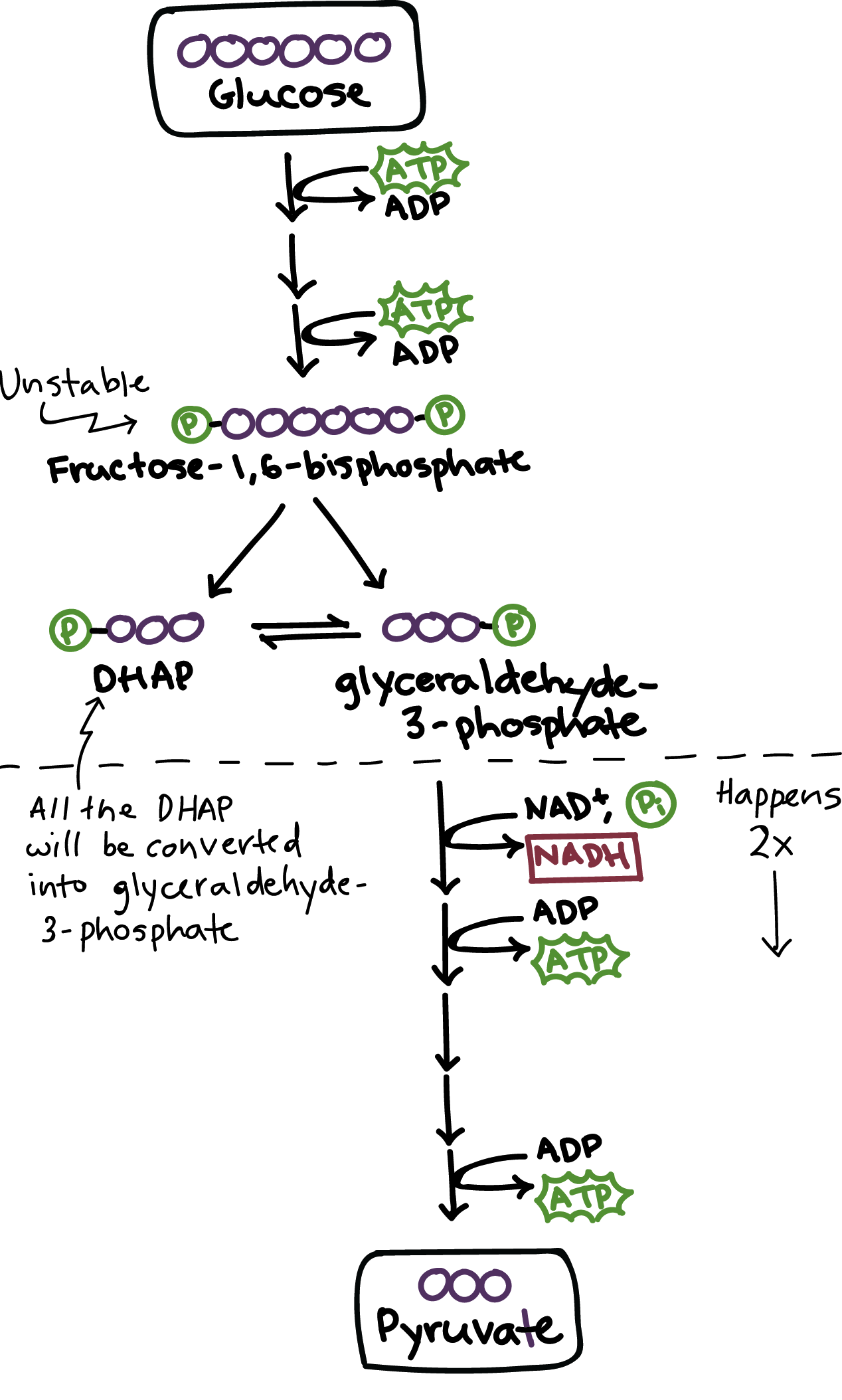
Takes place in the cytoplasm. The cell takes in a 6-carbon sugar (glucose), and breaks it down into two pyruvate (3 carbon) molecules. There is a net-gain of 2 ATP molecules and 2 NADH molecules. If no oxygen is present during this, it also produces lactic acid.
Light Reaction
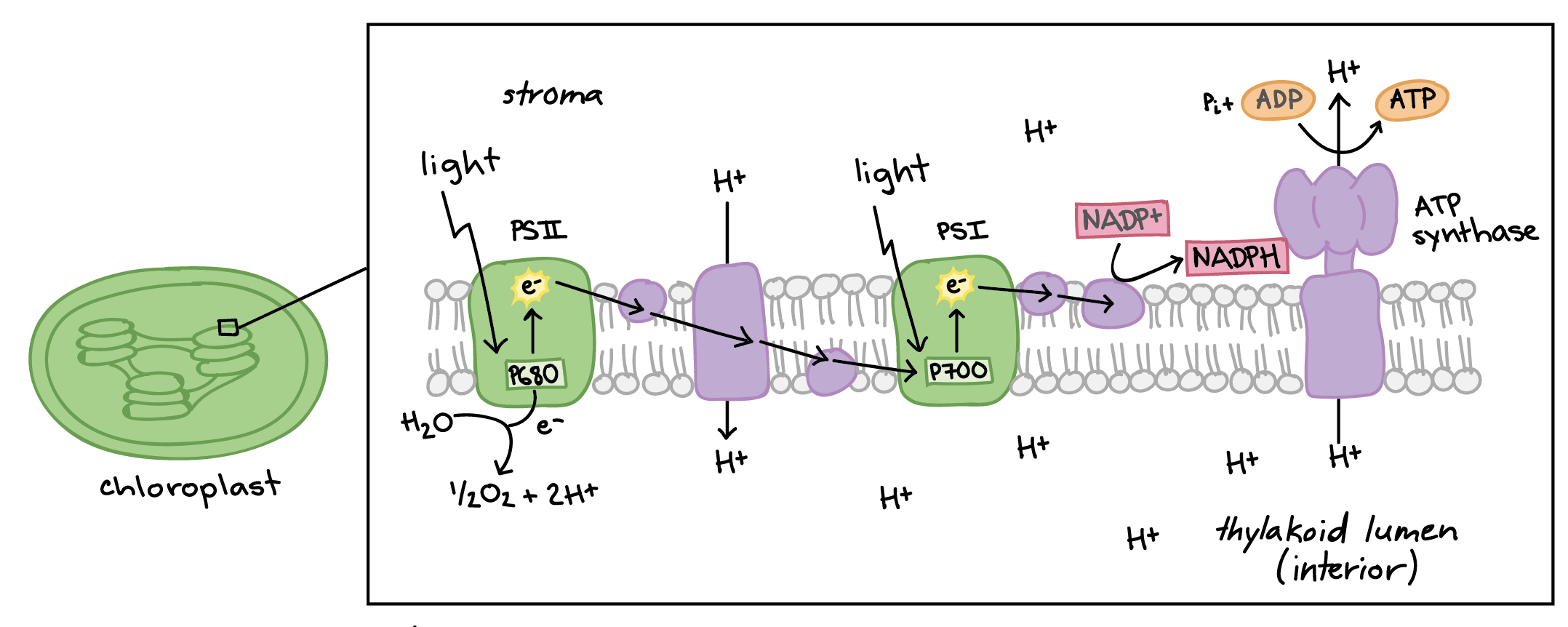
A photon lands on a photosynthesizer, which then absorbs it and brings it to Photo System 2 (PS2). It absorbs it and then sends out and electron, but it needs an electron, so it splits water into hydrogen and oxygen (photolysis), using that energy to make an electron. It pulls in hydrogens from the chloroplast thylakoid aswell. The electron travels to PS1, in which ATP synthesis happens from the movement (photophorylation). PS1 then releases that electron, NADP+ is reduced to NADPH. Both NADPH and ATP travel to the stroma.
Lactic Acid, Anaerobic Respiration
Anaerobic Respiration happens during glycolysis when theres no oxygen during the process, which happens during moments of high-intensity workouts. This creates lactic acid, a temporary emergency fuel for the muscles to signal to the body to adapt, causing muscle fatigue,
Mitochondria, cytosol
The mitochondria is a membrane bound organelles found in most eukratic cells. Its main job is to generate ATP to power the cells functions / other organelles.
The cytosol is a jelly like substance enclosed w/ a cells membrane. It hosts chemcical reactions (like glycolysis), and provides structure / transport
Photosystems
The structural / functional units in plants. Thus is where photosynthesis behind. They are “biochemical solar panels” that absorb light and convert ut unto usable chemical energy
Chlorophyll
Absorbs light into a plant using wavelengths of energy. Also green
Thylakoids
Membrane bound compartments inside chloroplasts. The sight of light dependant reactions in photosynthesis. House chlorophyll protein
Chloroplasts
Double membrane organelles in plant cells that convert sun unto energy because of chlorophyll. House other parts (like thylakoid, etc)
Stroma
The supportive fluid filled space between the space of a plants chloroplast. It provides structural integrity / delivers nutrients and discards waste.
Calvin Cycle
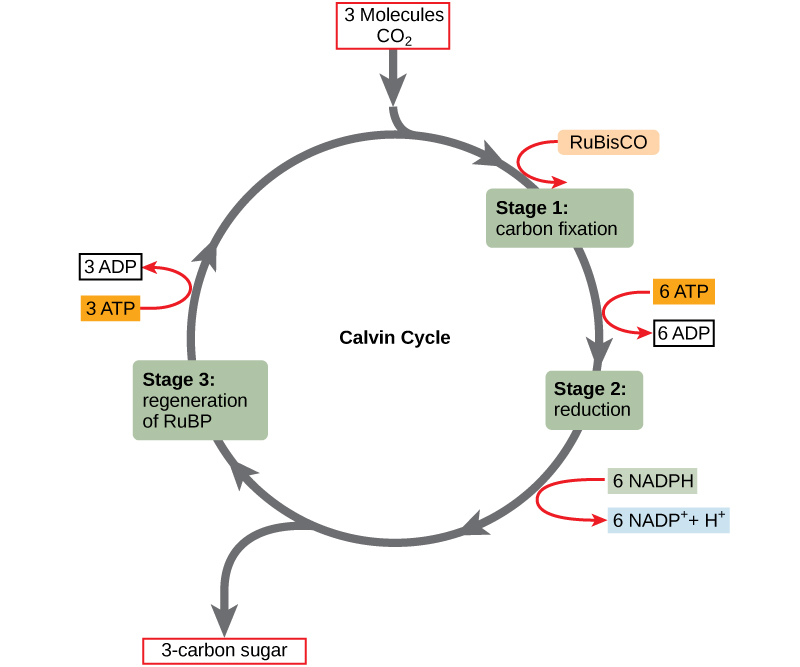
In the stroma of the chloroplast, carbon from CO2 is fixed into the glucose. CO2 reacts w/ the hydrogen, oxidizes into NADP+. ATP dephosphorylates into ADP, in which both travel back to PS2. The energy used from travel (and CO2 reacting w/ hydrgogen) creates glucose.
KPCOFGS?
Kingdom, Phylum, Class, Order, Family, Genus, Species
Binomial Nomenclature
Two-part naming system used by scientists to identify species of living things and create a universal name.
Domain
The highest taxonomic rank in classification. Bacteria, Archea, Eukarya
Krebs Cycle
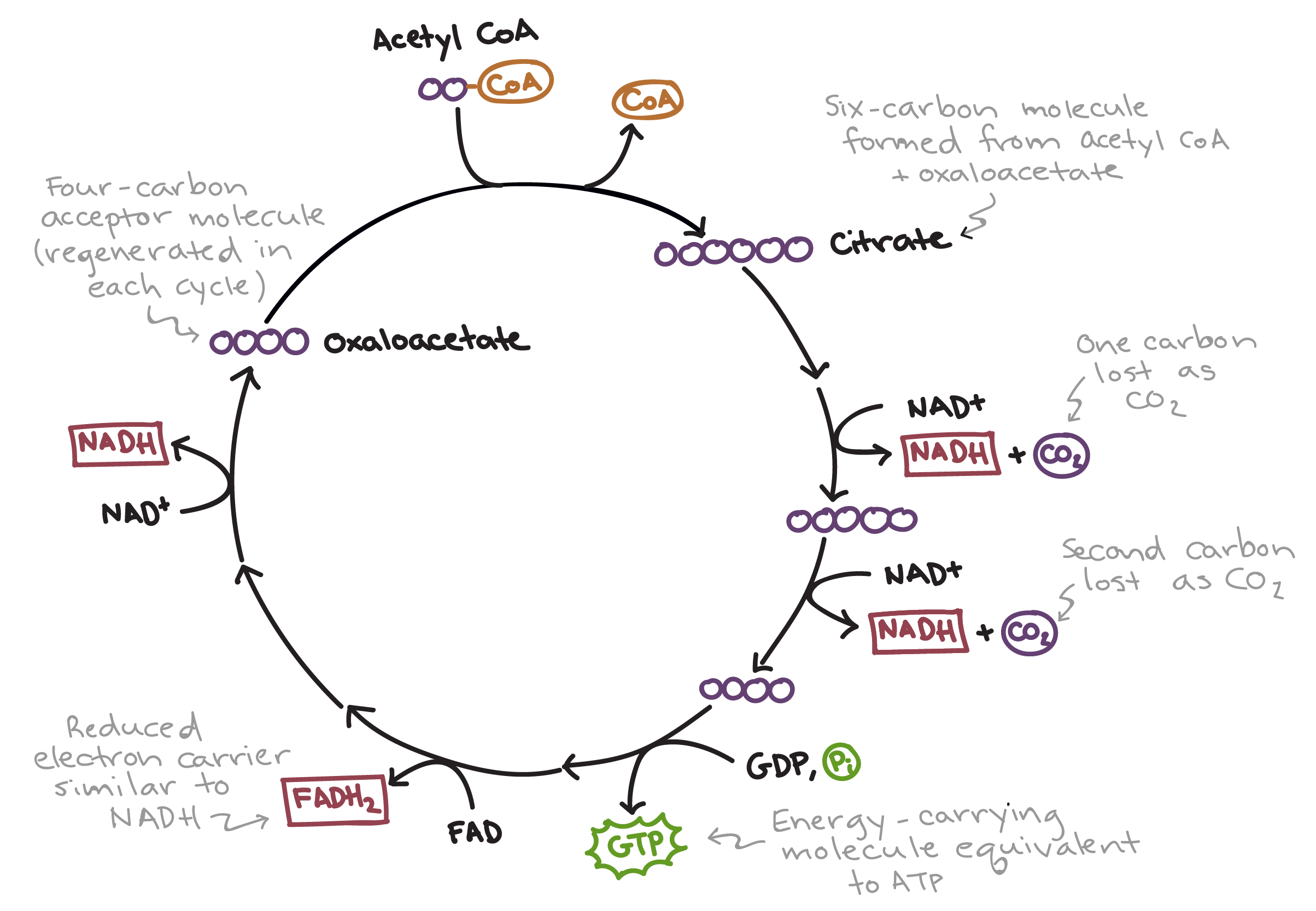
The pyruvate from glycolysis is brought to the mitochondria, where it then loses CO2 to form acetyl-CoA, a 2 carbon molecule. When oxidized, it turns back into CO2 in which chemical energy is released, making NADH, FADH2, and ATP. This cycle repeats.
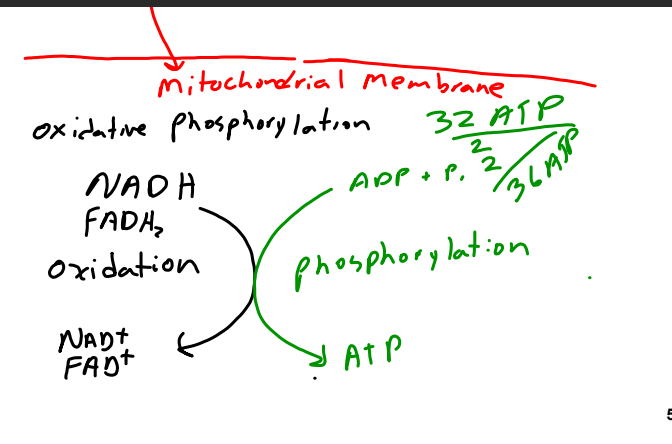
Oxidative Phosphorylation
This allows the release of large amounts of chemical energy stored in reduced NAD+ (NADH) and reduced FAD (FADH2). This energy is released and then captured in the form of ATP (3 ATP per NADH and 2 ATP per FADH2) this takes place in the inner mitochondrial membrane.
Gram Positive, Gram Negative
Positive is purple, negative is red
Bacteria Shapes
Cocci (circle) Baccili (rod) Sprilla (Spiral)
Bacteria Colonies
Strep (chain) Staph (cluster) Mono (single) Diplo (paired)
Protists - 3 types
Animal like: Hetertropic, most motile by variety of means
Plant like: Photosynthesizers, some are motile, some float
Fungi Like: Unique life cycle. Partly fungi, partly amoeba.
Fungus
Eukaryotic, not plants, multicellular unicellular, decomposers, have cell walls (chitin), makes spores, heterotrophs
Plantae
No means of movementt (sessile), cell walls consist of cellulose (provide structure / support), autotrophs, multicellular.
Animalia
Multicelluar, eukaryotic, motile at some point, heterotropic, reproduce sexually
Heterotropic
A heterotroph is an organism that cannot produce its own food, instead taking nutrition from other sources of organic carbon, mainly matter from other organisms
autotrophic
an organism that creates its own food using energy from sunlight or inorganic chemical reactions