Environmental Chemistry
 Call Kai
 Learn
Learn Practice Test
 Spaced Repetition
 Match
Match Flashcards
 Knowt Play
1/57

Earn XP
Description and Tags
Grade 9
Name | Mastery | Learn | Test | Matching | Spaced | Call with Kai |
|---|
No analytics yet
Send a link to your students to track their progress
58 Terms
Pollution
The introduction or presence of potentially harmful substances to an environment
Pollutant
The substance of pollution
Pollutants enters land via
Pesticide on crop to control pests (run-off), dumps, un-recycled matter, litter
Pollutants enter water via
Liquid wastes (sewage, oil, etc.) can be released into waterways
Pollutants enters air via
Gases and aerosolized particles are released into the atmosphere
How do organisms receive pollutants?
Via two ways, absorption and ingestion
Absorption
A chemical substance passes through a membrane (eg. cell wall, roots, skin)
Ingestion
A chemical substance that has been directly consumed by an organism (drinking, breathing, eating)
What are the different kinds of pesticides?
Herbicides, insecticides, and fungicides
Herbicide
Chemical products that kill plants
Selective Herbicides
Only kills certain species of plants (e.g. Killex)
Non-selective Herbicides
Kills ALL plants (e.g. Roundup- carcinogenic)
Insecticide
Substances that kills insects and/or invertebrates (no spinal column)
Fungicide
Chemical substances that kills mushroom and other fungi (e.g. Mefenoxam)
Persistant Pollutants
Waste/pollution that doesn’t biodegrade easily or at all in the environment
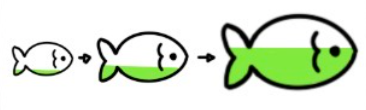
What does this diagram show?
Bioaccumulation
Bioaccumulation
The increase concentration in ONE organism as time passes, there will be more pollutant as the organism grows

What does this diagram show
Biomagnification
Biomagnification
The increase in concentration up the food chain (micro plastics)
Examples of persistent pollutants
Plastics
Mercury
Lead
CFC (found in old fridges)
PCB
DDT
Organic (nutrients)
Chemical products rich in carbon and hydrogen in the same molecule
Carbohydrates
Provides energy to cells (e.g. sugars, starches, grains)
Protein
Builds up and repairs structures
Lipids (fats)
Stockage of unused energy, good for long-term energy
Inorganic Nutrients
Other necessary and important chemicals (e.g. fertilizer)
Macrominerals
Elements we need more of (e.g. Ca, P, Mg, Na)
Trace Elements
Elements we need less of (e.g. Cu, Zn, Fe, I)
Fertilizers
Contains phosphorus, potassium and nitrogen which helps plants grow, it tries to mimic the nitrogen cycle (N conversions)
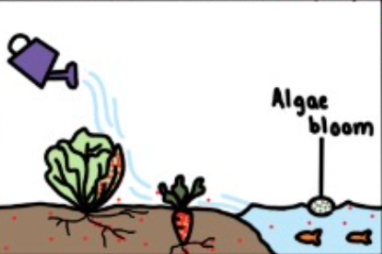
Explain the soil in this diagram
The concentration of nitrogen in the soil is low, but the plants concentrate minerals in their structures (we eat plants)
Algal bloom
When there is too much phosphorus and/or nitrogen which causes algae growth on the surface of the water. It blocks sunlight, reduces turbidity, and kills plants and fish (Low oxygen and biodiversity)
What does the pH scale tell us?
It tells us how acidic or how basic a solution or fluid is
What is neutral on the pH scale?
7
How do the numbers on the pH scale work?
The numbers are logarithmic, the difference between each number is a change by a factor of 10
Neutralization
When an acid and base are mixed
Indicators
A chemical that changes colour at different pH levels
Bases (alkaline)
Based on concentration of OH- (e.g. NaOH, drain cleaner, bleach)
Acids
Based on the concentration of H+ (e.g. lemons, vinegar, hydrochloric acid, etc.)
Natural Indicators
Some plants have natural indicators and change colours (e.g. hydrangea, red cabbage- Dasia Taylor)
How does air carry pollutants?
Circumpolar winds carry pollutants/pollution from industrial areas to areas 100s of kilometers away (winds move clockwise)
How do clouds carry pollution?
Precipitation brings down water and dissolved pollutants from the clouds
How does soil carry pollutants?
More porous soil can absorb water and dissolved pollutants as they pass through, less porous/impenetrable soil stops/redirects the flow
How does water carry pollutants?
Toxins dissipate and get diluted (diffusion) and can be concentrated in collection zones (e.g. lakes)
What does landfills have to have?
Landfills must always have an impermeable layer/dam to prevent toxins/pollutants from leaching into the waterways
Biomediation
Using organisms to fix an environmental problem (e.g. a bacteria that cleans up spills)
Biodegradation
Things that can chemically and physically break down and decompose on their own (typically good and sustainable)
Acid precipitation
Rain, hail or snow with a pH less than 7
What do emissions from fossil fuels and water form?
Carboxyl acid(s)
Nitric and nitrous acids
Sulphuric acid
What happens when pH goes down?
Crops go down, plants die and harvest goes down
What pH levels affect fish?
7- Good
~4.5-5.5- Meh (reproductive difficulties)
<4.5- Dead
What are the different ways to neutralize acid precipitation?
Liming, scrubbers, catalytic converters
Liming
When calcium carbonate (basic) is added to acidified bodies of water, neutralizes pH, not preventative, temporary solution, exothermic reaction (can cause unwanted temperature changes)
Scrubbers
Passing harmful gases through a mixture contain calcium carbonate to “filter”/neutralize them before they reach the atmosphere
Catalytic Converters
A honey comb coated with a catalyst such as platinum for combustions (leads to a complete combustion before exhaust is released)
LD50
The amount of any substance that would kill 50% of people
Acute toxicity
When it only takes one exposure of small dose to have serious effects
Chronic toxicity
The substance builds up overtime and has bad effects (bioaccumulation)
ppm
Parts per million, 1/1 000 000 particles of the solution contain the toxin or [] of 1mg/1kg
ppb
Parts per billion, 1/1 000 000 000 particles contain the toxin or [] 1mewg/1 kg