Chapter 10 Pressure, Gravity, Moments
 Call Kai
 Learn
Learn Practice Test
 Spaced Repetition
 Match
Match Flashcards
 Knowt Play
1/30

There's no tags or description
Looks like no tags are added yet.
Name | Mastery | Learn | Test | Matching | Spaced | Call with Kai |
|---|
No analytics yet
Send a link to your students to track their progress
31 Terms
What is Density?
Mass per unit Volume
p=m/V
unit: kg m-3
What is Pressure?
Pressure is Force per unit Area
P=F/A
Unit: Pascal (Pa)
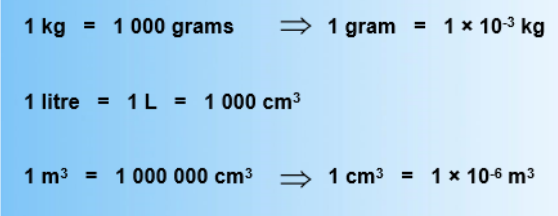
Conversion of Units
State Archimedes’ Principle
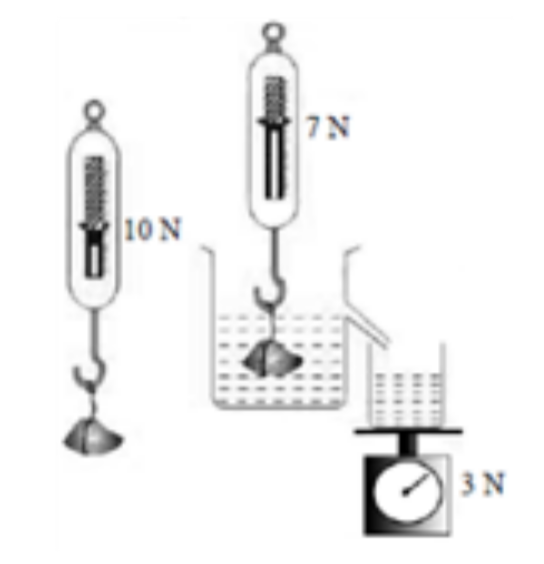
When an object is completely or partially immersed in a fluid it experiences an upthrust equal in magnitude to the weight of the fluid displaced
To Demonstrate The Principle of Archimedes
A stone which weighs 10N in air is immersed in an overflow can which was full to the brim
The stone now weights 7N and the weight of the fluid displaced is 3N
State the Law of Flotation
The weight of a floating body is equal to the weight of the fluid it displaces
What device is used to measure the density of a liquid
Hydrometer
Real life applications of a Hydrometer
Hydrometers are used to find:
The percentage of alchohol in beers, wines and sprites
The density of sulfuric acid in a lead acid battery
The percentage of fat in milk
State Boyles Law
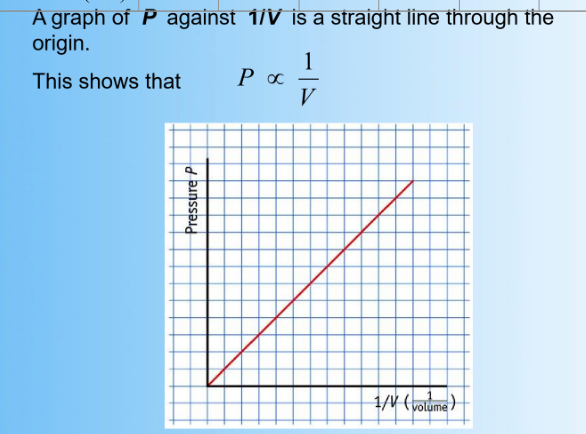
Boyles law states that at constant temperature the volume of a fixed mass of gas is inversely proportional to its pressure
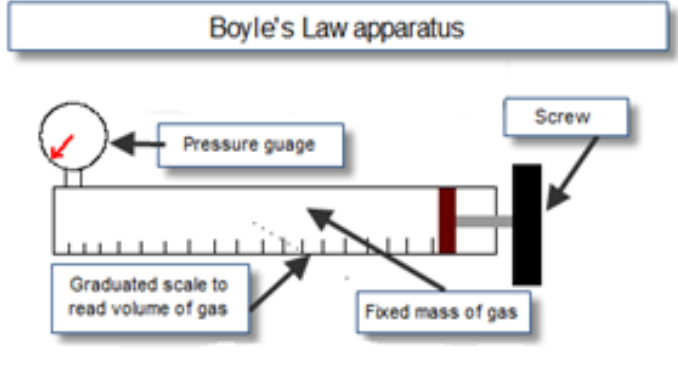
Verification of Boyle’s Law
The tube is filled with air.
Note the pressure of the gas from the pressure-gauge and the volume from the graduated scale.
Turn the screw to decrease the volume and increase the pressure.
Note the new readings and repeat to get about seven readings.
Draw a graph of pressure against 1/volume. This should result in a straight line through the origin.
Graph for Boyles Law
Why is it necessary for the column of air to have a uniform diameter?
So that V is proportional to l
Why might temperature change during the experiment?
Change in pressure increases molecule collisions and could increase temperature
How do you ensure temperature stays the same throughout?
Wait to make readings after changing volume
Why is there no atmosphere on the moon?
The gravitational force is too weak to sustain an atmosphere
Why does the Moon not fall down to Earth?
The gravitational force is too weak / Tangential velocity
Define Moment of a force
Moment = Force X perpendicular distance
M = (F)(⟂d)
Unit: Newton Metre (Nm)
What is a Lever?
A lever is any rigid object free to turn about a fixed point called a fulcrum
State the laws of Equilibrium
The vector sum of the forces in any direction is zero
The vector sum of the moments about any point is zero
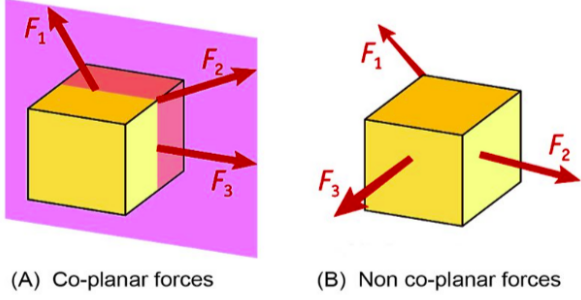
What are co-planer forces?
Forces acting on a body in the same plane
What is a Couple?
Two parallel forces with the same magnitude acting in opposite directions is called a couple
What is the moment of a couple?
The moment of a couple is known as Torque
Torque = Force x Distance
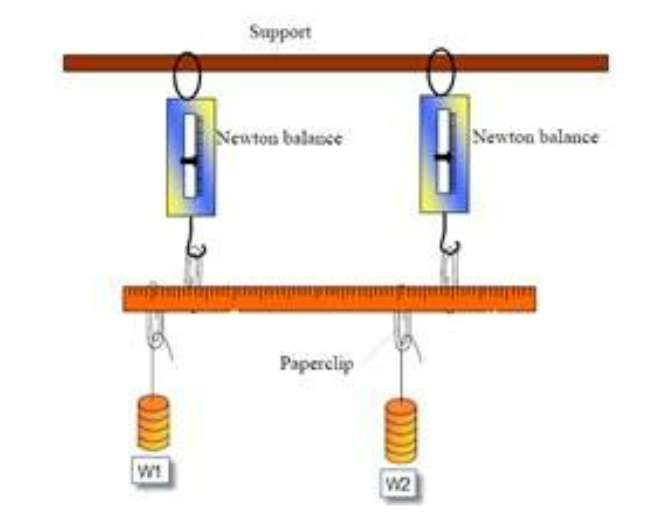
Investigation of the Laws of Equilibrium for a set of Co-planer Forces
Find the centre of gravity on the metre stick by balancing it on a pivot
Note the weight of the metre stick using an electronic balance
Set up as shown and make sure the metre stick is horizontal
Record the weights and readings on Newton Metres
How was the centre of Gravity found?
Balance metre stick on a pivot or finger
How did student know the system was in equilibrium?
System not accelerating, remains horizontal
Why is it important to have forces applied vertically to the metre stick?
So that distance to each force is a perpendicular distance
Why is it necessary to find the centre of gravity?
So you can differentiate between clockwise and anticlockwise moments
Why could the centre of gravity be sightly off the 50cm mark?
Stick could be dented or chipped
How was weight found?
Weighing scale / Electronic Balance
How were vertical forces applied?
Weights for downward forces
Newton Balances for upward forces
Explain how the results verify the laws of Equilibrium
Net Force = 0
Net Moments = 0