CMB Exam 4
 Call Kai
 Learn
Learn Practice Test
 Spaced Repetition
 Match
Match Flashcards
 Knowt Play
1/16

Earn XP
Description and Tags
Nucleus
Name | Mastery | Learn | Test | Matching | Spaced | Call with Kai |
|---|
No analytics yet
Send a link to your students to track their progress
17 Terms
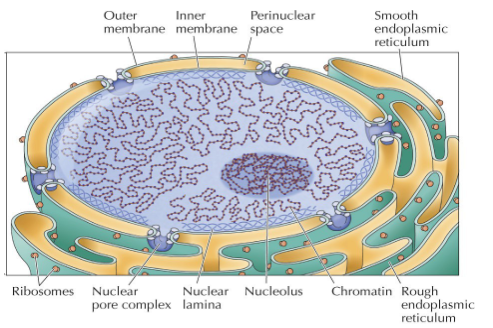
What does the nuclear envelop consist of
The inner and outer membranes that are joined at nuclear pore complexes
The outer membrane of the nuclear envelope is contiguous with the endoplasmic reticulum
What is the nuclear lamina
A meshwork of intermediate filaments that provides structural support for the nucleus
What is the model of lamin assembly
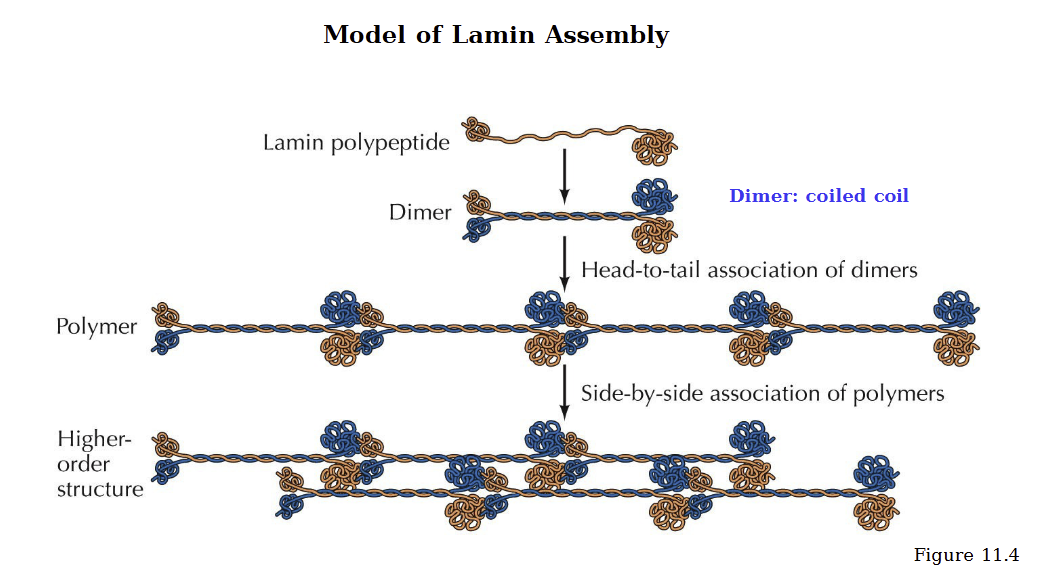
Lamin polypeptides coil to form a dimer.
Head to tail association of dimers combine to form a dimer
Side by side association of polymers will form the higher order structure of the nuclear membrane
Prenylation
targets Lamins to inner nuclear membrane
Hutchinson-Gilford Progeria Syndrome
Dominant negative effect of mutant lamin A on lamina function. Essentially nucleus is wonky and kid ends up with a bunch of problems and a big head
How do small molecules pass through the NPC
Small molecules go through passive diffusion
How do macromolecules such as proteins and RNAs transport through the NPC
It is a selective, energy-dependent process
Central channel of the NPCs
Occupied by FG-repeat nups
~200 FG-nups/NPC form a flexible, highly amorphous meshwork
FG-nups serve as binding sites for nuclear transport receptors (importins and exportins)
About the NPCs??
Vertebrate cells typically contain 1000-10000 NPCs/cell
Molecular weight cutoff ~30-40 kD
NPC contains ~30 different protein subunits (nucleoporins or nups)
Protein import through the NPC
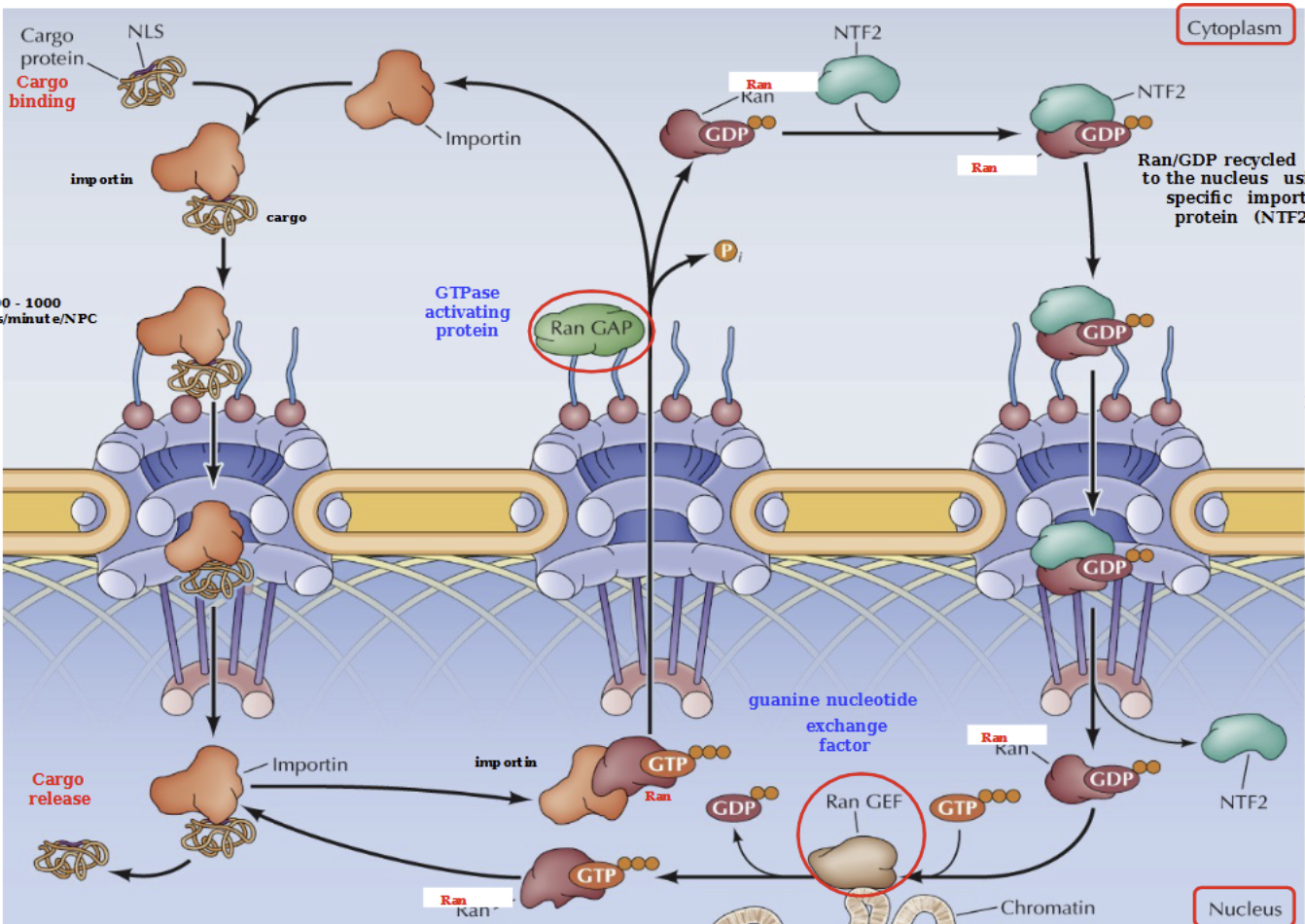
Cargo contains a nuclear localization sequence (NLS) that acts like a zip code for protein import
Importin binds to the NLS and brings it through the NPC into the nucleus, where cargo is then released
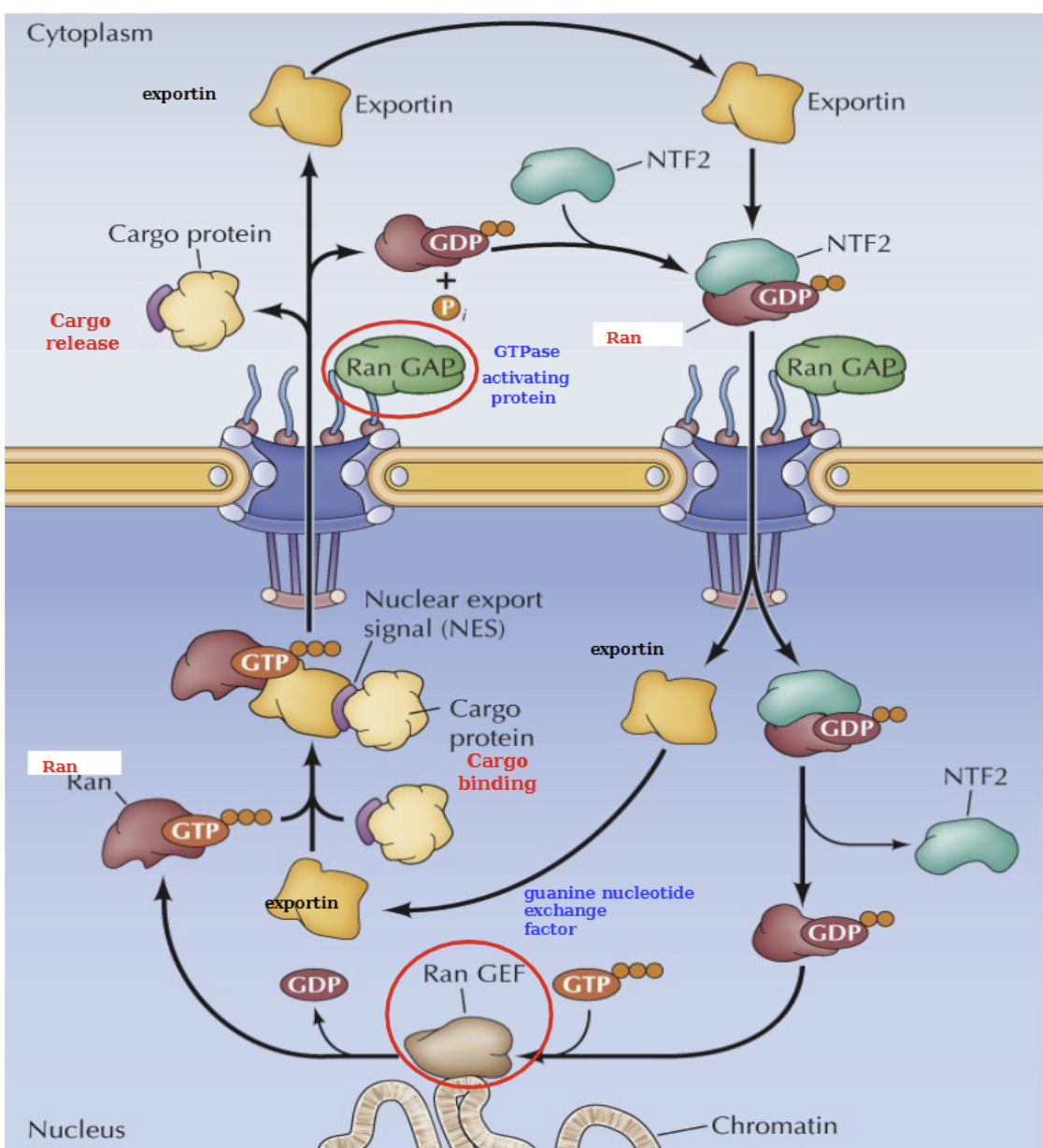
Ran-GTP binds to importin and propels through the NPC into the cytoplasm using a GTPase activating protein Ran-GAP. The importin is then released
Ran-GDP is recycled back to the nucleus using NTF2 (importin protein).
Once Ran-GDP is back in the nucleus, it is phosphorylated into Ran-GTP with a Ran GEF (guanine nucleotide exchange factor) where it can be active n shit
Cytoplasm - low Ran/GTP
Nucleus - high Ran/GTP
Nuclear Localization signal (NLS)
Comprised of single or bipartile segments of basic amino acids
It is recognized by importin proteins (nuclear transport receptors)
Export through the nuclear pore complex (NPC)
Ran-GTP, NES (nuclear export signal), and cargo protein form a threesome.
Triplet is propelled through the NPC into the cytoplasm using the Ran GAP, which will dissociate them
Cargo is released, Ran-GDP binds to NTF2, that complex binds to exportin
Threesome travels through the NPC using Ran GAP. Dissociates once in nucleus.
Ran-GDP is phosphorylated back into Ran-GTP by Ran GEF
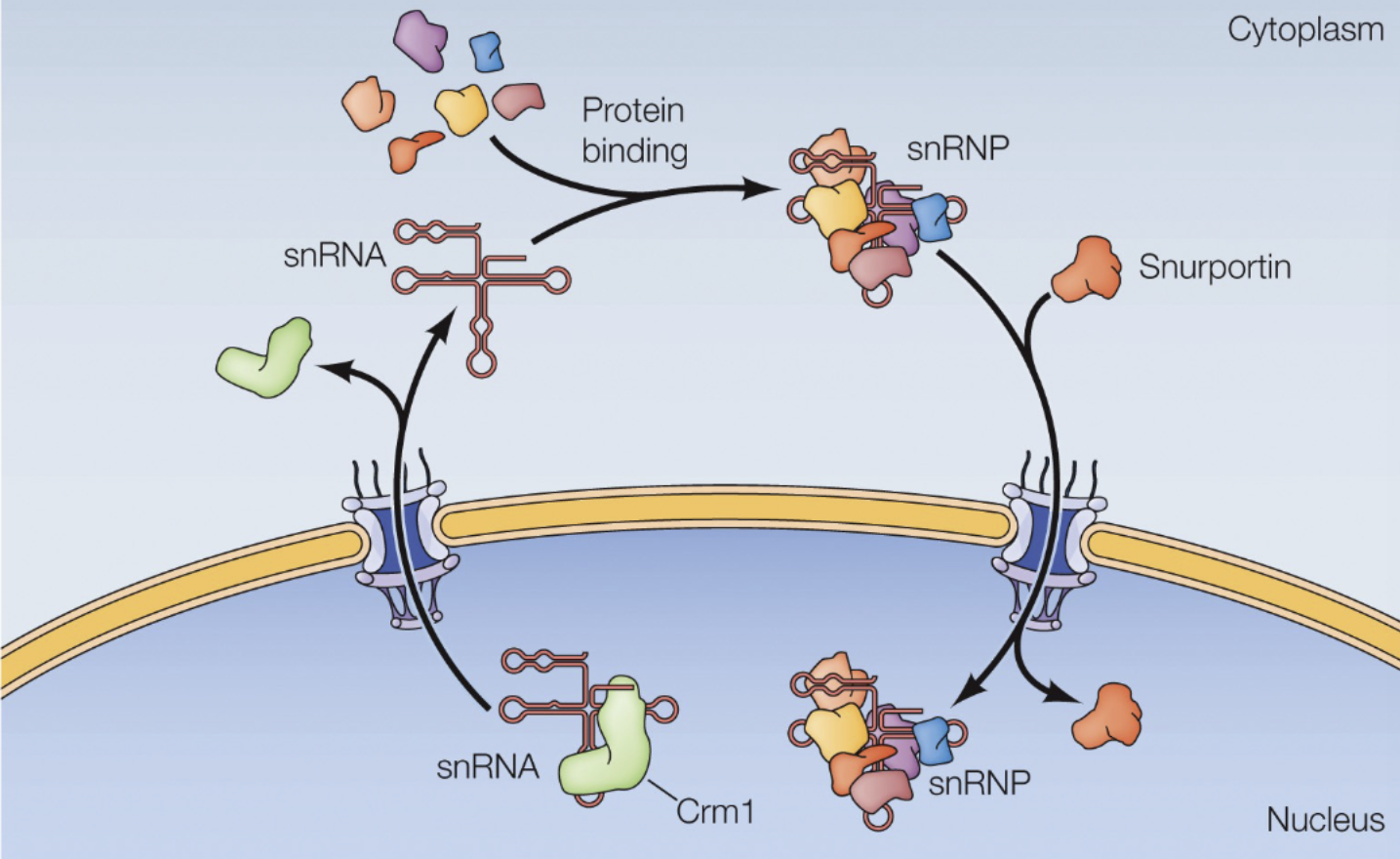
Transport of snRNAs between the nucleus and cytoplasm
snRNA-Crm1 bound in nucleus, travels through NPC
Complex dissociates in cytoplasm
snRNA binds to proteins → snRNP
Snurportin binds to snRNP and transports through NPC into nucleus.
Snurportin dissociates
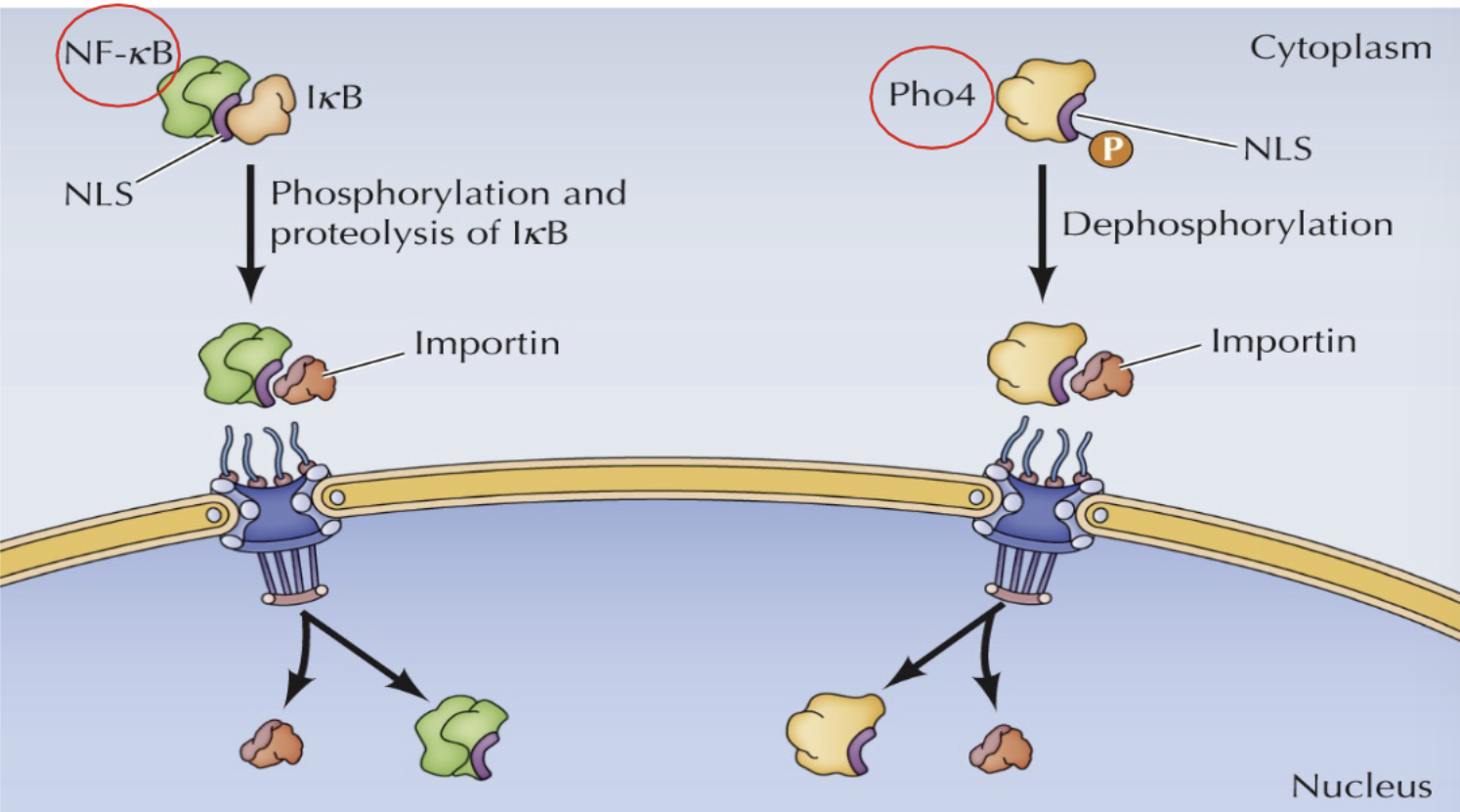
Transcription factor import in response to cell signaling
NF-kB/NLS/IkB is phosphorylated and proteolyzed (IkB dissociates), allowing importin to attach
Proceeds through NPC into nucleus
or
Pho4/NLS/Pi is dephosphorylated (unmasks NLS), allowing importin to attach
Proceeds through NPC into nucleus
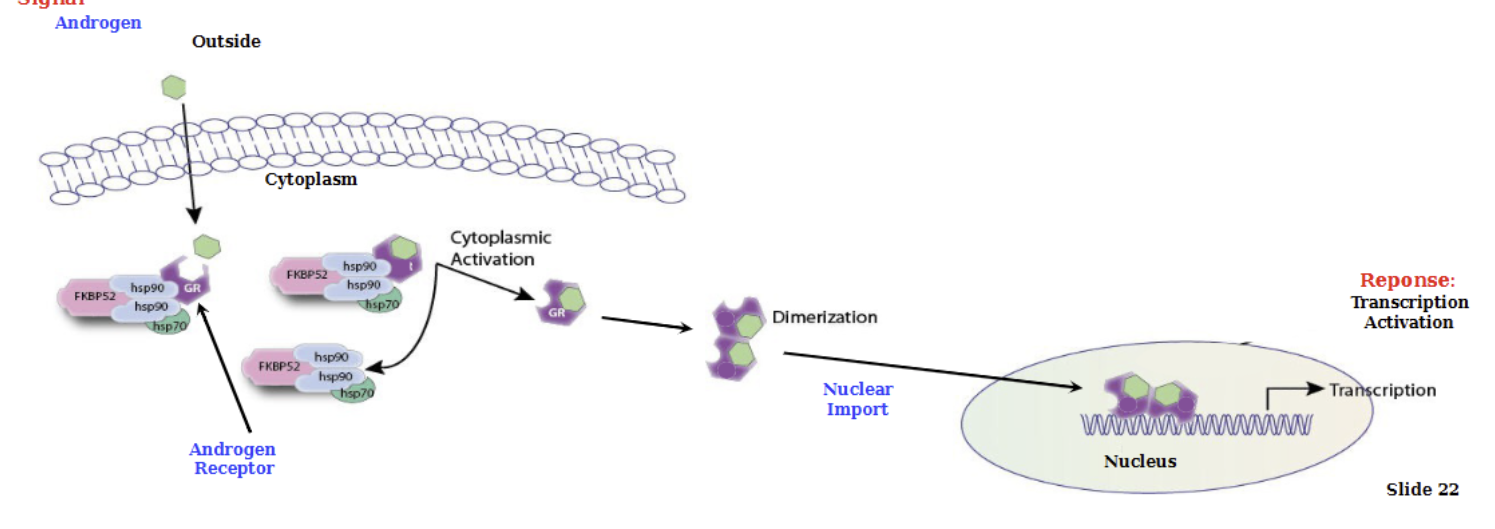
Induction of androgen receptor nuclear import by androgen
Signal = androgen diffuses across plasma membrane into cytoplasm
Androgen binds to an androgen receptor. This complex dissociates and dimerizes, allowing nuclear transport
Dimer binds to DNA and activates transcription
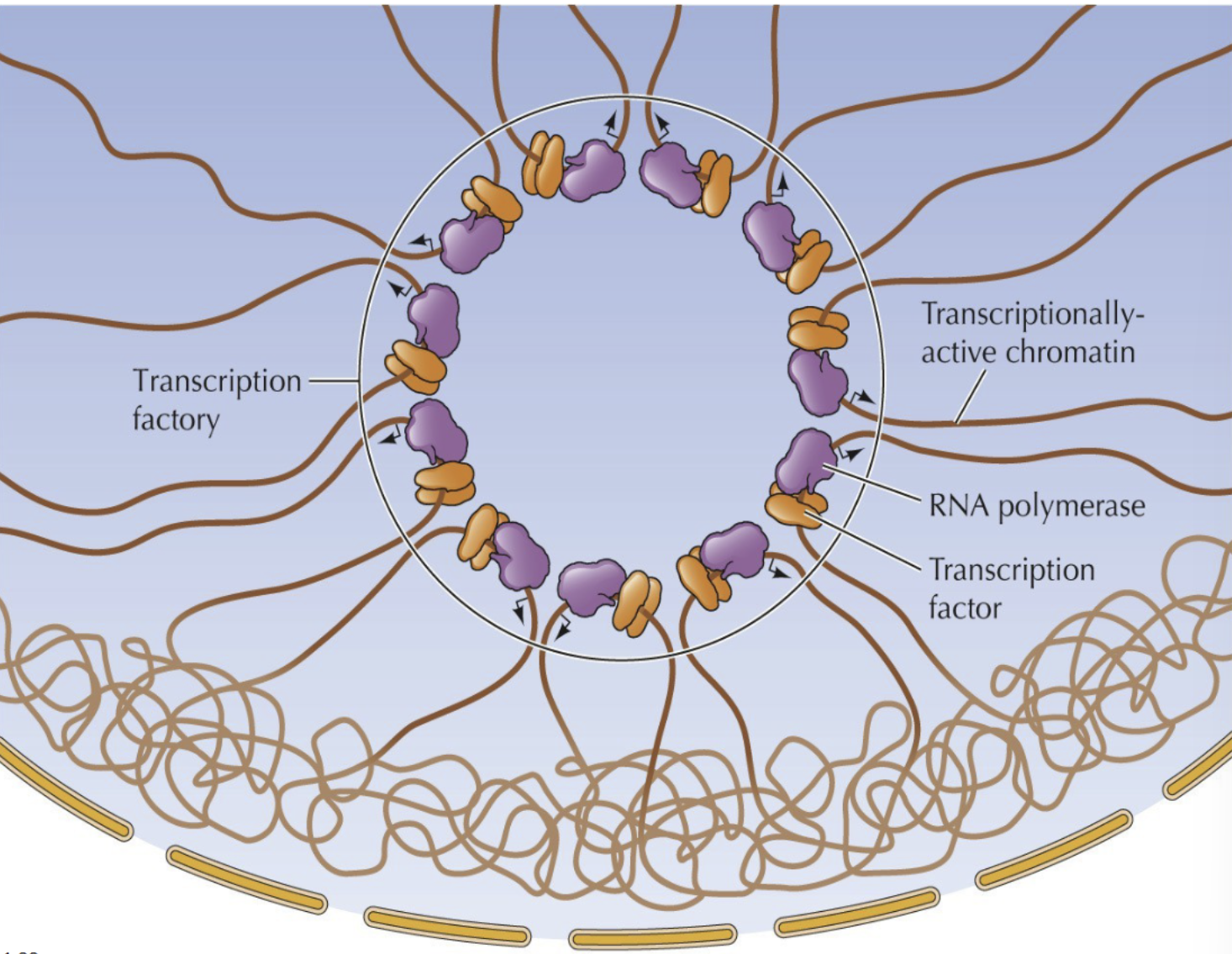
Distribution of transcriptionally active and inactive chromatin
NAD - nucleolus associated domains
LAD - lamina associated domains
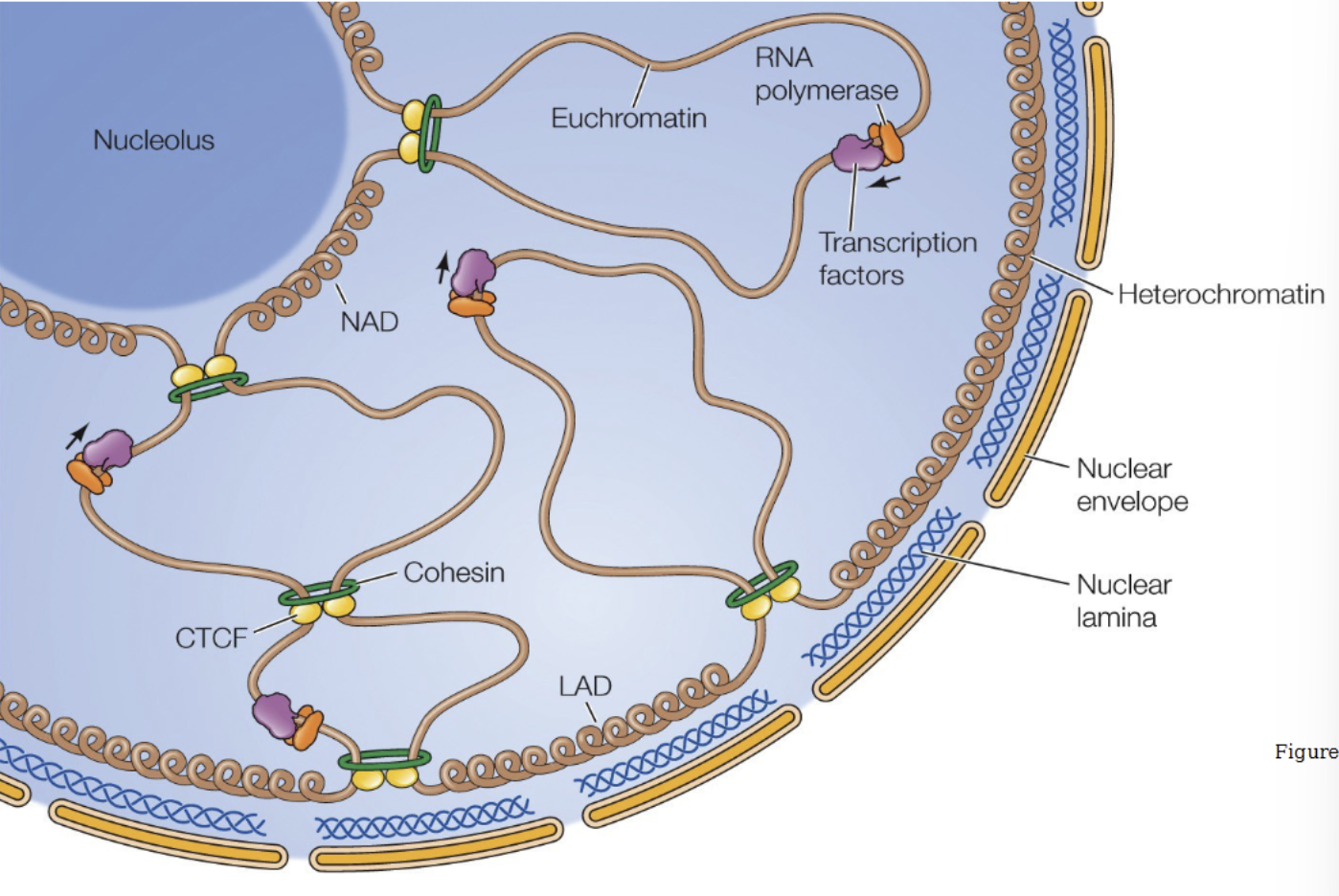
Transcription factories
Circle of transcriptionally-active chromatin through RNA polymerase and transcription factors