8.2.2 EPIGENETICS, ACETYLATION, AND METHYLATION:
 Call Kai
 Learn
Learn Practice Test
 Spaced Repetition
 Match
Match Flashcards
 Knowt Play
1/9

There's no tags or description
Looks like no tags are added yet.
Name | Mastery | Learn | Test | Matching | Spaced | Call with Kai |
|---|
No analytics yet
Send a link to your students to track their progress
10 Terms
EPIGENETICS:
Involves heritable changes in gene function, without changes to the base sequence of DNA.
Caused by changes in the environment that inhibit eukaryote gene trnscription.
Resulting changes in gene function affect phenotype and can be inherited.
HISTONES:
CHROMATIN:
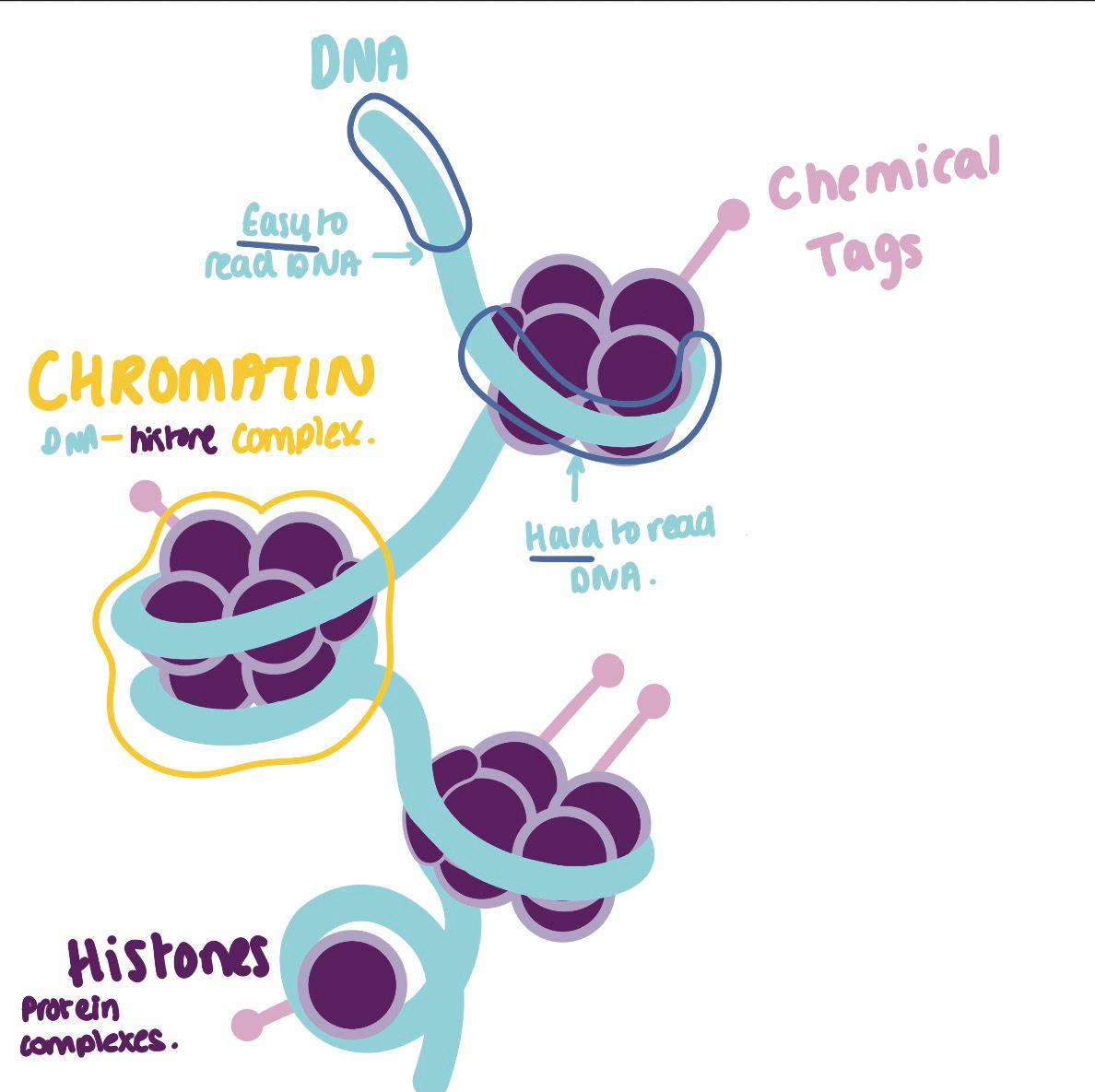
HISTONES: Protein complexes.
CHROMATIN: DNA-histone complex,
DRAW A DIAGRAM OF A SECTION OF THE EPIGENOME:
EPIGENOME: Comprises all of the chemical compounds that have been added to the entirety of the genome as a way to regulate gene expression.
Both DNA and histones have chemical tags attached to them.
Number and position of chemical tags affects shape of DNA-histone complex.
HOW IS DNA MADE TO FIT INTO A SMALLER VOLUME?
It is condensed by winding it around histones.
WHAT DETERMINES WHETHER A GENE IS TRANSCRIBED?
Condensation of the chromatin determines whether or not a gene is transcribed.
Switched off genes are found in tightly packed arrangements, TF do not have access, mRNA cannot be transcribed.
WHAT DETERMINES THE EXTENT OF CONDENSATION?
Addition/ removal of acetyl/ methyl groups (chemical tags).
Environmental factors ca affect number of these groups.
ACETYLATION:
Acetylation of histones:
From acetyl-coA.
Histones are negatively charged, allowing them to attract DNA for coiling.
Acetyl (negative) can reduce/ remove charge, reducing attraction between histones and DNA, and how tightly packed DNA is around them.
Decreased acetylation leads to inhibited transcription.
METHYLATION:
Methylation of DNA, transfer of methyl group.
Added to cytosine.
Changes shape of binding site, preventing TF from binding.
Inhibiting transcription.
Also:
Attract proteins that decrease acetylationn.
DIFFERENCE BETWEEN MALIGNANT AND BENIGN TUMOUR NUCLEI ON A MICROSCOPE:
Nucleus is more stained in malignant tumours because there is more DNA,
EPIGENETICS AND METHYLATION:
Environmental factors can increase the risk of abnormal DNA methylation patterns.
If parts of a tumour suppressor gene become heavily methylated, the gene is inactivated.