Food Science: Proteins, Structure, Reactions, and Meat Cooking Techniques
 Call Kai
 Learn
Learn Practice Test
 Spaced Repetition
 Match
Match Flashcards
 Knowt Play
1/160

There's no tags or description
Looks like no tags are added yet.
Name | Mastery | Learn | Test | Matching | Spaced | Call with Kai |
|---|
No analytics yet
Send a link to your students to track their progress
161 Terms
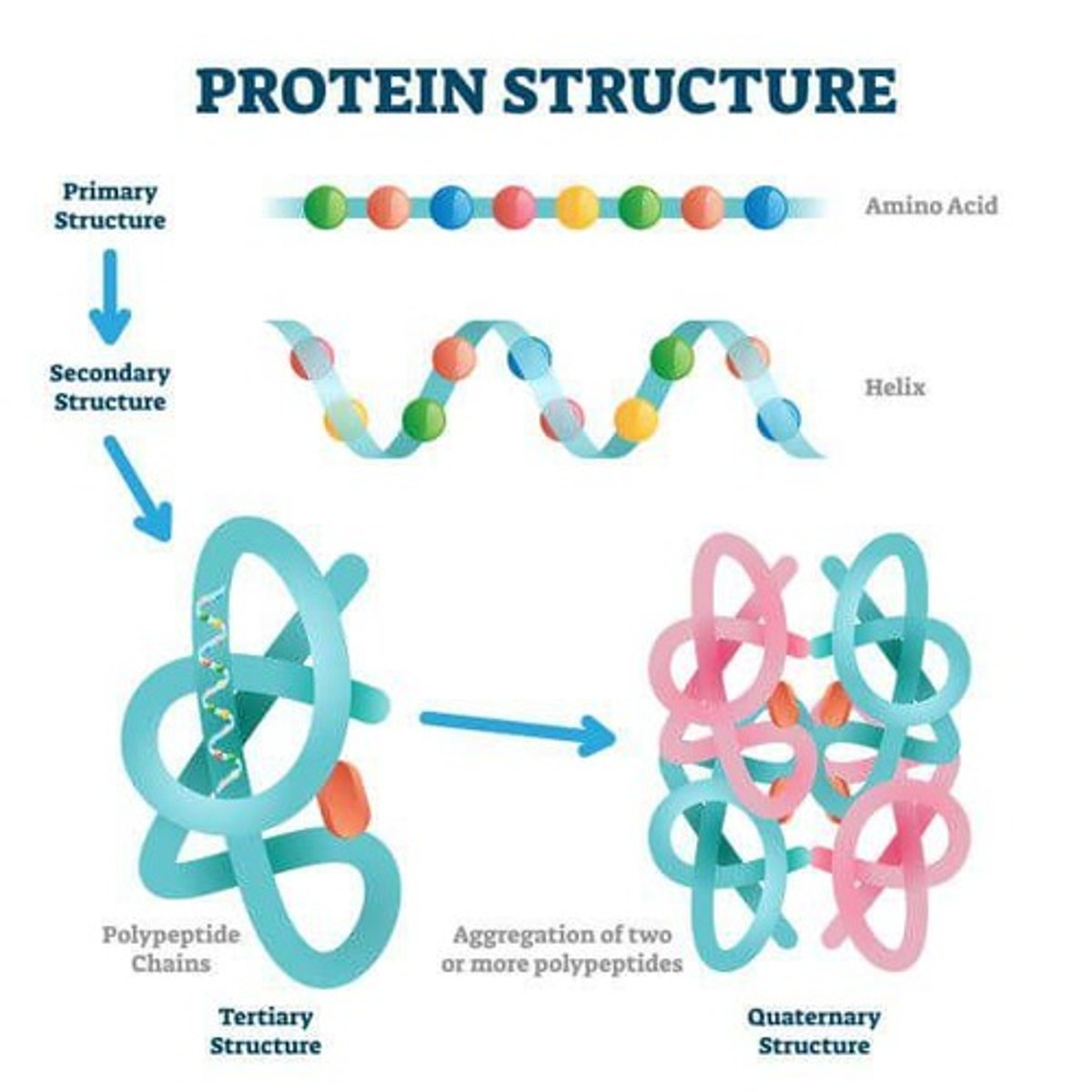
What is the primary structure of a protein?
The sequence of amino acids in a polypeptide chain.
What are the four levels of protein structure?
Primary, secondary, tertiary, and quaternary.
What is the role of enzymes in food?
Enzymes are proteins that accelerate chemical reactions, which can be desirable or undesirable.
What is denaturation in proteins?
The process where proteins lose their structure due to external stress, such as heat.
What is the isoelectric point of a protein?
The pH at which a protein has no net charge and is least soluble.
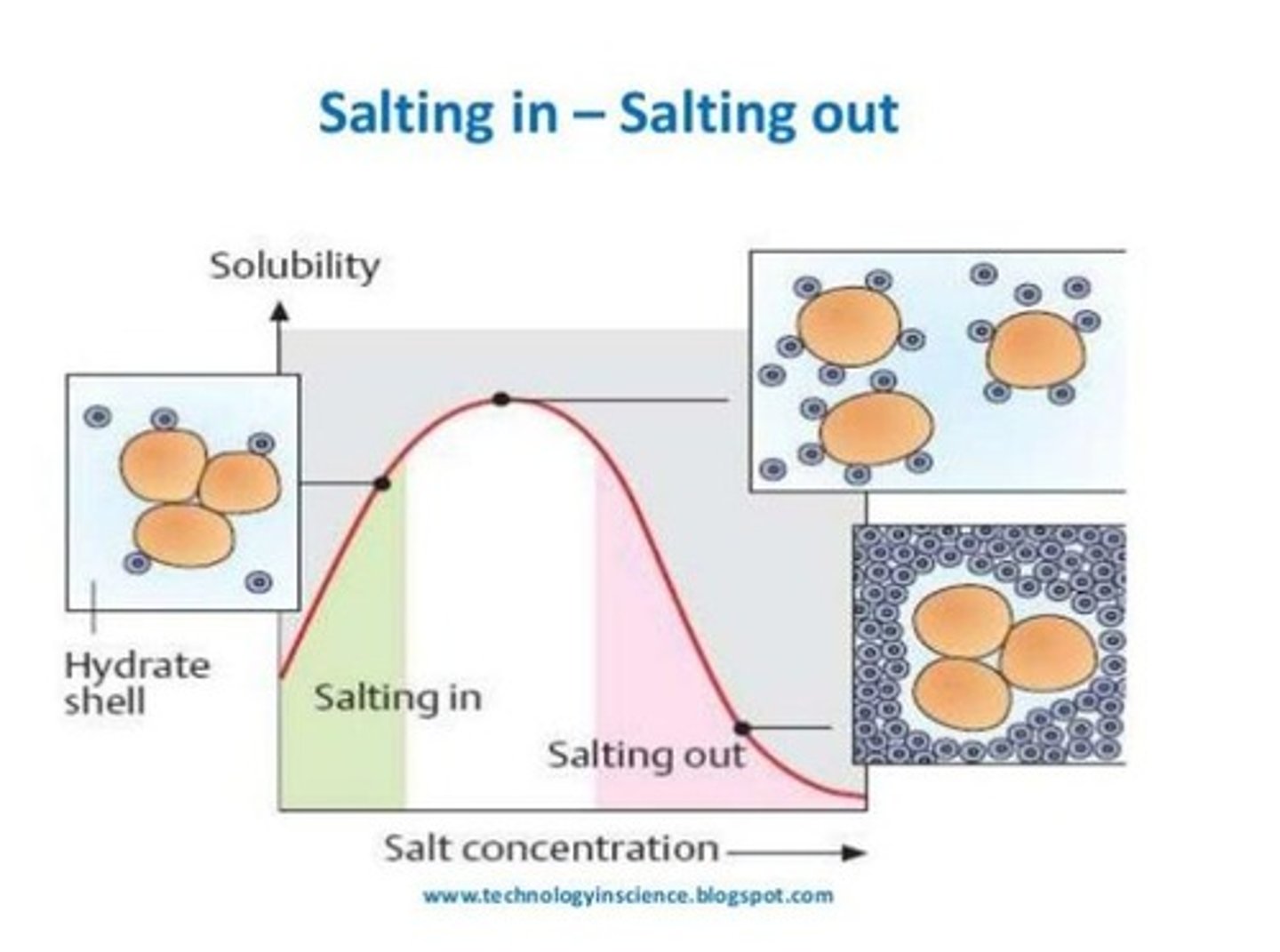
What happens during salting in?
Proteins become more soluble in the presence of salt, enhancing their functionality.
What is salting out?
The process where proteins precipitate out of solution due to high salt concentration.
What is hydrolysis in the context of proteins?
The chemical breakdown of proteins into amino acids by the addition of water.
What is Maillard browning?
A chemical reaction between amino acids and reducing sugars that results in browning and flavor development in cooked foods.
How do polar and non-polar amino acids affect protein functionality?
Polar amino acids interact with water, while non-polar amino acids do not, influencing protein folding and interactions.
What is the significance of covalent bonding in proteins?
Covalent bonds, such as disulfide bonds, link amino acids and stabilize protein structure.
How does pH affect protein charge?
The charge of a protein is influenced by pH; changes can lead to denaturation or altered solubility.
What is the impact of cooking on protein nutrients?
Cooking can denature proteins but generally does not significantly reduce their nutritional value.
What is a real-life example of salting in?
Mixing cream cheese and peanut butter in a pie, where salt helps bind water and maintain texture.
What happens to proteins when eggs are scrambled?
The proteins denature and coagulate, changing the texture from liquid to solid.
What is the effect of enzymes on avocados turning brown?
Enzymatic reactions cause oxidation, leading to browning when avocados are cut.
What are the functions of proteins in food?
Proteins contribute to texture, flavor, and nutritional content, and can facilitate food reactions.
Why is spoiled milk clumpy?
Clumping occurs due to protein denaturation and aggregation, often from bacterial action.
What is the relationship between protein and water binding?
Proteins can bind water, affecting the texture and moisture retention in food products.
What is the role of amino acid properties in protein functionality?
The unique properties of each amino acid influence how proteins interact and function in various conditions.
What is the significance of protein folding?
Folding determines the protein's shape and function, influencing its biological activity.
How does the addition of fresh pineapple affect gelatin?
Fresh pineapple contains bromelain, an enzyme that breaks down proteins, preventing gelatin from setting.
What is the difference between raw and cooked protein in terms of structure?
Cooking denatures proteins, altering their structure but generally preserving their nutritional value.
What is a common misconception about protein denaturation?
Some believe denaturation destroys all nutritional value, but it often retains essential nutrients.
How do proteins influence food texture?
Proteins can create foams, gels, and emulsions, contributing to the overall texture of food.
What is the impact of overmixing on proteins?
Overmixing can lead to excessive denaturation, affecting the final texture of food products.
What is the connection between proteins and dietary sources?
Proteins are essential nutrients found in various foods, providing amino acids necessary for bodily functions.
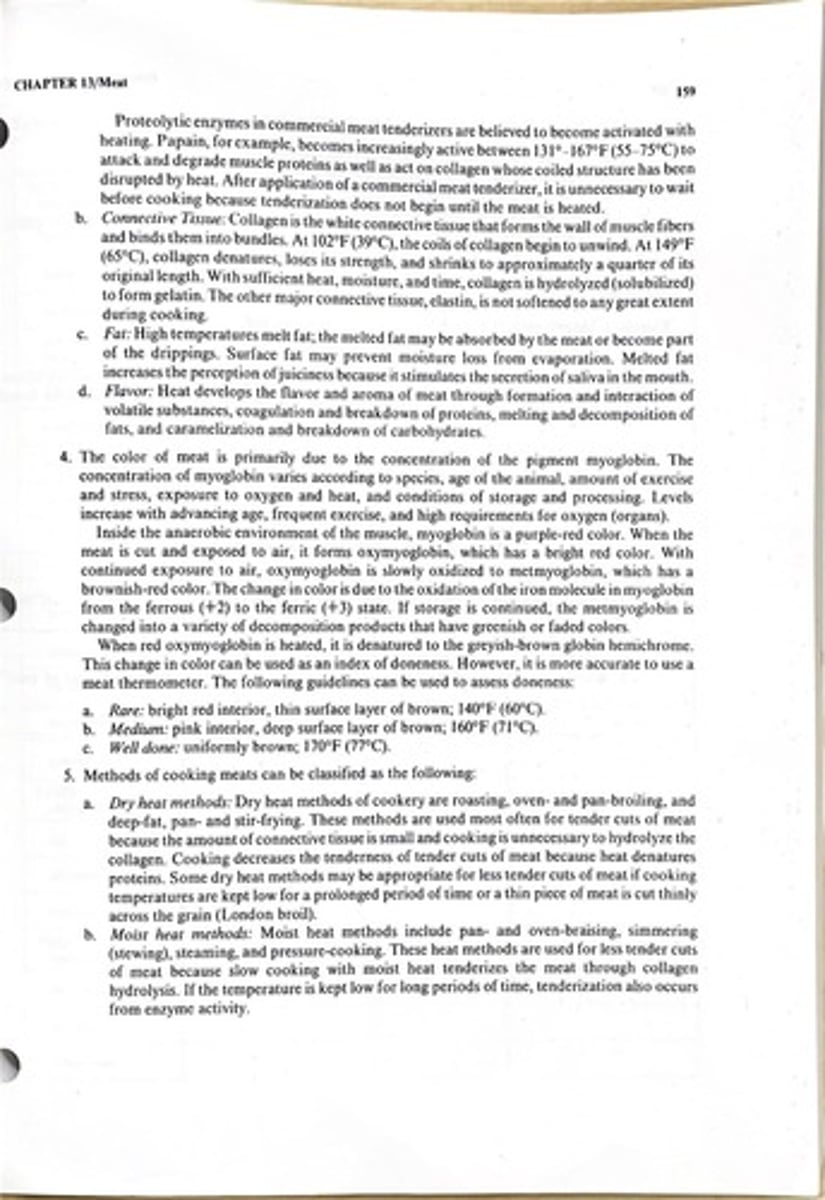
What factors influence the predicted tenderness of meats?
Type of cut, muscle exercise, connective tissue content, aging, processing methods, and cooking methods.
Which muscles are generally less tender?
Muscles that are highly exercised, such as those from the abdomen, shoulder, and rump.
What are the primary nutrients found in meat?
Protein, iron, and zinc.
How does cooking temperature affect meat tenderness?
Low temperatures for long periods allow more protein degradation, while high temperatures can lead to toughness and cooking losses.
What happens to collagen during cooking?
Collagen unwinds at 102°F (39°C) and denatures at 149°F (65°C), eventually hydrolyzing to form gelatin with sufficient heat and moisture.
What is the effect of fat on the perception of juiciness in meat?
Melted fat can be absorbed by the meat or become part of the drippings, enhancing juiciness and stimulating saliva secretion.
What is myoglobin and how does it affect meat color?
Myoglobin is a pigment that gives meat its color; it changes from purple-red to bright red (oxymyoglobin) when exposed to air and can turn brown (metmyoglobin) with oxidation.
What are the doneness guidelines for meat?
Rare: 140°F (60°C), Medium: 160°F (71°C), Well done: 170°F (77°C).
What are dry heat cooking methods for meat?
Roasting, oven- and pan-broiling, and deep-fat, pan- and stir-frying.
What are moist heat cooking methods for meat?
Pan- and oven-braising, simmering (stewing), steaming, and pressure-cooking.
How can less tender cuts of meat be tenderized at home?
Mechanical means (grinding, pounding), enzymes, moist heat, marinating, and cooking at low temperatures.
What is the role of proteolytic enzymes in meat tenderization?
They degrade muscle proteins and collagen, enhancing tenderness when activated by heat.
What happens to proteins during the initial heating of meat?
Enzymes activate and degrade muscle proteins until they are denatured by high temperatures.
What is the relationship between primal cuts and tenderness?
Primal cuts from less exercised muscles (like rib and loin) are generally more tender than those from more exercised areas.
What is the significance of the characteristic bone in meat cuts?
It helps determine the primal cut and can indicate the tenderness of the meat.
How does marinating affect meat?
Marinating with acids increases moisture retention and can enhance tenderness.
What is the effect of high cooking temperatures on meat?
They can accelerate protein denaturation, leading to loss of juiciness and increased toughness.
What is the impact of aging on meat tenderness?
Aging can enhance tenderness by allowing natural enzymes to break down muscle fibers.
What is the importance of cooking time in meat preparation?
Longer cooking times at low temperatures can tenderize meat through collagen hydrolysis.
What is the role of elastin in meat?
Elastin is a connective tissue that does not soften significantly during cooking.
What happens to meat color when it is heated?
Red oxymyoglobin is denatured to greyish-brown globin hemichrome, indicating doneness.
What are the effects of broiling distance on meat quality?
Closer broiling can lead to quicker cooking and potential overcooking, affecting juiciness and tenderness.
What is the relationship between exercise and myoglobin concentration?
Myoglobin levels increase with frequent exercise and higher oxygen requirements in the muscle.
How does the fat content of meat vary?
It depends on the species and cut of meat; higher grades of beef typically have more saturated fat.
What is the effect of cooking methods on flavor development in meat?
Heat develops flavor through interactions of volatile substances, protein breakdown, fat melting, and carbohydrate caramelization.
What is the predicted tenderness of arm steak?
Tender
Which primal cut does the brisket belong to?
Beef
What is the characteristic bone associated with T-bone steak?
T-bone
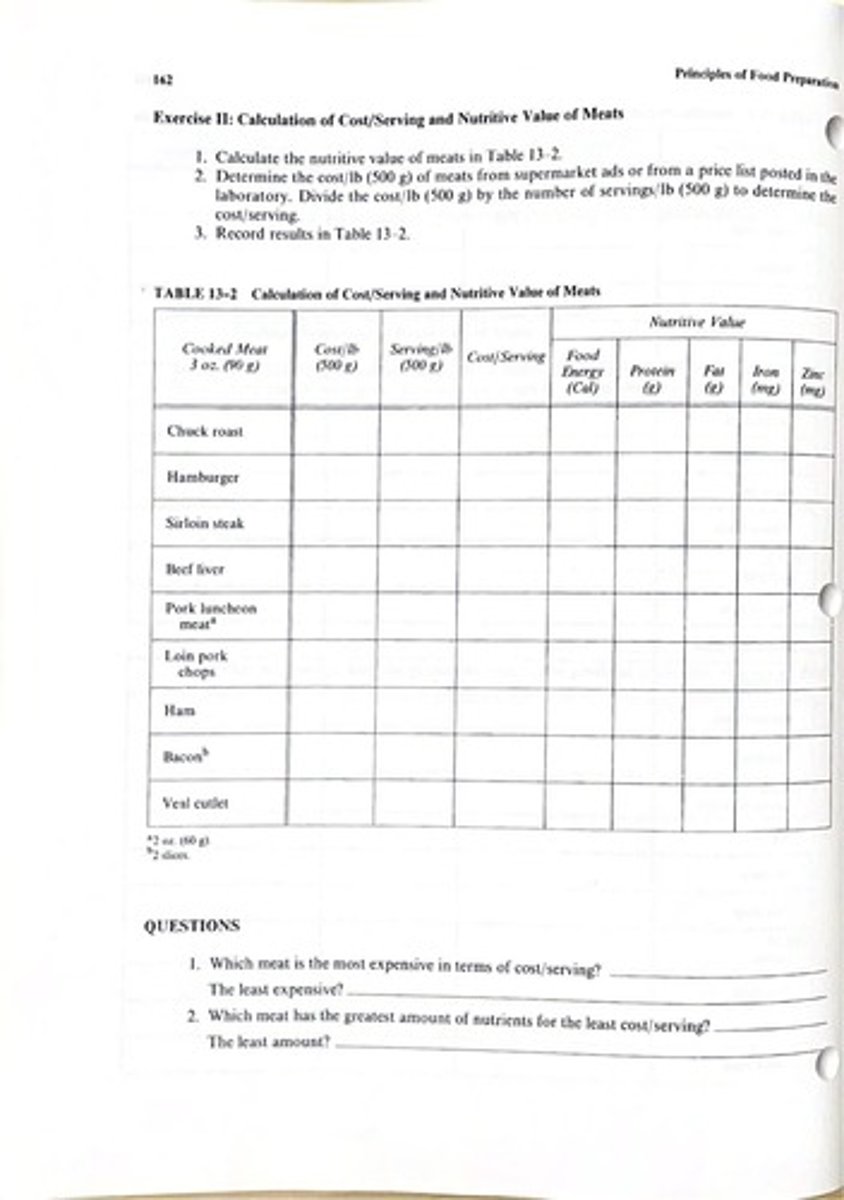
Which meat is typically the least expensive in terms of cost/serving?
Pork luncheon meat
What nutrient is most associated with the food energy of meat?
Fat
Which meat cut has the greatest amount of nutrients for the least cost/serving?
Beef liver
What is the average protein content per serving of muscle meats?
Varies, but typically high in protein
What two minerals are meats good sources of?
Iron and Zinc
What is the effect of cooking meat at 325°F (160°C) on cooking loss?
Produces moderate cooking loss
At what temperature is meat considered well-done?
170°F (77°C)
What was the purpose of Experiment I in the meat preparation chapter?
To determine the effect of oven temperature on cooking losses of meat
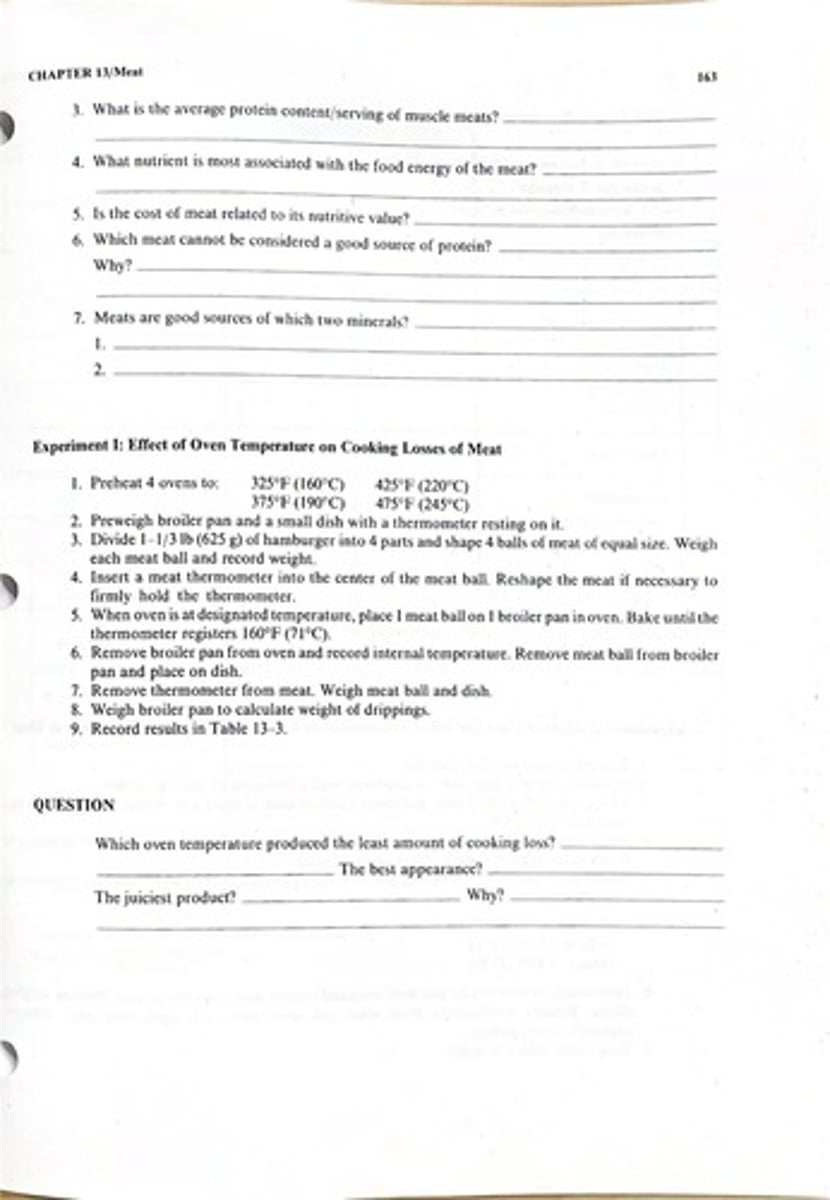
What is the effect of distance from heat in broiling on cooking losses?
Closer distance generally results in greater cooking losses
What final end-point temperature produced the juiciest meat ball?
160°F (71°C)
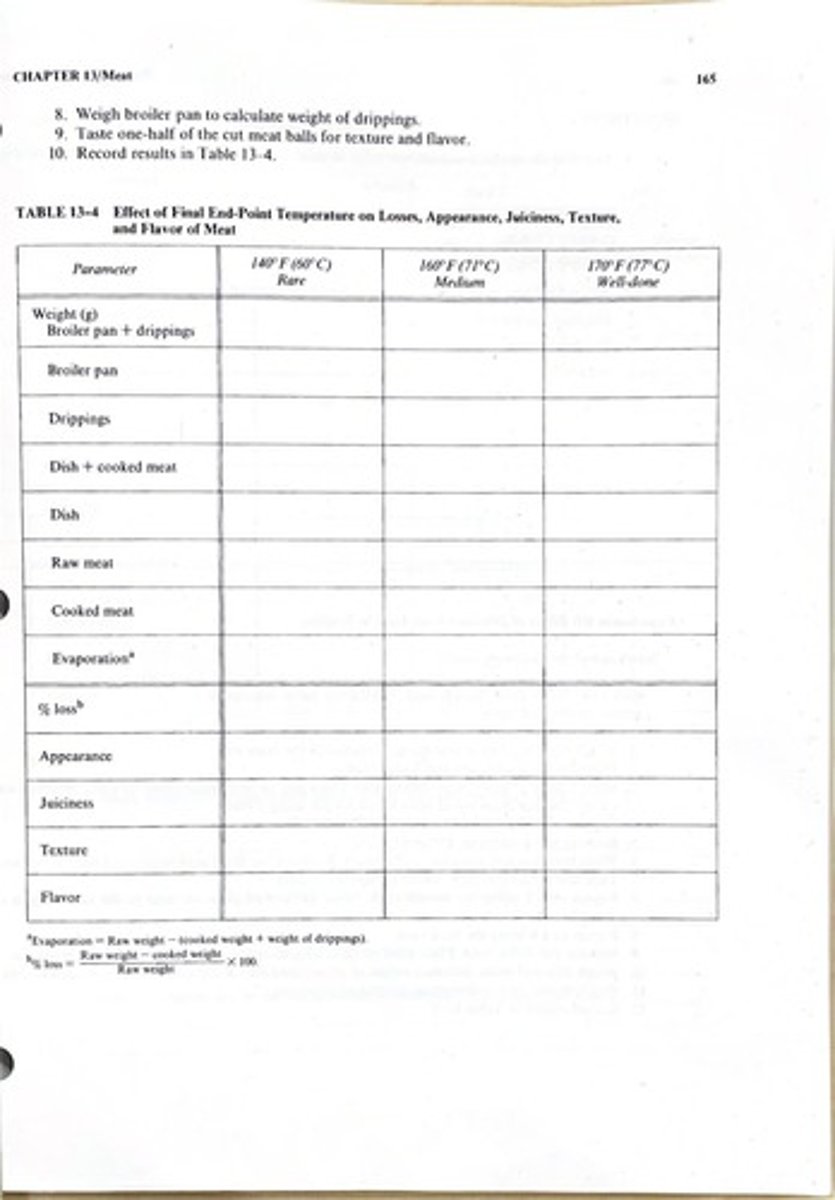
What is the significance of the evaporation calculation in meat cooking?
It helps determine the percentage of weight loss during cooking
What is the recommended cooking temperature for medium doneness?
160°F (71°C)
What happens to meat when it is cooked to rare?
It retains more juiciness but has a red interior
What is the primary method of tenderizing meat mentioned in the chapter?
Mechanical tenderization or marinating
What is the effect of cooking meat to well-done?
It results in the greatest cooking losses and less juiciness
What is the purpose of using a meat thermometer during cooking?
To ensure the meat reaches the desired internal temperature
What is the average cooking loss percentage for meat cooked at 375°F (190°C)?
Higher than at 325°F but lower than at higher temperatures
What is the role of drippings in meat cooking?
They contribute to flavor and moisture
What are the visual indicators of meat cooked to 140°F (60°C)?
Red interior, slightly brown exterior
What is the effect of cooking meat at higher temperatures?
Increases cooking losses and affects texture
What is the significance of measuring the distance from the broiler?
It affects cooking time and moisture retention
What is the main goal of Experiment IV?
To explore methods of tenderization for different cuts of meat
What happens to the appearance of meat as it cooks to higher temperatures?
It becomes browner and less juicy
How does the cooking method affect the flavor of meat?
Different methods can enhance or diminish the natural flavors
What is the purpose of enzyme tenderizing meat?
To break down proteins in the meat, making it more tender.
How long should meat stand after enzyme tenderizing before cooking?
30 minutes.
What ingredients are used in the braised beef recipe?
Margarine, oil, round steak, water, salt, and pepper.
What is the first step in preparing braised beef?
Heat margarine and oil in a skillet until sizzling.
What is the cooking time for braised beef?
45 minutes.
What is the purpose of marinating meat?
To enhance tenderness and flavor.
What is the effect of marinating meat on tenderness?
It increases tenderness by allowing flavors to penetrate and breaking down proteins.
Why should enzyme-tenderized meat be cooked immediately?
To prevent over-tenderization and loss of texture.
What is the method for preparing enzyme-tenderized beef?
Moisten beef, sprinkle tenderizer, pierce with a fork, and cook immediately.
What are the steps to prepare ground meat patties?
Shape into patties, weigh, and pan-fry.
What is the effect of grinding meat on tenderness?
It increases tenderness by breaking down muscle fibers.
What is the cooking method for pounded meat?
Pan-fry according to the specified method.
What should be done before roasting meat?
Wipe the meat with a dampened paper towel and weigh it.
What is the recommended oven temperature for roasting small cuts of meat?
325°F (160°C).
How should meat be placed in the oven for roasting?
Fat side up on a rack in an uncovered pan.
What is the purpose of inserting a meat thermometer?
To check the internal temperature for doneness.
What is the resting time for meat after roasting?
15-20 minutes before carving.
What is the basic method for oven broiling?
Slash fat, place on a greased broiler pan, and broil until browned.
What is the cooking guideline for broiling tender steaks?
Cook for 15-30 minutes depending on thickness.
What is the significance of cooking losses in meat preparation?
It measures the weight loss during cooking, indicating moisture retention.
How is % cooking loss calculated?
Initial weight - final weight / initial weight × 100.