AP Psychology - Development Psychology
 Call Kai
 Learn
Learn Practice Test
 Spaced Repetition
 Match
Match Flashcards
 Knowt Play
1/74

There's no tags or description
Looks like no tags are added yet.
Name | Mastery | Learn | Test | Matching | Spaced | Call with Kai |
|---|
No analytics yet
Send a link to your students to track their progress
75 Terms
Developmental Psychology
a branch of psychology that studies physical, cognitive, and social change throughout the life span.
Zygote
the fertilized egg; it enters a 2-week period of rapid cell division and develops into an embryo.
Embryo
the developing human organism from about 2 weeks after fertilization through the second month.
Fetus
the developing human organism from 9 weeks after conception to birth.
Teratogens
agents, such as chemicals and viruses, that can reach the embryo or fetus during prenatal development and cause harm.
Fetal Alcohol Syndrome (FAS)
physical and cognitive abnormalities in children caused by a pregnant woman's heavy drinking. In severe cases, symptoms include noticeable facial misproportions.
Habituation
decreasing responsiveness with repeated stimulation. As infants gain familiarity with repeated exposure to a visual stimulus, their interest wanes and they look away sooner.
Maturation
biological growth processes that enable orderly changes in behavior, relatively uninfluenced by experience.
Cognition
all the mental activities associated with thinking, knowing, remembering, and communicating.
Schema
a concept or framework that organizes and interprets information.
Assimilation
interpreting our new experience in terms of our existing schemas.
Accommodation
Development - adapting our current understandings (schemas) to incorporate new information.
Sensorimotor Stage
in Piaget's theory, the stage (from birth to about 2 years of age) during which infants know the world mostly in terms of their sensory impressions and motor activities.
Object Permanence
the awareness that things continue to exist even when not perceived. (sensorimotor)
Preoperational Stage
in Piaget's theory, the stage (from 2 to about 6 or 7 years of age) during which a child learns to use language but does not yet comprehend the mental operations of concrete logic.
Conservation
the principle (which Piaget believed to be a part of concrete operational reasoning) that properties such as mass, volume, and number remain the same despite changes in the forms of objects. (preoperational)
Egocentrism
in Piaget's theory, the preoperational child's difficulty taking another's point of view.
Theory of Mind
people's ideas about their own and others' mental states—about their feelings, perceptions, and thoughts, and the behaviors these might predict. (preoperational)
Concrete Operational Stage
in Piaget's theory, the stage of cognitive development (from about 6 or 7 to 11 years of age) during which children gain the mental operations that enable them to think logically about concrete events.
Formal Operational Stage
in Piaget's theory, the stage of cognitive development (normally beginning about age 12) during which people begin to think logically about abstract concepts.
Autism
a disorder that appears in childhood and is marked by deficient communication, social interaction, and understanding of others' states of mind.
Stranger Anxiety
the fear of strangers that infants commonly display, beginning by about 8 months of age.

Attachment
an emotional tie with another person; shown in young children by their seeking closeness to the caregiver and showing distress on separation.
Critical Period
an optimal period shortly after birth when an organism's exposure to certain stimuli or experiences produces proper development.
Imprinting
the process by which certain animals form attachments during a critical period very early in life.
Temperament
a person's characteristic emotional reactivity and intensity.
Basic Trust
according to Erik Erikson, a sense that the world is predictable and trustworthy; said to be formed during infancy by appropriate experiences with responsive caregivers.
Self-Concept
all our thoughts and feelings about ourselves, in answer to the question, "Who am I?"
Gender
in psychology, the biologically and socially influenced characteristics by which people define male and female.
X Chromosome
the sex chromosome found in both men and women. Females have two of these; males have one. One chromosome from each parent produces a female child.
Y Chromosome
the sex chromosome found only in males. When paired with an X chromosome from the mother, it produces a male child.
Testosterone
the most important of the male sex hormones. Both males and females have it, but the additional levels in males stimulates the growth of the male sex organs in the fetus and the development of the male sex characteristics during puberty.
Role
a set of expectations (norms) about a social position, defining how those in the position ought to behave.
Gender Typing
the acquisition of a traditional masculine or feminine role.
Social Learning Theory
the theory that we learn social behavior by observing and imitating and by being rewarded or punished.
Adolescence
the transition period from childhood to adulthood, extending from puberty to independence.
Puberty
the period of sexual maturation, during which a person becomes capable of reproducing.
Primary Sex Characteristics
the body structures (ovaries, testes, and external genitalia) that make sexual reproduction possible.
Secondary Sex Characteristics
nonreproductive sexual characteristics, such as female breasts and hips, male voice quality, and body hair.
Identity
our sense of self; according to Erikson, the adolescent's task is to solidify a sense of self by testing and integrating various roles.
Social Identity
the "we" aspect of our self-concept; the part of our answer to "Who am I?" that comes from our group memberships.
Cross-Sectional Study
a study in which people of different ages are compared with one another.
Longitudinal Study
research in which the same people are restudied and retested over a long period.
Social Clock
the culturally preferred timing of social events such as marriage, parenthood, and retirement.
Lev Vygotsky
child development; investigated how culture & interpersonal communication guide development; zone of proximal development (ZPD); play research
MKO
More Knowledgeable Other (Vygotsky) who has a better understanding or a higher ability level with respect to some concept or task
ZPD
Zone of Proximal development- What a child can do to, from independent activities to those that require a caregivers support
Universal Grammar (Chomsky)
- all across the world we learn the rules of grammar around the same time
- if we do not learn them during this critical period we probably will not learn them at all
authoritarian parents
low responsive/acceptance, high demand
authoritative parents
high demand and high acceptance/responsive
permissive parenting
low demand, high acceptance
Uninvolved/Neglectful Parenting
Low control and low support
-Don't care about their kids, only provide them with the basics to survive
Impact: Trust issues, Rebellious
Morphemes
The smallest units of meaning in a language.
Phonemes
in language, the smallest distinctive sound unit
Syntax
Sentence structure
Semantics
Meaning of words and sentences
Benjamin Whorf
language; his hypothesis is that language determines the way we think
Ainsworth Strange Situation
a sequence of staged episodes that illustrate the strength of attachment between a child and (typically) his or her mother
secure vs insecure attachment
When parents leave child: secure- crying, then calm OR insecure- crying or apathy
Harry Harlow
Studied attachment in monkeys with artificial mothers; baby monkeys valued nurture over sustenance
Babinsky response
Infant reflex (goes away over time): in response to touch on bottom of foot, the infant's toes splay outward, then curled in
Moro reflex
Reflex in which a newborn strectches out the arms and legs and cries in response to a loud noise or an abrupt change in the environment
Trust vs. Mistrust (Erikson)
0-1 years. Erikson's first stage during the first year of life, infants learn to trust when they are cared for in a consistent warm manner
Autonomy vs. Shame and Doubt
Erikson's stage in which a toddler learns to exercise will and to do things independently; failure to do so causes shame and doubt
Initiative vs. Guilt (Erikson)
3-6 yrs, good: sense of purpose, ability to initiate activities, ability to enjoy accomplishment, bad: fear of punishment, restrict himself, show off
Industry vs. Inferiority (Erikson)
6-12 yrs, good: competence, exercise his/her abilities and intelligence in the world, be able to affect world in the way that the child desires bad: inadequacy, low self esteem
Identity vs. Role Confusion (Erikson)
13-19 yr, *most crucial to self concept* teens struggle with identity crisis, if healthy experimentation is fostered they attain identity achievement; if not, they face insecurity and low self-worth
Intimacy vs. Isolation (Erikson)
20-40 yrs, good: love, intimate relationships, commitment. bad: avoidance of commitment, alienation, distancing oneself
Genrativity vs stagnation
Erickson's Psychosocial stage
Giving back to society by raising children, being productive at work, and becoming involved in community activities and organizations
Integrity vs. Despair (Erikson)
60- death. involves reevaluating what we have done in our lives. If we feel we have done well we have a sense of integrity, otherwise we experience gloom and doubt.
Erik Erikson
neo-Freudian/ humanistic; 8 psychoSOCIALstages of development: theory shows how people evolve through the life span. Each stage is marked by a psychological crisis that involves confronting "Who am I?"
menarche [meh-NAR-key]
the first menstrual period
Language Development
a timeline for acquisition of benchmarks in verbal communication. Age 1: one word, Age 2: two word/telegraphic speech, few months: babbling stage.
linguistic determinism
Whorf's hypothesis that language determines the way we think
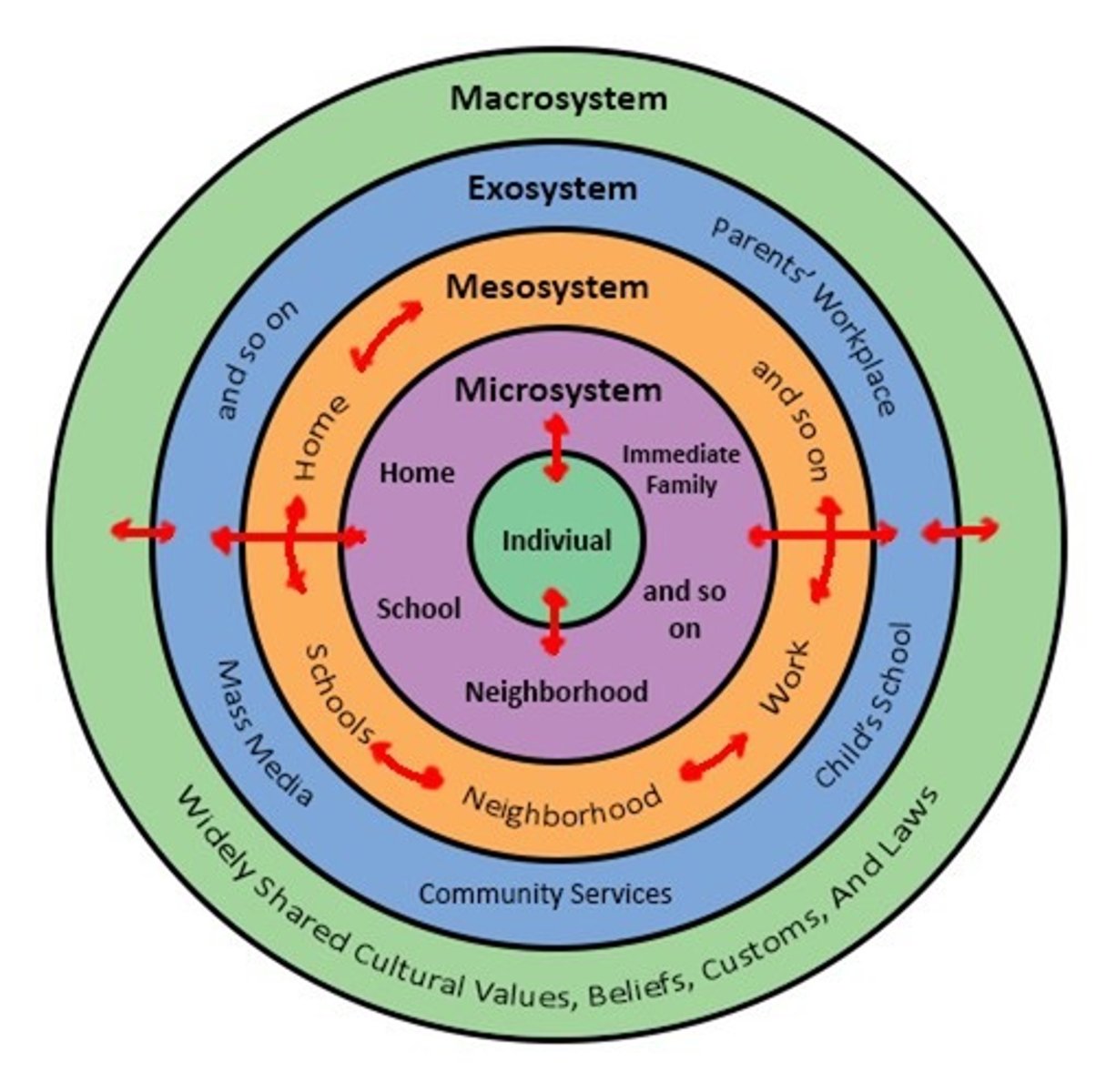
Ecological Systems Theory
views the person as developing within a complex system of relationships affected by multiple levels of the surrounding environment